


Grain Analysis Market Overview
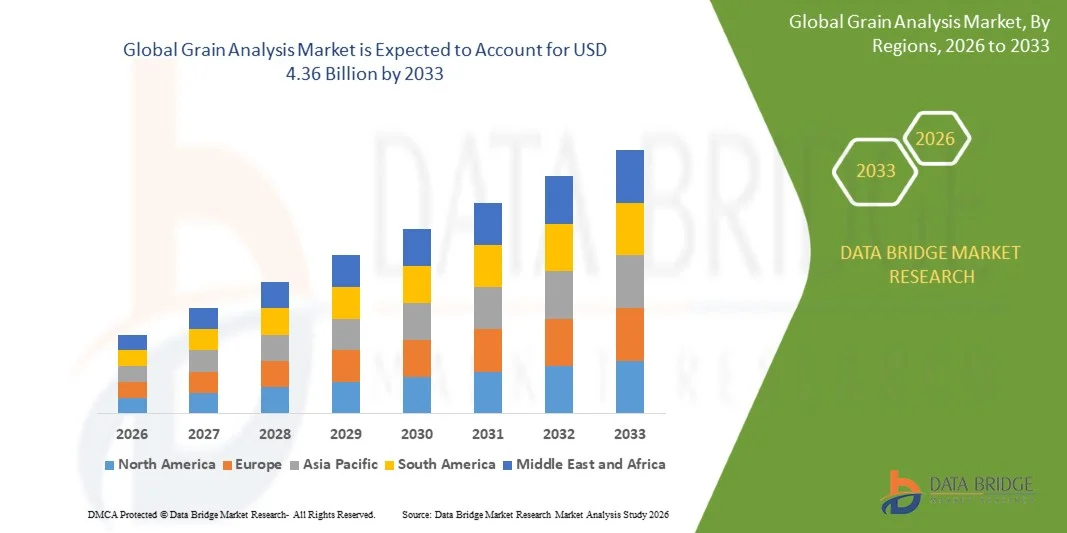
As per Data Bridge Market Research analysis The grain analysis market was valued at USD 2.68 billion in 2025 and is projected to reach USD 4.36 billion by 2033, growing at a CAGR of 6.30% from 2026 to 2033. The market is experiencing consistent growth driven by increasing demand for accurate grain quality assessment, rising food safety regulations, and growing adoption of advanced analytical technologies across agriculture, food processing, and grain trading industries. The market is driven by the need for rapid and reliable testing solutions for evaluating moisture content, protein levels, oil content, starch composition, contaminants, and overall grain quality. Advanced techniques such as near-infrared (NIR) spectroscopy, chromatography, and automated grain analyzers are increasingly being adopted to improve testing efficiency and accuracy.
The growing emphasis on food safety standards, expansion of global grain trade, and increasing adoption of precision agriculture practices are encouraging farmers, laboratories, and food manufacturers to implement modern grain analysis solutions. Portable and automated grain testing systems are replacing conventional laboratory methods by providing faster, non-destructive, and real-time analysis, supporting quality control, regulatory compliance, and optimized grain processing operations.
Market Size & Forecast
- Global Market Value (2025): USD 2.68 Billion
- Expected Market Value (2033): USD 4.36 Billion
- Forecast CAGR (2026–2033): 6.30%
- Leading Region in 2025: North America
- Fastest Growing Region: Asia Pacific
Key Market Trends & Insights
- North America dominated the grain analysis market with the largest revenue share of 38.4% in 2025, supported by advanced agricultural infrastructure, increasing adoption of precision farming technologies, and stringent food safety regulations driving demand for advanced grain testing solutions.
- The cereals segment led the market with a 55.60% share in 2025, driven by to the extensive production, consumption, and trading volume of wheat, rice, corn, barley, and other cereal grains globally
- Asia-Pacific is expected to be the fastest-growing region during the forecast period, with a CAGR of 8.2% from 2026 to 2033, fueled by rising grain production, increasing food safety awareness, expanding agricultural modernization initiatives, and growing adoption of advanced grain quality assessment technologies in China and India.
- Oilseeds are the fastest-growing grain type, projected to register a CAGR of 7.8%, reflecting the surge in demand for quality testing of soybean, sunflower, rapeseed, and other oil-producing crops.
- The mycotoxins segment dominated the target tested category with a 30.35% revenue share in 2025, led by increasing concerns regarding fungal contamination in grains and the growing importance of food and feed safety testing
- Rapid technology accounted for 60.65% of the market, preferred by increasing adoption of near-infrared (NIR) spectroscopy, automated grain analyzers, and portable testing solutions.
- The traditional technology segment is the fastest-growing technology category, with a CAGR of 8.9%, driven by increasing demand for highly accurate and standardized laboratory-based grain testing across regulatory agencies, food safety laboratories, and research institutions
Report Scope and Grain Analysis Market Segmentation
|
Attributes |
Grain Analysis Key Market Insights |
|
Segments Covered |
|
|
Countries Covered |
North America
Europe
Asia-Pacific
Middle East and Africa
South America
|
|
Key Market Players |
|
|
Market Opportunities |
|
|
Value Added Data Infosets |
In addition to the insights on market scenarios such as market value, growth rate, segmentation, geographical coverage, and major players, the market reports curated by the Data Bridge Market Research also include in-depth expert analysis, pricing analysis, brand share analysis, consumer survey, demography analysis, supply chain analysis, value chain analysis, raw material/consumables overview, vendor selection criteria, PESTLE Analysis, Porter Analysis, and regulatory framework. |
Grain Analysis Market Trends
Trend: Growth in Advanced Grain Quality Testing Technologies
Grain producers, food processors, and agricultural laboratories are increasingly adopting advanced grain analysis technologies to improve quality assessment, ensure food safety, and optimize processing operations. The integration of near-infrared (NIR) spectroscopy, hyperspectral imaging, and automated testing systems enables rapid, accurate, and non-destructive measurement of key parameters such as moisture, protein, oil, starch, and contaminants. Digital analysis platforms are further supporting real-time monitoring, traceability, and data-driven decision-making across grain production and supply chains. For instance, FOSS provides the Infratec NIR Grain Analyzer, which uses near-infrared (NIR) technology for rapid and non-destructive grain quality analysis. The system analyzes parameters including moisture, protein, oil, test weight, starch, wet gluten, fibre, and ash across wheat, barley, corn, and other cereals.
The adoption of advanced spectroscopy and automated grain testing technologies is reshaping grain quality assessment by enabling faster, more accurate, and efficient analysis across the agricultural value chain.
Grain Analysis Market Dynamics
Key Market Driver: Increasing Focus on Food Safety and Grain Quality Standards
The increasing implementation of food safety regulations and grain quality standards is creating strong demand for advanced grain analysis solutions capable of detecting contaminants, mycotoxins, pesticide residues, and nutritional characteristics. Food manufacturers, regulatory bodies, and grain trading organizations are adopting analytical technologies to improve quality control, support regulatory compliance, and minimize risks associated with contaminated grain. The expansion of global grain trade and rising demand for certified quality products are further accelerating the adoption of grain testing systems. For instance, In March 2024, the U.S. Department of Agriculture (USDA) Agricultural Marketing Service (AMS) announced the 2024 fee schedule for official grain inspection and weighing services performed under the U.S. Grain Standards Act (USGSA), supporting standardized grain quality assessment and certification for domestic and export grain markets.
Growing regulatory requirements and increasing demand for safe, high-quality grains are driving the adoption of advanced grain analysis solutions across food production and global trading networks.
Key Restraint/Challenge: High Cost and Technical Requirements of Advanced Grain Analyzers
A significant restraint in the grain analysis market is the high investment required for advanced analytical instruments and testing systems. Modern grain analyzers incorporate sophisticated spectroscopy, imaging, and laboratory technologies that require substantial expenditure for equipment purchase, calibration, maintenance, and skilled operation. These cost and technical barriers limit adoption among small-scale agricultural producers, independent laboratories, and developing regions with limited access to advanced testing infrastructure. The requirement for trained personnel and regular instrument maintenance further increases the total cost of ownership, creating challenges for organizations seeking affordable grain quality assessment solutions. For instance: Perten Instruments developed the Inframatic 9500 NIR Grain Analyzer, which uses near-infrared technology to analyze whole grains for quality parameters including moisture, protein, oil, and test weight, supporting rapid grain quality testing for grain traders and flour millers.
Although advanced grain analyzers improve accuracy and efficiency, high equipment costs, maintenance requirements, and technical expertise needs continue to restrict adoption among smaller users and developing markets.
Key Market Opportunity: Integration of AI and Digital Technologies in Grain Analysis Platforms
The integration of artificial intelligence, machine learning, and automated imaging technologies in grain analysis presents a significant market opportunity. AI-enabled grain analysis platforms can improve classification accuracy, identify quality defects, predict grain characteristics, and support automated decision-making processes. The development of connected analyzers, digital agriculture platforms, and cloud-based grain monitoring solutions is expanding opportunities for efficient quality management across farms, storage facilities, laboratories, and food processing industries. For instance, Satake Corporation provides optical sorting systems for grain and food applications that use technologies such as RGB cameras, NIR (near-infrared) detection, shape recognition, and image processing to identify defects and foreign materials, improving product quality and food safety
AI integration and digital transformation are expected to create new growth opportunities by enabling automated, predictive, and real-time grain quality analysis across the agricultural ecosystem.
Grain Analysis Market Scope
The grain analysis market is segmented on the basis of grain type, target tested, technology, end use, and component.
- By Grain Type
On the basis of grain type, the grain analysis market is segmented into cereals, oilseeds, and pulses. The cereals segment dominated the market with an estimated 55.60% share in 2025, owing to the extensive production, consumption, and trading volume of wheat, rice, corn, barley, and other cereal grains globally. Cereal grains require comprehensive analysis for moisture content, protein levels, starch composition, contamination detection, and nutritional assessment. Increasing food safety regulations and quality certification requirements are driving adoption of grain analysis technologies across cereal processing industries. The segment benefits from widespread applications in milling, food manufacturing, storage, and international grain trade. Rising concerns regarding mycotoxin contamination and grain quality consistency are further supporting demand for advanced analytical solutions. The large-scale commercial importance of cereals continues to make this the leading grain type segment.
The oilseeds segment is projected to register the fastest growth at a CAGR of 7.8% from 2026 to 2033, driven by increasing demand for quality testing of soybean, sunflower, rapeseed, and other oil-producing crops. Grain analysis technologies help evaluate oil content, moisture levels, protein composition, and overall quality characteristics of oilseed products. Growing demand for edible oils, animal feed ingredients, and nutritional products is increasing the need for accurate oilseed testing solutions. The adoption of rapid technologies such as near-infrared (NIR) spectroscopy is improving testing efficiency in oilseed processing facilities. Increasing global production and trade of oilseeds are further supporting market expansion. Rising focus on quality optimization and processing efficiency is expected to create additional growth opportunities.
- By Target Tested
On the basis of target tested, the grain analysis market is segmented into pathogens, pesticides, GMO, mycotoxins, and others. The mycotoxins segment dominated the market with an estimated 30.35% share in 2025, owing to increasing concerns regarding fungal contamination in grains and the growing importance of food and feed safety testing. Mycotoxin analysis is widely performed to detect harmful compounds produced by fungi that can affect human health and animal productivity. Regulatory authorities and food manufacturers are implementing strict testing requirements to maintain acceptable contamination levels. Increasing awareness regarding grain safety and contamination risks is accelerating adoption of analytical testing solutions. The segment is supported by growing demand for accurate detection technologies across agricultural laboratories and food processing facilities. Rising global trade of grains is further increasing the need for mycotoxin screening and quality certification.
The GMO segment is expected to witness the fastest growth at a CAGR of 8.9% from 2026 to 2033, driven by increasing demand for traceability, transparency, and regulatory compliance in genetically modified grain production. GMO testing helps identify genetically modified materials in agricultural products and supports labeling requirements across international markets. Growing consumer preference for non-GMO products is increasing adoption of advanced testing solutions. Food manufacturers and exporters are using GMO analysis to maintain supply chain transparency and meet regional regulations. Advances in molecular testing technologies are improving accuracy and testing efficiency. Increasing global trade of genetically modified and non-modified grains is expected to support segment growth.
- By Technology
On the basis of technology, the grain analysis market is segmented into traditional technology and rapid technology. The rapid technology segment dominated the market with an estimated 60–65% share in 2025, driven by increasing adoption of near-infrared (NIR) spectroscopy, automated grain analyzers, and portable testing solutions. Rapid technologies enable fast, non-destructive measurement of important grain parameters including moisture, protein, oil, and starch content. These solutions reduce testing time and improve operational efficiency compared with conventional laboratory methods. Increasing demand for real-time quality assessment across grain trading, storage, and processing facilities is supporting adoption. Integration of digital platforms and automated analysis systems is further strengthening segment growth. The ability to provide accurate results with minimal sample preparation continues to drive preference for rapid grain analysis technologies.
The traditional technology segment is projected to register the fastest growth at a CAGR of 8.9% from 2026 to 2033, driven by increasing demand for highly accurate and standardized laboratory-based grain testing across regulatory agencies, food safety laboratories, and research institutions. Traditional technologies remain widely utilized for confirmatory analysis of contaminants, mycotoxins, pesticide residues, and grain composition parameters where validated reference methods are required. Growing regulatory scrutiny regarding food safety and grain quality is supporting continued investment in conventional analytical techniques. These methods provide reliable results and are often used to verify findings generated by rapid testing systems. Increasing expansion of food testing laboratories and quality assurance programs is further contributing to market growth
- By End Use
On the basis of end use, the grain analysis market is segmented into food and feed. The food segment dominated the market with an estimated 65.70% share in 2025, driven by increasing demand for grain quality testing across food processing, milling, and manufacturing industries. Grain analysis helps food companies evaluate moisture, protein, nutritional composition, and contamination levels to maintain product quality. Increasing consumer awareness regarding food safety is encouraging adoption of advanced testing technologies. Regulatory requirements for food quality compliance are further supporting market growth. Expansion of processed food industries and global grain trade is increasing demand for reliable grain analysis solutions. The segment continues to benefit from the need for standardized quality assessment throughout the food supply chain.
The feed segment is expected to register significant growth at a CAGR of 7.8% from 2026 to 2033, supported by increasing demand for quality assessment of grains used in animal nutrition products. Feed manufacturers require grain analysis solutions to evaluate nutritional composition and detect contaminants that may affect animal health. Rising livestock production and increasing focus on feed safety are accelerating adoption of testing technologies. Mycotoxin detection in animal feed is becoming increasingly important due to its impact on livestock performance. Rapid testing solutions are improving efficiency in feed manufacturing operations. Growing demand for high-quality animal feed is expected to create additional market opportunities.
- By Component
On the basis of component, the grain analysis market is segmented into instruments, reagents & consumables, and others. The instruments segment dominated the market with an estimated 55.60% share in 2025, owing to increasing adoption of grain analyzers, spectroscopy systems, and automated testing equipment. Advanced instruments provide accurate measurement of grain quality parameters and improve efficiency in laboratories and processing facilities. Increasing investment in food safety infrastructure is driving demand for analytical equipment. The segment benefits from technological advancements in NIR analyzers, imaging systems, and automated inspection solutions. Growing adoption of portable grain testing instruments is further expanding market penetration. The need for reliable and precise quality assessment continues to support dominance of the instruments segment.
The reagents & consumables segment is projected to grow at a CAGR of 7.8% from 2026 to 2033, driven by recurring demand for testing materials used in pathogen, pesticide, GMO, and contamination analysis. Increasing frequency of grain quality testing is supporting consumption of reagents and laboratory supplies. Food safety regulations are encouraging continuous monitoring of grain products. Expansion of agricultural and food testing laboratories is increasing demand for consumable products. The segment benefits from repeated usage requirements in analytical testing procedures. Growing adoption of advanced testing methods is expected to support steady segment expansion.
Grain Analysis Market Regional Analysis
North America dominated the grain analysis market with the largest revenue share of 38.4% in 2025, supported by advanced agricultural infrastructure, increasing adoption of precision farming technologies, and stringent food safety regulations driving demand for advanced grain testing solutions. The region benefits from the presence of established analytical instrument manufacturers, accredited testing laboratories, and well-developed grain trading systems. Regulatory frameworks such as the U.S. Food and Drug Administration's Food Safety Modernization Act and the Federal Grain Inspection Service continue to drive demand for comprehensive grain quality testing and certification. Increasing adoption of automated analyzers, AI-enabled quality monitoring systems, and precision agriculture technologies is further accelerating market growth. Strong investments in food safety, supply chain traceability, and digital grain quality management continue to reinforce North America's leadership position in the global grain analysis market.
U.S. Grain Analysis Market Insight
The U.S. grain analysis market is witnessing strong growth due to increasing food safety requirements, extensive grain production, and widespread adoption of advanced analytical technologies across agricultural and food processing industries. The country benefits from a well-established grain inspection framework, sophisticated laboratory infrastructure, and high utilization of near-infrared (NIR) spectroscopy and automated testing systems. Growing demand for quality certification, contamination detection, and supply chain traceability is further driving market expansion. In addition, increasing investments in precision agriculture and digital farming technologies are accelerating the adoption of grain quality monitoring solutions across commercial grain operations. The U.S. Department of Agriculture's Federal Grain Inspection Service (FGIS) provides official grain inspection, weighing, and certification services that support domestic and export grain trade quality requirements.
Europe Grain Analysis Market Insight
The Europe grain analysis market remains a major contributor to global revenue, driven by stringent food safety regulations, strong agricultural research capabilities, and high demand for grain quality assurance solutions. The region benefits from widespread adoption of advanced analytical technologies for monitoring contaminants, mycotoxins, and nutritional quality parameters. Increasing focus on food traceability, sustainability, and regulatory compliance is supporting market expansion across European countries. Continuous investments in agricultural modernization and laboratory infrastructure are further enhancing adoption of grain analysis technologies throughout the region. The European Food Safety Authority (EFSA) continues to conduct scientific assessments related to contaminants and mycotoxins in food and feed products, supporting increased testing requirements across the grain industry.
U.K. Grain Analysis Market Insight
The U.K. grain analysis market is experiencing steady growth, supported by increasing demand for food safety testing, grain quality assessment, and agricultural quality assurance programs. Grain producers, processors, and food manufacturers are increasingly implementing analytical technologies to maintain compliance with regulatory standards and customer requirements. Growing adoption of automated grain testing solutions and digital quality monitoring platforms is contributing to market development. Furthermore, increasing focus on supply chain transparency and contamination control is strengthening demand for grain analysis services across the country. The Agriculture and Horticulture Development Board (AHDB) provides grain quality monitoring and cereal testing programs to support quality improvement and market competitiveness within the U.K. grain sector.
Germany Grain Analysis Market Insight
The Germany grain analysis market is expanding steadily due to the country's advanced food processing sector, strong agricultural research capabilities, and increasing adoption of modern grain testing technologies. Food manufacturers and grain processors are increasingly utilizing analytical systems for quality control, contamination detection, and regulatory compliance. Continuous advancements in laboratory automation, spectroscopy technologies, and digital agriculture solutions are supporting market growth. Strong emphasis on food quality, consumer safety, and agricultural innovation is further driving adoption of grain analysis technologies in Germany. Germany is one of Europe's largest grain producers, supporting extensive demand for grain quality testing and food safety monitoring throughout the agricultural value chain.
Asia-Pacific Grain Analysis Market Insight
The Asia-Pacific grain analysis market is expected to witness rapid growth, driven by increasing grain production, expanding food processing industries, and rising investments in agricultural modernization across countries such as China, India, and Japan. Growing awareness regarding food safety, increasing adoption of advanced analytical technologies, and expanding grain trade activities are supporting regional market expansion. In addition, government initiatives promoting quality assurance and agricultural productivity are accelerating the adoption of grain testing solutions. The region is also benefiting from growing demand for efficient and scalable grain quality monitoring systems. The Food and Agriculture Organization (FAO) identifies Asia as the world's largest grain-consuming region, supporting significant demand for grain quality assessment and food safety testing infrastructure.
Japan Grain Analysis Market Insight
The Japan grain analysis market is witnessing consistent growth due to increasing emphasis on food safety, grain quality assurance, and advanced agricultural technologies. Food manufacturers, research institutes, and testing laboratories are increasingly adopting analytical solutions to monitor grain quality and detect contaminants. Growing implementation of automated testing technologies and digital quality management systems is supporting market development. Moreover, increasing focus on supply chain traceability and premium food quality standards is further contributing to market growth. Japan's Ministry of Health, Labour and Welfare (MHLW) implements annual imported food monitoring and inspection plans under the Food Sanitation Act, requiring laboratory testing of food products for contaminants, residues, and safety compliance, thereby supporting demand for advanced analytical testing technologies.
China Grain Analysis Market Insight
The China grain analysis market is growing rapidly, driven by expanding grain production, rising food safety awareness, and increasing government focus on agricultural quality management. Growing adoption of rapid testing technologies, contamination monitoring systems, and digital agricultural platforms is significantly boosting market demand. In addition, increasing investments in grain storage infrastructure, food processing facilities, and agricultural modernization programs are supporting market expansion. Rapid technological advancements and strengthening quality regulations are positioning China as one of the fastest-growing grain analysis markets globally. China has established a multi-level grain quality and safety inspection and monitoring system comprising more than 1,500 grain quality and safety inspection institutions and laboratories nationwide, strengthening grain quality management and supporting food security initiatives.
Grain Analysis Market Share
The grain analysis industry is primarily led by well-established companies, including:
- FOSS A/S (Denmark)
- Neogen Corporation (U.S.)
- Agilent Technologies, Inc. (U.S.)
- Bruker (U.S.)
- Thermo Fisher Scientific Inc. (U.S.)
- Shimadzu Corporation (Japan)
- Waters Corporation (U.S.)
- Kett Electric Laboratory Co., Ltd. (Japan)
- Satake Corporation (Japan)
- Perten Instruments AB (Sweden)
- PerkinElmer (U.S.)
- CEM Corporation (U.S.)
- SGS SA (Switzerland)
- Bureau Veritas (France)
- Eurofins Scientific SE (Luxembourg)
- Intertek Group plc (U.K.)
- ALS Limited (Australia)
- Pfeuffer GmbH (Germany)
- Romer Labs Division Holding (Austria)
- AMETEK, Inc. (U.S.)
Latest Developments in Grain Analysis Market
- In February 2025, BoMill AB announced that it had partnered with GrainSense Oy after receiving Eurostars funding to jointly develop a next-generation automated high-precision grain quality monitoring and sorting system. The collaboration combines BoMill's single-kernel grain sorting technology with GrainSense's patented near-infrared (NIR) sensor technology to improve large-scale grain quality analysis, sorting accuracy, and operational efficiency across the grain value chain
- In May 2023, Neogen Corporation announced the launch of Reveal® Q+ EndPoint assays for detecting deoxynivalenol (DON) and aflatoxin in corn and wheat. The assays received USDA Federal Grain Inspection Service (FGIS) Certificates of Compliance, enabling rapid, quantitative mycotoxin analysis for official grain inspection and commercial quality testing.
- In January 2023, BoMill AB commercially launched BoMill InSight™, the industry's first industrial grain sorting equipment capable of sorting individual kernels based on internal quality characteristics using patented near-infrared transmittance (NIR-T) technology. The launch enables grain processors to improve quality, reduce waste, and optimize grain utilization at industrial scale.
- In June 2022, BoMill AB unveiled the next-generation BoMill InSight™ grain sorting platform, designed to analyze and sort grain kernel-by-kernel using patented NIR-T spectroscopy. The system was developed to improve grain quality classification, enhance processing efficiency, and reduce waste across grain handling and food processing operations
- In September 2021, FOSS expanded the application capabilities of its Infratec™ NOVA grain analyzer for cereals, oilseeds, pulses, and beans, enabling rapid multi-parameter analysis of moisture, protein, oil, starch, and other quality characteristics. The development strengthened high-speed grain quality assessment for grain traders, processors, and testing laboratories

- Interactive Data Analysis Dashboard
- Company Analysis Dashboard for high growth potential opportunities
- Research Analyst Access for customization & queries
- Competitor Analysis with Interactive dashboard
- Latest News, Updates & Trend analysis
- Harness the Power of Benchmark Analysis for Comprehensive Competitor Tracking
Global Grain Analysis Market, Supply Chain Analysis and Ecosystem Framework
To support market growth and help clients navigate the impact of geopolitical shifts, DBMR has integrated in-depth supply chain analysis into its Global Grain Analysis Market research reports. This addition empowers clients to respond effectively to global changes affecting their industries. The supply chain analysis section includes detailed insights such as Global Grain Analysis Market consumption and production by country, price trend analysis, the impact of tariffs and geopolitical developments, and import and export trends by country and HSN code. It also highlights major suppliers with data on production capacity and company profiles, as well as key importers and exporters. In addition to research, DBMR offers specialized supply chain consulting services backed by over a decade of experience, providing solutions like supplier discovery, supplier risk assessment, price trend analysis, impact evaluation of inflation and trade route changes, and comprehensive market trend analysis.
Data collection and base year analysis are done using data collection modules with large sample sizes. The stage includes obtaining market information or related data through various sources and strategies. It includes examining and planning all the data acquired from the past in advance. It likewise envelops the examination of information inconsistencies seen across different information sources. The market data is analysed and estimated using market statistical and coherent models. Also, market share analysis and key trend analysis are the major success factors in the market report. To know more, please request an analyst call or drop down your inquiry.
The key research methodology used by DBMR research team is data triangulation which involves data mining, analysis of the impact of data variables on the market and primary (industry expert) validation. Data models include Vendor Positioning Grid, Market Time Line Analysis, Market Overview and Guide, Company Positioning Grid, Patent Analysis, Pricing Analysis, Company Market Share Analysis, Standards of Measurement, Global versus Regional and Vendor Share Analysis. To know more about the research methodology, drop in an inquiry to speak to our industry experts.
Data Bridge Market Research is a leader in advanced formative research. We take pride in servicing our existing and new customers with data and analysis that match and suits their goal. The report can be customized to include price trend analysis of target brands understanding the market for additional countries (ask for the list of countries), clinical trial results data, literature review, refurbished market and product base analysis. Market analysis of target competitors can be analyzed from technology-based analysis to market portfolio strategies. We can add as many competitors that you require data about in the format and data style you are looking for. Our team of analysts can also provide you data in crude raw excel files pivot tables (Fact book) or can assist you in creating presentations from the data sets available in the report.













