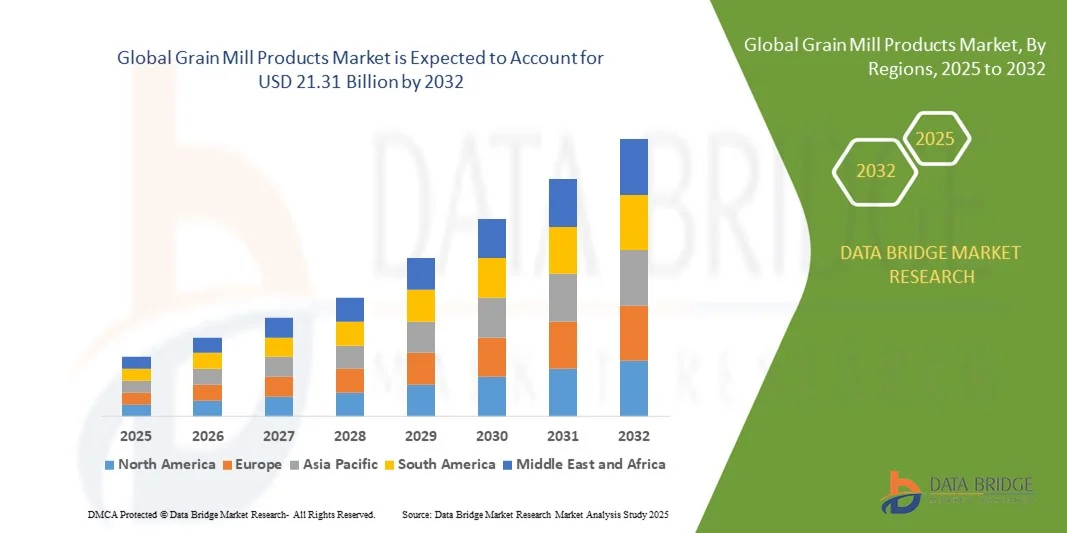
What is the Global Grain Mill Products Market Size and Growth Rate?
- The global grain mill products market size was valued at USD 4.92 billion in 2024 and is expected to reach USD 21.31 billion by 2032, at a CAGR of 3.55% during the forecast period
- Rising number of hotels, restaurants and cafes and surge in the awareness in regards to the benefits of grain mill products are the major factors fostering the growth of the grain mill products market
- Changing lifestyle, growing technological advancements in the grain mill equipment and rising demand for gluten- free products are other important factors acting as grain mill products market growth determinants
What are the Major Takeaways of Grain Mill Products Market?
- Developing tastes and preferences of consumers, surging dietary concerns and rising demand for packaged/ ready-to-eat food will further induce growth in the grain mill products market value
- However, fluctuations in the prices of raw materials will pose a major challenge to the growth of the grain mill products market. Requirement of high battery maintenance will also hamper the grain mill products market growth rate. Contamination of food grains owing to improper warehousing will yet again derail the grain mill products market growth rate
- The Asia-Pacific region dominated the grain mill products market with the largest revenue share of 32.3% in 2024, driven by robust agricultural production, expanding food processing industries, and increasing consumption of cereal-based food products across developing economies such as China, India, and Indonesia
- The North American grain mill products market is poised to grow at the fastest CAGR of 11.6% from 2025 to 2032, driven by growing consumer interest in organic, gluten-free, and fortified grain-based products
- The Wheat and Maslin Flour segment dominated the market with the largest revenue share of 36.5% in 2024, attributed to its extensive use in bakery, confectionery, and staple food products worldwide
Report Scope and Grain Mill Products Market Segmentation
|
Attributes |
Grain Mill Products Key Market Insights |
|
Segments Covered |
|
|
Countries Covered |
North America
Europe
Asia-Pacific
Middle East and Africa
South America
|
|
Key Market Players |
|
|
Market Opportunities |
|
|
Value Added Data Infosets |
In addition to the insights on market scenarios such as market value, growth rate, segmentation, geographical coverage, and major players, the market reports curated by the Data Bridge Market Research also include in-depth expert analysis, pricing analysis, brand share analysis, consumer survey, demography analysis, supply chain analysis, value chain analysis, raw material/consumables overview, vendor selection criteria, PESTLE Analysis, Porter Analysis, and regulatory framework. |
What is the Key Trend in the Grain Mill Products Market?
Rising Demand for Nutrient-Enriched and Functional Flours
- A major and accelerating trend in the global grain mill products market is the increasing demand for nutrient-enriched, fiber-rich, and functional flours driven by consumers’ growing focus on health, wellness, and clean-label nutrition. Manufacturers are reformulating products to include whole grains, high-protein blends, and gluten-free alternatives
- For instance, General Mills, Inc. (U.S.) launched its “Good Measure” brand with low glycemic index ingredients, while ADM (U.S.) expanded its functional flour portfolio through its “HarvestEdge” line, focusing on enhanced fiber and protein content
- The demand is further boosted by the shift toward plant-based diets and natural ingredients, encouraging the use of ancient grains such as quinoa, amaranth, and millet in milling operations
- This trend is transforming traditional grain processing, prompting millers to adopt fortification technologies, bio-enrichment, and precision milling techniques to retain more nutrients in final products
- As health-conscious consumers increasingly prefer balanced nutrition from daily staples, the demand for functional and fortified grain mill products is expected to continue growing, driving innovation and product diversification across the global market
What are the Key Drivers of Grain Mill Products Market?
- The growing awareness of healthy eating habits, combined with the rise in urbanization and convenience food consumption, is a key factor driving the grain mill products market. Consumers are seeking healthier grain-based alternatives such as whole-grain flour, fortified wheat, and high-protein cereals
- For instance, in June 2024, Wilmar International Ltd. (Singapore) announced the expansion of its whole-grain flour production facility in China to meet the rising demand for functional bakery ingredients
- The surge in demand for ready-to-eat and bakery products in emerging economies, along with the increasing availability of advanced milling technologies, supports market growth
- In addition, government initiatives promoting nutritional fortification such as adding iron, folic acid, and vitamin B12 to wheat flour are further accelerating demand in developing nations
- The expansion of online retail platforms has also made premium and fortified grain mill products more accessible to a broader consumer base, stimulating consistent growth in both developed and emerging regions
Which Factor is Challenging the Growth of the Grain Mill Products Market?
- One of the major challenges hindering the market is the fluctuating cost and availability of raw grains, which directly affects production margins and product pricing. Factors such as climate change, droughts, and global supply chain disruptions significantly impact wheat, corn, and rice availability
- For instance, in 2023, global wheat prices surged due to the Russia-Ukraine conflict, impacting manufacturers such as Conagra Brands, Inc. (U.S.) and Ardent Mills (U.S.), which rely heavily on consistent grain imports.
- In addition, the rising energy costs and logistical challenges in transporting bulk grain materials increase operational expenses, making it difficult for small and mid-sized mills to remain competitive
- Quality inconsistencies in locally sourced grains, coupled with limited access to modern milling technologies in developing economies, further pose production challenges
- Overcoming these barriers through supply chain diversification, sustainable sourcing, and technological upgrades will be crucial to ensuring steady growth and price stability in the grain mill products market
How is the Grain Mill Products Market Segmented?
The market is segmented on the basis of product type, end use, and distribution channel.
- By Product Type
On the basis of product type, the grain mill products market is segmented into Broken Rice, Husked Brown Rice, Semi-Milled/Wholly Milled Rice, Maize (Corn) Flour, Wheat and Maslin Flour, Other Cereal Flours, Maize (Corn) Meal and Groats, Wheat Meal, Other Cereal Meal and Groats, Other Worked Cereal Grains, Meal and Flour of Legumes, Citrus, Nuts, Roots and Tubers, and Other Grain Mill Products. The Wheat and Maslin Flour segment dominated the market with the largest revenue share of 36.5% in 2024, attributed to its extensive use in bakery, confectionery, and staple food products worldwide. Wheat-based flours offer excellent texture and nutritional value, making them a key ingredient in global diets.
Meanwhile, the Maize (Corn) Flour segment is expected to witness the fastest growth rate of 19.4% from 2025 to 2032, driven by the rising demand for gluten-free and fortified food products. The growing popularity of corn-based snacks and traditional foods in Latin America, Africa, and Asia further supports segment expansion.
- By End Use
On the basis of end use, the grain mill products market is divided into Commercial Use and Household Use. The Household Use segment accounted for the largest market share of 58.7% in 2024, owing to the increasing adoption of nutrient-enriched flours and the rising trend of home baking and cooking. The COVID-19 pandemic accelerated at-home consumption, and this shift continues as consumers emphasize freshness, ingredient control, and cost-effectiveness.
The Commercial Use segment is projected to register the fastest CAGR of 17.8% from 2025 to 2032, fueled by expanding food service sectors such as bakeries, restaurants, and ready-to-eat manufacturers. Increasing urbanization and the global demand for processed and convenient food items are further stimulating commercial adoption of grain mill products.
- By Distribution Channel
On the basis of distribution channel, the grain mill products market is segmented into Supermarkets/Hypermarkets, Grocery Stores, Online Stores, and Others. The Supermarkets/Hypermarkets segment dominated the market with the largest revenue share of 41.2% in 2024, due to the wide availability of brands, bulk purchasing options, and consumer preference for physical inspection before purchase. Major retail chains provide promotional offers and in-store product variety, attracting a broad consumer base.
However, the Online Stores segment is anticipated to exhibit the fastest growth rate of 22.1% from 2025 to 2032, driven by the increasing penetration of e-commerce platforms, convenience of doorstep delivery, and the rising popularity of health-oriented digital grocery stores. The integration of subscription models and discounts for organic and fortified grain products is further propelling online sales growth.
Which Region Holds the Largest Share of the Grain Mill Products Market?
- The Asia-Pacific region dominated the grain mill products market with the largest revenue share of 32.3% in 2024, driven by robust agricultural production, expanding food processing industries, and increasing consumption of cereal-based food products across developing economies such as China, India, and Indonesia
- The region’s strong demand for rice, wheat, and maize-based products, coupled with government initiatives to enhance food security and improve grain storage infrastructure, has accelerated market expansion
- Rising urbanization, growing disposable incomes, and a surge in demand for convenient and packaged food products have also boosted the adoption of grain mill products in both household and commercial sectors
China Grain Mill Products Market Insight
The China grain mill products market captured the largest revenue share of 65% in 2024 within Asia-Pacific, supported by its vast population base, strong domestic grain production, and increasing consumption of processed foods. Rapid industrialization and investment in advanced milling technologies are modernizing China’s grain processing sector. In addition, the nation’s focus on self-sufficiency in food production and the rise of health-conscious consumers are driving the demand for fortified and whole-grain flours.
India Grain Mill Products Market Insight
The India grain mill products market is projected to expand at a noteworthy CAGR during 2025–2032, fueled by the country’s expanding middle-class population, changing dietary habits, and rising preference for packaged grain-based products. Government policies promoting agricultural mechanization and food industry development are further boosting local milling operations. The growing trend of ready-to-eat and fortified food consumption, along with technological advancements in grain processing, is strengthening market penetration across both rural and urban areas.
Japan Grain Mill Products Market Insight
The Japan grain mill products market is expected to grow steadily during the forecast period, driven by increasing demand for premium and health-oriented flour varieties. Japanese consumers favor whole-grain and low-gluten options, reflecting a broader shift toward nutrition-focused food consumption. The use of automation and precision milling technology also enhances product consistency and quality. In addition, Japan’s strong bakery and confectionery industries are key contributors to sustained market growth.
Which Region is the Fastest Growing Region in the Grain Mill Products Market?
The North American grain mill products market is poised to grow at the fastest CAGR of 11.6% from 2025 to 2032, driven by growing consumer interest in organic, gluten-free, and fortified grain-based products. The region’s advanced food processing infrastructure, coupled with strong demand from bakery, snack, and breakfast cereal manufacturers, continues to propel market expansion. Furthermore, sustainability trends and clean-label preferences are encouraging the use of minimally processed grain ingredients.
U.S. Grain Mill Products Market Insight
The U.S. grain mill products market accounted for the largest revenue share of 78% in 2024 within North America, supported by a mature food processing industry and growing adoption of whole-grain products. The rising popularity of artisanal and specialty flours, alongside the demand for plant-based and functional foods, is reshaping the country’s grain milling sector. In addition, the integration of automation and digital quality control systems enhances production efficiency and product consistency.
Canada Grain Mill Products Market Insight
The Canada grain mill products market is anticipated to register robust growth during the forecast period, driven by the expansion of domestic grain exports and the rise of health-conscious consumers. Canadian manufacturers are increasingly investing in organic and gluten-free milling technologies to cater to evolving consumer preferences. The strong presence of wheat and oat production, combined with sustainable agricultural practices, positions Canada as a key regional player.
Mexico Grain Mill Products Market Insight
The Mexico grain mill products market is gaining momentum due to rising consumption of maize-based products, such as tortillas and snacks, and growing modernization in milling technologies. Increasing investment from multinational food companies and government initiatives to enhance food quality standards are driving market growth. In addition, the adoption of fortified flours to address nutritional deficiencies supports long-term industry expansion.
Which are the Top Companies in Grain Mill Products Market?
The grain mill products industry is primarily led by well-established companies, including:
- ADM (U.S.)
- Oy Karl Fazer Ab. (Finland)
- General Mills, Inc. (U.S.)
- Conagra Brands, Inc. (U.S.)
- Unilever (U.K.)
- ARDENT MILLS. (U.S.)
- King Arthur Baking Company, Inc. (U.S.)
- Grain Millers, Inc. (U.S.)
- Rising Industries. (India)
- Shree Laxmi Industries. (India)
- Shankar Engineering Corporation. (India)
- Padmanaban Engineering Private Limited. (India)
- Flora Appliances. (India)
- haystar (India)
- Jas Enterprises. (India)
- M. G. Industries. (India)
- Maruti Industries. (India)
- Jay Khodiyar Industries. (India)
- Mechpro Engineering. (India)
- Wilmar International Ltd (Singapore)
What are the Recent Developments in Global Grain Mill Products Market?
- In April 2024, King Arthur Baking Company launched its innovative Regeneratively-Grown Climate Blend Flour, marking a major step toward sourcing all its flour from regeneratively-grown wheat by 2030. This initiative emphasizes improving soil health and sustainable farming practices, enabling farmers to achieve higher profits with lower grain output. The new whole-wheat blend offers higher fiber content while maintaining the same taste as traditional flour, reinforcing the company’s commitment to environmental sustainability and product quality
- In June 2023, Ardent Mills introduced two new products — Egg Replacement Powder and Ancient Grains Flour Blend — designed to meet evolving consumer demands for nutritious, flavorful, and high-quality ingredients. These products also help customers navigate supply chain challenges and tap into new market opportunities within the health and wellness segment. This strategic expansion underscores Ardent Mills’ focus on innovation and customer-centric product development
- In April 2022, Ardent Mills launched Certified Gluten-Free and Keto-Friendly Flour Blends for the Canadian market, catering to the rising demand for healthy and alternative baking solutions. These blends can effectively replace traditional flour without compromising taste, texture, or functionality, offering versatility across bakery and foodservice applications. The initiative highlights the company’s ongoing commitment to nutrition-driven innovation and market adaptability
- In March 2022, Ardent Mills inaugurated its advanced Port Redwing Mill in Gibsonton, Florida, as part of its strategic expansion to strengthen supply chain resilience and operational efficiency. The 150,000-square-foot facility, capable of producing 1.75 million pounds of flour daily, is strategically located for multi-modal transportation access via rail, ocean, and truck. This milestone reflects the company’s dedication to scalable production and enhanced customer service capabilities
- In April 2021, KRBL Limited introduced India Gate Rice Flour under its FMCG portfolio, expanding into the wholesome grain and oil products category. The fine, smooth, and gluten-free flour is versatile, suitable for making roti, bread, rice noodles, cakes, cookies, and snacks, particularly in Western and Southern Indian cuisines. This launch signifies KRBL’s strategic move to diversify its product line and meet growing consumer demand for healthy, gluten-free alternatives

- Interactive Data Analysis Dashboard
- Company Analysis Dashboard for high growth potential opportunities
- Research Analyst Access for customization & queries
- Competitor Analysis with Interactive dashboard
- Latest News, Updates & Trend analysis
- Harness the Power of Benchmark Analysis for Comprehensive Competitor Tracking
Global Grain Mill Products Market, Supply Chain Analysis and Ecosystem Framework
To support market growth and help clients navigate the impact of geopolitical shifts, DBMR has integrated in-depth supply chain analysis into its Global Grain Mill Products Market research reports. This addition empowers clients to respond effectively to global changes affecting their industries. The supply chain analysis section includes detailed insights such as Global Grain Mill Products Market consumption and production by country, price trend analysis, the impact of tariffs and geopolitical developments, and import and export trends by country and HSN code. It also highlights major suppliers with data on production capacity and company profiles, as well as key importers and exporters. In addition to research, DBMR offers specialized supply chain consulting services backed by over a decade of experience, providing solutions like supplier discovery, supplier risk assessment, price trend analysis, impact evaluation of inflation and trade route changes, and comprehensive market trend analysis.
Data collection and base year analysis are done using data collection modules with large sample sizes. The stage includes obtaining market information or related data through various sources and strategies. It includes examining and planning all the data acquired from the past in advance. It likewise envelops the examination of information inconsistencies seen across different information sources. The market data is analysed and estimated using market statistical and coherent models. Also, market share analysis and key trend analysis are the major success factors in the market report. To know more, please request an analyst call or drop down your inquiry.
The key research methodology used by DBMR research team is data triangulation which involves data mining, analysis of the impact of data variables on the market and primary (industry expert) validation. Data models include Vendor Positioning Grid, Market Time Line Analysis, Market Overview and Guide, Company Positioning Grid, Patent Analysis, Pricing Analysis, Company Market Share Analysis, Standards of Measurement, Global versus Regional and Vendor Share Analysis. To know more about the research methodology, drop in an inquiry to speak to our industry experts.
Data Bridge Market Research is a leader in advanced formative research. We take pride in servicing our existing and new customers with data and analysis that match and suits their goal. The report can be customized to include price trend analysis of target brands understanding the market for additional countries (ask for the list of countries), clinical trial results data, literature review, refurbished market and product base analysis. Market analysis of target competitors can be analyzed from technology-based analysis to market portfolio strategies. We can add as many competitors that you require data about in the format and data style you are looking for. Our team of analysts can also provide you data in crude raw excel files pivot tables (Fact book) or can assist you in creating presentations from the data sets available in the report.