What is the Grain Protectants Market Size and Growth Rate?
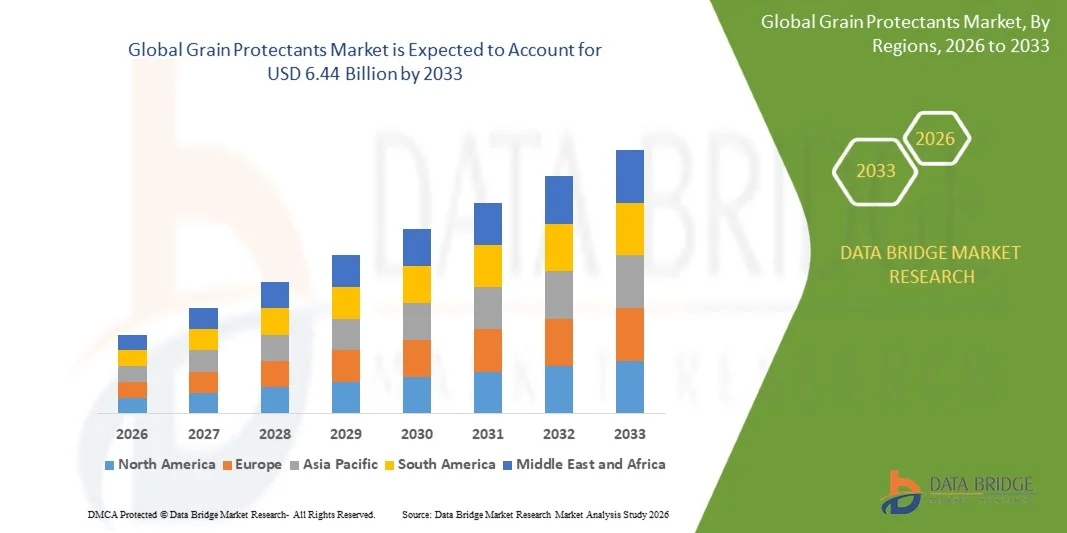
- As per Data Bridge Market Research analysis, the grain protectants market was valued at USD 4.40 billion in 2025 and is projected to reach USD 6.44 billion by 2033, growing at a CAGR of 4.88% from 2026 to 2033.
- The market is experiencing consistent growth driven by rising global grain production and food demand, increasing emphasis on preserving grain quality during storage, and the need to reduce contamination, spoilage, and post-harvest losses.
- The growing world population and rising food demand, combined with increasing concerns over pest infestation, grain contamination, and spoilage during storage, are encouraging farmers, grain storage facilities, and food processors to adopt effective grain protection solutions. Chemical, physical, and biological protectants are increasingly being used to preserve grain quality, while integrated pest management is gaining traction as a sustainable and environmentally friendly approach to pest control.
Market Size & Forecast
- Global Market Value (2025): USD 4.40 Billion
- Expected Market Value (2033): USD 6.44 Billion
- Forecast CAGR (2026–2033): 4.88%
- Leading Region in 2025: North America
- Fastest Growing Region: Asia Pacific
What are the Major Takeaways of the Grain Protectants Market?
- North America dominated the grain protectants market with the largest revenue share of 35.2% in 2025, supported by the presence of numerous grain warehouses and processing plants, growing demand for meeting grain-storage standards, and increasing emphasis on food safety.
- Asia-Pacific is expected to be the fastest-growing region at a CAGR of 7.9% from 2026 to 2033, fueled by increasing grain production, rising post-harvest losses during storage, growing food-safety concerns, and expanding adoption of grain protection solutions
- The insecticides segment led the market with a 70% share in 2025, driven by the widespread occurrence of insects in stored grains and extensive use of insecticides for controlling stored-product pests.
- Fungicides are the fastest-growing type, projected to register a CAGR of 5.0%, reflecting the surge in concerns regarding fungal contamination, mold development, and mycotoxin formation during grain storage
- The chemical segment dominated the control method category with a 63.2% revenue share in 2025, led by its established effectiveness, rapid action, and widespread adoption across grain-storage facilities.
- Insects accounted for 60% of the market share in 2025, preferred by the widespread occurrence of stored-grain insects and their significant impact on grain quantity and quality.
- The rice segment is the fastest-growing grain type category, with a CAGR of 7.5%, driven by the increasing rice production and modernization of grain-storage infrastructure
Report Scope and Grain Protectants Market Segmentation
|
Attributes |
Grain Protectants Key Market Insights |
|
Segments Covered |
|
|
Countries Covered |
North America
Europe
Asia-Pacific
Middle East and Africa
South America
|
|
Key Market Players |
|
|
Market Opportunities |
|
|
Value Added Data Infosets |
In addition to the insights on market scenarios such as market value, growth rate, segmentation, geographical coverage, and major players, the market reports curated by the Data Bridge Market Research also include import export analysis, production capacity overview, production consumption analysis, price trend analysis, climate change scenario, supply chain analysis, value chain analysis, raw material/consumables overview, vendor selection criteria, PESTLE Analysis, Porter Analysis, and regulatory framework. |
What is the Key Trend in the Grain Protectants Market?
- The grain protectants market is increasingly shifting toward integrated and sustainable pest-management solutions, as concerns over pesticide residues, insecticide resistance, and environmental impacts encourage the adoption of biological protectants, inert dusts, controlled-atmosphere treatments, aeration, and other non-chemical approaches.
- For instance, in December 2024, a study published in the Journal of Stored Products Research identified essential-oil-loaded polymeric nanoparticles as a promising alternative for controlling storage-grain insects, noting that encapsulation can improve essential-oil stability, efficacy, and sustained release
- Biological and plant-based grain protection solutions are gaining research and commercial attention, particularly as food producers and storage operators seek safer alternatives to conventional synthetic chemicals while maintaining effective control of stored-grain insects.
- Advanced formulations and alternative delivery technologies are being developed to improve protection efficacy and extend the storage life of cereals, including nanoencapsulated essential oils, botanical compounds, biological agents, and improved fumigation technologies.
- Integrated pest management is becoming increasingly important for stored-grain protection, combining sanitation, monitoring, aeration, physical barriers, biological controls, and chemical treatments to reduce dependence on repeated insecticide applications.
- For instance, in July 2025, a study published in Scientific Reports investigated Plectranthus amboinicus essential oil as a natural alternative to synthetic insecticides for controlling Sitophilus oryzae (rice weevil), highlighting the growing research focus on plant-based grain protectants.
- As grain-storage operators increasingly prioritize residue reduction, resistance management, and sustainable pest control, the adoption of biological protectants and integrated protection technologies is expected to accelerate, creating new opportunities for innovation in the global grain protectants market.
What are the Key Drivers of the Grain Protectants Market?
- The rising post-harvest grain losses caused by insects, moisture, fungi, and unsuitable storage conditions are significantly increasing the need for effective grain-protection solutions, particularly in regions with warm and humid storage environments.
- For instance, in May 2025, a study published in the Journal of Stored Products Research evaluated phosphine fumigation across Indian rice warehouses and found 100% mortality of major stored-grain insects under effective treatment conditions, demonstrating the continuing need for effective grain-protection solutions to maintain stored-grain quality and reduce pest losses.
- Stored-product insects can cause substantial quantitative and qualitative losses, increasing the importance of preventive and curative treatments across commercial warehouses, grain silos, food-processing facilities, and farm-level storage.
- Increasing global grain production and the need to preserve grain quality throughout extended storage periods are encouraging the use of insecticides, fumigants, biological protectants, and integrated pest-management practices.
- The effectiveness of grain protection is particularly important under climatic conditions favorable to pest development, with stored-product pests generally developing rapidly at temperatures of 28–33°C and relative humidity of 60–80%.
- For instance, in June 2024, a research article published in the Journal of Stored Products Research found that conventional polypropylene, jute, and fertilizer bags were ineffective in protecting stored maize from insect-related losses, while PICS and AgroZ® bags provided effective protection, highlighting the growing need for improved grain-storage and protection technologies
- With stored-grain protection remaining essential for reducing post-harvest losses and maintaining food quality, demand for effective chemical, biological, and integrated protection solutions is expected to remain strong, particularly across large-scale grain-storage operations.
Which Factors are Challenging the Growth of the Grain Protectants Market?
- Increasing insecticide and fumigant resistance represents a major challenge for the grain protectants market, particularly because phosphine remains one of the most widely used fumigants for stored-grain pest management.
- For instance, in October 2023, a study published in Scientific Reports found that Indian field populations of Tribolium castaneum showed phosphine resistance ranging from 2.11-fold to 70.94-fold compared with a susceptible population, highlighting the challenge of declining fumigant effectiveness in stored-grain pest management.
- Repeated and inappropriate use of phosphine can accelerate resistance development, reducing treatment effectiveness and increasing the need for resistance monitoring, improved application practices, and alternative pest-control technologies.
- Regulatory and food-safety concerns surrounding pesticide residues are also encouraging restrictions on certain conventional grain-protection chemicals, increasing compliance requirements for manufacturers, storage operators, and food processors.
- The effectiveness of protectants can also vary according to pest species, grain type, moisture content, temperature, storage conditions, and application practices, making consistent protection more difficult across different storage environments.
- For instance, in September 2023, a research article published in the Journal of Stored Products Research assessed 79 bruchid populations from 74 locations across India and recorded relative phosphine resistance ratios of 1.1–4.5-fold, warning that resistance could escalate with inappropriate and indiscriminate phosphine use.
- The increasing resistance of stored-grain insects and the need to comply with food-safety requirements therefore create pressure for grain-storage operators to adopt resistance-management programs, alternative protectants, and integrated pest-management strategies, potentially increasing operational complexity and treatment costs.
How is the Grain Protectants Market Segmented?
The grain protectants market is segmented on the basis of type, control method, target pest, grain type, and application method.
- By Type
On the basis of type, the grain protectants market is segmented into insecticides and fungicides. The insecticides segment dominated the market with an estimated 70% share in 2025, owing to the widespread occurrence of insects in stored grains and extensive use of insecticides for controlling stored-product pests. These products provide rapid and effective protection against weevils, beetles, grain borers, and moths. Insecticides are extensively used across commercial grain warehouses, silos, food-processing facilities, and agricultural storage operations. Their established efficacy and availability through well-developed distribution networks continue to support their leading position. Increasing concerns regarding post-harvest losses are further sustaining demand for insect-based pest-control solutions.
The fungicides segment is projected to register steady growth at an estimated CAGR of 5.0% during the forecast period, supported by increasing concerns regarding fungal contamination, mold development, and mycotoxin formation during grain storage. Fungicides help protect stored grains from fungal deterioration, particularly under conditions of elevated moisture and humidity. Growing food-safety requirements are increasing the importance of controlling fungal contamination throughout storage and transportation. Increasing awareness regarding grain quality is also encouraging storage operators to adopt broader protection strategies. The growing emphasis on reducing post-harvest losses provides additional opportunities for fungicide-based grain protection.
- By Control Method
On the basis of control method, the grain protectants market is segmented into chemical, physical, and biological. The chemical segment dominated the market with an estimated 63.2% share in 2025, owing to its established effectiveness, rapid action, and widespread adoption across grain-storage facilities. Chemical protectants include insecticides, fumigants, and other treatments used to control stored-grain pests. Their broad-spectrum activity and established application procedures make them particularly suitable for large-scale grain-storage operations. Chemical treatments are also supported by established manufacturing and distribution networks across major agricultural markets. The segment continues to benefit from the need for reliable pest control and preservation of grain quality during prolonged storage.
The biological segment is projected to be the fastest-growing control method, registering a CAGR of 12.4% through 2033, driven by increasing demand for sustainable and residue-free grain protection solutions. Biological protectants are gaining attention as regulations surrounding pesticide residues become more stringent. Increasing consumer preference for naturally derived products is further supporting development of biological alternatives. These solutions can also form part of integrated pest-management programs designed to reduce dependence on conventional chemicals. Manufacturers are increasingly developing botanical and microbial formulations with improved efficacy and stability. The shift toward environmentally friendly grain-storage practices is expected to accelerate adoption of biological protectants during the forecast period.
- By Target Pest
On the basis of target pest, the grain protectants market is segmented into insects, rodents, and others. The insects segment dominated the market with an estimated 60% share in 2025, driven by the widespread occurrence of stored-grain insects and their significant impact on grain quantity and quality. Major stored-product pests include beetles, weevils, moths, and grain borers. These pests can cause direct feeding losses, contamination, deterioration, and reduced market value of stored grains. Grain warehouses and storage facilities therefore rely extensively on insecticides and fumigants for preventive and curative pest management. The high frequency of insect infestation across different grain types continues to generate sustained demand for effective insect-control products.
The rodents segment is projected to grow at an estimated CAGR of 4.5% during the forecast period, supported by increasing awareness of contamination and quantitative losses caused by rodents in grain-storage facilities. Rodents can consume stored grain while also contaminating stocks through feces, urine, hair, and other biological material. Increasing food-safety requirements are encouraging warehouses and processing facilities to strengthen rodent-control programs. Modern storage facilities are increasingly adopting integrated pest-management practices that combine physical barriers, monitoring, sanitation, and chemical control. Expansion of commercial grain-storage infrastructure is also increasing the need for systematic rodent management.
- By Grain Type
On the basis of grain type, the grain protectants market is segmented into corn, wheat, rice, and others. The wheat segment dominated the market with a 30.4% share in 2025, supported by wheat's importance in food consumption, grain reserves, and international trade. Large volumes of wheat require prolonged storage, increasing exposure to insects, moisture, and other deterioration factors. Grain-storage operators therefore use protectants to maintain wheat quality and minimize post-harvest losses. The extensive wheat-storage infrastructure across major producing and consuming regions further supports demand for grain protection products. Increasing emphasis on food security and grain-quality preservation continues to reinforce the segment's leading position.
The rice segment is projected to be the fastest-growing grain type at a CAGR of 7.5% through 2033, supported by increasing rice production and modernization of grain-storage infrastructure. Rice-storage operations face significant risks from insect infestation, moisture, and deterioration, particularly in warm and humid environments. Growing investments in improved storage facilities across Asia-Pacific are increasing demand for effective rice-protection solutions. Exporters are also placing greater emphasis on maintaining premium grain quality and meeting international food-safety standards. The expansion of organized grain-storage systems is further encouraging adoption of modern protectant technologies. These factors are expected to strengthen rice's position as the fastest-growing grain category.
- By Application Method
On the basis of application method, the grain protectants market is segmented into seed treatment and post-harvest treatment. The post-harvest treatment segment dominated the market with an estimated 70% share in 2025, owing to the extensive use of protectants to control pests and preserve grain quality during storage and transportation. Post-harvest protection includes fumigation, spraying, dusting, and grain-coating approaches used across commercial warehouses and storage facilities. Increasing grain-storage capacity and concerns regarding post-harvest losses are supporting continued adoption. The need to preserve large grain stocks over extended storage periods further strengthens demand for post-harvest treatment solutions
The seed treatment segment is projected to register an estimated CAGR of 5.5% during the forecast period, driven by increasing emphasis on protecting seeds from pests and diseases before and during the early stages of crop development. Seed treatment enables targeted application of crop-protection products directly to seeds, helping improve protection efficiency. Increasing adoption of improved seeds and precision agricultural practices is supporting demand for targeted treatment technologies. Seed treatment can also reduce the requirement for repeated crop-protection applications during early plant development. Growing awareness of input efficiency and sustainable agricultural practices is creating additional opportunities for treated-seed technologies.
Which Region Holds the Largest Share of the Grain Protectants Market?
- North America dominated the grain protectants market with the largest revenue share of 35.2% in 2025, supported by the presence of numerous grain warehouses and processing plants, growing demand for meeting grain-storage standards, and increasing emphasis on food safety.
- The region also benefits from well-developed grain elevators, on-farm storage facilities, stringent food-safety and pesticide regulations, and increasing adoption of integrated pest-management practices. The availability of advanced storage technologies and the need to protect large quantities of grain during prolonged storage further support demand for insecticides, fumigants, and biological alternatives. North America is therefore expected to retain its leading position as storage operators increasingly prioritize grain quality, residue compliance, and reduction of post-harvest losses.
U.S. Grain Protectants Market Insight
The U.S. grain protectants market is witnessing steady growth due to the country’s large-scale grain production, extensive commercial storage infrastructure, and continued need to prevent insect infestation and quality deterioration during storage. Grain elevators, warehouses, and processing facilities require effective fumigation and residual insecticide treatments to maintain grain quality and meet food-safety requirements. The U.S. grain-storage industry also benefits from established professional pest-management practices and regulated grain-treatment procedures. In addition, the continued importance of corn and wheat storage supports demand for grain-protection products across the country. The U.S. Department of Agriculture’s grain-export protocol recognizes residual insecticide treatment and fumigation as established methods for grain disinfestation, highlighting the importance of professional grain-protection practices.
Asia-Pacific Grain Protectants Market Insight
The Asia-Pacific grain protectants market is expected to witness rapid growth, driven by extensive rice and wheat production, expanding grain-storage infrastructure, and increasing efforts to reduce post-harvest losses across China, India, and Southeast Asia. Urbanization is also encouraging centralized grain storage and the development of multi-silo facilities. Growing food-security requirements are further encouraging investment in modern storage and pest-management technologies. China, India, and Vietnam are expanding grain-storage infrastructure and modernizing storage facilities to reduce post-harvest losses and improve food security, supporting greater demand for grain protection solutions across Asia-Pacific.
Japan Grain Protectants Market Insight
The Japan grain protectants market is witnessing consistent growth due to the country's importance as a major rice-consuming market, stringent grain-quality requirements, and emphasis on maintaining food safety throughout storage and distribution. Japan's sophisticated agricultural and food-processing infrastructure creates demand for effective protection against insects, moisture-related deterioration, and contamination. Increasing attention toward residue management and sustainable pest-control practices is also encouraging interest in alternative grain-protection technologies. Advanced storage and monitoring practices support the effective management of stored commodities. Furthermore, Japan's strict quality requirements for food imports create greater emphasis on maintaining grain quality throughout the supply chain. Research on Asia-Pacific grain post-harvest systems identifies safe drying and storage as critical to maintaining grain quality, while Japan’s crop-protection market shows strong demand for quality-driven pest-management practices.
China Grain Protectants Market Insight
The China grain protectants market is growing rapidly, driven by the country's enormous grain-production base, government emphasis on food security, modernization of storage infrastructure, and increasing adoption of advanced grain-storage technologies. China is one of the world's largest grain-producing and consuming countries, making effective post-harvest management essential for preserving grain quality. Government initiatives aimed at improving storage conditions are reducing losses while increasing the efficiency of grain-storage operations. Study covering 1,202 rural households across 23 Chinese provinces found that advanced storage facilities reduced household maize storage losses by 60%, reducing the loss rate from 2.85% to 0.87% and saving approximately 33 kg of maize per household.
U.K. Grain Protectants Market Insight
The U.K. grain protectants market is experiencing steady growth, supported by extensive grain-storage and export activities, strict phytosanitary requirements, and increasing emphasis on safe and effective stored-grain pest management. The country has established professional standards for residual insecticide treatment and fumigation of grain intended for export. Increasing concerns regarding insecticide resistance and restrictions on conventional pesticides are also encouraging development of biological and alternative grain-protection technologies. Research and innovation programs are therefore supporting the development of safer solutions for stored-grain protection. Innovate UK supported Hampshire-based Exosect with a USD 0.366 million grant to develop Entostat, a biological grain-protection technology using fungal spores to control storage insects.
Germany Grain Protectants Market Insight
The Germany grain protectants market is expanding steadily due to its large commercial grain-storage infrastructure, strong agricultural sector, and increasing emphasis on preventing pest infestation in long-term grain storage. Commercial warehouses require effective physical protection, monitoring, and pest-control measures to maintain stored grain quality. Germany's advanced storage facilities also encourage adoption of integrated approaches combining structural protection with targeted grain treatments. Increasing regulatory attention toward pesticide use is further supporting interest in non-chemical and physical protection methods. Research conducted in northeastern Germany examined commercial warehouses with capacities of approximately 500–1,900 tonnes and found that sealing visible openings could help create pest-proof storage conditions; a 3,000-tonne wheat storage site nevertheless recorded Indianmeal moth infestation, demonstrating the continuing need for comprehensive pest management
Which are the Top Companies in Grain Protectants Market?
The grain protectants industry is primarily led by well-established companies, including:
- Garden & Pet Company Central. (U.S.)
- Corteva (U.S.)
- Nufarm (Australia)
- BASF (Germany)
- Bayer AG (Germany)
- FMC Corporation (U.S.)
- UPL Limited (India)
- Syngenta (Switzerland)
- Sumitomo Chemical Co., Ltd. (Japan)
- Mitsui Chemicals, Inc. (Japan)
- PI Industries Limited (India)
- Gharda Chemicals Ltd. (India)
- AMVAC Chemical Corporation (U.S.)
- Certis USA L.L.C. (U.S.)
- PelGar International (U.K.)
- Liphatech, Inc. (U.S.)
- Bell Laboratories, Inc. (U.S.)
- Bio-Gene Technology Limited (Australia)
- Draslovka Holding a.s. (Czech Republic)
What are Latest Developments in Grain Protectants Market?
- In March 2025, Central Life Sciences announced the availability of Gravista Insecticide in a quart-size package, providing greater application flexibility for post-harvest stored-grain protection. The product uses a three-in-one formulation combining an insect growth regulator, an adulticide, and a synergist to control stored-product insects. The new size is particularly suited to pre-bin treatments before grain enters storage and provides long-lasting residual protection. Gravista is labeled for grain sorghum, corn, popcorn, barley, oats, rice, rye, and wheat. The development expands application options for growers and strengthens the company's stored-grain protection portfolio.
- In January 2024, Central Life Sciences introduced Gravista-D Insecticide, a ready-to-use stored-grain insecticide combining an adulticide with an insect growth regulator. The product was designed for post-harvest grain protection and is labeled for commodities including corn, wheat, rice, barley, oats, rye, and grain sorghum. It can be applied as a pre-bin treatment or directly to grain as it enters storage for extended residual insect control.
- In November 2023, K-Obiol EC Combi received approval for on-farm use in Western Australia, giving grain growers an additional chemistry and mode of action for controlling stored-grain insect pests. The synergized grain protectant contains deltamethrin and can be used on malt barley, wheat, oats, sorghum, rice, maize, and other cereal grains. The product provides protection against major stored-grain insects, particularly the lesser grain borer, for up to nine months. The approval was significant because growers previously had limited options for on-farm stored-grain insect management, making the additional chemistry valuable for resistance-management strategies
- In February 2022, Central Life Sciences announced the addition of Gravista Insecticide and Centynal Synergized Insecticide to its stored-grain insect-control portfolio. Gravista combines an adulticide, an insect growth regulator, and a synergist in a liquid formulation for stored-grain protection. Centynal combines an insecticide with a synergist to provide enhanced control of stored-product insects. The company positioned both products as new grain-protectant technologies intended to provide growers and grain handlers with additional options for protecting stored commodities. The portfolio expansion also increased the range of formulations available for different grain-storage strategies
- In April 2021, Central Life Sciences announced the addition of Inselux Fog & Mill Spray to its stored-grain insect-control portfolio. The fogging product contains an adulticide, a synergist, and (S)-methoprene insect growth regulator technology to provide extended residual control. It was developed for use in flour mills, feed mills, and other commercial operations where stored-product insect control is essential. The product was positioned to control both adult insects and larvae, expanding the company's range of solutions for commercial grain and food-processing facilities. The launch reflected continued development of integrated stored-product pest-management technologies.

- Interactive Data Analysis Dashboard
- Company Analysis Dashboard for high growth potential opportunities
- Research Analyst Access for customization & queries
- Competitor Analysis with Interactive dashboard
- Latest News, Updates & Trend analysis
- Harness the Power of Benchmark Analysis for Comprehensive Competitor Tracking
Data collection and base year analysis are done using data collection modules with large sample sizes. The stage includes obtaining market information or related data through various sources and strategies. It includes examining and planning all the data acquired from the past in advance. It likewise envelops the examination of information inconsistencies seen across different information sources. The market data is analysed and estimated using market statistical and coherent models. Also, market share analysis and key trend analysis are the major success factors in the market report. To know more, please request an analyst call or drop down your inquiry.
The key research methodology used by DBMR research team is data triangulation which involves data mining, analysis of the impact of data variables on the market and primary (industry expert) validation. Data models include Vendor Positioning Grid, Market Time Line Analysis, Market Overview and Guide, Company Positioning Grid, Patent Analysis, Pricing Analysis, Company Market Share Analysis, Standards of Measurement, Global versus Regional and Vendor Share Analysis. To know more about the research methodology, drop in an inquiry to speak to our industry experts.
Data Bridge Market Research is a leader in advanced formative research. We take pride in servicing our existing and new customers with data and analysis that match and suits their goal. The report can be customized to include price trend analysis of target brands understanding the market for additional countries (ask for the list of countries), clinical trial results data, literature review, refurbished market and product base analysis. Market analysis of target competitors can be analyzed from technology-based analysis to market portfolio strategies. We can add as many competitors that you require data about in the format and data style you are looking for. Our team of analysts can also provide you data in crude raw excel files pivot tables (Fact book) or can assist you in creating presentations from the data sets available in the report.