


Granuloma Inguinale Market Overview
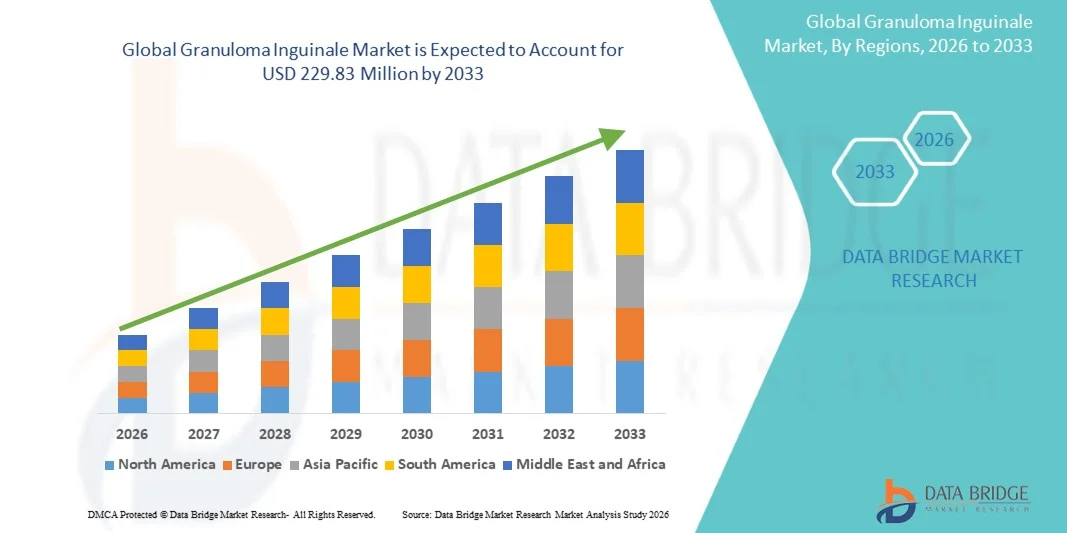
The Granuloma Inguinale Market was valued at USD 163.99 Million in 2025 and is projected to reach USD 229.83 Million by 2033, growing at a CAGR of 4.31% from 2026 to 2033. The market is experiencing consistent growth driven by the rising prevalence of sexually transmitted bacterial infections, increasing awareness regarding early diagnosis and treatment of Granuloma Inguinale, and expanding access to antimicrobial therapies across developing and developed healthcare systems. Growing investments in infectious disease management programs, improvements in sexually transmitted infection (STI) screening infrastructure, and increasing public health initiatives focused on sexual health education are further supporting market expansion globally.
The increasing incidence of sexually transmitted infections worldwide, combined with growing government efforts to strengthen infectious disease surveillance and improve access to antibiotic treatment, is compelling healthcare providers, public health agencies, and diagnostic laboratories to adopt advanced diagnostic and treatment approaches for Granuloma Inguinale. Broad-spectrum antibiotic therapies such as azithromycin, doxycycline, erythromycin, and ciprofloxacin are increasingly being utilized for effective disease management, while advancements in molecular diagnostic technologies and STI screening programs are improving early detection, reducing transmission risks, and enhancing patient outcomes across hospitals, sexual health clinics, and community healthcare centers.
Key Market Trends & Insights
- North America dominated the Granuloma Inguinale Market with the largest revenue share of 35.46% in 2025, supported by increasing awareness regarding sexually transmitted bacterial infections, strong availability of antibiotic therapies, advanced diagnostic infrastructure, and rising government initiatives focused on STI screening and infectious disease management across hospitals and public healthcare systems.
- The Azithromycin segment led the market with a 39.18% share in 2025, driven by its widespread use as a first-line treatment option for Granuloma Inguinale due to its high clinical efficacy, convenient dosing regimen, and strong physician preference for managing chronic bacterial sexually transmitted infections.
- Asia-Pacific is expected to be the fastest-growing region at a CAGR of 7.5% from 2026 to 2033, fueled by improving healthcare access, increasing awareness regarding sexually transmitted infections, expanding public health screening programs, and growing adoption of antibiotic treatment therapies across China, India, and Southeast Asia.
- The Doxycycline segment is projected to register the fastest CAGR of 7.1% from 2026 to 2033, supported by increasing use in patients requiring prolonged antimicrobial therapy, rising availability of low-cost generic formulations, and growing physician adoption in emerging healthcare markets.
- Hospital Pharmacy dominated the distribution channel category with a 43.27% revenue share in 2025, owing to the high volume of STI-related treatments administered through hospitals, infectious disease clinics, and specialized sexual health centers equipped with advanced diagnostic and prescription management systems.
- Online Pharmacies are expected to witness the fastest growth at a CAGR of 7.3% from 2026 to 2033, driven by rising digital healthcare adoption, increasing preference for confidential STI medication purchases, expanding e-pharmacy platforms, and improving access to prescription antibiotics in remote and underserved regions.
- Increasing prevalence of sexually transmitted bacterial infections, rising awareness regarding early diagnosis and antibiotic treatment, and expanding government-led STI control initiatives continue to accelerate demand for Granuloma Inguinale treatment solutions globally.
Market Size & Forecast
- Global Market Value (2025): USD 163.99 Million
- Expected Market Value (2033): USD 229.83 Million
- Forecast CAGR (2026–2033): 4.31%
- Leading Region in 2025: North America
- Fastest Growing Region: Asia-Pacific
Report Scope and Granuloma Inguinale Market Segmentation
|
Attributes |
Granuloma Inguinale Key Market Insights |
|
Segments Covered |
|
|
Countries Covered |
North America · U.S. · Canada · Mexico Europe · Germany · France · U.K. · Netherlands · Switzerland · Belgium · Russia · Italy · Spain · Turkey · Rest of Europe Asia-Pacific · China · Japan · India · South Korea · Singapore · Malaysia · Australia · Thailand · Indonesia · Philippines · Rest of Asia-Pacific Middle East and Africa · Saudi Arabia · U.A.E. · South Africa · Egypt · Israel · Rest of Middle East and Africa South America · Brazil · Argentina · Rest of South America |
|
Key Market Players |
• Pfizer Inc. (U.S.) |
|
Market Opportunities |
· Expansion of sexually transmitted infection (STI) screening and awareness programs across emerging economies · Growing penetration of online pharmacies and telemedicine platforms · Increasing investments in advanced molecular diagnostics |
|
Value Added Data Infosets |
In addition to the insights on market scenarios such as market value, growth rate, segmentation, geographical coverage, and major players, the market reports curated by the Data Bridge Market Research also include in-depth expert analysis, geographically represented company-wise production and capacity, network layouts of distributors and partners, detailed and updated price trend analysis and deficit analysis of supply chain and demand. |
Granuloma Inguinale Market Trends
Trend: Rising Focus on Sexually Transmitted Infection (STI) Awareness & Early Antibiotic Intervention
Healthcare organizations and public health agencies are increasingly focusing on awareness, early diagnosis, and antibiotic treatment of sexually transmitted bacterial infections such as Granuloma Inguinale (Donovanosis). Increasing adoption of molecular diagnostic testing, PCR-based bacterial identification, and sexually transmitted infection screening programs is improving early detection and reducing complications associated with delayed treatment. Governments and sexual health organizations across Asia-Pacific, Africa, and Latin America are strengthening STI surveillance and awareness campaigns to control infection spread in high-risk populations. For instance, the World Health Organization (WHO) estimates that more than one million sexually transmitted infections are acquired globally every day, highlighting the growing importance of effective diagnosis and antimicrobial treatment strategies. In addition, rising use of azithromycin- and doxycycline-based therapies through public healthcare programs is supporting market growth globally.
Granuloma Inguinale Market Dynamics
Key Market Driver: Increasing Prevalence of Sexually Transmitted Bacterial Infections & Growing Public Health Initiatives
The increasing prevalence of sexually transmitted bacterial infections and growing government focus on STI prevention programs are major drivers for the Granuloma Inguinale Market. Expanding awareness regarding early diagnosis and treatment of Donovanosis is encouraging healthcare providers to adopt effective antibiotic therapies such as azithromycin, doxycycline, ciprofloxacin, and erythromycin. According to the World Health Organization, sexually transmitted infections remain a major global public health concern, particularly in low- and middle-income countries with limited access to early screening services. In addition, increasing investments in sexual health clinics, infectious disease diagnostic laboratories, and antimicrobial stewardship programs are improving treatment accessibility. Public healthcare agencies are also expanding awareness campaigns focused on safe sexual practices, routine STI screening, and infection control measures, further strengthening market demand across hospital and retail pharmacy channels globally.
Key Restraint/Challenge: Limited Disease Awareness & Delayed Diagnosis
A major challenge in the Granuloma Inguinale Market is the limited awareness and delayed diagnosis associated with the disease, particularly in underdeveloped and resource-constrained healthcare systems. Symptoms of Granuloma Inguinale often resemble other sexually transmitted infections, leading to misdiagnosis and delayed treatment initiation. In many endemic regions, inadequate laboratory infrastructure, limited access to advanced molecular diagnostics, and social stigma associated with sexually transmitted diseases continue to restrict timely medical intervention. Additionally, prolonged antibiotic treatment durations and the growing concern regarding antimicrobial resistance increase treatment complexity and healthcare costs. Limited surveillance data and underreporting of Donovanosis cases also reduce commercial incentives for pharmaceutical companies to invest in targeted drug development and advanced diagnostic technologies.
Key Market Opportunity: Expansion of Advanced STI Diagnostics & Digital Sexual Health Platforms
The growing expansion of advanced molecular diagnostic technologies and digital sexual healthcare platforms presents a significant growth opportunity for the Granuloma Inguinale Market. Increasing adoption of rapid PCR-based STI testing, AI-assisted infectious disease diagnostics, and telemedicine consultation platforms is improving early disease identification and treatment accessibility. Online pharmacy platforms are also expanding confidential access to prescription antibiotic therapies, particularly among younger populations and patients in remote regions. In addition, collaborations between infectious disease research institutes, public healthcare organizations, and pharmaceutical companies are accelerating innovation in antimicrobial therapies and STI management programs. Growing investments in mobile healthcare applications, digital patient monitoring systems, and community-based sexual health awareness campaigns are expected to further improve diagnosis rates and treatment compliance across emerging healthcare markets in Asia-Pacific, Latin America, and Africa.
Granuloma Inguinale Market Scope
The Granuloma Inguinale market is segmented on the basis of treatment and distribution channel.
- By Treatment
On the basis of treatment, the Granuloma Inguinale Market is segmented into azithromycin, doxycycline, ciprofloxacin, and erythromycin. The azithromycin segment dominated the market with a share of 39.18% in 2025 due to its widespread adoption as a first-line antibiotic therapy for Granuloma Inguinale infections. High clinical effectiveness, convenient once-daily dosing, and strong physician preference for macrolide antibiotics are supporting the segment’s leading position globally. In addition, increasing awareness regarding sexually transmitted bacterial infections and expanding access to antibiotic therapies through public healthcare programs are further driving segment growth. The availability of generic azithromycin formulations across both developed and emerging healthcare markets has improved affordability and treatment accessibility. Hospitals and sexual health clinics increasingly prefer azithromycin because of its strong patient compliance and lower risk of treatment discontinuation. Growing investments in infectious disease management programs and STI screening initiatives are also contributing to rising prescription volumes globally. Furthermore, increasing healthcare expenditure and improved access to diagnostic testing are supporting earlier treatment initiation, strengthening the dominance of the azithromycin segment across hospital and retail pharmacy channels worldwide.
The doxycycline segment is expected to witness the fastest CAGR of 7.1% from 2026 to 2033, driven by increasing adoption for prolonged antimicrobial therapy and rising preference for cost-effective broad-spectrum antibiotics. Growing physician awareness regarding alternative treatment regimens for resistant bacterial infections is supporting segment expansion globally. In addition, increasing availability of low-cost generic doxycycline formulations and expanding healthcare access in developing economies are improving patient affordability and treatment penetration. Public healthcare agencies are also increasingly incorporating doxycycline into sexually transmitted infection treatment guidelines due to its proven efficacy against multiple bacterial pathogens. Rising investments in infectious disease control programs and expanding pharmacy distribution networks are further supporting growth opportunities for this segment. Increasing online pharmacy penetration and telemedicine consultations are additionally improving prescription access among underserved populations. Moreover, the rising prevalence of sexually transmitted infections and increasing awareness regarding early antimicrobial treatment are expected to accelerate adoption of doxycycline-based therapies across Asia-Pacific, Latin America, and Africa during the forecast period.
- By Distribution Channel
On the basis of distribution channel, the Granuloma Inguinale Market is segmented into hospital pharmacy, retail pharmacy, online pharmacies, and others. The hospital pharmacy segment dominated the market with a share of 43.27% in 2025 due to the high volume of sexually transmitted infection treatments administered through hospitals, infectious disease clinics, and specialized healthcare centers. Strong availability of prescription antibiotics, advanced diagnostic facilities, and physician-supervised treatment protocols are reinforcing the leading position of hospital pharmacies globally. In addition, increasing government investments in public healthcare infrastructure and STI management programs are improving access to hospital-based treatment services. Hospitals also provide integrated infectious disease diagnostics, laboratory testing, and patient counseling services, improving treatment compliance and clinical outcomes. Rising hospitalization rates associated with severe bacterial infections and increasing awareness regarding early diagnosis are further contributing to segment growth. Furthermore, strong collaborations between healthcare providers, pharmaceutical companies, and public health agencies are ensuring consistent antibiotic supply and strengthening hospital pharmacy distribution networks worldwide. Expanding healthcare reimbursement programs and rising healthcare expenditure are also supporting the dominance of this segment across developed and emerging markets.
The online pharmacies segment is expected to register the fastest CAGR of 7.3% from 2026 to 2033, driven by rising adoption of digital healthcare services and growing consumer preference for convenient and confidential medication purchasing platforms. Increasing internet penetration, smartphone usage, and expansion of e-pharmacy platforms are significantly improving access to prescription antibiotics for sexually transmitted infections globally. In addition, telemedicine integration is enabling patients to receive remote consultations and digital prescriptions, supporting online treatment accessibility. Growing awareness regarding privacy and confidentiality associated with STI treatment is further encouraging consumers to adopt online pharmacy channels. Pharmaceutical companies and healthcare providers are increasingly partnering with digital pharmacy platforms to improve antibiotic distribution efficiency and patient engagement. Expanding logistics infrastructure, faster home delivery services, and rising adoption of digital payment technologies are also accelerating segment growth across emerging economies. Furthermore, increasing investments in healthcare digitization and online healthcare ecosystems are expected to strengthen the long-term growth potential of online pharmacies in the Granuloma Inguinale Market.
Granuloma Inguinale Market Regional Analysis
Europe dominated the Granuloma Inguinale market and accounted for the largest revenue share of 33.84% in 2025, supported by advanced driver training infrastructure, strong investments in simulation technologies, and the presence of established automotive and motorsport industries. The region also benefits from stringent road safety regulations, high adoption of VR- and AI-enabled simulation platforms, and growing use of simulators across automotive R&D, professional training, and vehicle testing applications. Increasing focus on immersive training experiences and autonomous vehicle development continues to strengthen Europe’s leadership position in the global market.
U.S. Granuloma Inguinale Market Insight
The U.S. Granuloma Inguinale market is witnessing strong growth due to rising investments in advanced driver training programs, road safety initiatives, and autonomous vehicle testing technologies. The country’s mature automotive and motorsport ecosystem, along with increasing adoption of AI-powered, VR-based, and connected simulation systems, is driving demand across commercial, defense, and research applications. In addition, growing emphasis on reducing road accidents and improving driver competency standards is accelerating simulator adoption across training centers and automotive manufacturers.
Europe Granuloma Inguinale Market Insight
The Europe Granuloma Inguinale market remains a major contributor to global revenue, driven by strong government support, technological innovation, and high demand for advanced training solutions. The widespread use of professional-grade simulators in motorsports, automotive R&D, and driver education programs is supporting market expansion across the region. Increasing investments in immersive simulation technologies, coupled with strict safety regulations and a highly skilled workforce, continue to enhance the adoption of Granuloma Inguinale throughout Europe.
U.K. Granuloma Inguinale Market Insight
The U.K. Granuloma Inguinale market is experiencing steady growth, supported by rising adoption of simulation technologies in professional driver training, automotive testing, and motorsport applications. Increasing investments in advanced simulator infrastructure and growing demand for cost-effective, risk-free training solutions are contributing to market growth. Furthermore, integration of AI, VR, and data analytics technologies is improving simulator performance and training efficiency, positioning the U.K. as a key innovation hub in the Granuloma Inguinale industry.
Germany Granuloma Inguinale Market Insight
The Germany Granuloma Inguinale market is expanding steadily due to the country’s strong automotive manufacturing base, advanced research capabilities, and increasing adoption of next-generation simulation technologies. Automotive companies, motorsport organizations, and training institutes are increasingly utilizing simulators for driver assessment, vehicle testing, and R&D activities. Continuous advancements in motion simulation, AI integration, and virtual reality technologies, along with strong government focus on road safety and innovation, are further driving market growth in Germany.
Asia-Pacific Granuloma Inguinale Market Insight
The Asia-Pacific Granuloma Inguinale market is expected to witness rapid growth, driven by increasing urbanization, expanding automotive production, and rising investments in driver training infrastructure across countries such as China, India, and Japan. Growing awareness regarding road safety, rising adoption of advanced simulation technologies, and increasing demand for scalable and cost-effective training solutions are supporting regional market expansion. Additionally, the growing presence of automotive R&D centers and motorsport activities is accelerating simulator adoption across commercial and academic sectors.
Japan Granuloma Inguinale Market Insight
The Japan Granuloma Inguinale market is witnessing consistent growth due to rising investments in advanced driver training technologies, automotive innovation, and road safety initiatives. Automotive manufacturers, motorsport teams, and research institutes are increasingly adopting high-fidelity simulators for vehicle testing, skill enhancement, and R&D purposes. Moreover, increasing integration of VR/AR technologies and the country’s focus on efficient and safe mobility solutions are further contributing to market growth.
China Granuloma Inguinale Market Insight
The China Granuloma Inguinale market is growing rapidly, driven by increasing urbanization, expanding transportation infrastructure, and rising government focus on road safety and professional driver education. Growing adoption of AI-enabled and VR/AR-based simulation platforms across commercial, automotive, and defense sectors is significantly boosting market demand. In addition, rising investments in automotive R&D, increasing awareness regarding safe driving practices, and rapid technological advancements are positioning China as one of the fastest-growing markets for Granuloma Inguinale globally.
Granuloma Inguinale Market Share
The Granuloma Inguinale industry is primarily led by well-established companies, including:
- Moog Inc. (U.S.)
- Dallara (Italy)
- Exail (France)
- IPG Automotive GmbH (Germany)
- aiMotive (Hungary)
- VI‑grade GmbH (Germany)
- Cruden B.V. (Netherlands)
- Dynisma Ltd. (UK)
- Applied Intuition Inc. (U.S.)
- rFpro (rFpro Limited) (England)
- Siemens AG (Germany)
- Dassault Systèmes SE (France)
- MTS Systems Corporation (U.S.)
- CAE Inc. (Canada)
- NVIDIA Corporation (U.S.)
- AB Dynamics PLC (U.K.)
- Forum8 (Japan)
- Mitsubishi Precision Co., Ltd. (Japan)
- FAAC Incorporated (U.S.)
- DriveSafety (U.S.)
- Simtec Simulation Technology GmbH (Germany)
- MB Dynamics Inc. (U.S.)
- Sanlab Simulation (India)
- SimCraft (U.S.)
- CXC Simulations (U.S.)
- XPI Simulation (United Kingdom)
- Tecknotrove Simulator Systems Pvt. Ltd. (India)
- Zhejiang Kechi Intelligent Technology Co., Ltd. (China)
- Shenzhen Zhongzhi Simulation (China)
- Hindustan Simulators (India)
- DriveSimSolutions (U.S.)
- Teksim Technologies (India)
- iMVR Inc. (U.S.)
- SimXperience (U.S.)
Latest Developments in Granuloma Inguinale Market
- In July 2021, the Centers for Disease Control and Prevention published its updated “Sexually Transmitted Infections Treatment Guidelines, 2021,” reaffirming azithromycin as the recommended first-line therapy for Granuloma Inguinale (Donovanosis) and highlighting the growing importance of molecular diagnostic methods for identifying Klebsiella granulomatis. The updated guideline also emphasized prolonged antibiotic therapy and follow-up monitoring to reduce recurrence risks and improve clinical outcomes for sexually transmitted bacterial infections globally
- In October 2021, Medscape updated its clinical treatment and management guidance for Granuloma Inguinale, highlighting the increasing adoption of doxycycline, azithromycin, ciprofloxacin, and erythromycin-based therapies for long-term infection control. The update also emphasized the importance of early diagnosis and combination antimicrobial management in preventing tissue destruction and chronic genital ulcer complications associated with donovanosis
- In March 2023, StatPearls Publishing released an updated clinical review on Granuloma Inguinale management, emphasizing advancements in PCR-based diagnostic approaches and renewed clinical focus on azithromycin-centered treatment protocols. The publication also highlighted the growing role of molecular testing and infectious disease surveillance programs in improving early detection of rare sexually transmitted bacterial infections
- In January 2023, the Centers for Disease Control and Prevention issued an erratum and clarification update to its STI Treatment Guidelines, reinforcing antibiotic treatment recommendations for Granuloma Inguinale and strengthening guidance on patient follow-up, HIV testing, and antimicrobial management strategies. This development supported broader infectious disease control initiatives and improved standardization of rare STI treatment practices globally
- In August 2025, MSD Manuals revised its professional infectious disease guidance for Granuloma Inguinale, emphasizing advancements in tetracycline- and macrolide-based treatment regimens along with the increasing role of molecular diagnostics for identifying Klebsiella granulomatis. The update also highlighted the growing importance of extended follow-up care and specialized infectious disease management for recurrent donovanosis infections

- Interactive Data Analysis Dashboard
- Company Analysis Dashboard for high growth potential opportunities
- Research Analyst Access for customization & queries
- Competitor Analysis with Interactive dashboard
- Latest News, Updates & Trend analysis
- Harness the Power of Benchmark Analysis for Comprehensive Competitor Tracking
Data collection and base year analysis are done using data collection modules with large sample sizes. The stage includes obtaining market information or related data through various sources and strategies. It includes examining and planning all the data acquired from the past in advance. It likewise envelops the examination of information inconsistencies seen across different information sources. The market data is analysed and estimated using market statistical and coherent models. Also, market share analysis and key trend analysis are the major success factors in the market report. To know more, please request an analyst call or drop down your inquiry.
The key research methodology used by DBMR research team is data triangulation which involves data mining, analysis of the impact of data variables on the market and primary (industry expert) validation. Data models include Vendor Positioning Grid, Market Time Line Analysis, Market Overview and Guide, Company Positioning Grid, Patent Analysis, Pricing Analysis, Company Market Share Analysis, Standards of Measurement, Global versus Regional and Vendor Share Analysis. To know more about the research methodology, drop in an inquiry to speak to our industry experts.
Data Bridge Market Research is a leader in advanced formative research. We take pride in servicing our existing and new customers with data and analysis that match and suits their goal. The report can be customized to include price trend analysis of target brands understanding the market for additional countries (ask for the list of countries), clinical trial results data, literature review, refurbished market and product base analysis. Market analysis of target competitors can be analyzed from technology-based analysis to market portfolio strategies. We can add as many competitors that you require data about in the format and data style you are looking for. Our team of analysts can also provide you data in crude raw excel files pivot tables (Fact book) or can assist you in creating presentations from the data sets available in the report.












