


Granulomatous Lobular Mastitis Treatment Market Overview
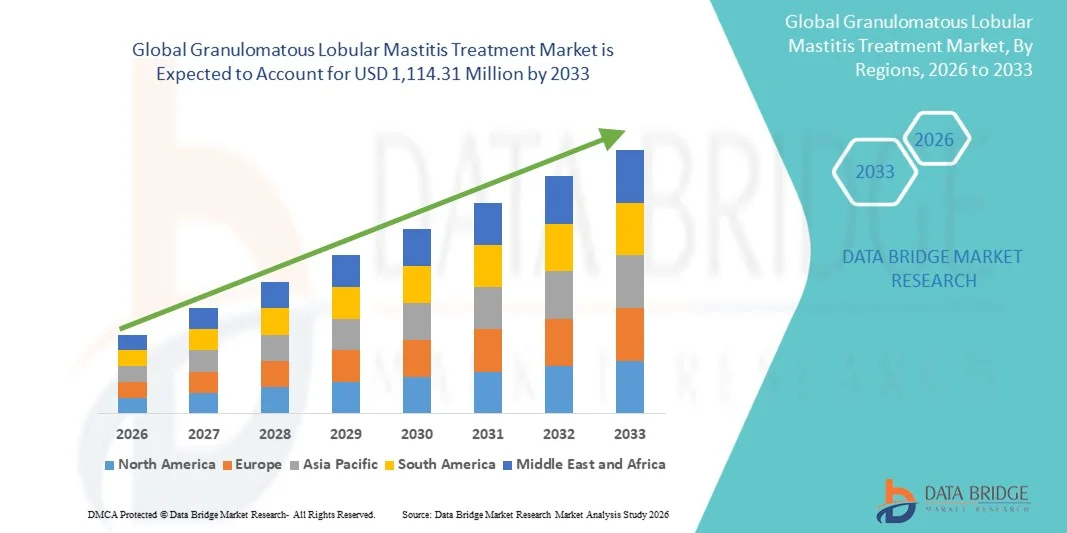
The Granulomatous Lobular Mastitis Treatment Market was valued at USD 650.00 million in 2025 and is projected to reach USD 1,114.31 million by 2033, growing at a CAGR of 6.97% from 2026 to 2033. The market is witnessing steady growth driven by increasing clinical recognition of granulomatous lobular mastitis as a distinct inflammatory breast disease, rising incidence rates in reproductive-age women, and growing preference for early diagnosis and targeted treatment approaches.
The expanding adoption of advanced imaging techniques and biopsy-based diagnostic confirmation is improving detection accuracy, leading to higher treatment uptake across hospitals and specialty clinics. In addition, growing awareness among healthcare professionals regarding the condition’s autoimmune and idiopathic nature is supporting the use of corticosteroids, immunosuppressive therapies, and minimally invasive surgical interventions. Increasing access to specialized breast care centers and improvements in healthcare infrastructure, particularly in emerging economies, are further contributing to the steady expansion of the granulomatous lobular mastitis treatment market globally.
Key Market Trends & Insights
- North America dominated the Granulomatous Lobular Mastitis Treatment Market with the largest revenue share of 36.12% in 2025, supported by strong healthcare infrastructure, higher diagnosis rates, and widespread availability of advanced breast care and pathology services.
- The Idiopathic Granulomatous Mastitis segment led the market with a 61.27% share in 2025, driven by its higher clinical prevalence and unclear etiology, which makes standardized treatment more complex and prolonged.
- Asia-Pacific is expected to be the fastest-growing region at a CAGR of 7.41% from 2026 to 2035, fueled by rising awareness of breast inflammatory diseases, improving access to diagnostic imaging, and expanding specialty hospital networks in China, India, and Southeast Asia.
- Granulomatous Mastitis are the fastest-growing type, projected to register a CAGR of 7.21%, reflecting the surge in improved diagnostic differentiation from infectious and malignancy-related breast conditions.
- The Ultrasound segment dominated the diagnosis category with a 48.36% revenue share in 2025, led by wide availability, cost-effectiveness, and ability to detect inflammatory breast lesions with high sensitivity.
- Corticosteroids accounted for 43.58% of the market, preferred by clinicians as the first-line therapy due to their strong anti-inflammatory effect, rapid symptom relief, and established clinical efficacy in reducing lesion size and recurrence in idiopathic granulomatous lobular mastitis cases.
- The Surgical Excision segment is the fastest-growing treatment category, with a CAGR of 7.09%, driven by increasing demand for definitive treatment in recurrent and treatment-resistant cases.
Market Size & Forecast
- Global Market Value (2025): USD 650.00 Million
- Expected Market Value (2033): USD 1,114.31 Million
- Forecast CAGR (2026–2033): 6.97%
- Leading Region in 2025: North America
- Fastest Growing Region: Asia Pacific
Report Scope and Granulomatous Lobular Mastitis Treatment Market Segmentation
|
Attributes |
Granulomatous Lobular Mastitis Treatment Key Market Insights |
|
Segments Covered |
|
|
Countries Covered |
North America · U.S. · Canada · Mexico Europe · Germany · France · U.K. · Netherlands · Switzerland · Belgium · Russia · Italy · Spain · Turkey · Rest of Europe Asia-Pacific · China · Japan · India · South Korea · Singapore · Malaysia · Australia · Thailand · Indonesia · Philippines · Rest of Asia-Pacific Middle East and Africa · Saudi Arabia · U.A.E. · South Africa · Egypt · Israel · Rest of Middle East and Africa South America · Brazil · Argentina · Rest of South America |
|
Key Market Players |
· Merck & Co., Inc. (U.S.) · Pfizer Inc. (U.S.) · Novartis AG (Switzerland) · Roche Holding AG (Switzerland) · Sanofi (France) · AbbVie Inc. (U.S.) · Johnson & Johnson Services, Inc. (U.S.) · Bristol Myers Squibb Company (U.S.) · AstraZeneca (U.K.) · GSK plc (U.K.) · Eli Lilly and Company (U.S.) · Bayer AG (Germany) · Teva Pharmaceutical Industries Ltd. (Israel) · Sun Pharmaceutical Industries Ltd. (India) · Dr. Reddy’s Laboratories Ltd. (India) · F. Hoffmann-La Roche Ltd (Switzerland) · GE HealthCare (U.S.) · Siemens Healthineers AG (Germany) · Philips Healthcare (Netherlands) · Hologic, Inc. (U.S.) |
|
Market Opportunities |
· Expansion of targeted immunomodulatory therapies · Growing adoption of AI-assisted breast imaging and pathology tools · Increasing establishment of specialized breast care and inflammatory disease clinics |
|
Value Added Data Infosets |
In addition to the insights on market scenarios such as market value, growth rate, segmentation, geographical coverage, and major players, the market reports curated by the Data Bridge Market Research also include in-depth expert analysis, patient epidemiology, pipeline analysis, pricing analysis, and regulatory framework. |
Granulomatous Lobular Mastitis Treatment Market Trends
Trend: Rising Shift Toward Steroid-Sparing and Personalized Therapy Approaches
Clinicians are increasingly shifting from prolonged high-dose corticosteroid monotherapy toward more individualized and combination-based treatment regimens that include immunosuppressants, antibiotics, and localized anti-inflammatory interventions to improve long-term disease control. This shift is largely driven by the recurrent nature of granulomatous lobular mastitis and the need to reduce steroid-associated complications such as weight gain, immunosuppression, and metabolic disturbances. Growing clinical recognition of the disease as an immune-mediated inflammatory disorder is further accelerating the adoption of precision-based treatment planning tailored to severity, lesion size, and recurrence history. For instance, tertiary breast care centers in Europe and Asia-Pacific are actively conducting comparative studies on methotrexate and azathioprine-based regimens to evaluate their effectiveness in reducing relapse rates compared to steroids alone, thereby supporting a more structured and long-term disease management approach.
Granulomatous Lobular Mastitis Treatment Market Dynamics
Key Market Driver: Increasing Diagnostic Accuracy Through Advanced Breast Imaging and Biopsy Techniques
The market is being strongly driven by improvements in diagnostic accuracy enabled by advanced imaging modalities such as high-resolution ultrasound, magnetic resonance imaging (MRI), and image-guided core needle biopsy, which allow earlier and more definitive identification of granulomatous lobular mastitis. These advancements are significantly reducing diagnostic uncertainty and enabling clinicians to distinguish the condition from breast cancer, tuberculous mastitis, and other inflammatory breast diseases with overlapping symptoms. Earlier and more accurate diagnosis directly translates into timely treatment initiation, reducing disease progression and complications such as abscess formation and fistula development. For instance, specialized breast diagnostic units in countries such as China and Germany have integrated standardized imaging-pathology correlation protocols, where radiological findings are immediately confirmed through biopsy, enabling same-week treatment planning and improving overall clinical outcomes and patient management efficiency.
Key Restraint/Challenge: Misdiagnosis and Limited Clinical Awareness in Early-Stage Disease
A major restraint in the market is the high rate of misdiagnosis due to the disease’s rare occurrence and its clinical similarity to more common conditions such as bacterial mastitis, breast abscesses, and malignancies, often leading to inappropriate or delayed treatment. Limited awareness among primary care physicians and general surgeons further contributes to inconsistent diagnostic pathways, especially in early-stage cases where symptoms are nonspecific and imaging findings may be inconclusive. This often results in repeated antibiotic prescriptions or unnecessary surgical interventions before histopathological confirmation is obtained, increasing patient morbidity and delaying effective immunosuppressive therapy.
For instance, retrospective clinical analyses in hospitals across South Asia and parts of the Middle East have documented cases where patients underwent multiple courses of antibiotics and even surgical drainage procedures before definitive biopsy results confirmed granulomatous lobular mastitis, highlighting the need for improved clinical education and standardized diagnostic guidelines.
Key Market Opportunity: Expansion of Targeted Immunomodulatory and Biologic Treatment Research
A significant market opportunity lies in the expansion of targeted immunomodulatory therapies and biologic agents aimed at addressing the underlying immune-driven mechanisms of granulomatous lobular mastitis, particularly in recurrent and treatment-resistant cases. As understanding of the disease pathophysiology improves, research is increasingly focusing on steroid-sparing biologics and disease-modifying agents that can offer sustained remission with fewer systemic side effects. This includes repurposing drugs used in autoimmune diseases, such as TNF-alpha inhibitors and other cytokine-targeting therapies, to evaluate their effectiveness in controlling chronic inflammation in breast tissue. For instance, ongoing academic clinical trials in specialized research hospitals are assessing biologic therapies originally developed for rheumatoid arthritis and inflammatory bowel disease in patients with refractory granulomatous lobular mastitis, opening new pathways for advanced, mechanism-based treatment strategies and long-term disease control.
Granulomatous Lobular Mastitis Treatment Market Scope
The granulomatous lobular mastitis treatment market is segmented on the basis of type, diagnosis, and treatment.
- By Type
On the basis of type, the Granulomatous Lobular Mastitis Treatment Market is segmented into idiopathic granulomatous mastitis and granulomatous mastitis. The Idiopathic Granulomatous Mastitis segment dominated the market with a share of 61.27% in 2025, owing to its higher clinical prevalence and unclear etiology, which makes standardized treatment more complex and prolonged. This subtype is frequently diagnosed in women of reproductive age and often presents with recurrent inflammatory breast lesions, increasing the need for repeated medical intervention. Clinicians primarily manage this condition using corticosteroids and immunosuppressive therapies due to its immune-mediated nature. The lack of definitive causative factors also drives higher diagnostic and therapeutic dependence on specialist care centers. Rising awareness and improved biopsy-based confirmation are further strengthening treatment adoption for this segment. In addition, recurrence risk remains high, supporting continuous follow-up and long-term therapy demand.
The Granulomatous Mastitis segment is expected to be the fastest growing, registering a CAGR of 7.21% from 2026 to 2035, driven by improved diagnostic differentiation from infectious and malignancy-related breast conditions. Increasing use of advanced imaging and histopathological testing is enabling more accurate classification of secondary cases. This segment is gaining traction as clinicians better identify underlying causes such as infections, autoimmune responses, or systemic inflammatory conditions. Growing adoption of targeted antibiotic and combined immunosuppressive therapies is supporting treatment expansion. For instance, hospitals in Asia-Pacific are increasingly reporting higher detection of secondary granulomatous mastitis through standardized biopsy protocols. Rising clinical awareness is further improving early-stage identification rates.
- By Diagnosis
On the basis of diagnosis, the market is segmented into ultrasound, mammography, and magnetic resonance imaging (MRI). The Ultrasound segment dominated the market with a share of 48.36% in 2025, due to its wide availability, cost-effectiveness, and ability to detect inflammatory breast lesions with high sensitivity. Ultrasound is often the first-line imaging modality used in suspected cases, allowing clinicians to identify abscess formation, tissue thickening, and fluid collections. It is also widely used for guiding core needle biopsies, which are critical for confirming diagnosis. The non-invasive nature and repeatability of ultrasound make it highly suitable for follow-up monitoring. Increasing deployment in outpatient breast clinics and diagnostic centers further strengthens its dominance. Its accessibility in both developed and emerging healthcare systems continues to support high utilization rates.
The Magnetic Resonance Imaging (MRI) segment is expected to be the fastest growing, registering a CAGR of 7.34% from 2026 to 2035, driven by its superior soft-tissue contrast and ability to differentiate inflammatory lesions from malignancies. MRI provides detailed visualization of lesion extent, helping in surgical planning and treatment response evaluation. Increasing use in complex and recurrent cases is significantly boosting demand. Growing adoption of advanced breast imaging protocols in tertiary care hospitals is further supporting segment expansion. For instance, specialized breast cancer and inflammatory disease centers in Europe are increasingly integrating MRI-based diagnostic pathways for complex granulomatous cases. Rising healthcare investment in precision diagnostics is also accelerating adoption.
- By Treatment
On the basis of treatment, the market is segmented into surgical excision, abscess drainage, use of corticosteroids, and antibiotics. The Use of Corticosteroids segment dominated the market with a share of 43.58% in 2025, as it remains the first-line therapy for most idiopathic and inflammatory cases due to its strong anti-inflammatory effects. Corticosteroids help reduce lesion size, pain, and recurrence risk when administered appropriately under clinical supervision. Their widespread availability and established clinical protocols make them the most commonly prescribed treatment option. Physicians often prefer steroids before escalating to surgical intervention in moderate to severe cases. Increasing clinical evidence supporting immunological involvement in the disease further reinforces steroid-based therapy dominance. Regular monitoring and dose adjustment protocols are also widely standardized in hospital settings.
The Surgical Excision segment is expected to be the fastest growing, registering a CAGR of 7.09% from 2026 to 2035, driven by increasing demand for definitive treatment in recurrent and treatment-resistant cases. Surgery is often required when medical therapy fails or when abscesses and fistulas persist. Advances in minimally invasive surgical techniques are improving cosmetic outcomes and reducing recovery time. Growing patient preference for long-term resolution over prolonged drug therapy is also supporting demand. For instance, specialized breast surgery units in Asia-Pacific and Europe are increasingly performing targeted excisions combined with adjunct steroid therapy to reduce recurrence. Rising healthcare access and improved surgical infrastructure are further accelerating adoption globally.
Granulomatous Lobular Mastitis Treatment Market Regional Analysis
North America dominated the Granulomatous Lobular Mastitis Treatment Market with the largest revenue share of 36.12% in 2025, supported by strong healthcare infrastructure, higher diagnosis rates, and widespread availability of advanced breast care and pathology services. The region also benefits from widespread availability of advanced imaging modalities, established clinical protocols for inflammatory breast diseases, and high adoption of corticosteroid and immunosuppressive therapies. Increasing awareness among clinicians, strong reimbursement frameworks, and growing use of biopsy-confirmed diagnosis continue to strengthen North America’s leadership position in the global market.
U.S. Granulomatous Lobular Mastitis Treatment Market Insight
The U.S. granulomatous lobular mastitis treatment market is experiencing robust growth due to advanced healthcare infrastructure, high specialization in breast disease management, and strong adoption of evidence-based treatment protocols. The country benefits from widespread use of ultrasound, MRI, and biopsy-driven diagnostic workflows that enable early and accurate disease identification. Increasing clinical awareness among radiologists and breast surgeons is improving timely initiation of corticosteroid and immunosuppressive therapies. In addition, strong pharmaceutical research activity and availability of advanced treatment options in tertiary care hospitals are further driving market expansion across the United States.
Europe Granulomatous Lobular Mastitis Treatment Market Insight
The Europe granulomatous lobular mastitis treatment market remains a significant contributor to global demand, driven by strong healthcare systems, high adoption of standardized diagnostic protocols, and increasing awareness of inflammatory breast disorders. The widespread use of ultrasound, MRI, and histopathology-based confirmation is supporting accurate disease identification and treatment planning. Growing clinical preference for steroid-sparing and immunosuppressive therapies is further enhancing treatment outcomes. In addition, increasing focus on multidisciplinary breast care units and research-driven treatment approaches continues to strengthen market expansion across the region.
U.K. Granulomatous Lobular Mastitis Treatment Market Insight
The U.K. granulomatous lobular mastitis treatment market is experiencing steady growth, supported by advanced National Health Service (NHS) diagnostic frameworks and increasing availability of specialized breast clinics. Rising awareness among clinicians regarding rare inflammatory breast conditions is improving early diagnosis rates and treatment initiation. The country also benefits from strong biopsy-based diagnostic adoption and structured treatment protocols involving corticosteroids and surgical management. Furthermore, growing research activity in academic hospitals and increasing focus on personalized treatment approaches are contributing to improved patient outcomes and market development.
Germany Granulomatous Lobular Mastitis Treatment Market Insight
The Germany granulomatous lobular mastitis treatment market is expanding steadily due to strong healthcare infrastructure, advanced imaging capabilities, and high emphasis on precision diagnostics. Hospitals and specialized breast centers are increasingly adopting MRI and ultrasound-guided biopsy techniques for accurate disease identification. The country’s strong clinical research ecosystem is also supporting advancements in immunosuppressive and steroid-sparing therapies. In addition, increasing awareness of inflammatory breast diseases among healthcare professionals and growing use of multidisciplinary treatment approaches are further driving market growth in Germany.
Asia-Pacific Granulomatous Lobular Mastitis Treatment Market Insight
The Asia-Pacific granulomatous lobular mastitis treatment market is expected to witness rapid growth, driven by rising incidence rates, improving healthcare access, and increasing awareness of breast inflammatory diseases. Expanding diagnostic infrastructure and growing adoption of ultrasound and biopsy-based confirmation are significantly enhancing early detection. The region also benefits from increasing availability of affordable corticosteroid and antibiotic therapies in hospital settings. In addition, rising investments in specialty breast care centers and growing clinical focus on women’s health are accelerating treatment adoption across emerging economies.
Japan Granulomatous Lobular Mastitis Treatment Market Insight
The Japan granulomatous lobular mastitis treatment market is witnessing consistent growth due to advanced healthcare infrastructure, high diagnostic precision, and strong adoption of imaging-based evaluation techniques. Hospitals and research institutions are increasingly using MRI and ultrasound for early and accurate disease identification. The country’s focus on evidence-based medicine is supporting structured use of corticosteroids and immunosuppressive therapies. Moreover, growing research into autoimmune-related breast conditions and increasing integration of minimally invasive treatment approaches are further contributing to improved clinical outcomes.
China Granulomatous Lobular Mastitis Treatment Market Insight
The China granulomatous lobular mastitis treatment market is growing rapidly, driven by rising awareness of inflammatory breast diseases, expanding healthcare infrastructure, and increasing access to advanced diagnostic technologies. Growing use of ultrasound-guided biopsy and improved pathological confirmation is enhancing early diagnosis rates. The country also benefits from increasing adoption of corticosteroid-based therapies and rising availability of specialized breast care services in urban hospitals. In addition, strong investments in women’s health initiatives and expanding clinical research activity are positioning China as a key high-growth market globally.
Granulomatous Lobular Mastitis Treatment Market Share
The granulomatous lobular mastitis treatment industry is primarily led by well-established companies, including:
- Merck & Co., Inc. (U.S.)
- Pfizer Inc. (U.S.)
- Novartis AG (Switzerland)
- Roche Holding AG (Switzerland)
- Sanofi (France)
- AbbVie Inc. (U.S.)
- Johnson & Johnson Services, Inc. (U.S.)
- Bristol Myers Squibb Company (U.S.)
- AstraZeneca (U.K.)
- GSK plc (U.K.)
- Eli Lilly and Company (U.S.)
- Bayer AG (Germany)
- Teva Pharmaceutical Industries Ltd. (Israel)
- Sun Pharmaceutical Industries Ltd. (India)
- Reddy’s Laboratories Ltd. (India)
- Hoffmann-La Roche Ltd (Switzerland)
- GE HealthCare (U.S.)
- Siemens Healthineers AG (Germany)
- Philips Healthcare (Netherlands)
- Hologic, Inc. (U.S.)
Latest Developments in Granulomatous Lobular Mastitis Treatment Market
- In May 2025, a systematic review on management strategies for granulomatous lobular mastitis was published in peer-reviewed literature, evaluating outcomes of corticosteroids, immunosuppressants, and surgical interventions. The study highlighted that combination therapy and steroid-sparing approaches significantly reduce recurrence rates compared to monotherapy in recurrent GLM cases. It also emphasized the growing shift toward individualized treatment planning based on disease severity and imaging-pathology correlation
- In August 2024, a comparative clinical study was published analyzing corticosteroid therapy versus surgical excision in patients with recurrent granulomatous lobular mastitis. The findings indicated that corticosteroid-based regimens showed higher short-term remission rates, while combined surgical approaches demonstrated better long-term recurrence control in severe cases. The study supported a stepwise treatment strategy to minimize invasive procedures
- In June 2023, a cohort study investigated the effectiveness of methotrexate as a steroid-sparing immunosuppressive therapy in idiopathic granulomatous lobular mastitis patients. Results showed improved remission maintenance and reduced corticosteroid dependency, particularly in patients with recurrent disease. The study supported methotrexate as a viable long-term management option in refractory cases
- In September 2022, a diagnostic accuracy study evaluated ultrasound-guided core needle biopsy in suspected granulomatous lobular mastitis cases. The research confirmed high diagnostic precision, enabling differentiation from breast cancer and infectious mastitis. It reinforced biopsy as a gold-standard diagnostic tool for early and accurate treatment initiation
- In March 2021, a multicenter case series from tertiary care hospitals documented clinical outcomes of granulomatous lobular mastitis treated with combined corticosteroid and antibiotic therapy. The study observed improved symptom control but noted significant recurrence in severe cases, highlighting the need for long-term follow-up and treatment optimization

- Interactive Data Analysis Dashboard
- Company Analysis Dashboard for high growth potential opportunities
- Research Analyst Access for customization & queries
- Competitor Analysis with Interactive dashboard
- Latest News, Updates & Trend analysis
- Harness the Power of Benchmark Analysis for Comprehensive Competitor Tracking
Data collection and base year analysis are done using data collection modules with large sample sizes. The stage includes obtaining market information or related data through various sources and strategies. It includes examining and planning all the data acquired from the past in advance. It likewise envelops the examination of information inconsistencies seen across different information sources. The market data is analysed and estimated using market statistical and coherent models. Also, market share analysis and key trend analysis are the major success factors in the market report. To know more, please request an analyst call or drop down your inquiry.
The key research methodology used by DBMR research team is data triangulation which involves data mining, analysis of the impact of data variables on the market and primary (industry expert) validation. Data models include Vendor Positioning Grid, Market Time Line Analysis, Market Overview and Guide, Company Positioning Grid, Patent Analysis, Pricing Analysis, Company Market Share Analysis, Standards of Measurement, Global versus Regional and Vendor Share Analysis. To know more about the research methodology, drop in an inquiry to speak to our industry experts.
Data Bridge Market Research is a leader in advanced formative research. We take pride in servicing our existing and new customers with data and analysis that match and suits their goal. The report can be customized to include price trend analysis of target brands understanding the market for additional countries (ask for the list of countries), clinical trial results data, literature review, refurbished market and product base analysis. Market analysis of target competitors can be analyzed from technology-based analysis to market portfolio strategies. We can add as many competitors that you require data about in the format and data style you are looking for. Our team of analysts can also provide you data in crude raw excel files pivot tables (Fact book) or can assist you in creating presentations from the data sets available in the report.












