


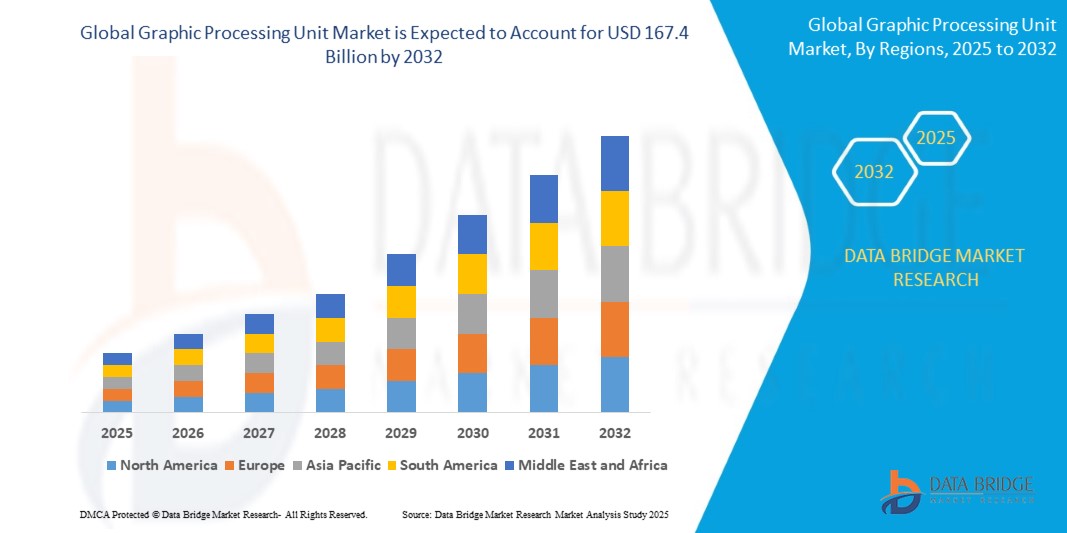
Graphic Processing Unit Market Size
- The Global Graphic Processing Unit (GPU) Market was valued at USD 65.3 billion in 2025 and is projected to reach USD 167.4 billion by 2032, growing at a robust CAGR of 14.4% during the forecast period.
- The explosive growth is driven by the widespread adoption of AI and machine learning, cloud gaming, autonomous vehicles, and data visualization, all of which require high-performance parallel computing capabilities.
Graphic Processing Unit Market Analysis
- GPUs have evolved from simple graphics rendering tools into critical computing engines powering AI training, data centers, video editing, autonomous driving, and edge computing.
- The surge in AI-based workloads, particularly in language modeling (LLMs), image recognition, and data analytics, is pushing demand for high-end GPUs across cloud hyperscalers, enterprises, and research institutions.
- In the gaming industry, GPUs are essential for real-time ray tracing, high frame-rate performance, and immersive experiences on PC, console, and mobile platforms.
- The market is also witnessing increasing GPU use in non-visual workloads like crypto mining, financial modeling, and medical diagnostics—significantly expanding the addressable market.
- Key innovations such as chiplet architecture, ray tracing acceleration, low-power AI cores, and HPC-optimized GPUs are reshaping GPU design and enhancing compute throughput.
Report Scope and Graphic Processing Unit Market Segmentation
|
Attributes |
Graphic Processing Unit Market Key Market Insights |
|
Segments Covered |
|
|
Countries Covered |
North America
Europe
Asia-Pacific
Middle East and Africa
South America
|
|
Key Market Players |
|
|
Market Opportunities |
|
|
Value Added Data Infosets |
In addition to the insights on market scenarios such as market value, growth rate, segmentation, geographical coverage, and major players, the market reports curated by the Data Bridge Market Research also include import export analysis, production capacity overview, production consumption analysis, price trend analysis, climate change scenario, supply chain analysis, value chain analysis, raw material/consumables overview, vendor selection criteria, PESTLE Analysis, Porter Analysis, and regulatory framework. |
Graphic Processing Unit Market Trends
“AI Integration, Energy Efficiency, and Industry-Specific GPU Customization”
- A major trend is the shift from general-purpose GPUs to AI-specific and workload-optimized architectures, with companies like NVIDIA and AMD developing tensor cores and AI-dedicated silicon to meet deep learning demands.
- The rise of energy-efficient GPU architectures, such as NVIDIA’s Grace Hopper and AMD’s RDNA series, reflects a growing focus on reducing power consumption while maintaining high-performance throughput, especially in data centers and mobile platforms.
- Custom GPU solutions are gaining popularity, with hyperscalers (Google, Amazon, Microsoft) developing proprietary chips or customizing GPUs for specific AI workloads, medical imaging, and scientific simulations.
- GPUs are being increasingly deployed in edge AI devices, such as smart cameras, drones, and mobile robotics, accelerating real-time inferencing and enabling ultra-low-latency decision-making.
- The convergence of CPU and GPU architectures, especially through chiplet and APU (Accelerated Processing Unit) designs, is enabling seamless integration and reducing latency for high-bandwidth AI workflows.implantation, reducing hospitalization costs and improving access in outpatient settings.
Graphic Processing Unit Market Dynamics
Driver
“Accelerated Adoption of AI, Cloud Gaming, and Visualization-Driven Applications”
- The global boom in AI training and inferencing workloads, especially for large language models (LLMs), generative AI, and computer vision, has fueled exponential growth in demand for high-performance GPUs.
- Cloud gaming platforms, like NVIDIA GeForce NOW and Microsoft Xbox Cloud Gaming, are transforming consumer behavior by offering low-latency, GPU-virtualized game streaming, increasing the deployment of GPU racks in data centers.
- The emergence of data-heavy industries—such as genomic analysis, medical imaging, autonomous systems, and financial modeling—relies on GPU acceleration for real-time, parallel processing at scale.
- The proliferation of 3D content, virtual production, and digital twins across entertainment, automotive, and industrial sectors further cements GPU's role as the foundational compute engine for visual computing.
Restraint/Challenge
“Supply Chain Constraints, High Costs, and Software Optimization Bottlenecks”
- The market faces supply chain volatility, particularly due to dependence on advanced semiconductor fabrication at foundries like TSMC, geopolitical risks, and raw material constraints (e.g., rare earth elements for GPUs).
- High initial costs of advanced GPUs can restrict adoption in SMEs and cost-sensitive applications, especially in developing economies or educational environments.
- Despite powerful hardware, software bottlenecks and lack of optimization in legacy systems limit the full utilization of GPU capabilities in enterprise applications.
- Environmental concerns related to energy-intensive GPU usage, especially in crypto mining and large-scale AI inference, are prompting demand for greener GPU solutions and stricter energy efficiency regulations.
Graphic Processing Unit Market Scope
The market is segmented on the Component, Monitoring Technique, Application and End User.
|
Segmentation |
Sub-Segmentation |
|
By Type |
|
|
By Deployment Mode |
|
|
By Device Type |
|
|
By Industry Vertical |
|
Graphic Processing Unit Market Scope
The market is segmented based on type, deployment mode, device type, and industry vertical, reflecting its multidisciplinary use across consumer, enterprise, and scientific applications.
• By Type
Segmented into Dedicated GPUs, Integrated GPUs, and Hybrid GPUs. Dedicated GPUs dominate in 2025, driven by their high-performance capabilities for gaming, AI processing, and 3D rendering. Integrated GPUs are widely adopted in laptops, tablets, and mobile devices due to cost-efficiency and power optimization.
• By Deployment Mode
Includes On-Premise and Cloud-Based. Cloud-based GPUs are growing rapidly as enterprises shift toward GPU-as-a-Service (GaaS) for deep learning and large-scale data processing. On-premise deployments remain strong in high-performance labs, media studios, and gaming PCs.
• By Device Type
Covers Computers, Tablets, Smartphones, Gaming Consoles, and Others. Computers and gaming consoles lead usage in 2025 due to mainstream gaming and creative workflows. The smartphone segment is expected to grow steadily as mobile GPUs improve for AR/VR and 3D gaming applications.
• By Industry Vertical
Includes Gaming, Media & Entertainment, Healthcare, Automotive, BFSI, IT & Telecom, and Others. Gaming holds the largest share, but AI-intensive sectors such as healthcare, autonomous driving, and telecom are witnessing the fastest growth. GPUs are increasingly vital in medical imaging, robotics, and driver-assistance systems.
Graphic Processing Unit Market Regional Analysis
- North America leads the global market in 2025, driven by high demand for AI training, cloud infrastructure, and gaming innovation. The U.S. remains a powerhouse due to strong investments by NVIDIA, AMD, and major hyperscalers in GPU-accelerated workloads.
- Europe is a growing market for GPUs in automotive simulation, healthcare AI, and energy sector visualization. Germany, France, and the U.K. are investing in sovereign compute infrastructure and sustainable AI acceleration.
- Asia-Pacific is the fastest-growing region, fueled by the massive gaming industry, mobile computing adoption, and AI ecosystem development in China, Japan, South Korea, and India. Taiwan plays a critical role in GPU fabrication and hardware R&D.
- Middle East and Africa (MEA) show increasing adoption of GPUs in smart city projects, oil & gas simulation, and military applications, with Gulf nations investing in AI datacenters and GPU-enabled digital twins.
- South America is witnessing steady growth in gaming, crypto mining, and educational computing, particularly in Brazil, where GPUs are used for both consumer and academic AI research purposes.
United States
The U.S. dominates the GPU market in 2025 due to strong leadership in AI development, cloud computing, and semiconductor innovation. Major tech players including NVIDIA, AMD, and Intel drive next-gen GPU development for AI, gaming, and enterprise computing.
China
China is rapidly investing in domestic GPU development, fueled by AI self-sufficiency goals and demand across surveillance, smart manufacturing, and edge computing. Companies like Biren and Huawei’s Ascend GPU lines are emerging as local alternatives.
Germany
Germany’s GPU market is driven by automotive digitalization, industrial AI, and scientific visualization. German OEMs integrate GPUs into ADAS platforms, simulation environments, and real-time production analytics systems.
Japan
Japan leverages GPUs in robotics, medical imaging, and semiconductor testing. The government is funding AI development programs to boost adoption of GPUs in smart healthcare and precision agriculture.
India
India is a fast-growing GPU market due to the expansion of cloud services, gaming culture, and AI startups. Government support for AI centers of excellence and educational infrastructure is driving GPU demand in academia and R&D.
Graphic Processing Unit Market Share
The Graphic Processing Unit industry is primarily led by well-established companies, including:
- NVIDIA Corporation (U.S.)
- Advanced Micro Devices, Inc. (AMD) (U.S.)
- Intel Corporation (U.S.)
- Qualcomm Technologies, Inc. (U.S.)
- ARM Ltd. (U.K.)
- Samsung Electronics Co., Ltd. (South Korea)
- Imagination Technologies (U.K.)
- Apple Inc. (U.S.)
- ASUSTeK Computer Inc. (Taiwan)
- ZOTAC International Limited (Hong Kong)
Latest Developments in Graphic Processing Unit Market
- In April 2025, NVIDIA launched its next-gen Blackwell architecture GPUs, offering 4x faster AI training performance and energy efficiency improvements. The platform is tailored for hyperscale AI training and large language model deployment.
- In March 2025, AMD introduced the Radeon RX 8000 series, leveraging its RDNA 4 architecture with real-time ray tracing and AI-enhanced rendering designed for immersive 4K gaming and content creation.
- In February 2025, Intel Corporation expanded its Arc GPU portfolio to include workstation-grade chips optimized for video editing, simulation, and cloud rendering workloads, focusing on energy-efficient silicon.
- In January 2025, Qualcomm released its Snapdragon X90 GPU, designed for high-performance mobile and XR devices, with enhanced AR rendering, low latency, and on-device AI inference for edge computing applications.
- In December 2024, Samsung Electronics announced a strategic collaboration with AMD to co-develop integrated mobile GPUs for flagship Exynos chipsets, enabling console-level performance on smartphones and tablets.

- Interactive Data Analysis Dashboard
- Company Analysis Dashboard for high growth potential opportunities
- Research Analyst Access for customization & queries
- Competitor Analysis with Interactive dashboard
- Latest News, Updates & Trend analysis
- Harness the Power of Benchmark Analysis for Comprehensive Competitor Tracking
Global Graphic Processing Unit Market, Supply Chain Analysis and Ecosystem Framework
To support market growth and help clients navigate the impact of geopolitical shifts, DBMR has integrated in-depth supply chain analysis into its Global Graphic Processing Unit Market research reports. This addition empowers clients to respond effectively to global changes affecting their industries. The supply chain analysis section includes detailed insights such as Global Graphic Processing Unit Market consumption and production by country, price trend analysis, the impact of tariffs and geopolitical developments, and import and export trends by country and HSN code. It also highlights major suppliers with data on production capacity and company profiles, as well as key importers and exporters. In addition to research, DBMR offers specialized supply chain consulting services backed by over a decade of experience, providing solutions like supplier discovery, supplier risk assessment, price trend analysis, impact evaluation of inflation and trade route changes, and comprehensive market trend analysis.
Data collection and base year analysis are done using data collection modules with large sample sizes. The stage includes obtaining market information or related data through various sources and strategies. It includes examining and planning all the data acquired from the past in advance. It likewise envelops the examination of information inconsistencies seen across different information sources. The market data is analysed and estimated using market statistical and coherent models. Also, market share analysis and key trend analysis are the major success factors in the market report. To know more, please request an analyst call or drop down your inquiry.
The key research methodology used by DBMR research team is data triangulation which involves data mining, analysis of the impact of data variables on the market and primary (industry expert) validation. Data models include Vendor Positioning Grid, Market Time Line Analysis, Market Overview and Guide, Company Positioning Grid, Patent Analysis, Pricing Analysis, Company Market Share Analysis, Standards of Measurement, Global versus Regional and Vendor Share Analysis. To know more about the research methodology, drop in an inquiry to speak to our industry experts.
Data Bridge Market Research is a leader in advanced formative research. We take pride in servicing our existing and new customers with data and analysis that match and suits their goal. The report can be customized to include price trend analysis of target brands understanding the market for additional countries (ask for the list of countries), clinical trial results data, literature review, refurbished market and product base analysis. Market analysis of target competitors can be analyzed from technology-based analysis to market portfolio strategies. We can add as many competitors that you require data about in the format and data style you are looking for. Our team of analysts can also provide you data in crude raw excel files pivot tables (Fact book) or can assist you in creating presentations from the data sets available in the report.













