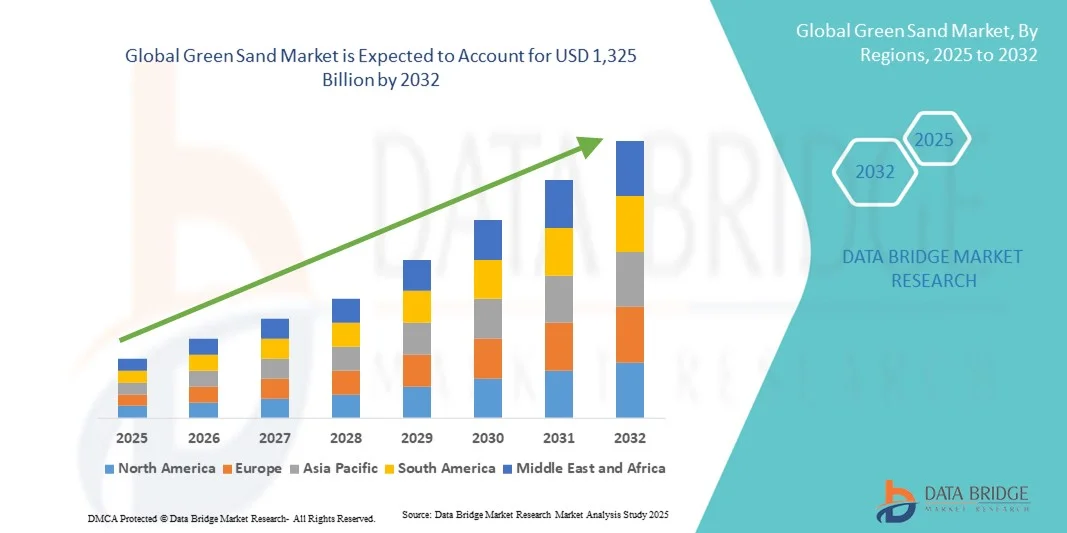
Green Sand Market Size
- The global green sand market size was valued at USD 946.41 million in 2024 and is expected to reach USD 1,325 million by 2032, at a CAGR of 4.30% during the forecast period
- The increasing demand for high-quality castings in automotive, industrial machinery, and construction sectors is driving the growth of the green sand market. Green sand is preferred due to its excellent molding properties, cost-effectiveness, and reusability in foundry applications
- Growing industrialization and urban infrastructure development in emerging economies are boosting the adoption of green sand in metal casting processes. Its ability to produce complex shapes with minimal defects makes it highly suitable for mass production
Green Sand Market Analysis
- The market growth is largely fuelled by the rising demand for high-quality metal castings in automotive, industrial machinery, and construction sectors, where green sand is preferred for its cost-effectiveness, reusability, and superior molding properties
- Increasing industrialization and infrastructure development in emerging economies are boosting the adoption of green sand in foundry applications
- Europe dominated the green sand market with the largest revenue share of 37.8% in 2024, driven by stringent environmental regulations, advanced foundry technologies, and the rising need for high-quality, defect-free castings across automotive, aerospace, and machinery sectors
- Asia-Pacific region is expected to witness the highest growth rate in the global green sand market, driven by increasing automotive and heavy machinery production, growing awareness of eco-friendly practices, and rising investments in advanced casting technologies
- The Silica segment held the largest market revenue share in 2024, driven by its superior moldability, high thermal stability, and widespread availability. Silica-based green sand is extensively used in foundries for producing high-quality castings with minimal defects, making it a preferred choice among manufacturers
Report Scope and Green Sand Market Segmentation
|
Attributes |
Green Sand Key Market Insights |
|
Segments Covered |
|
|
Countries Covered |
North America
Europe
Asia-Pacific
Middle East and Africa
South America
|
|
Key Market Players |
|
|
Market Opportunities |
|
|
Value Added Data Infosets |
In addition to the insights on market scenarios such as market value, growth rate, segmentation, geographical coverage, and major players, the market reports curated by the Data Bridge Market Research also include import export analysis, production capacity overview, production consumption analysis, price trend analysis, climate change scenario, supply chain analysis, value chain analysis, raw material/consumables overview, vendor selection criteria, PESTLE Analysis, Porter Analysis, and regulatory framework. |
Green Sand Market Trends
Increasing Adoption of Eco-Friendly and Efficient Foundry Materials
- The rising shift toward green sand in foundries is transforming the metal casting sector by enabling efficient mold production with reduced environmental impact. Green sand’s reusability and minimal chemical additives support sustainable manufacturing practices while maintaining casting quality
- The growing demand for precise and defect-free metal castings is accelerating the adoption of advanced green sand compositions and additives. These innovations improve mold stability, surface finish, and overall casting accuracy, supporting productivity and operational efficiency
- The cost-effectiveness and versatility of modern green sand systems are making them attractive for small and large foundries alike, reducing reliance on expensive synthetic molding materials. This contributes to better resource management and lower production costs
- For instance, in 2023, several European automotive foundries reported improved casting quality and reduced waste after implementing high-performance green sand systems. The adoption of these materials enhanced operational efficiency and strengthened compliance with environmental regulations
- While green sand adoption is accelerating in the foundry industry, continued innovation, operator training, and standardization of sand composition are essential for sustained market growth. Manufacturers must focus on optimized formulations and eco-friendly additives to fully capitalize on this demand
Green Sand Market Dynamics
Driver
Rising Demand for Sustainable and Cost-Effective Foundry Solutions
- The global push toward sustainability is encouraging foundries to adopt green sand as a primary molding material. Its recyclability and low environmental footprint make it preferable to chemically bonded sand or synthetic alternatives. This shift also supports corporate ESG initiatives, helping companies meet sustainability targets and improve brand reputation. Foundries are increasingly highlighting green sand usage as a key differentiator in global markets
- Industrial sectors, including automotive, aerospace, and machinery, are increasingly seeking high-quality castings with minimal defects, boosting the need for advanced green sand compositions. This trend drives investment in research and development of new additives and binders. In addition, reduced defect rates lower operational costs, enhance production efficiency, and improve supply chain reliability for manufacturers. High-quality castings are also critical for meeting stringent industry safety and performance standards
- Government regulations promoting eco-friendly manufacturing processes further support green sand adoption. Incentives for sustainable practices and stricter emission norms are compelling foundries to shift toward reusable, low-impact molding materials. Compliance with such regulations not only avoids penalties but also enables access to green certifications, which can increase market acceptance and customer trust. Environmental compliance can also improve partnerships with multinational clients prioritizing sustainability
- For instance, in 2022, several North American foundries upgraded their molding operations to high-performance green sand systems, achieving lower waste generation and enhanced compliance with environmental regulations. These upgrades also improved operational efficiency by reducing sand replacement cycles and energy consumption during molding. The adoption of automated sand handling systems alongside green sand further streamlined production workflows
- While demand for green sand is growing, consistent quality control, proper handling, and optimized sand reclamation systems are critical for maintaining casting efficiency and ensuring widespread adoption. Investments in monitoring equipment and training programs are increasingly important to prevent defects and maintain uniformity. Proper reclamation also reduces material costs and waste generation, reinforcing the economic benefits of green sand
Restraint/Challenge
High Initial Setup Costs and Limited Availability of Advanced Additives
- The implementation of modern green sand systems, including high-quality binders and reclamation units, requires significant capital investment. Small and mid-sized foundries may face budget constraints that limit adoption. Furthermore, high upfront costs can delay return on investment, making it challenging for emerging foundries to compete with established players. Long-term financial planning and phased implementation strategies are often necessary to overcome these hurdles
- In certain regions, the availability of advanced additives, such as bentonite clay or chemical binders, is limited, restricting the ability of foundries to produce consistent and defect-free castings. Supply chain disruptions, import dependencies, and regional price fluctuations further complicate procurement. This scarcity often forces foundries to rely on lower-quality alternatives, which can impact casting quality and reduce overall production efficiency
- Skilled labor is required to manage green sand systems effectively, including monitoring moisture content, compaction, and reclamation processes. Lack of training can result in casting defects or operational inefficiencies. In addition, continuous workforce development programs are necessary to keep pace with evolving green sand technologies and automation systems. Retention of experienced operators becomes crucial for long-term operational stability
- For instance, in 2023, several foundries in Southeast Asia reported operational challenges due to inconsistent sand quality and limited access to high-grade binders, impacting production efficiency and yield. These challenges often led to increased scrap rates, higher production costs, and delayed delivery schedules. Companies also had to invest in additional quality checks and corrective measures to maintain industry standards
- While green sand remains a preferred environmentally friendly option, addressing cost barriers, material availability, and workforce training is essential for long-term market growth. Foundries are exploring collaborative ventures with suppliers and investing in in-house additive production to mitigate risks. Strategic planning and technological innovation are key to ensuring consistent product quality and competitive advantage
Green Sand Market Scope
The market is segmented on the basis of component and application.
- By Component
On the basis of component, the green sand market is segmented into Marine Potash, Silica, Iron Oxide, Magnesia, Lime, Phosphoric Acid, and Others. The Silica segment held the largest market revenue share in 2024, driven by its superior moldability, high thermal stability, and widespread availability. Silica-based green sand is extensively used in foundries for producing high-quality castings with minimal defects, making it a preferred choice among manufacturers.
The Iron Oxide segment is expected to witness the fastest growth rate from 2025 to 2032, fueled by its ability to enhance sand strength, reduce shrinkage defects, and improve casting surface finish. Iron Oxide-enriched green sand formulations are increasingly adopted in automotive, aerospace, and heavy machinery industries, where precision and durability of castings are critical.
- By Component
On the basis of component, the green sand market is segmented into Marine Potash, Silica, Iron Oxide, Magnesia, Lime, Phosphoric Acid, and Others. The Silica segment dominated the market in 2024, driven by its superior moldability, high thermal stability, and widespread availability. Silica-based green sand is extensively used in foundries for producing high-quality castings with minimal defects, making it a preferred choice among manufacturers.
The Iron Oxide segment is expected to be the fastest-growing from 2025 to 2032, fueled by its ability to enhance sand strength, reduce shrinkage defects, and improve casting surface finish. Iron Oxide-enriched green sand formulations are increasingly adopted in automotive, aerospace, and heavy machinery industries, where precision and durability of castings are critical.
Green Sand Market Regional Analysis
- Europe dominated the green sand market with the largest revenue share of 37.8% in 2024, driven by stringent environmental regulations, advanced foundry technologies, and the rising need for high-quality, defect-free castings across automotive, aerospace, and machinery sectors
- Foundries in the region highly value green sand for its recyclability, low environmental impact, and ability to produce precision castings, making it a preferred choice over chemically bonded or synthetic alternatives
- This widespread adoption is further supported by government initiatives promoting sustainable manufacturing practices, skilled labor availability, and growing awareness of eco-friendly molding solutions, establishing green sand as a standard in European foundries
Germany Green Sand Market Insight
The Germany green sand market captured the largest revenue share in Europe in 2024, fueled by the country’s established automotive and industrial manufacturing base. German foundries are increasingly implementing modern green sand systems to improve casting quality, minimize defects, and meet strict emission standards. In addition, investments in innovative additives, reclamation units, and eco-friendly production processes are strengthening the market’s expansion.
U.K. Green Sand Market Insight
The U.K. green sand market is expected to be the fastest-growing from 2025 to 2032, driven by rising demand for sustainable foundry practices and high-performance castings in automotive and engineering industries. The country’s focus on eco-conscious manufacturing, coupled with increasing industrial modernization and regulatory compliance requirements, supports widespread adoption of green sand systems. U.K. foundries are also leveraging advanced sand compositions to optimize production efficiency and reduce operational waste.
North America Green Sand Market Insight
North America is expected to be the fastest-growing from 2025 to 2032, driven by the widespread adoption of sustainable foundry practices, strict environmental regulations, and demand for high-quality castings in automotive, aerospace, and heavy machinery industries. Foundries in the U.S. and Canada highly value green sand for its recyclability, consistent performance, and ability to minimize defects in complex castings. The region’s growth is further supported by advanced industrial infrastructure, skilled workforce, and ongoing investments in R&D to develop superior binders and sand reclamation systems
U.S. Green Sand Market Insight
The U.S. green sand market is expected to be the fastest-growing from 2025 to 2032, fueled by the country’s well-established foundry and manufacturing base. Foundries are increasingly adopting modern green sand compositions, reclamation technologies, and environmentally friendly binders to enhance casting quality and comply with regulatory standards. Demand from automotive and aerospace sectors is a key growth driver.
Asia-Pacific Green Sand Market Insight
The Asia-Pacific green sand market is expected to be the fastest-growing from 2025 to 2032, driven by rapid industrialization, increasing automotive and machinery manufacturing, and growing awareness of eco-friendly molding solutions in countries such as China, India, and Japan. The region’s affordability and emerging foundry base support adoption of green sand as a cost-effective, environmentally sustainable molding material. Government initiatives promoting green manufacturing and investments in modern foundry equipment further stimulate market growth.
China Green Sand Market Insight
The China green sand market accounted for the largest revenue share in APAC in 2024, attributed to rapid industrial growth, expanding automotive and machinery sectors, and increased adoption of advanced sand reclamation and binder technologies. The focus on sustainable manufacturing and high-quality castings is boosting green sand usage.
Japan Green Sand Market Insight
The Japan green sand market is expected to be the fastest-growing from 2025 to 2032, fueled by technological advancements in foundry operations, stringent environmental regulations, and demand for precision castings in automotive and industrial sectors. Japanese foundries are focusing on sustainable and high-performance green sand systems.
Green Sand Market Share
The Green Sand industry is primarily led by well-established companies, including:
- GreenSand (U.K.)
- Saichem (U.S.)
- Greenstar Fertilizers Limited (India)
- Tata Chemicals Ltd. (India)
- The Scotts Company LLC (U.S.)
- Coromandel International Limited (India)
- NATIONAL FERTILIZERS LIMITED (India)
- ILSA S.p.A. (Italy)
- Perfect Blend, LLC (U.S.)
- Suståne Natural Fertilizer, Inc. (U.S.)
- Biostar Renewables, LLC. (U.S.)
- AgroCare Canada, Inc. (Canada)
- Nature Safe (Canada)
- Fertikal N.V. (Belgium)
- MultiplexGroup (India)
- KRIBHCO (India)
- Midwestern BioAg (U.S.)
- Italpollina S.p.A. (Italy)

- Interactive Data Analysis Dashboard
- Company Analysis Dashboard for high growth potential opportunities
- Research Analyst Access for customization & queries
- Competitor Analysis with Interactive dashboard
- Latest News, Updates & Trend analysis
- Harness the Power of Benchmark Analysis for Comprehensive Competitor Tracking
Data collection and base year analysis are done using data collection modules with large sample sizes. The stage includes obtaining market information or related data through various sources and strategies. It includes examining and planning all the data acquired from the past in advance. It likewise envelops the examination of information inconsistencies seen across different information sources. The market data is analysed and estimated using market statistical and coherent models. Also, market share analysis and key trend analysis are the major success factors in the market report. To know more, please request an analyst call or drop down your inquiry.
The key research methodology used by DBMR research team is data triangulation which involves data mining, analysis of the impact of data variables on the market and primary (industry expert) validation. Data models include Vendor Positioning Grid, Market Time Line Analysis, Market Overview and Guide, Company Positioning Grid, Patent Analysis, Pricing Analysis, Company Market Share Analysis, Standards of Measurement, Global versus Regional and Vendor Share Analysis. To know more about the research methodology, drop in an inquiry to speak to our industry experts.
Data Bridge Market Research is a leader in advanced formative research. We take pride in servicing our existing and new customers with data and analysis that match and suits their goal. The report can be customized to include price trend analysis of target brands understanding the market for additional countries (ask for the list of countries), clinical trial results data, literature review, refurbished market and product base analysis. Market analysis of target competitors can be analyzed from technology-based analysis to market portfolio strategies. We can add as many competitors that you require data about in the format and data style you are looking for. Our team of analysts can also provide you data in crude raw excel files pivot tables (Fact book) or can assist you in creating presentations from the data sets available in the report.