


What is the Global Green Seaweed Market Size and Growth Rate?
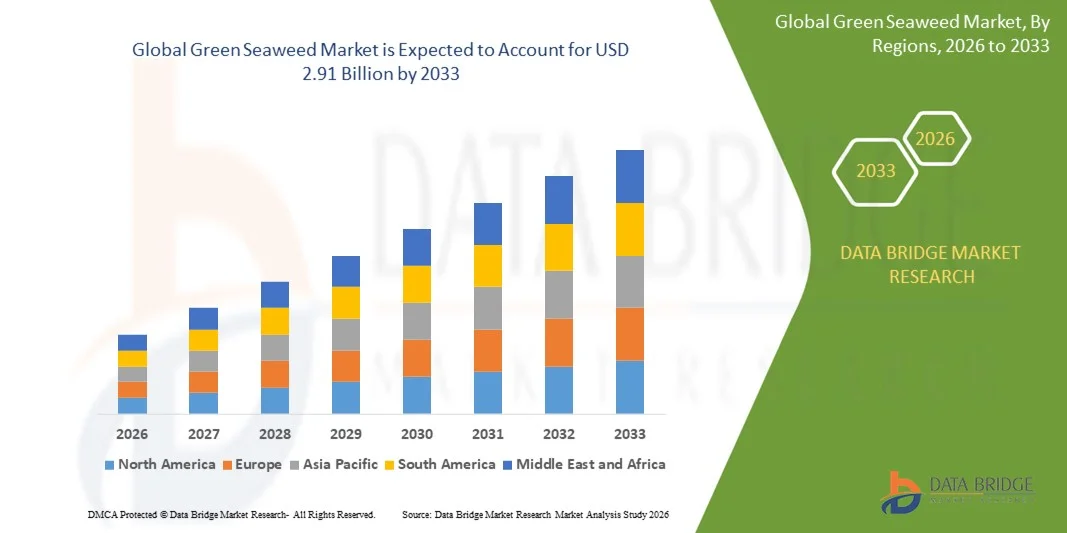
- As per Data Bridge Market Research Analysis the global green seaweed market size was valued at USD 1.71 billion in 2025 and is expected to reach USD 2.91 billion by 2033, at a CAGR of 6.90% during the forecast period
- The major growing factor towards green seaweed market is the rise in the application scope of seaweed in pharmaceutical and personal care
- Furthermore, the rise in the awareness regarding the health benefits of the product associated with high demand for foods and snacks derived from commercial seaweed are also expected to heighten the overall demand for green seaweed market
Market Size & Forecast
- Global Market Value (2025): USD 1.71 billion in 2025
- Expected Market Value (2033): USD 2.91 billion by 2033
- Forecast CAGR (2026–2033): 6.90%
What are the Major Takeaways of Green Seaweed Market?
- The high demand for seaweeds in food applications and high demand for eco-friendly fertilizers are also expected to serve as foremost drivers for the green seaweed market at a global level. In addition, the high demand in food processing industry and high demand in infant food products are also lifting the growth of the green seaweed market
- However, the high fluctuations in seaweed prices and high cost of the seaweed cultivated are projected to act as a restraint towards the growth of green seaweed market, whereas the toxicity coupled with the consumption of seaweeds can challenge the growth of the green seaweed market
- Asia-Pacific dominated the green seaweed market with an estimated 48.2% revenue share in 2025, driven by abundant coastal resources, long-standing seaweed consumption traditions, and large-scale production across countries such as China, Japan, South Korea, Indonesia, and India
- North America is projected to register the fastest CAGR of 9.32% from 2026 to 2033, driven by rising demand for sustainable, plant-based, and organic ingredients across food, cosmetics, agriculture, and dietary supplements
- The Powder segment dominated the market with an estimated 44.6% share in 2025, driven by its longer shelf life, ease of storage, and high versatility across food, nutraceutical, agricultural, and cosmetic applications
Report Scope and Green Seaweed Market Segmentation
|
Attributes |
Green Seaweed Key Market Insights |
|
Segments Covered |
|
|
Countries Covered |
North America
Europe
Asia-Pacific
Middle East and Africa
South America
|
|
Key Market Players |
|
|
Market Opportunities |
|
|
Value Added Data Infosets |
In addition to the insights on market scenarios such as market value, growth rate, segmentation, geographical coverage, and major players, the market reports curated by the Data Bridge Market Research also include in-depth expert analysis, pricing analysis, brand share analysis, consumer survey, demography analysis, supply chain analysis, value chain analysis, raw material/consumables overview, vendor selection criteria, PESTLE Analysis, Porter Analysis, and regulatory framework. |
What is the Key Trend in the Green Seaweed Market?
Increasing Shift Toward Sustainable, Nutrient-Rich, and Multi-Application Green Seaweed Products
- The green seaweed market is witnessing growing adoption driven by rising demand for nutrient-rich, plant-based, and sustainable marine ingredients across food, agriculture, cosmetics, and pharmaceuticals
- Producers are focusing on processed and value-added green seaweed forms, including powders, flakes, extracts, and concentrates, to improve shelf life, usability, and application versatility
- Growing emphasis on functional nutrition, clean-label foods, and vegan diets is accelerating the incorporation of green seaweeds such as Ulva in health foods and supplements
- For instance, companies such as Cargill, CP Kelco, Ocean Rainforest, and The Seaweed Company are expanding green seaweed sourcing and processing capabilities to support food-grade and industrial applications
- Increasing interest in bio-stimulants, organic fertilizers, and soil enhancers derived from green seaweed is boosting adoption in sustainable agriculture
- As sustainability and marine-based solutions gain importance, green seaweed is emerging as a strategic raw material for food security, environmental protection, and bio-based industries
What are the Key Drivers of Green Seaweed Market?
- Rising demand for natural hydrocolloids, plant-based proteins, and functional ingredients in food and beverage formulations
- For instance, in 2024–2025, several global ingredient manufacturers expanded investments in seaweed farming, extraction technologies, and eco-certified marine sourcing
- Growing use of green seaweed extracts in agriculture as bio-fertilizers and plant growth stimulants, supporting soil health and crop yield improvement
- Increasing consumer awareness regarding health benefits of green seaweeds, including antioxidants, minerals, and dietary fiber
- Expanding applications in cosmetics and personal care, particularly for skin hydration, anti-aging, and natural thickening agents
- Supported by sustainability initiatives, circular economy models, and marine resource innovation, the green seaweed market is expected to witness steady long-term growth
Which Factor is Challenging the Growth of the Green Seaweed Market?
- Seasonal availability and dependence on marine environmental conditions limit consistent supply and large-scale harvesting
- For instance, during 2024–2025, climate variability, coastal pollution, and regulatory restrictions impacted seaweed farming yields in several regions
- High processing and drying costs for food- and pharma-grade green seaweed increase overall production expenses
- Limited standardization in quality, species classification, and nutrient composition creates challenges for global trade
- Competition from synthetic alternatives and land-based plant ingredients exerts pricing pressure in certain applications
- To address these challenges, companies are investing in offshore farming, controlled cultivation systems, advanced processing technologies, and supply chain traceability to strengthen global adoption of green seaweed
How is the Green Seaweed Market Segmented?
The market is segmented on the basis of channel count, application, and vertical.
- By Form
On the basis of form, the green seaweed market is segmented into Liquid, Powder, and Flakes. The Powder segment dominated the market with an estimated 44.6% share in 2025, driven by its longer shelf life, ease of storage, and high versatility across food, nutraceutical, agricultural, and cosmetic applications. Powdered green seaweed is widely used as a functional ingredient due to its concentrated nutrient profile, uniform blending capability, and suitability for large-scale processing. Manufacturers prefer powder form for standardized dosing and efficient transportation, supporting strong demand from industrial buyers.
The Liquid segment is expected to grow at the fastest CAGR from 2026 to 2033, supported by rising adoption of liquid seaweed extracts in agriculture, bio-stimulants, and cosmetics. Fast absorption, ease of application, and effectiveness in foliar sprays and soil treatments are accelerating demand for liquid green seaweed products.
- By Method of Harvesting
On the basis of harvesting method, the market is segmented into Aquaculture and Wild Harvesting. The Wild Harvesting segment held the largest share of 52.3% in 2025, supported by the natural abundance of green seaweed in coastal regions and long-established harvesting practices in Asia-Pacific and parts of Europe. Wild-harvested seaweed is widely utilized for food and traditional applications due to minimal cultivation costs and naturally rich mineral content.
The Aquaculture segment is projected to witness the fastest growth during 2026–2033, driven by increasing emphasis on sustainable sourcing, traceability, and consistent quality. Controlled farming techniques enable year-round supply, reduced ecological impact, and standardized output, making aquaculture increasingly attractive to food-grade, pharmaceutical, and cosmetic manufacturers.
- By End User
On the basis of end user, the green seaweed market is segmented into Food and Beverages, Pharmaceuticals, Agriculture, Dietary Supplements, Animal Feed, Cosmetics and Personal Care, Biofuels, and Others. The Food and Beverages segment dominated the market with a 37.8% share in 2025, driven by growing consumption of seaweed-based foods, functional ingredients, and plant-based diets. Green seaweed is extensively used for its nutritional benefits, flavor enhancement, and natural thickening properties.
The Agriculture segment is expected to grow at the fastest CAGR from 2026 to 2033, supported by rising adoption of green seaweed extracts as bio-fertilizers and plant growth stimulants. Increasing focus on sustainable farming, soil health improvement, and reduced chemical input usage is accelerating demand across global agricultural markets.
Which Region Holds the Largest Share of the Green Seaweed Market?
- Asia-Pacific dominated the green seaweed market with an estimated 48.2% revenue share in 2025, driven by abundant coastal resources, long-standing seaweed consumption traditions, and large-scale production across countries such as China, Japan, South Korea, Indonesia, and India. Green seaweed is widely used in food, agriculture, and traditional health applications across the region
- Strong presence of seaweed farming hubs, cost-effective labor, and expanding aquaculture infrastructure supports high-volume harvesting and processing
- Rising demand for plant-based foods, bio-stimulants, and sustainable marine ingredients further reinforces Asia-Pacific’s leadership in the global green seaweed market
China Green Seaweed Market Insight
China is the largest contributor within Asia-Pacific, supported by extensive coastline availability, large-scale aquaculture operations, and strong government support for marine biotechnology. Green seaweed is widely used in food processing, animal feed, and agricultural bio-fertilizers. Continuous investments in sustainable seaweed farming and processing technologies further strengthen domestic and export market growth.
Japan Green Seaweed Market Insight
Japan shows steady growth due to high per-capita consumption of seaweed-based foods and strong demand for premium, food-grade green seaweed. Advanced processing standards, quality control, and growing applications in nutraceuticals and cosmetics support consistent market expansion.
India Green Seaweed Market Insight
India is emerging as a key growth hub, driven by increasing awareness of seaweed-based fertilizers, expanding coastal aquaculture initiatives, and government-backed marine farming programs. Rising use of green seaweed in agriculture and dietary supplements is accelerating market penetration.
North America Green Seaweed Market
North America is projected to register the fastest CAGR of 9.32% from 2026 to 2033, driven by rising demand for sustainable, plant-based, and organic ingredients across food, cosmetics, agriculture, and dietary supplements. Increasing focus on regenerative agriculture, bio-stimulants, and clean-label food products is boosting adoption of green seaweed-derived inputs. Growing investments in seaweed farming, marine startups, and sustainable ocean-based solutions further accelerate regional market growth.
U.S. Green Seaweed Market Insight
The U.S. leads North America due to expanding use of green seaweed in functional foods, dietary supplements, and organic farming. Strong innovation ecosystems, rising consumer awareness of marine nutrition, and growing adoption of seaweed-based bio-products support rapid market expansion.
Canada Green Seaweed Market Insight
Canada contributes significantly through expanding cold-water seaweed farming, supportive regulatory frameworks, and increasing demand for eco-friendly agricultural inputs. Growth in marine biotechnology and sustainable food production strengthens long-term market adoption.
Which are the Top Companies in Green Seaweed Market?
The green seaweed industry is primarily led by well-established companies, including:
- Cargill, Incorporated (U.S.)
- DuPont (U.S.)
- AtSeNova (China)
- Beijing Leili Agricultural Co., Ltd. (China)
- Pacific Harvest (New Zealand)
- Irish Seaweed (Ireland)
- Ocean Rainforest (Faroe Islands)
- Indigrow Ltd. (U.K.)
- Marcel Carrageenan (Philippines)
- Seaweed Solutions AS (Norway)
- Maine Coast Sea Vegetables (U.S.)
- Kelp Industries Pty. Ltd. (Australia)
- Green Ocean Farming UK (U.K.)
- Annie Chun's, Inc. (U.S.)
- The Seaweed Company (Netherlands)
- Organic Irish Seaweed – Emerald Isle (Ireland)
- Cascadia Seaweed (Canada)
- Green Rise Agro Industries (India)
- CP Kelco U.S., Inc. (U.S.)
- KwangcheonKim (South Korea)

- Interactive Data Analysis Dashboard
- Company Analysis Dashboard for high growth potential opportunities
- Research Analyst Access for customization & queries
- Competitor Analysis with Interactive dashboard
- Latest News, Updates & Trend analysis
- Harness the Power of Benchmark Analysis for Comprehensive Competitor Tracking
Global Green Seaweed Market, Supply Chain Analysis and Ecosystem Framework
To support market growth and help clients navigate the impact of geopolitical shifts, DBMR has integrated in-depth supply chain analysis into its Global Green Seaweed Market research reports. This addition empowers clients to respond effectively to global changes affecting their industries. The supply chain analysis section includes detailed insights such as Global Green Seaweed Market consumption and production by country, price trend analysis, the impact of tariffs and geopolitical developments, and import and export trends by country and HSN code. It also highlights major suppliers with data on production capacity and company profiles, as well as key importers and exporters. In addition to research, DBMR offers specialized supply chain consulting services backed by over a decade of experience, providing solutions like supplier discovery, supplier risk assessment, price trend analysis, impact evaluation of inflation and trade route changes, and comprehensive market trend analysis.
Data collection and base year analysis are done using data collection modules with large sample sizes. The stage includes obtaining market information or related data through various sources and strategies. It includes examining and planning all the data acquired from the past in advance. It likewise envelops the examination of information inconsistencies seen across different information sources. The market data is analysed and estimated using market statistical and coherent models. Also, market share analysis and key trend analysis are the major success factors in the market report. To know more, please request an analyst call or drop down your inquiry.
The key research methodology used by DBMR research team is data triangulation which involves data mining, analysis of the impact of data variables on the market and primary (industry expert) validation. Data models include Vendor Positioning Grid, Market Time Line Analysis, Market Overview and Guide, Company Positioning Grid, Patent Analysis, Pricing Analysis, Company Market Share Analysis, Standards of Measurement, Global versus Regional and Vendor Share Analysis. To know more about the research methodology, drop in an inquiry to speak to our industry experts.
Data Bridge Market Research is a leader in advanced formative research. We take pride in servicing our existing and new customers with data and analysis that match and suits their goal. The report can be customized to include price trend analysis of target brands understanding the market for additional countries (ask for the list of countries), clinical trial results data, literature review, refurbished market and product base analysis. Market analysis of target competitors can be analyzed from technology-based analysis to market portfolio strategies. We can add as many competitors that you require data about in the format and data style you are looking for. Our team of analysts can also provide you data in crude raw excel files pivot tables (Fact book) or can assist you in creating presentations from the data sets available in the report.













