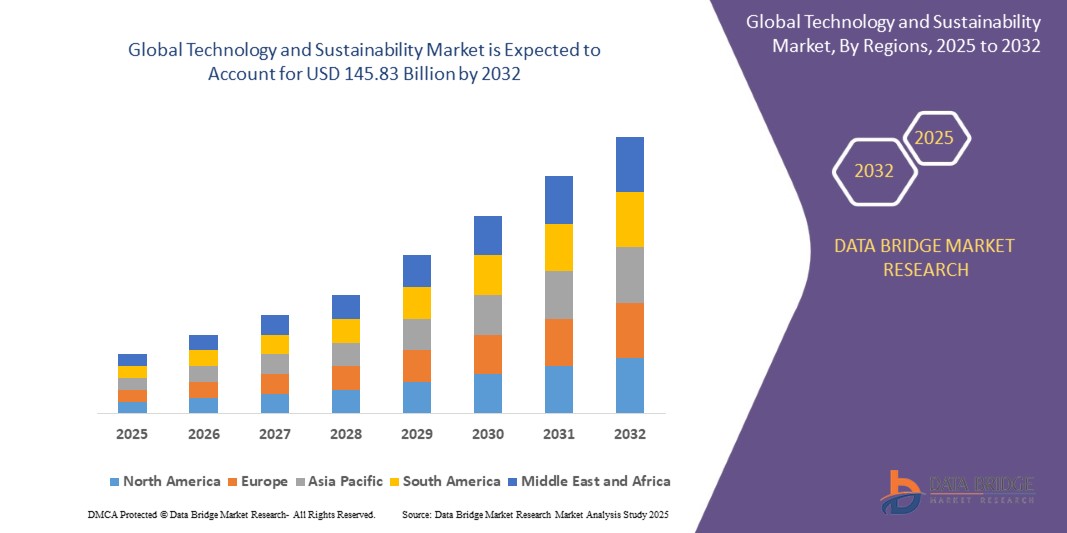
What is the Global Green Technology and Sustainability Market Size and Growth Rate?
- The global green technology and sustainability market size was valued at USD 21.82 billion in 2024 and is expected to reach USD 145.83 billion by 2032, at a CAGR of 26.80% during the forecast period
- The market’s growth is fueled by the increasing focus on carbon footprint reduction, climate change mitigation, and sustainable energy adoption across industries and governments worldwide
- Advancements in IoT, AI, and blockchain technologies to optimize resource management and environmental monitoring are further propelling the adoption of green tech solutions in energy, agriculture, and transportation sectors
What are the Major Takeaways of Green Technology and Sustainability Market?
- Green technologies promote sustainable development by minimizing environmental harm and enabling energy-efficient operations through smart infrastructure, clean energy, and eco-friendly manufacturing practices
- The surge in demand is driven by stringent environmental regulations, rising corporate sustainability goals, and growing public awareness of eco-conscious products and services
- Moreover, the integration of smart sensors, big data, and predictive analytics into environmental systems is enabling proactive solutions for emissions control, waste reduction, and renewable energy management
- North America dominated the green technology and sustainability market with the largest revenue share of 39.26% in 2024, driven by the growing demand for eco-friendly innovations and sustainability initiatives across residential and commercial sectors
- Asia-Pacific green technology and sustainability market is poised to grow at the fastest CAGR of 14.45% during the forecast period from 2025 to 2032, driven by rapid industrialization, increasing environmental regulations, and expanding investments in renewable energy infrastructure in countries such as China, India, and Japan
- The Solution segment dominated the market with the largest revenue share of 62.5% in 2024, driven by the increasing deployment of integrated hardware and software solutions that enable real-time monitoring and control of environmental factors
Report Scope and Green Technology and Sustainability Market Segmentation
|
Attributes |
Green Technology and Sustainability Key Market Insights |
|
Segments Covered |
|
|
Countries Covered |
North America
Global
Asia-Pacific
Middle East and Africa
South America
|
|
Key Market Players |
|
|
Market Opportunities |
|
|
Value Added Data Infosets |
In addition to the insights on market scenarios such as market value, growth rate, segmentation, geographical coverage, and major players, the market reports curated by the Data Bridge Market Research also include in-depth expert analysis, pricing analysis, brand share analysis, consumer survey, demography analysis, supply chain analysis, value chain analysis, raw material/consumables overview, vendor selection criteria, PESTLE Analysis, Porter Analysis, and regulatory framework. |
What is the Key Trend in the Green Technology and Sustainability Market?
“Enhanced Convenience through AI and Voice Integration”
- A major trend shaping the green technology and sustainability market is the increasing integration of artificial intelligence (AI) and voice-enabled systems such as Amazon Alexa, Google Assistant, and Apple HomeKit. This convergence is driving smarter energy management, intuitive user interfaces, and automation across residential and commercial environments
- For instance, Google Nest leverages AI to learn user behavior and optimize heating and cooling, resulting in energy savings and improved user comfort. Similarly, Amazon’s Alexa-compatible devices are enabling voice-controlled smart lighting and appliances to reduce energy waste
- AI in green technology is also being used for predictive analytics, helping utilities and enterprises reduce carbon emissions by optimizing energy consumption patterns. Smart grids and home energy management systems now use machine learning to suggest energy-efficient actions
- The seamless voice integration allows for centralized control over a wide range of devices—from lighting to HVAC systems—enhancing accessibility and user engagement in sustainability practices
- Companies such as Siemens, Schneider Electric, and Honeywell are expanding their AI-based green solutions, including autonomous energy systems and smart building platforms, to meet increasing sustainability demands
- This trend toward AI-driven automation and intelligent control is reshaping the landscape of sustainable technology, making it more user-friendly and accessible, and accelerating adoption across the globe
What are the Key Drivers of Green Technology and Sustainability Maret?
- The growing focus on reducing carbon emissions and achieving climate targets under frameworks such as the Paris Agreement is a core driver accelerating investments in green technologies globally
- For instance, in January 2024, Microsoft announced the expansion of its 100% renewable-powered data centers, reinforcing its net-zero carbon goals and pushing the adoption of sustainable energy technologies
- Government incentives and regulatory mandates, such as carbon credit systems and green building codes, are further propelling the demand for energy-efficient systems, green construction materials, and sustainable industrial practices
- Rising corporate ESG (Environmental, Social, Governance) commitments and consumer demand for eco-friendly products are driving sectors such as transportation, manufacturing, and agriculture to adopt sustainable alternatives, including electric vehicles, solar panels, and precision farming
- The increasing affordability and scalability of renewable energy sources, smart grid infrastructure, and green cloud computing solutions is broadening market access and enabling businesses of all sizes to adopt green technologies
Which Factor is challenging the Growth of the Green Technology and Sustainability Market?
- One of the biggest challenges is the high initial cost of green technologies, which can deter small businesses and developing countries from adopting sustainable alternatives despite long-term benefits
- For instance, while solar and wind energy offer long-term savings, the upfront investment in infrastructure, battery storage, and installation remains substantial, limiting adoption in regions with constrained capital
- In addition, interoperability issues among various green technologies—especially in smart buildings or cities—can hinder system integration, creating inefficiencies and compatibility concerns
- Cybersecurity risks associated with connected sustainable infrastructure, such as smart grids and IoT-based monitoring systems, also pose challenges. Breaches in these systems can compromise critical utilities, deterring broader deployment
- Companies such as ABB and Schneider Electric are investing in secure and interoperable platforms, but standardization across the industry remains a work in progress
- Overcoming these challenges will require policy support, financial incentives, robust cybersecurity frameworks, and public-private collaboration to ensure scalable and secure deployment of sustainable technologies
How is the Green Technology and Sustainability Market Segmented?
The market is segmented on the basis of component, technology, and application.
• By Component
On the basis of component, the green technology and sustainability market is segmented into Solution and Services. The Solution segment dominated the market with the largest revenue share of 62.5% in 2024, driven by the increasing deployment of integrated hardware and software solutions that enable real-time monitoring and control of environmental factors. Organizations and governments prioritize comprehensive solutions for effective sustainability management, boosting demand in this segment.
The services segment is projected to witness steady growth, supported by the rising need for consulting, maintenance, and managed services to optimize green technology implementations and ensure compliance with evolving regulations.
• By Technology
On the basis of technology, the market is segmented into IoT, AI and analytics, Digital twin, Cloud computing, Security, and Blockchain. The IoT segment held the largest market revenue share of 38.4% in 2024, driven by the widespread adoption of connected sensors and devices that enable continuous environmental data collection and automated responses. IoT forms the backbone of many green technology solutions, facilitating efficient resource management.
The AI and analytics segment is expected to register the fastest CAGR from 2025 to 2032, fueled by advancements in machine learning and data processing that enhance predictive maintenance, energy optimization, and sustainability reporting.
• By Application
On the basis of application, the market is segmented into Carbon Footprint Management, Green Building, Water Purification, Water Leak Detection, Fire Detection, Soil Condition/Moisture Monitoring, Crop Monitoring, Forest Monitoring, Weather Monitoring and Forecasting, Air and Water Pollution Monitoring, and Sustainable Mining and Exploration. The Carbon Footprint Management segment dominated the market with a revenue share of 29.7% in 2024, owing to increasing regulatory pressures and corporate commitments to reduce greenhouse gas emissions. Growing awareness about climate change and carbon accounting frameworks further support this segment’s expansion.
The Green Building application is projected to grow at the fastest CAGR during the forecast period, propelled by increasing adoption of energy-efficient construction and smart building management systems worldwide.
Which Region Holds the Largest Share of the Green Technology and Sustainability Maret?
- North America dominated the green technology and sustainability market with the largest revenue share of 39.26% in 2024, driven by the growing demand for eco-friendly innovations and sustainability initiatives across residential and commercial sectors
- Consumers in the region highly value energy-efficient technologies, renewable energy integration, and smart environmental monitoring systems that reduce carbon footprints and operational costs
- This widespread adoption is further supported by strong regulatory frameworks, government incentives for green initiatives, and a high level of environmental awareness, making North America a key market for sustainable technology solutions
U.S. Green Technology and Sustainability Market Insight
The U.S. green technology and sustainability market captured the largest revenue share in North America in 2024, fueled by increasing investments in renewable energy, smart grid technologies, and carbon management solutions. Corporations and municipalities are aggressively adopting green technologies to meet stringent emission targets and sustainability goals. The growing focus on clean energy solutions, electric vehicles, and energy-efficient infrastructure continues to expand the market. Furthermore, government policies promoting sustainable development and clean energy adoption significantly boost market growth.
U.K. Green Technology and Sustainability Market Insight
The U.K. green technology and sustainability market is expected to grow at a noteworthy CAGR during the forecast period, driven by government policies promoting net-zero emissions and renewable energy projects. Growing awareness of climate change and increasing investment in energy-efficient building solutions and sustainable urban infrastructure are key growth factors. The U.K.’s robust sustainability frameworks and incentives for green innovation are encouraging businesses and homeowners to adopt advanced sustainability technologies.
Germany Green Technology and Sustainability Market Insight
The Germany green technology and sustainability market is projected to expand at a significant CAGR during the forecast period, supported by the country’s strong emphasis on environmental protection, renewable energy adoption, and sustainable industrial practices. Germany’s leadership in green technologies, especially in energy-efficient manufacturing and smart energy management, fuels market demand. The integration of green solutions in both residential and commercial sectors aligns with the nation’s commitment to achieving ambitious climate goals.
Which Region is the Fastest Growing Region in the Green Technology and Sustainability Market?
Asia-Pacific green technology and sustainability market is poised to grow at the fastest CAGR of 14.45% during the forecast period from 2025 to 2032, driven by rapid industrialization, increasing environmental regulations, and expanding investments in renewable energy infrastructure in countries such as China, India, and Japan. The region’s rising focus on smart cities, green building technologies, and water and air pollution monitoring is further accelerating adoption. Government initiatives promoting sustainable development and technological innovation enhance the market’s growth potential.
Japan Green Technology and Sustainability Market Insight
The Japan green technology and sustainability market is gaining momentum due to the country’s advanced technology landscape, strong governmental support for sustainability, and increasing urbanization. The demand for energy-efficient solutions, smart grid technologies, and environmental monitoring systems is growing steadily. Japan’s aging population also encourages the adoption of easy-to-use, secure, and sustainable technologies in both residential and commercial sectors.
China Green Technology and Sustainability Market Insight
The China green technology and sustainability market accounted for the largest market revenue share in Asia-Pacific in 2024, driven by aggressive government policies targeting carbon neutrality, extensive urban development, and high consumer demand for green products. The country is a leading manufacturer and adopter of renewable energy technologies, smart grid systems, and pollution monitoring solutions. China’s push towards sustainable urbanization and green infrastructure development continues to drive significant market expansion.
Which are the Top Companies in Green Technology and Sustainability Market?
The green technology and sustainability industry is primarily led by well-established companies, including:
- General Electric Company (U.S.)
- IBM (U.S.)
- Microsoft (U.S.)
- Wolters Kluwer N.V. (Netherlands)
- Xylem (U.S.)
- Taranis (Israel)
- Trace Genomics (U.S.)
- CONSENSYS (U.S.)
- CropX Inc. (U.S.)
- Hortau (Canada)
- SMAP Energy (U.K.)
- Treevia Forest Technologies (Canada)
- Pycno Industries, Inc. (U.S.)
- IOT Solutions & Consulting (U.K.)
- OIZOM INSTRUMENTS PVT. LTD. (India)
- MineSense Technologies Ltd. (Canada)
What are the Recent Developments in Global Green Technology and Sustainability Market?
- In April 2025, China Petroleum & Chemical Corporation (Sinopec) and Contemporary Amperex Technology Co., Limited signed a strategic cooperation agreement in Beijing to develop a nationwide battery swap network, combining Sinopec’s extensive energy infrastructure with Contemporary Amperex’s advanced battery technology. This partnership aims to establish China as a leader in green infrastructure innovation and supports national goals for low-carbon transportation and new infrastructure development
- In June 2024, Wolters Kluwer N.V. introduced CCH Tagetik ESG & Sustainability for Carbon Emissions, a new solution designed to report both direct and indirect carbon emissions in compliance with the Corporate Sustainability Reporting Directive (CSRD). This innovation strengthens organizations' ability to meet evolving sustainability reporting standards effectively
- In March 2024, Schneider Electric announced it would enhance its EcoStruxure IT data center infrastructure management tool with advanced sustainability reporting features starting the following month, helping data center operators comply with the European Energy Efficiency Directive (EED). This addition supports greater transparency and energy efficiency in data center operations
- In March 2024, Adani Tradecom Limited (ATL), a wholly-owned subsidiary of Adani Enterprises, completed the acquisition of the remaining 49% stake in Adani Green Technology Limited (AGTL) from Adani Trading Services LLP (ATS LLP), making AGTL a step-down wholly-owned subsidiary of Adani Enterprises. This strategic acquisition streamlines renewable energy operations and reinforces the group’s commitment to expanding its green energy footprint
- In February 2024, IBM Envizi upgraded its Scope 3 emissions accounting solution by adding enhanced functionality to the Supply Chain Intelligence module within the IBM Envizi ESG Suite, enabling the collection of Product Carbon Footprint Data (PCF) and extensive supplier and product-level transactional data for more accurate Scope 3 emissions reporting. This update facilitates comprehensive supply chain carbon management

- Interactive Data Analysis Dashboard
- Company Analysis Dashboard for high growth potential opportunities
- Research Analyst Access for customization & queries
- Competitor Analysis with Interactive dashboard
- Latest News, Updates & Trend analysis
- Harness the Power of Benchmark Analysis for Comprehensive Competitor Tracking
Data collection and base year analysis are done using data collection modules with large sample sizes. The stage includes obtaining market information or related data through various sources and strategies. It includes examining and planning all the data acquired from the past in advance. It likewise envelops the examination of information inconsistencies seen across different information sources. The market data is analysed and estimated using market statistical and coherent models. Also, market share analysis and key trend analysis are the major success factors in the market report. To know more, please request an analyst call or drop down your inquiry.
The key research methodology used by DBMR research team is data triangulation which involves data mining, analysis of the impact of data variables on the market and primary (industry expert) validation. Data models include Vendor Positioning Grid, Market Time Line Analysis, Market Overview and Guide, Company Positioning Grid, Patent Analysis, Pricing Analysis, Company Market Share Analysis, Standards of Measurement, Global versus Regional and Vendor Share Analysis. To know more about the research methodology, drop in an inquiry to speak to our industry experts.
Data Bridge Market Research is a leader in advanced formative research. We take pride in servicing our existing and new customers with data and analysis that match and suits their goal. The report can be customized to include price trend analysis of target brands understanding the market for additional countries (ask for the list of countries), clinical trial results data, literature review, refurbished market and product base analysis. Market analysis of target competitors can be analyzed from technology-based analysis to market portfolio strategies. We can add as many competitors that you require data about in the format and data style you are looking for. Our team of analysts can also provide you data in crude raw excel files pivot tables (Fact book) or can assist you in creating presentations from the data sets available in the report.