What is the Global Greenhouse Heaters Market Size and Growth Rate?
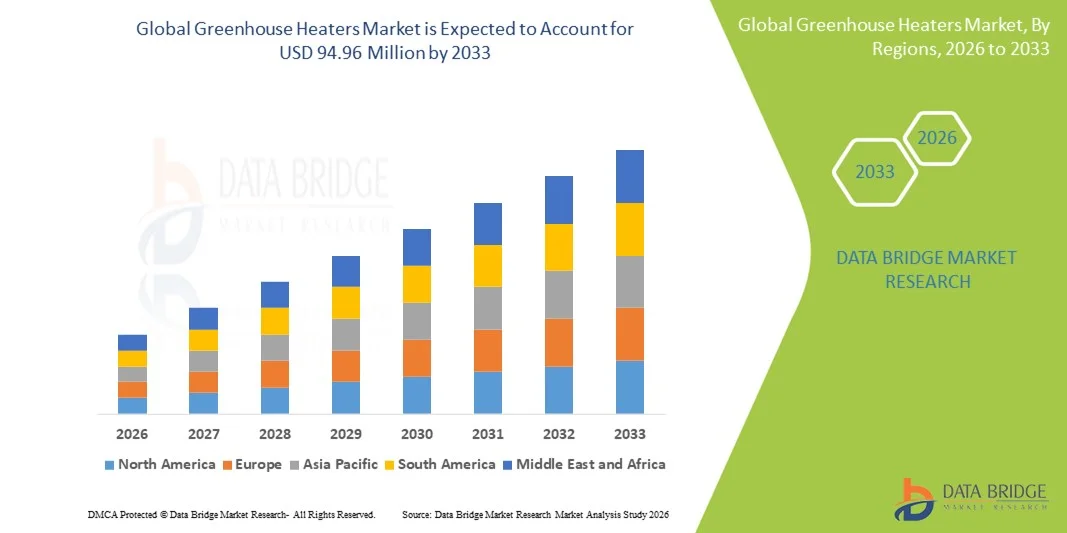
- The global greenhouse heaters market size was valued at USD 46.96 million in 2025 and is expected to reach USD 94.96 million by 2033, at a CAGR of9.20% during the forecast period
- The increase in the number of greenhouses across the globe acts as one of the major factors driving the growth of greenhouse heaters market. The rise in the awareness in people regarding the environment from further degradation and high use in the production in an organized shelter for delivering customized provisions accelerate the market growth
What are the Major Takeaways of Greenhouse Heaters Market?
- The increase in the adoption of the greenhouse for controlling the external parameters such as temperature, carbon dioxide, light and humidity emissions, and rise in the demand for protected crop cultivation further influence the market
- In addition, the rise in population, adverse climate conditions, and growth in awareness by government and public associations positively affect the greenhouse heaters market
- North America dominated the Greenhouse Heaters market with a 42.05% revenue share in 2025, driven by rapid growth in commercial and small-scale greenhouse operations, adoption of energy-efficient heating solutions, and strong focus on precision agriculture in the U.S. and Canada
- Asia-Pacific is projected to register the fastest CAGR of 10.69% from 2026 to 2033, fueled by rapid expansion of greenhouse farming in China, Japan, India, South Korea, and Southeast Asia
- The Gas Heaters segment dominated the market with a 41.2% share in 2025, driven by their widespread use in commercial and small-scale greenhouses due to low operating costs, high efficiency, and ease of installation
Report Scope and Greenhouse Heaters Market Segmentation
|
Attributes |
Greenhouse Heaters Key Market Insights |
|
Segments Covered |
|
|
Countries Covered |
North America
Europe
Asia-Pacific
Middle East and Africa
South America
|
|
Key Market Players |
|
|
Market Opportunities |
|
|
Value Added Data Infosets |
In addition to the insights on market scenarios such as market value, growth rate, segmentation, geographical coverage, and major players, the market reports curated by the Data Bridge Market Research also include in-depth expert analysis, pricing analysis, brand share analysis, consumer survey, demography analysis, supply chain analysis, value chain analysis, raw material/consumables overview, vendor selection criteria, PESTLE Analysis, Porter Analysis, and regulatory framework. |
What is the Key Trend in the Greenhouse Heaters Market?
Increasing Shift Toward Energy-Efficient, Smart, and Automated Greenhouse Heaters
- The greenhouse heaters market is witnessing strong adoption of energy-efficient, compact, and smart heating systems designed to optimize plant growth, reduce operational costs, and integrate with modern greenhouse automation technologies
- Manufacturers are introducing multi-functional heaters with digital controls, wireless connectivity, and IoT-enabled monitoring, allowing precise temperature regulation and integration with climate management systems
- Growing demand for low-energy, cost-effective, and environmentally friendly heating solutions is driving adoption across commercial greenhouses, research facilities, and small-scale farms
- For instance, companies such as Richel Group SA, Argus Control Systems Ltd., Lumigrow, Inc., Certhon, and Logiqs B.V. have enhanced their product lines with smart sensors, automated controls, and cloud-based monitoring capabilities
- Increasing need for real-time climate control, energy optimization, and scalable deployment is accelerating the shift toward automated and digitally controlled greenhouse heaters
- As greenhouse cultivation becomes more technology-driven and sustainability-focused, Greenhouse Heaters will remain essential for high-yield, resource-efficient crop production
What are the Key Drivers of Greenhouse Heaters Market?
- Rising demand for precision climate management to improve crop yield, reduce energy consumption, and ensure consistent plant growth is a major driver
- For instance, in 2025, leading greenhouse technology companies such as Richel Group SA, Argus Control Systems Ltd., and Lumigrow, Inc. upgraded their heater systems with IoT-enabled controls, automation, and energy-efficient designs
- Growing adoption of controlled-environment agriculture (CEA), vertical farming, and greenhouse cultivation in North America, Europe, and Asia-Pacific is boosting market demand
- Advancements in smart sensors, digital thermostats, and wireless integration have strengthened performance, safety, and operational efficiency
- Rising focus on sustainable agriculture, carbon footprint reduction, and cost-effective heating solutions is creating demand for innovative greenhouse heaters
- Supported by steady investments in greenhouse automation, IoT-based agriculture, and energy-efficient farming infrastructure, the Greenhouse Heaters market is expected to witness strong long-term growth
Which Factor is Challenging the Growth of the Greenhouse Heaters Market?
- High initial costs associated with advanced, automated, and energy-efficient greenhouse heaters restrict adoption among small farms and emerging-market growers
- For instance, during 2024–2025, fluctuations in energy prices and raw material costs increased system implementation expenses for several global vendors
- Complexity in integrating smart heating systems with existing greenhouse infrastructure increases the need for skilled technicians and training
- Limited awareness in emerging regions regarding benefits of smart greenhouse heaters slows adoption
- Competition from traditional heating solutions and DIY climate control setups creates pricing pressure and reduces product differentiation
- To address these issues, companies are focusing on modular, energy-optimized designs, user-friendly controls, training programs, and remote monitoring solutions to increase global adoption of Greenhouse Heaters
How is the Greenhouse Heaters Market Segmented?
The market is segmented on the basis of type and application.
- By Type
On the basis of type, the greenhouse heaters market is segmented into Gas Heaters, Electric Heaters, and Paraffin Heaters. The Gas Heaters segment dominated the market with a 41.2% share in 2025, driven by their widespread use in commercial and small-scale greenhouses due to low operating costs, high efficiency, and ease of installation. Gas heaters offer rapid heating, compatibility with various greenhouse sizes, and reliable temperature control, making them preferred for consistent plant growth.
The Electric Heaters segment is expected to grow at the fastest CAGR from 2026 to 2033, propelled by rising adoption of energy-efficient and smart greenhouse systems, integration with climate automation, and increasing use in environmentally sensitive regions. Advancements in electric heating technology, IoT-enabled controllers, and low-carbon initiatives further support accelerated adoption.
- By Application
On the basis of application, the greenhouse heaters market is segmented into Small and Middle Greenhouse and Large Greenhouse. The Small and Middle Greenhouse segment dominated the market with a 44.5% share in 2025, supported by increasing greenhouse farming in residential, urban, and semi-commercial setups, which require compact, cost-effective heating solutions. Small and middle greenhouses benefit from modular heaters, rapid installation, and scalable climate control, making them suitable for high-value crops and niche vegetables.
The Large Greenhouse segment is projected to grow at the fastest CAGR from 2026 to 2033, driven by the expansion of commercial greenhouse farming, vertical farming operations, and large-scale horticulture. Rising demand for high-yield, energy-efficient heating solutions and integration with automated climate control systems are driving market growth in this segment.
Which Region Holds the Largest Share of the Greenhouse Heaters Market?
- North America dominated the Greenhouse Heaters market with a 42.05% revenue share in 2025, driven by rapid growth in commercial and small-scale greenhouse operations, adoption of energy-efficient heating solutions, and strong focus on precision agriculture in the U.S. and Canada. Rising demand for automated climate control systems, high-performance heating technologies, and sustainable horticulture practices continues to fuel adoption across floriculture, vegetable, and fruit greenhouse farms
- Leading companies in North America are introducing advanced gas, electric, and paraffin heaters with smart thermostats, IoT-enabled monitoring, and energy-efficient designs, strengthening the region’s technological advantage. Continuous investments in agritech innovation, government incentives, and greenhouse infrastructure modernization drive long-term market expansion
- High concentration of commercial greenhouse farms, strong horticultural expertise, and supportive policies for sustainable agriculture further reinforce regional market leadership
U.S. Greenhouse Heaters Market Insight
The U.S. is the largest contributor in North America, supported by modern greenhouse infrastructure, rising adoption of climate-controlled systems, and increasing use of energy-efficient heating solutions for high-value crops. Expanding vertical farming, floriculture, and vegetable greenhouse operations intensify demand for heaters capable of precise temperature regulation, uniform heat distribution, and integration with automated monitoring systems. Presence of major greenhouse equipment manufacturers, strong R&D activities, and growing awareness of sustainable agriculture practices further drive market growth.
Canada Greenhouse Heaters Market Insight
Canada contributes significantly to regional growth, driven by expansion of commercial greenhouses, increasing government subsidies for energy-efficient farming, and rising adoption of electric and gas heaters in horticulture. Greenhouse operators increasingly utilize advanced heating systems for year-round crop production and frost prevention. Skilled agritech workforce, innovation programs, and focus on renewable energy-based heating solutions further strengthen market adoption across the country.
Asia-Pacific Greenhouse Heaters Market
Asia-Pacific is projected to register the fastest CAGR of 10.69% from 2026 to 2033, fueled by rapid expansion of greenhouse farming in China, Japan, India, South Korea, and Southeast Asia. Rising focus on high-value crop production, climate-resilient agriculture, and automation integration increases demand for energy-efficient and smart heating systems. Growth in floriculture, vegetable, and fruit greenhouse operations, along with government-supported agriculture modernization initiatives, accelerates adoption of portable and digitally controlled heaters across farms.
China Greenhouse Heaters Market Insight
China is the largest contributor to Asia-Pacific, supported by rapid greenhouse expansion, government subsidies for modern farming, and strong focus on year-round crop cultivation. Rising adoption of smart climate control systems, energy-efficient gas and electric heaters, and integration with IoT-based monitoring drives demand. Local manufacturing capacity, competitive pricing, and large-scale horticulture adoption further expand domestic and export market penetration.
Japan Greenhouse Heaters Market Insight
Japan shows steady growth, backed by advanced greenhouse technology, precision horticulture, and strong emphasis on energy-efficient heating solutions. Demand for automated and low-carbon heaters, combined with high-value crop cultivation, supports premium product adoption. Continuous modernization of greenhouse infrastructure and focus on climate-resilient farming ensure long-term market expansion.
India Greenhouse Heaters Market Insight
India is emerging as a major growth hub, driven by rising greenhouse infrastructure, government incentives for horticulture modernization, and growing adoption of energy-efficient gas and electric heaters. Increasing use of climate-controlled systems, IoT-enabled temperature monitoring, and modular heating solutions for vegetables, fruits, and flowers accelerates market penetration. Expansion of agritech startups and R&D investments further support growth.
South Korea Greenhouse Heaters Market Insight
South Korea contributes significantly due to growing greenhouse farming, rising adoption of smart climate control systems, and focus on year-round crop production. Demand for energy-efficient, automated, and IoT-enabled heaters is increasing across vegetable and floriculture sectors. Technological innovation, strong manufacturing capabilities, and government-backed sustainable agriculture programs support sustained market growth.
Which are the Top Companies in Greenhouse Heaters Market?
The greenhouse heaters industry is primarily led by well-established companies, including:
- Richel Group SA (Canada)
- Argus Control Systems Ltd. (Canada)
- Certhon (Netherlands)
- Lumigrow, Inc. (U.S.)
- Agra Tech, Inc. (U.S.)
- Logiqs B.V. (Netherlands)
- Rough Brothers, Inc. (U.S.)
- Nexus Corporation (U.S.)
- Hort Americas, LLC (U.S.)
- Heliospectra AB (Sweden)
- DutchGreenhouses (Netherlands)
- Green Tek (U.S.)
- Texas Greenhouse Company Inc (U.S.)
- L.B. White Company, LLC (U.S.)
- International Greenhouse Company (U.S.)
- Southern Burner Co. (U.S.)
- HotBox International (U.S.)
- Siebring Manufacturing (U.S.)
- Greentech India (India)
- Roberts-Gordon (U.S.)

- Interactive Data Analysis Dashboard
- Company Analysis Dashboard for high growth potential opportunities
- Research Analyst Access for customization & queries
- Competitor Analysis with Interactive dashboard
- Latest News, Updates & Trend analysis
- Harness the Power of Benchmark Analysis for Comprehensive Competitor Tracking
Data collection and base year analysis are done using data collection modules with large sample sizes. The stage includes obtaining market information or related data through various sources and strategies. It includes examining and planning all the data acquired from the past in advance. It likewise envelops the examination of information inconsistencies seen across different information sources. The market data is analysed and estimated using market statistical and coherent models. Also, market share analysis and key trend analysis are the major success factors in the market report. To know more, please request an analyst call or drop down your inquiry.
The key research methodology used by DBMR research team is data triangulation which involves data mining, analysis of the impact of data variables on the market and primary (industry expert) validation. Data models include Vendor Positioning Grid, Market Time Line Analysis, Market Overview and Guide, Company Positioning Grid, Patent Analysis, Pricing Analysis, Company Market Share Analysis, Standards of Measurement, Global versus Regional and Vendor Share Analysis. To know more about the research methodology, drop in an inquiry to speak to our industry experts.
Data Bridge Market Research is a leader in advanced formative research. We take pride in servicing our existing and new customers with data and analysis that match and suits their goal. The report can be customized to include price trend analysis of target brands understanding the market for additional countries (ask for the list of countries), clinical trial results data, literature review, refurbished market and product base analysis. Market analysis of target competitors can be analyzed from technology-based analysis to market portfolio strategies. We can add as many competitors that you require data about in the format and data style you are looking for. Our team of analysts can also provide you data in crude raw excel files pivot tables (Fact book) or can assist you in creating presentations from the data sets available in the report.