


Greenhouse Lighting Market Overview
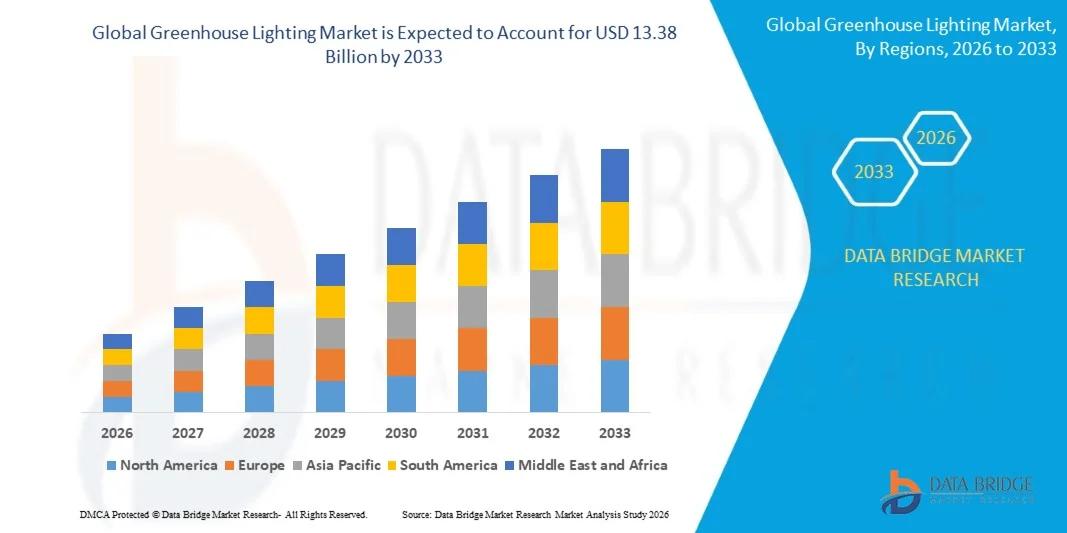
The Greenhouse Lighting Market was valued at USD 3.49 Billion in 2025 and is projected to reach USD 13.38 Billion by 2033, growing at a CAGR of 18.30% from 2026 to 2033. The market is experiencing consistent growth driven by increasing adoption of controlled environment agriculture, rising demand for year-round crop production, and growing investments in greenhouse farming infrastructure. Expanding deployment of energy-efficient LED grow lights and increasing integration of smart lighting control systems are further supporting market expansion across commercial greenhouse operations worldwide.
The growing global demand for food security and sustainable agricultural production, combined with declining availability of arable land, is encouraging growers to adopt advanced greenhouse cultivation technologies. Greenhouse lighting systems play a critical role in optimizing plant growth, improving crop yields, and maintaining consistent production regardless of seasonal variations. Increasing adoption of precision agriculture practices, coupled with advancements in spectrum-specific lighting technologies and automated greenhouse management solutions, is further accelerating market development across major agricultural regions.
Key Market Trends & Insights
- North America dominated the Greenhouse Lighting Market with the largest revenue share of 36.5% in 2025, supported by the widespread adoption of controlled environment agriculture, advanced greenhouse technologies, and strong demand for year-round crop production
- The hardware segment led the market with a 64.5% share in 2025, driven by the high adoption of lighting fixtures, controllers, sensors, and power management systems across commercial greenhouse facilities
- Asia-Pacific is expected to be the fastest-growing region at a CAGR of 13.9% from 2026 to 2033, fueled by rapid agricultural modernization, expanding greenhouse cultivation activities, and increasing demand for high-yield crop production
- Herbs & microgreens are the fastest-growing crop type, projected to register a CAGR of 13.2% from 2026 to 2033, supported by increasing demand for nutrient-rich specialty crops and premium culinary ingredient
- The LED grow lights segment dominated the lighting category with a 62.7% revenue share in 2025, led by their superior energy efficiency, longer operational lifespan, and ability to provide customized light spectrums for different crop stages
- New installations accounted for 60.3% of the market in 2025, preferred by the rapid establishment of modern greenhouse facilities across major agricultural regions
- The software segment is the fastest-growing component category, with a CAGR of 12.8% from 2026 to 2033, driven by the growing integration of smart greenhouse management platforms and automated lighting control systems
Market Size & Forecast
- Global Market Value (2025): USD 3.49 Billion
- Expected Market Value (2033): USD 13.38 Billion
- Forecast CAGR (2026–2033): 18.30%
- Leading Region in 2025: North America
- Fastest Growing Region: Asia-Pacific
Report Scope and Greenhouse Lighting Market Segmentation
|
Attributes |
Greenhouse Lighting Key Market Insights |
|
Segments Covered |
|
|
Countries Covered |
North America · U.S. · Canada · Mexico Europe · Germany · France · U.K. · Netherlands · Switzerland · Belgium · Russia · Italy · Spain · Turkey · Rest of Europe Asia-Pacific · China · Japan · India · South Korea · Singapore · Malaysia · Australia · Thailand · Indonesia · Philippines · Rest of Asia-Pacific Middle East and Africa · Saudi Arabia · U.A.E. · South Africa · Egypt · Israel · Rest of Middle East and Africa South America · Brazil · Argentina · Rest of South America |
|
Key Market Players |
· Samsung Electronics Co., Ltd. (South Korea) · Valoya (Finland) · Hort Americas (U.S.) · EVERLIGHT ELECTRONICS CO., LTD. (Taiwan) · Senmatic (Denmark) · California LightWorks (U.S.) · Gavita International B.V. (Netherlands) · ams-OSRAM AG (Austria) · Nanolux (U.S.) · Heliospectra (Sweden) · Signify Holding (Netherlands) · Crecer Lighting (Canada) · HLI Solutions, Inc. (U.S.) · Hortilux Schréder (Netherlands) · Cree LED (U.S.) |
|
Market Opportunities |
· Expansion of Vertical Farming and Urban Agriculture Projects · Growing Adoption of AI-Integrated Greenhouse Lighting Solutions · Increasing Greenhouse Development in Emerging Agricultural Economies |
|
Value Added Data Infosets |
In addition to the insights on market scenarios such as market value, growth rate, segmentation, geographical coverage, and major players, the market reports curated by the Data Bridge Market Research also include in-depth expert analysis, geographically represented company-wise production and capacity, network layouts of distributors and partners, detailed and updated price trend analysis and deficit analysis of supply chain and demand. |
Greenhouse Lighting Market Trends
Trend: Growing Adoption of Smart LED Grow Lights
Greenhouse operators are increasingly adopting smart LED grow lighting systems to improve crop productivity, optimize energy consumption, and support precision agriculture practices. Advanced LED technologies provide spectrum control, dimming capabilities, and integration with automated greenhouse management systems, allowing growers to customize lighting conditions based on crop requirements and environmental conditions. The transition from traditional HID and fluorescent lighting to energy-efficient LEDs is accelerating across commercial greenhouse facilities due to lower operating costs and longer product lifespans.
Companies such as Signify Holding have introduced advanced horticulture lighting solutions including Philips GrowWise Smart Spectrum, which automatically adjusts supplemental lighting according to available sunlight, helping growers maximize crop growth while reducing electricity consumption.
Greenhouse Lighting Market Dynamics
Key Market Driver: Rising Demand for Year-Round Crop Production
The increasing demand for consistent supplies of fruits, vegetables, herbs, and ornamental plants throughout the year is significantly driving adoption of greenhouse lighting systems. Controlled environment agriculture enables growers to overcome seasonal limitations and maintain stable production regardless of weather conditions. Supplemental lighting plays a critical role in extending photoperiods and supporting crop growth during periods of low natural sunlight, particularly in regions with long winters and limited daylight availability.
Major greenhouse producers across North America and Europe are expanding controlled-environment cultivation facilities equipped with LED lighting systems to meet growing consumer demand for fresh produce. Organizations such as the Netherlands Greenhouse Horticulture Sector continue to utilize advanced greenhouse lighting technologies to support year-round high-yield agricultural production.
Key Restraint/Challenge: High Initial Installation and Infrastructure Investment Costs
A major challenge in the Greenhouse Lighting market is the significant upfront investment required for advanced lighting systems and supporting greenhouse infrastructure. Commercial growers must invest in LED fixtures, control systems, sensors, electrical upgrades, and automation technologies, which can create financial barriers, particularly for small and medium-sized agricultural operations. Although energy savings are achieved over time, the initial capital expenditure often slows technology adoption.
For instance, large-scale greenhouse modernization projects involving LED conversion require substantial investment in lighting equipment and environmental control systems. The adoption of advanced horticultural lighting solutions from companies such as Signify Holding and Heliospectra often involves considerable infrastructure upgrades before operational benefits can be fully realized.
Key Market Opportunity: Expansion of Vertical Farming and Urban Agriculture Projects
The rapid expansion of vertical farming and urban agriculture is creating significant growth opportunities for greenhouse lighting manufacturers. These cultivation systems rely heavily on artificial lighting to support plant growth in indoor environments where natural sunlight is limited or unavailable. Increasing urbanization, demand for locally produced food, and growing interest in sustainable farming practices are accelerating investments in indoor agriculture facilities worldwide.
Companies such as Samsung Electronics Co., Ltd. and Signify Holding are actively developing advanced LED technologies tailored for vertical farming applications. The continued expansion of indoor farming projects across Asia-Pacific, North America, and Europe is expected to create strong long-term demand for high-performance greenhouse and horticultural lighting solutions.
Greenhouse Lighting Market Scope
The greenhouse lighting market is segmented on the basis of component, lighting, greenhouse, installation, crop, and end use.
- By Component
On the basis of component, the Greenhouse Lighting Market is segmented into hardware, software, and services. The Hardware segment dominated the market with the largest share of 64.5% in 2025, driven by the high adoption of lighting fixtures, controllers, sensors, and power management systems across commercial greenhouse facilities. Greenhouse operators continue to invest heavily in advanced lighting infrastructure to maximize crop productivity and maintain consistent growing conditions throughout the year. The increasing shift toward energy-efficient lighting technologies has further strengthened demand for hardware solutions. Expansion of controlled environment agriculture facilities worldwide is creating sustained equipment demand. Continuous technological advancements in lighting systems further reinforce the segment’s leadership position.
The Software segment is projected to register the fastest growth at a CAGR of 12.8% from 2026 to 2033, driven by the growing integration of smart greenhouse management platforms and automated lighting control systems. Advanced software solutions enable real-time monitoring of crop requirements, light intensity, and energy consumption, improving operational efficiency. The increasing adoption of artificial intelligence and data analytics in precision agriculture is accelerating software deployment. Cloud-based greenhouse management systems are also enhancing scalability and remote operation capabilities. Rising demand for optimized resource utilization and data-driven cultivation practices is supporting rapid segment growth.
- By Lighting
On the basis of lighting, the Greenhouse Lighting Market is segmented into LED Grow Lights, High-Intensity Discharge (HID) Lights, Fluorescent Lights, and Incandescent Lights. The LED Grow Lights segment dominated the market with a share of 62.7% in 2025, supported by their superior energy efficiency, longer operational lifespan, and ability to provide customized light spectrums for different crop stages. Commercial growers increasingly prefer LED systems due to lower electricity consumption and reduced maintenance requirements. These lighting solutions improve crop quality, yield consistency, and production efficiency across greenhouse operations. Government initiatives promoting sustainable agriculture are further encouraging LED adoption. Continuous innovations in spectrum optimization technologies strengthen the segment’s dominant position.
The Fluorescent Lights segment is also projected to register the fastest growth at a CAGR of 11.2% from 2026 to 2033, driven by its cost-effectiveness and suitability for small-scale greenhouse operations requiring moderate light intensity. These lighting systems are widely adopted for seedling propagation, leafy greens cultivation, and research applications where uniform light distribution is essential. Lower initial investment costs compared to advanced lighting technologies continue to attract budget-conscious growers. Improvements in fluorescent lamp efficiency and performance are supporting continued utilization across various greenhouse environments.
- By Greenhouse
On the basis of greenhouse, the Greenhouse Lighting Market is segmented into glass greenhouses and poly greenhouses. The Glass Greenhouses segment dominated the market with the largest share of 57.9% in 2025, driven by superior light transmission capabilities and suitability for advanced commercial cultivation. Glass structures provide optimal growing environments that maximize the effectiveness of supplemental lighting systems. Large-scale greenhouse operators prefer glass facilities due to their durability and long-term operational benefits. These structures are widely used in technologically advanced agricultural regions where productivity optimization is a key priority. Growing investments in high-value crop production continue to support segment dominance.
The Poly Greenhouses segment is projected to register the fastest growth at a CAGR of 11.9% from 2026 to 2033, driven by lower installation costs and increasing adoption among emerging greenhouse operators. Poly greenhouses offer an economical solution for expanding controlled environment agriculture in developing markets. Their flexibility and ease of construction make them attractive for small and medium-sized agricultural enterprises. Growing awareness regarding protected cultivation methods is further driving adoption. Rising demand for affordable greenhouse infrastructure is expected to accelerate segment expansion over the forecast period.
- By Installation
On the basis of installation, the Greenhouse Lighting Market is segmented into new installations and retrofit installations. The New Installations segment dominated the market with a share of 60.3% in 2025, supported by the rapid establishment of modern greenhouse facilities across major agricultural regions. Growing investments in controlled environment agriculture and indoor farming projects are generating significant demand for integrated lighting systems. New greenhouse developments increasingly incorporate advanced lighting technologies from the planning stage to maximize productivity and efficiency. Expansion of commercial cultivation operations is further contributing to segment growth. Increasing focus on sustainable agricultural production reinforces its leading market position.
The Retrofit Installations segment is projected to register the fastest growth at a CAGR of 12.4% from 2026 to 2033, driven by the replacement of conventional lighting systems with energy-efficient alternatives. Existing greenhouse operators are upgrading facilities to reduce operating costs and improve crop performance. Government incentives promoting energy-efficient agricultural technologies are encouraging retrofit activities. Advances in LED compatibility and installation flexibility are simplifying modernization projects. Rising pressure to improve energy efficiency and sustainability is accelerating demand for retrofit solutions globally.
- By Crop
On the basis of crop, the Greenhouse Lighting Market is segmented into fruits & vegetables, flowers & ornamentals, herbs & microgreens, nursery crops, and others. The Fruits & Vegetables segment dominated the market with the largest share of 49.8% in 2025, driven by strong global demand for year-round production of fresh produce. Greenhouse lighting plays a critical role in improving crop yield, quality, and production consistency for vegetables such as tomatoes, cucumbers, and peppers. Increasing consumer preference for locally grown produce is supporting greenhouse cultivation expansion. Commercial growers continue to invest in advanced lighting technologies to enhance productivity. Growing food security concerns further strengthen segment leadership.
The Herbs & Microgreens segment is projected to register the fastest growth at a CAGR of 13.2% from 2026 to 2033, driven by increasing demand for nutrient-rich specialty crops and premium culinary ingredients. Controlled environment cultivation enables rapid growth cycles and consistent quality for herbs and microgreens. Urban farming initiatives and indoor agriculture projects are significantly boosting production capacity. Rising consumer interest in healthy diets and fresh ingredients is creating strong market opportunities. The segment benefits from high-value crop economics and expanding adoption among commercial growers.
- By End Use
On the basis of end use, the Greenhouse Lighting Market is segmented into commercial growers, research institutions, retail & small-scale growers, and others. The Commercial Growers segment dominated the market with a share of 52.3% in 2025, driven by large-scale greenhouse operations focused on maximizing yield and production efficiency. Commercial facilities require advanced lighting systems to support continuous cultivation and maintain consistent crop quality throughout the year. Rising investments in greenhouse expansion projects are contributing significantly to segment growth. Adoption of precision agriculture technologies is further increasing demand for sophisticated lighting solutions. Strong emphasis on profitability and operational optimization reinforces market leadership.
The Retail & Small-Scale Growers segment is projected to register the fastest growth at a CAGR of 12.1% from 2026 to 2033, driven by increasing interest in urban farming, home gardening, and localized food production. Affordable greenhouse lighting technologies are making controlled environment cultivation accessible to smaller operators. Growing awareness regarding fresh produce cultivation and sustainable farming practices is supporting adoption. Expansion of community farming initiatives and small commercial greenhouse projects is creating new growth opportunities. Continuous improvements in compact and energy-efficient lighting systems are accelerating segment development.
Greenhouse Lighting Market Regional Analysis
North America dominated the greenhouse lighting market and accounted for the largest revenue share of 36.5% in 2025, driven by the widespread adoption of controlled environment agriculture, advanced greenhouse technologies, and strong demand for year-round crop production. The region benefits from high investments in commercial greenhouse facilities, extensive use of energy-efficient lighting systems, and increasing focus on improving agricultural productivity. Growers are actively implementing LED-based lighting solutions to optimize crop yields while reducing energy consumption. Strong government support for sustainable farming practices and technological innovation further contributes to market growth. In addition, the presence of leading greenhouse technology providers continues to strengthen North America’s dominant position in the global market.
U.S. Greenhouse Lighting Market Insight
The U.S. Greenhouse Lighting market is experiencing significant growth driven by increasing adoption of precision agriculture technologies, rising demand for locally produced fresh food, and expanding investments in commercial greenhouse operations. Growers are increasingly utilizing advanced lighting systems to improve crop quality, accelerate growth cycles, and maintain year-round production. The country’s strong technological infrastructure supports rapid integration of smart lighting controls and automation solutions. Growing emphasis on food security and sustainable agricultural production is further boosting demand. In addition, continuous expansion of indoor and controlled environment farming facilities is accelerating market development across the U.S.
Canada Greenhouse Lighting Market Insight
The Canada Greenhouse Lighting market is witnessing steady growth supported by increasing greenhouse cultivation activities and the need to overcome seasonal limitations in agricultural production. Growers are investing in supplemental lighting technologies to maintain crop productivity during periods of limited natural sunlight. The country’s focus on enhancing food self-sufficiency and agricultural sustainability is encouraging adoption of energy-efficient lighting solutions. Rising demand for greenhouse-grown vegetables and fruits is further supporting market expansion. In addition, government initiatives promoting advanced agricultural technologies continue to contribute to growth in Canada.
Europe Greenhouse Lighting Market Insight
The Europe Greenhouse Lighting market is expanding steadily due to the region’s advanced greenhouse farming industry, increasing focus on sustainable food production, and strong adoption of energy-efficient agricultural technologies. Commercial growers are increasingly deploying LED lighting systems to optimize crop performance while reducing operational costs. The region benefits from stringent environmental regulations that encourage energy conservation and lower carbon emissions in agricultural operations. Rising investments in smart greenhouse infrastructure are further supporting market development. In addition, growing consumer demand for high-quality fresh produce continues to strengthen market growth across Europe.
U.K. Greenhouse Lighting Market Insight
The U.K. Greenhouse Lighting market is growing steadily, driven by increasing investments in protected cultivation technologies and rising demand for domestically produced fruits and vegetables. Growers are adopting advanced lighting systems to improve production efficiency and reduce dependence on imported produce. The country's focus on agricultural innovation and food supply resilience is supporting market expansion. Smart greenhouse projects incorporating automated lighting controls are gaining significant traction. In addition, increasing awareness regarding sustainable farming practices is further contributing to demand growth in the U.K.
Germany Greenhouse Lighting Market Insight
The Germany Greenhouse Lighting market is expanding due to strong adoption of modern agricultural technologies, increasing emphasis on energy-efficient farming solutions, and growing demand for premium greenhouse-grown produce. Commercial greenhouse operators are integrating advanced LED lighting systems to enhance productivity and crop quality. The country’s strong commitment to sustainability and resource-efficient agriculture supports widespread adoption of innovative greenhouse technologies. Increasing investments in automation and climate-controlled cultivation facilities are further driving growth. In addition, supportive policies promoting environmentally responsible farming practices continue to strengthen market development in Germany.
Asia-Pacific Greenhouse Lighting Market Insight
The Asia-Pacific Greenhouse Lighting market is expected to register the fastest growth with a CAGR of 13.9% from 2026 to 2033, driven by rapid agricultural modernization, expanding greenhouse cultivation activities, and increasing demand for high-yield crop production. Countries across the region are investing heavily in controlled environment agriculture to address food security concerns and optimize land utilization. Rising adoption of LED grow lights and smart greenhouse technologies is significantly enhancing cultivation efficiency. Growing urbanization and increasing consumption of fresh fruits and vegetables are further supporting market expansion. In addition, favorable government initiatives promoting advanced agricultural practices continue to accelerate growth across the region.
Japan Greenhouse Lighting Market Insight
The Japan Greenhouse Lighting market is witnessing steady growth supported by limited arable land availability, increasing adoption of high-tech farming solutions, and strong demand for premium-quality agricultural products. Growers are leveraging advanced lighting systems to maximize production efficiency within controlled environments. The country’s emphasis on technological innovation and automation is encouraging widespread deployment of smart greenhouse infrastructure. Rising labor shortages in agriculture are also driving investment in automated cultivation systems. In addition, increasing focus on sustainable food production is strengthening market growth in Japan.
China Greenhouse Lighting Market Insight
The China Greenhouse Lighting market is growing rapidly due to large-scale greenhouse expansion, increasing adoption of modern farming technologies, and rising demand for year-round agricultural production. Commercial growers are investing heavily in advanced lighting systems to improve crop yields and operational efficiency. Government support for agricultural modernization and food security initiatives is significantly accelerating market adoption. The country’s expanding greenhouse cultivation area creates substantial demand for energy-efficient lighting solutions. In addition, continuous advancements in smart agriculture technologies are further driving market growth across China.
Greenhouse Lighting Market Share
The greenhouse lighting industry is primarily led by well-established companies, including:
- Samsung Electronics Co., Ltd. (South Korea)
- Valoya (Finland)
- Hort Americas (U.S.)
- EVERLIGHT ELECTRONICS CO., LTD. (Taiwan)
- Senmatic (Denmark)
- California LightWorks (U.S.)
- Gavita International B.V. (Netherlands)
- ams-OSRAM AG (Austria)
- Nanolux (U.S.)
- Heliospectra (Sweden)
- Signify Holding (Netherlands)
- Crecer Lighting (Canada)
- HLI Solutions, Inc. (U.S.)
- Hortilux Schréder (Netherlands)
- Cree LED (U.S.)
Latest Developments in Greenhouse Lighting Market
- In June 2025, Signify launched the Philips GreenPower LED Toplighting Force 4-channel system, introducing advanced spectral control capabilities that allow greenhouse operators to precisely adjust light recipes according to crop growth stages. This development is expected to strengthen adoption of intelligent greenhouse lighting solutions by improving crop yield, quality, and energy efficiency, thereby supporting the transition toward data-driven and high-productivity cultivation practices
- In June 2025, Signify introduced Philips GrowWise Smart Spectrum, an AI-enabled lighting optimization solution that automatically adjusts greenhouse lighting based on real-time sunlight availability. This innovation is expected to accelerate the adoption of smart greenhouse technologies by helping growers reduce energy costs while maintaining optimal crop growth conditions, enhancing the overall value proposition of advanced lighting systems.
- In June 2025, Signify enhanced its Philips GrowWise Control platform with remote management, spectral light steering, and energy trading integration capabilities. The upgrade is expected to improve operational flexibility for commercial greenhouse operators and increase demand for connected lighting ecosystems that support precision agriculture and sustainable greenhouse production
- In June 2024, Photosynthetic launched its D-Series Dynamic Grow Lights at GreenTech Amsterdam, offering advanced spectrum tuning and energy-efficient lighting performance for controlled-environment agriculture. The launch is expected to expand technology adoption among greenhouse growers seeking greater control over crop development while reducing energy consumption and operational costs
- In 2024, Philips Horticulture LED Solutions partnered with Hoogendoorn Growth Management to integrate intelligent LED lighting systems with advanced greenhouse climate control technologies. This collaboration is expected to drive innovation in autonomous greenhouse operations by enabling more precise environmental management, improving crop productivity, and supporting the growth of smart greenhouse infrastructure worldwide

- Interactive Data Analysis Dashboard
- Company Analysis Dashboard for high growth potential opportunities
- Research Analyst Access for customization & queries
- Competitor Analysis with Interactive dashboard
- Latest News, Updates & Trend analysis
- Harness the Power of Benchmark Analysis for Comprehensive Competitor Tracking
Global Greenhouse Lighting Market, Supply Chain Analysis and Ecosystem Framework
To support market growth and help clients navigate the impact of geopolitical shifts, DBMR has integrated in-depth supply chain analysis into its Global Greenhouse Lighting Market research reports. This addition empowers clients to respond effectively to global changes affecting their industries. The supply chain analysis section includes detailed insights such as Global Greenhouse Lighting Market consumption and production by country, price trend analysis, the impact of tariffs and geopolitical developments, and import and export trends by country and HSN code. It also highlights major suppliers with data on production capacity and company profiles, as well as key importers and exporters. In addition to research, DBMR offers specialized supply chain consulting services backed by over a decade of experience, providing solutions like supplier discovery, supplier risk assessment, price trend analysis, impact evaluation of inflation and trade route changes, and comprehensive market trend analysis.
Data collection and base year analysis are done using data collection modules with large sample sizes. The stage includes obtaining market information or related data through various sources and strategies. It includes examining and planning all the data acquired from the past in advance. It likewise envelops the examination of information inconsistencies seen across different information sources. The market data is analysed and estimated using market statistical and coherent models. Also, market share analysis and key trend analysis are the major success factors in the market report. To know more, please request an analyst call or drop down your inquiry.
The key research methodology used by DBMR research team is data triangulation which involves data mining, analysis of the impact of data variables on the market and primary (industry expert) validation. Data models include Vendor Positioning Grid, Market Time Line Analysis, Market Overview and Guide, Company Positioning Grid, Patent Analysis, Pricing Analysis, Company Market Share Analysis, Standards of Measurement, Global versus Regional and Vendor Share Analysis. To know more about the research methodology, drop in an inquiry to speak to our industry experts.
Data Bridge Market Research is a leader in advanced formative research. We take pride in servicing our existing and new customers with data and analysis that match and suits their goal. The report can be customized to include price trend analysis of target brands understanding the market for additional countries (ask for the list of countries), clinical trial results data, literature review, refurbished market and product base analysis. Market analysis of target competitors can be analyzed from technology-based analysis to market portfolio strategies. We can add as many competitors that you require data about in the format and data style you are looking for. Our team of analysts can also provide you data in crude raw excel files pivot tables (Fact book) or can assist you in creating presentations from the data sets available in the report.













