


Guillain-Barre Syndrome Market Size
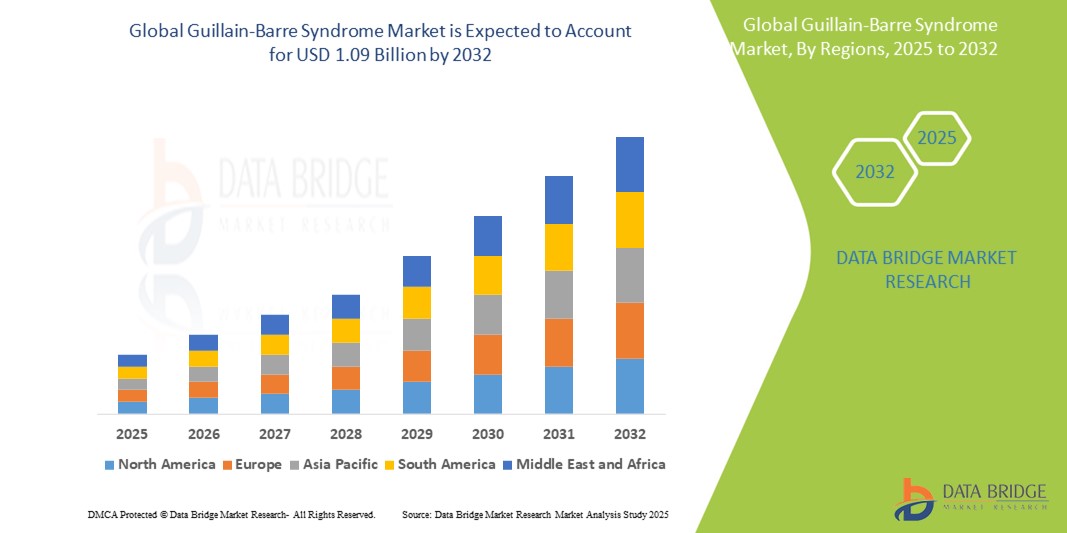
- The Global Guillain-Barre Syndrome Market size was valued at USD 0.72 billion in 2024 and is expected to reach USD 1.09 billion by 2032, at a CAGR of 5.30% during the forecast period
- The market growth is primarily driven by increased awareness and early diagnosis of autoimmune neurological disorders, along with advancements in electrodiagnostic techniques and imaging modalities that facilitate early and accurate detection
- Additionally, the rising prevalence of GBS cases globally, often associated with infections such as Zika virus, Campylobacter jejuni, and more recently post-COVID-19 vaccination or infection, has propelled the demand for effective treatment options such as IV immunoglobulins (IVIG), plasmapheresis, and physical rehabilitation therapies. These evolving healthcare needs and technological advancements are reinforcing the market’s expansion
Guillain-Barre Syndrome Market Analysis
- Guillain-Barré Syndrome (GBS) is a rare but serious autoimmune neurological disorder where the body’s immune system mistakenly attacks the peripheral nerves. Growing recognition of the disease, coupled with improvements in diagnostic technologies and therapeutic interventions, is shaping the market's expansion, particularly in acute care settings.
- The rising demand for GBS treatment is primarily driven by increased incidence of viral and bacterial infections, such as Campylobacter jejuni, Zika virus, and COVID-19, which have been linked to triggering GBS. In addition, growing awareness, enhanced government support for rare diseases, and advancements in IVIG and plasma exchange therapies are fueling the market.
- North America dominates the Guillain-Barré Syndrome market, expected to hold the largest revenue share of over 38% in 2025, supported by robust healthcare infrastructure, high awareness levels, and increased investments in rare neurological disorder research. The U.S. leads the region, with strong adoption of advanced diagnostic tools such as nerve conduction studies and electromyography.
- Asia-Pacific is projected to be the fastest-growing region during the forecast period due to improving healthcare access, increased public health initiatives targeting neurological conditions, and a rising patient population. Countries such as India and China are witnessing increased diagnostic rates and evolving treatment accessibility.
- The Intravenous Immunoglobulin (IVIG) segment is expected to dominate the GBS therapeutics market, accounting for over 45% market share in 2025, attributed to its widespread use, faster onset of action, and inclusion in standard treatment protocols globally.
Report Scope and Guillain-Barre Syndrome Market Segmentation
|
Attributes |
Guillain-Barre Syndrome Key Market Insights |
|
Segments Covered |
|
|
Countries Covered |
North America
Europe
Asia-Pacific
Middle East and Africa
South America
|
|
Key Market Players |
|
|
Market Opportunities |
|
|
Value Added Data Infosets |
In addition to the insights on market scenarios such as market value, growth rate, segmentation, geographical coverage, and major players, the market reports curated by the Data Bridge Market Research also include in-depth expert analysis, pricing analysis, brand share analysis, consumer survey, demography analysis, supply chain analysis, value chain analysis, raw material/consumables overview, vendor selection criteria, PESTLE Analysis, Porter Analysis, and regulatory framework. |
Guillain-Barre Syndrome Market Trends
“Therapeutic Advances and Improved Access to Early Diagnosis”
- A significant and emerging trend in the global Guillain-Barré Syndrome (GBS) market is the increasing integration of novel diagnostic techniques and improved treatment protocols aimed at shortening disease progression and improving long-term outcomes.
- Enhanced use of nerve conduction studies (NCS), electromyography (EMG), and cerebrospinal fluid (CSF) analysis has made earlier and more accurate diagnosis possible, allowing timely intervention with standard therapies such as intravenous immunoglobulin (IVIG) and plasmapheresis.
- For instance, recent clinical research has demonstrated the early administration of IVIG within 7 days of onset significantly reduces the severity of symptoms and improves mobility outcomes. Newer IVIG formulations with improved safety and reduced infusion times are gaining clinical adoption, particularly in high-burden healthcare settings.
- In addition, the rising focus on rehabilitation techniques such as robotic-assisted physical therapy and hydrotherapy, along with advancements in neuromuscular recovery programs, is reshaping post-acute treatment protocols for GBS patients.
- These evolving trends are not only improving patient quality of life but also promoting the development of multidisciplinary care models combining neurology, rehabilitation, and homecare—paving the way for integrated and patient-centric treatment approaches.
- Companies and institutions are increasingly collaborating on clinical trials and real-world evidence studies to evaluate the long-term efficacy of current and emerging treatment options, indicating a trend toward evidence-based customization of therapies.
Guillain-Barre Syndrome Market Dynamics
Driver
“Increasing Incidence of Viral Infections and Rising Awareness of Neurological Autoimmune Disorders”
- The rising number of GBS cases linked to viral infections—such as Zika virus, Epstein-Barr virus, Campylobacter jejuni, and more recently, COVID-19—has heightened awareness about the disorder and emphasized the need for faster diagnosis and treatment access.
- For instance, during the Zika virus outbreaks in Latin America and Southeast Asia, GBS incidence rose by over 10 times in certain populations, prompting urgent global public health interventions. These outbreaks have pushed governments and private organizations to fund better diagnostic frameworks and stockpile essential treatments like IVIG and plasma exchange kits.
- Growing public health campaigns, coupled with neurological disorder awareness initiatives by organizations like the National Institute of Neurological Disorders and Stroke (NINDS) and Global Rare Disease Patient Networks, have contributed to higher diagnosis rates and earlier therapeutic intervention.
- Furthermore, improving access to tertiary care and rehabilitation services in emerging markets, supported by investments in healthcare infrastructure, is fostering demand for GBS-related therapeutics and services, especially in Asia-Pacific and Latin America.
Restraint/Challenge
“High Treatment Costs and Limited Access in Low-Income Regions”
- One of the key challenges limiting the growth of the Guillain-Barré Syndrome market is the high cost of treatment, particularly for IVIG therapy and extended hospital stays, which can be financially burdensome in regions with limited healthcare funding or insurance coverage.
- A typical GBS treatment course using IVIG can cost between USD 10,000 to USD 20,000 per patient, making it unaffordable for many, especially in low-income countries where access to specialized neurology centers is sparse.
- In addition, the availability of trained neurologists, diagnostic infrastructure, and plasma exchange facilities is inconsistent across various global regions. These disparities result in delayed diagnosis and suboptimal treatment outcomes, further impacting survival and quality of life for patients.
- Another concern is lack of disease-specific therapeutic innovation. Despite the progress in supportive care, no curative drugs are available, and current treatment relies primarily on immune modulation and symptom management. This limits long-term disease control, especially in recurrent or treatment-resistant cases.
- Overcoming these barriers will require a multifaceted approach, including policy-level healthcare funding, inclusion of GBS in rare disease programs, broader availability of biosimilar IVIG, and global collaboration for more accessible therapeutic pipelines.
Guillain-Barre Syndrome Market Scope
The market is segmented on the basis of type, communication protocol, unlocking mechanism, and application.
- By Type
On the basis of type, the Guillain-Barré Syndrome (GBS) market is segmented into Acute Inflammatory Demyelinating Polyradiculoneuropathy (AIDP), Miller Fisher Syndrome (MFS), and Acute Motor Axonal Neuropathy (AMAN). The AIDP segment dominated the market with the largest revenue share of 54.6% in 2025, as it is the most common subtype in North America and Europe. Characterized by muscle weakness and areflexia, AIDP is often triggered by bacterial or viral infections. Its prevalence, combined with early diagnostic recognition and standardized treatment protocols, reinforces its market dominance across developed healthcare systems.
The AMAN segment is projected to witness the fastest CAGR of 6.9% from 2025 to 2032, especially in Asia-Pacific and Latin America, where this subtype is more prevalent. The growing incidence in pediatric populations and increasing awareness among healthcare professionals in countries like China, India, and Brazil are expected to drive this segment's rapid growth over the forecast period.
- By Therapeutics
On the basis of therapeutics, the market is segmented into Intravenous Immunoglobulin (IVIG), Plasma Exchange, and Others. IVIG holds the largest market share in 2025, driven by its status as the first-line treatment for GBS, owing to its ease of administration, faster action, and minimal side effects. IVIG is commonly used across all GBS subtypes and age groups, making it a highly versatile therapeutic option.
The Plasma Exchange segment is expected to grow at the fastest CAGR during the forecast period, due to increasing use in severe or IVIG-resistant cases and its proven efficacy in shortening recovery time when started early in the disease course. Technological improvements in apheresis equipment and availability in tertiary hospitals are contributing to its rising adoption.
• By Route of Administration
The route of administration is segmented into Oral and Parenteral. Parenteral administration dominates the market in 2025, as both IVIG and plasma exchange are delivered intravenously. This segment’s leadership is due to the acute nature of GBS requiring rapid intervention, which parenteral delivery ensures.
The Oral segment, while limited, is projected to witness moderate growth as adjunct therapies such as corticosteroids or pain relievers are administered orally in some supportive care cases.
• By Diagnosis
The diagnosis segment is categorized into Lumbar Puncture, Electromyography (EMG), Nerve Conduction Studies (NCS), and Others. Nerve Conduction Studies held the largest share in 2025, due to their diagnostic accuracy in identifying demyelinating versus axonal forms of GBS. Their non-invasive nature and integration into neurology protocols across major hospitals drive their dominance.
Lumbar puncture is expected to grow at the fastest CAGR, as it plays a critical role in confirming GBS through cerebrospinal fluid (CSF) analysis, especially in regions where EMG/NCS may not be readily available.
• By Treatment
The treatment segment includes Plasmapheresis, Medication, Physical Therapy, Hydrotherapy, and Others. Medication (especially IVIG) leads the market in 2025, due to its frontline usage in both inpatient and outpatient settings. However, Physical Therapy is projected to experience the fastest growth, as rehabilitation becomes integral to long-term recovery and recurrence prevention. Increasing investment in neuro-rehabilitation centers globally is also boosting this segment.
• By End User
The end user segment is classified into Hospitals and Clinics, Diagnostic Centers, and Others. Hospitals and Clinics accounted for the largest revenue share in 2025, owing to the acute nature of the disease that necessitates inpatient care, continuous monitoring, and intravenous therapy. Specialized neurology units further contribute to the high preference for hospitals.
Diagnostic Centers are expected to grow at the fastest CAGR, as advancements in outpatient diagnostics and the decentralization of neurological testing (EMG/NCS) facilitate earlier diagnosis and referral, improving access in developing regions.
• By Distribution Channel
On the basis of distribution channel, the market is segmented into Hospital Pharmacies, Retail Pharmacies, and Others. Hospital Pharmacies dominated the market in 2025, as IVIG and plasma exchange therapies are typically administered in clinical settings, where procurement and storage are handled in-house.
The Retail Pharmacies segment is projected to grow significantly, particularly in urban areas, where prescriptions for supportive medications such as pain relievers, corticosteroids, and physical therapy supplements are increasingly filled through retail outlets. Expanding e-pharmacy platforms in Asia-Pacific are also expected to contribute to this segment’s growth.
Guillain-Barre Syndrome Market Regional Analysis
- North America dominates the Guillain-Barré Syndrome (GBS) market with the largest revenue share of 38.4% in 2024, driven by high awareness levels, robust healthcare infrastructure, and early access to advanced neurological care and immunotherapies.
- Consumers and healthcare providers in the region benefit from rapid diagnostic capabilities, including widespread availability of nerve conduction studies, electromyography (EMG), and lumbar puncture facilities, ensuring timely diagnosis and intervention.
- The market is further fueled by government-backed rare disease initiatives, increasing research funding, and the availability of high-cost but effective treatments like IVIG and plasmapheresis under insurance coverage. These factors collectively establish North America as the leading region for GBS treatment adoption, particularly across specialized hospitals and academic research institutions.
U.S. Guillain-Barré Syndrome (GBS) Market Insight
The U.S. GBS market captured the largest revenue share of over 78% within North America in 2025, driven by advanced healthcare infrastructure, high awareness levels, and access to cutting-edge treatment options. The availability of intravenous immunoglobulin (IVIG), plasmapheresis, and comprehensive rehabilitation services supports early intervention and recovery. In addition, active research by institutions like the NIH and CDC, coupled with strong insurance coverage for rare neurological conditions, contributes to the market’s strength. Increasing case detection linked to viral infections, such as Zika and COVID-19, is further amplifying the clinical focus on GBS.
Europe Guillain-Barré Syndrome (GBS) Market Insight
The European GBS market is expected to grow at a steady CAGR during the forecast period, supported by structured healthcare systems, favorable reimbursement policies, and a strong presence of clinical neurologists. The region’s emphasis on early neurological diagnosis through EMG and nerve conduction studies ensures timely treatment with IVIG or plasma exchange. GBS registries and collaborative research across countries like France, Italy, and Spain are helping track incidence and improve care protocols. Heightened surveillance post-COVID-19 has also contributed to increased case recognition and treatment uptake across Europe.
U.K. Guillain-Barré Syndrome (GBS) Market Insight
The U.K. GBS market is projected to grow at a notable CAGR, driven by a well-established NHS framework that ensures fast-track referrals to neurologists and access to IVIG treatment. Rising awareness of post-infectious neurological conditions and recent government-funded studies on GBS post-COVID-19 vaccination are driving more robust data collection and clinical research. Continued investment in rehabilitation services and neurological support centers is strengthening the long-term care ecosystem for GBS patients across the country.
Germany Guillain-Barré Syndrome (GBS) Market Insight
Germany is expected to hold a significant share of the European GBS market, benefiting from its highly specialized neurological departments and advanced diagnostic facilities. The country’s strong focus on research and real-world evidence generation is helping to optimize GBS treatment protocols. Furthermore, Germany’s universal health coverage ensures timely access to costly therapies like IVIG, even in rural areas. The rising prevalence of post-infectious autoimmune conditions has led to more proactive diagnostic screening in hospitals, supporting long-term market growth.
Asia-Pacific Guillain-Barré Syndrome (GBS) Market Insight
The Asia-Pacific GBS market is poised to grow at the fastest CAGR of over 7.1% in 2025, owing to rapid improvements in healthcare access, rising public health awareness, and government-led neurological disorder initiatives. Countries like India, China, and Japan are experiencing a rise in GBS incidence linked to viral outbreaks and vaccination campaigns. Enhanced access to EMG, lumbar puncture diagnostics, and IVIG in urban hospitals, along with investments in neurorehabilitation infrastructure, are supporting broader treatment availability across the region.
Japan Guillain-Barré Syndrome (GBS) Market Insight
Japan is witnessing steady growth in the GBS market, driven by its aging population, high medical standards, and efficient diagnostic protocols. The prevalence of post-infectious neurological disorders and increasing investment in geriatric neurology are driving the need for early diagnosis and effective care. Japan’s universal health system covers IVIG and rehabilitation services, and national research programs continue to track GBS incidence trends and optimize patient management strategies.
China Guillain-Barré Syndrome (GBS) Market Insight
China accounted for the largest revenue share in the Asia-Pacific GBS market in 2025, supported by significant population size, rising GBS case incidence, and large-scale healthcare modernization. The country is seeing an increasing number of GBS diagnoses post-COVID-19, which has prompted more investments in neurology departments and IVIG supply chains. Government healthcare reform, combined with public hospital expansions and access to diagnostic tools, is improving early detection and treatment across both urban and semi-urban areas.
Guillain-Barre Syndrome Market Share
The Guillain-Barre Syndrome industry is primarily led by well-established companies, including:
- Grifols, S.A. (Spain)
- CSL (Australia)
- Octapharma AG (Switzerland)
- Baxter (U.S.)
- Kedrion (Italy)
- Biotest AG (Germany)
- LFB (France)
- Takeda Pharmaceutical Company Limited (Japan)
- Bristol-Myers Squibb (U.S.)
- Sanofi (France)
- Novo Nordisk A/S (Denmark)
- Sobi (Swedish Orphan Biovitrum) (Sweden)
- Alexion Pharmaceuticals, Inc. (U.S.)
- Lilly (U.S.)
- Regeneron Pharmaceuticals Inc. (U.S.)
Latest Developments in Global Guillain-Barre Syndrome Market
- In February 2025, Grifols announced positive results from a Phase 2/3 clinical trial of its subcutaneous immunoglobulin (SCIg) therapy for GBS. The study demonstrated improved physical performance in patients, as measured by the two-minute walk distance (2MWD), after one year of treatment. This advancement offers a more convenient and potentially effective alternative to traditional intravenous immunoglobulin (IVIG) therapy
- In December 2024, CSL Behring initiated a strategic partnership with leading academic hospitals in Europe to advance research on GBS biomarkers and personalized immunotherapy approaches. The initiative focuses on early identification of severe cases and tailoring treatment based on patient-specific immune response profiles
- In November 2024, the U.S. National Institute of Neurological Disorders and Stroke (NINDS) funded a multi-center study to develop AI-powered diagnostic models for Guillain-Barré Syndrome. This project aims to leverage machine learning to analyze clinical and electrophysiological data, improving early detection and prognosis prediction
- In October 2024, Octapharma AG received FDA Fast Track designation for its novel immunoglobulin therapy, OctaGBS, developed specifically for GBS. The therapy is designed to enhance immune modulation with a faster onset of action, and Phase II trials are currently underway, with promising interim safety and efficacy data.

- Interactive Data Analysis Dashboard
- Company Analysis Dashboard for high growth potential opportunities
- Research Analyst Access for customization & queries
- Competitor Analysis with Interactive dashboard
- Latest News, Updates & Trend analysis
- Harness the Power of Benchmark Analysis for Comprehensive Competitor Tracking
Data collection and base year analysis are done using data collection modules with large sample sizes. The stage includes obtaining market information or related data through various sources and strategies. It includes examining and planning all the data acquired from the past in advance. It likewise envelops the examination of information inconsistencies seen across different information sources. The market data is analysed and estimated using market statistical and coherent models. Also, market share analysis and key trend analysis are the major success factors in the market report. To know more, please request an analyst call or drop down your inquiry.
The key research methodology used by DBMR research team is data triangulation which involves data mining, analysis of the impact of data variables on the market and primary (industry expert) validation. Data models include Vendor Positioning Grid, Market Time Line Analysis, Market Overview and Guide, Company Positioning Grid, Patent Analysis, Pricing Analysis, Company Market Share Analysis, Standards of Measurement, Global versus Regional and Vendor Share Analysis. To know more about the research methodology, drop in an inquiry to speak to our industry experts.
Data Bridge Market Research is a leader in advanced formative research. We take pride in servicing our existing and new customers with data and analysis that match and suits their goal. The report can be customized to include price trend analysis of target brands understanding the market for additional countries (ask for the list of countries), clinical trial results data, literature review, refurbished market and product base analysis. Market analysis of target competitors can be analyzed from technology-based analysis to market portfolio strategies. We can add as many competitors that you require data about in the format and data style you are looking for. Our team of analysts can also provide you data in crude raw excel files pivot tables (Fact book) or can assist you in creating presentations from the data sets available in the report.












