


Gynecology Surgical Instruments Market Size
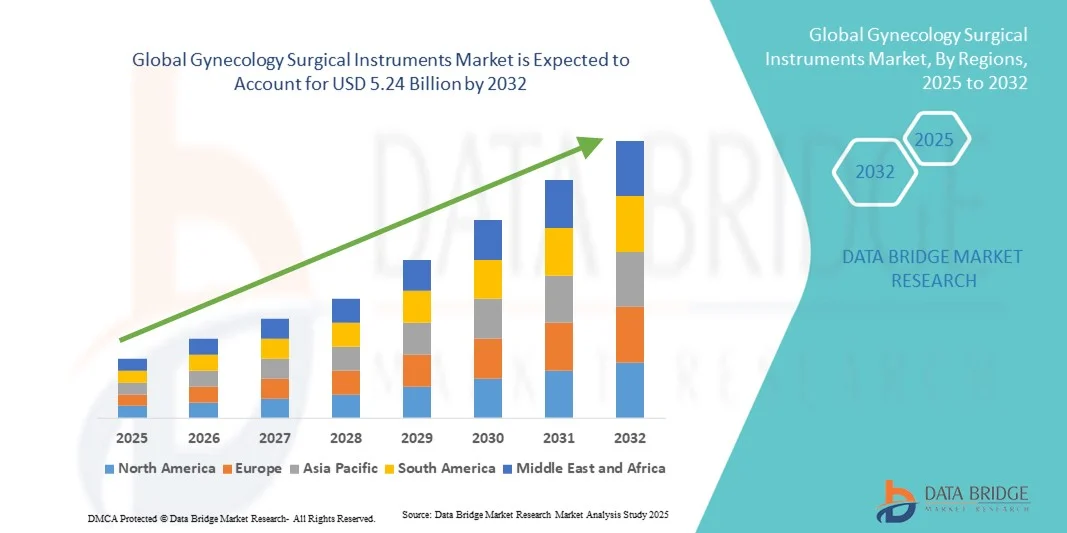
- The global gynecology surgical instruments market size was valued at USD 3.00 billion in 2024 and is expected to reach USD 5.24 billion by 2032, at a CAGR of 7.23% during the forecast period
- The market growth is largely driven by the rising prevalence of gynecological disorders, increasing surgical procedures, and technological advancements in minimally invasive instruments, which are improving clinical outcomes and patient safety
- Furthermore, growing healthcare investments, heightened demand for advanced diagnostic and treatment solutions, and the expanding adoption of robotic-assisted surgeries are establishing gynecology surgical instruments as a critical component of modern women’s healthcare. These converging factors are accelerating the uptake of these solutions, thereby significantly boosting the industry’s growth
Gynecology Surgical Instruments Market Analysis
- Gynecology surgical instruments, encompassing forceps, scissors, trocars, and curettes, are essential tools in procedures such as hysterectomy, cesarean section, laparoscopy, and other gynecological surgeries, owing to their precision, reliability, and role in improving patient outcomes through minimally invasive techniques
- The escalating demand for gynecology surgical instruments is primarily fueled by the rising incidence of gynecological disorders, increasing awareness of women’s health, and the growing preference for minimally invasive and robotic-assisted procedures that reduce recovery time and surgical risks
- North America dominated the gynecology surgical instruments market with the largest revenue share of 44.2% in 2024, characterized by advanced healthcare infrastructure, high adoption of innovative surgical solutions, and strong presence of leading medical device manufacturers, with the U.S. witnessing robust growth in surgical volumes supported by favorable reimbursement and technology integration
- Asia-Pacific is expected to be the fastest growing region in the gynecology surgical instruments market during the forecast period due to rising healthcare expenditure, expanding medical tourism, and increasing investments in women’s healthcare services
- The forceps segment dominated the gynecology surgical instruments market with a market share of 32.9% in 2024, driven by their wide clinical applications, cost-effectiveness, and indispensable role across a variety of gynecological procedures
Report Scope and Gynecology Surgical Instruments Market Segmentation
|
Attributes |
Gynecology Surgical Instruments Key Market Insights |
|
Segments Covered |
|
|
Countries Covered |
North America
Europe
Asia-Pacific
Middle East and Africa
South America
|
|
Key Market Players |
|
|
Market Opportunities |
|
|
Value Added Data Infosets |
In addition to the insights on market scenarios such as market value, growth rate, segmentation, geographical coverage, and major players, the market reports curated by the Data Bridge Market Research also include in-depth expert analysis, pricing analysis, brand share analysis, consumer survey, demography analysis, supply chain analysis, value chain analysis, raw material/consumables overview, vendor selection criteria, PESTLE Analysis, Porter Analysis, and regulatory framework. |
Gynecology Surgical Instruments Market Trends
Shift Toward Minimally Invasive and Robotic-Assisted Surgeries
- A significant and accelerating trend in the global gynecology surgical instruments market is the growing adoption of minimally invasive and robotic-assisted surgical techniques, driven by demand for shorter recovery times, reduced surgical risks, and improved patient outcomes
- For instance, Intuitive Surgical’s da Vinci system has been increasingly used in gynecological procedures, enabling enhanced precision and reduced post-operative complications. Similarly, Medtronic has been expanding its minimally invasive instrument portfolio tailored for women’s health surgeries
- The integration of robotics and advanced imaging with gynecology surgical instruments enables surgeons to perform complex procedures with greater accuracy and flexibility, reducing errors and enhancing clinical efficiency. For instance, Zimmer Biomet’s robotic-assisted platforms are being adopted in gynecological applications to provide real-time data and optimized surgical planning
- The seamless combination of robotic systems, high-definition visualization, and precision instruments allows for greater control, smaller incisions, and improved ergonomics for surgeons, thereby transforming operative workflows
- This trend toward less invasive, technology-driven interventions is reshaping expectations of gynecological surgery. Consequently, companies such as Olympus are developing advanced endoscopic and robotic-compatible surgical instruments to strengthen their market position
- The demand for minimally invasive and robotic-assisted gynecology surgical instruments is rapidly growing across hospitals and specialty clinics, as healthcare providers increasingly prioritize efficiency, patient satisfaction, and enhanced surgical outcomes
Gynecology Surgical Instruments Market Dynamics
Driver
Increasing Surgical Volumes Driven by Rising Gynecological Disorders
- The rising prevalence of gynecological disorders such as fibroids, endometriosis, and ovarian cysts, coupled with increasing surgical intervention rates, is a significant driver for the growing demand for gynecology surgical instruments
- For instance, in March 2024, CooperSurgical launched a new range of hysteroscopic instruments aimed at improving surgical efficiency and patient safety in minimally invasive gynecological procedures. Such developments are expected to fuel market expansion in the coming years
- As awareness of women’s health increases and more patients seek surgical treatment, the demand for advanced instruments offering precision, safety, and efficiency continues to grow, creating strong momentum in the market
- Furthermore, rising global investments in women’s healthcare and the modernization of hospital surgical departments are making gynecology surgical instruments indispensable to improving procedural outcomes
- The convenience of advanced tools that reduce operative time, support minimally invasive techniques, and enhance recovery rates are key factors propelling their adoption across hospitals and specialty clinics worldwide. The trend toward outpatient and day-care procedures is further amplifying demand
Restraint/Challenge
High Cost of Advanced Instruments and Stringent Regulatory Compliance
- Concerns surrounding the high cost of advanced robotic and minimally invasive gynecology instruments, along with stringent regulatory requirements for medical devices, pose significant challenges to broader adoption
- For instance, regulatory delays in the approval of new laparoscopic and robotic-assisted instruments in Europe have slowed their market penetration, raising hurdles for manufacturers
- Addressing these barriers through cost-optimized designs, value-based healthcare strategies, and adherence to strict compliance frameworks is essential for strengthening provider confidence. Companies such as Karl Storz emphasize compliance certifications and global safety standards to reinforce their brand positioning
- In addition, the financial burden of high-priced robotic and advanced instruments can restrict adoption in low- and middle-income regions, limiting access for many healthcare providers. While reusable and modular instruments have reduced costs, initial investments remain substantial
- While affordability challenges are being gradually addressed through cost-effective alternatives, the perceived premium pricing for advanced surgical technology continues to hinder widespread adoption, particularly in price-sensitive regions
- Overcoming these challenges through government support, training programs, and affordable innovations will be crucial for ensuring equitable access and sustained market growth
Gynecology Surgical Instruments Market Scope
The market is segmented on the basis of type, application, and end user.
- By Type
On the basis of type, the gynecology surgical instruments market is segmented into forceps, scissors, trocars, needle holders, vaginal speculums, dilators, and others. The forceps segment dominated the market with the largest market revenue share of 32.9% in 2024, driven by their widespread use across various gynecological procedures such as hysterectomy, cesarean section, and laparoscopy. Surgeons prioritize forceps for their precision, reliability, and versatility in tissue handling and suturing. The high adoption is also supported by continuous innovations in ergonomic design and specialized coatings that enhance grip and reduce tissue trauma. Furthermore, hospitals and clinics favor forceps due to their reusability and cost-effectiveness over disposable alternatives. The segment sees steady demand across both developed and emerging markets, particularly where minimally invasive surgeries are becoming standard. Forceps are considered indispensable in operative gynecology, contributing to their sustained market dominance.
The trocar segment is anticipated to witness the fastest growth rate of 20% from 2025 to 2032, fueled by the increasing adoption of laparoscopic and robotic-assisted surgeries. Trocars provide safe and controlled access to the abdominal cavity, making them critical for minimally invasive procedures. The growing preference for smaller incisions, reduced postoperative pain, and faster recovery has driven surgeons to increasingly rely on advanced trocar designs. Innovations such as bladeless, optical, and single-use trocars are further stimulating demand. The expanding number of outpatient and day-care surgical procedures also contributes to the segment’s rapid growth. Trocars are particularly gaining traction in Asia-Pacific due to rising healthcare infrastructure investments and growing surgical volumes.
- By Application
On the basis of application, the gynecology surgical instruments market is segmented into laparoscopy, hysteroscopy, dilation and curettage, colposcopy, and others. The laparoscopy segment dominated the market with the largest market share of 40% in 2024, due to the rising preference for minimally invasive gynecological surgeries. Laparoscopic instruments reduce hospital stay, post-operative pain, and recovery time, making them favorable among patients and healthcare providers asuch as. Surgeons prefer laparoscopic procedures for complex surgeries such as myomectomy and ovarian cystectomy due to higher precision and better visualization. The segment is supported by technological advancements such as high-definition imaging, ergonomic instrument designs, and energy-based devices. Laparoscopy is also widely adopted in developed regions with advanced surgical infrastructure. Hospitals increasingly invest in laparoscopic instrument sets, reinforcing the segment’s market dominance.
The hysteroscopy segment is expected to witness the fastest growth rate of 18% from 2025 to 2032, driven by the increasing prevalence of uterine disorders such as fibroids, polyps, and abnormal bleeding. Hysteroscopic instruments allow for minimally invasive diagnosis and treatment of intrauterine conditions. Rising awareness of women’s health and the benefits of early intervention are accelerating the adoption of hysteroscopic procedures. The availability of advanced endoscopic systems, coupled with training programs for gynecologists, further supports growth. Emerging markets with increasing healthcare access and gynecological procedure volumes are witnessing strong uptake. The segment benefits from hospitals and ambulatory surgery centers expanding their outpatient surgical capabilities.
- By End User
On the basis of end user, the gynecology surgical instruments market is segmented into hospitals and clinics, and ambulatory surgery centers. The hospitals and clinics segment dominated the market with the largest share of 68% in 2024, attributed to the high number of gynecological procedures performed in inpatient settings. Hospitals offer advanced surgical infrastructure, specialized gynecologists, and a broad range of instruments, ensuring the use of both basic and advanced surgical tools. Large hospitals also prioritize instrument quality, durability, and adherence to regulatory standards, driving consistent demand. The segment benefits from continuous investments in women’s health departments and minimally invasive surgical programs. Moreover, hospitals in developed regions have standardized procurement processes that favor established instrument suppliers. The segment’s dominance is reinforced by the growing patient population requiring operative gynecology interventions.
The ambulatory surgery centers segment is expected to witness the fastest growth rate of 16% from 2025 to 2032, driven by the increasing preference for outpatient gynecological procedures. ASCs provide cost-effective, efficient care for procedures such as hysteroscopy, laparoscopy, and dilation and curettage, offering shorter recovery times and lower hospital overhead. The growth is further supported by rising investments in modern outpatient surgical facilities and the adoption of minimally invasive instruments. ASCs appeal to patients seeking convenience, reduced waiting times, and lower procedural costs. Advanced instrument suppliers are increasingly targeting ASCs with compact, versatile, and easy-to-use gynecology surgical tools. This trend is particularly pronounced in North America and Asia-Pacific, where outpatient surgical adoption is rising rapidly.
Gynecology Surgical Instruments Market Regional Analysis
- North America dominated the gynecology surgical instruments market with the largest revenue share of 44.2% in 2024, characterized by advanced healthcare infrastructure, high adoption of innovative surgical solutions, and strong presence of leading medical device manufacturers
- Hospitals and clinics in the region prioritize advanced instruments that enhance precision, reduce operative time, and improve patient outcomes, fueling consistent demand for high-quality surgical tools
- This widespread adoption is further supported by strong healthcare investments, favorable reimbursement policies, a skilled medical workforce, and a technologically advanced population, establishing North America as a leading market for gynecology surgical instruments in both hospital and outpatient settings
U.S. Gynecology Surgical Instruments Market Insight
The U.S. gynecology surgical instruments market captured the largest revenue share of ~42% in 2024 within North America, fueled by a high prevalence of gynecological disorders and increasing adoption of minimally invasive and robotic-assisted surgeries. Hospitals and specialty clinics are prioritizing advanced instruments that enhance surgical precision, reduce operative time, and improve patient recovery outcomes. The growing preference for outpatient procedures and ambulatory surgery centers, combined with strong investments in women’s healthcare infrastructure, further propels market growth. Moreover, the integration of robotic-assisted systems, endoscopic imaging, and energy-based instruments is significantly contributing to the expansion of the U.S. market.
Europe Gynecology Surgical Instruments Market Insight
The Europe gynecology surgical instruments market is projected to expand at a substantial CAGR throughout the forecast period, primarily driven by rising surgical volumes, increasing awareness of women’s health, and adoption of advanced minimally invasive surgical technologies. Growing urbanization, coupled with well-established healthcare systems, is fostering the demand for gynecology surgical instruments across hospitals and clinics. European providers are also drawn to the precision, durability, and regulatory compliance of these instruments. The region is experiencing notable growth across hysteroscopy, laparoscopy, and outpatient surgical procedures, with instruments being incorporated in both new hospital setups and modernization of existing facilities.
U.K. Gynecology Surgical Instruments Market Insight
The U.K. gynecology surgical instruments market is anticipated to grow at a noteworthy CAGR during the forecast period, driven by the rising adoption of minimally invasive and robotic-assisted gynecological surgeries. Concerns regarding women’s health and the increasing number of surgical interventions are encouraging hospitals and clinics to invest in advanced surgical instruments. The U.K.’s strong healthcare infrastructure, high patient awareness, and well-established e-commerce and medical supply chains are expected to continue stimulating market growth. In addition, the trend of outpatient procedures and day-care surgeries is supporting the demand for compact and versatile instrument sets.
Germany Gynecology Surgical Instruments Market Insight
The Germany gynecology surgical instruments market is expected to expand at a considerable CAGR during the forecast period, fueled by increasing awareness of women’s health issues and the demand for technologically advanced surgical solutions. Germany’s robust healthcare infrastructure, focus on surgical innovation, and strict adherence to regulatory standards promote the adoption of precision instruments for both hospitals and outpatient facilities. The integration of instruments with minimally invasive and robotic-assisted procedures is becoming increasingly prevalent, with a strong preference for quality, durability, and patient safety aligning with local healthcare expectations.
Asia-Pacific Gynecology Surgical Instruments Market Insight
The Asia-Pacific gynecology surgical instruments market is poised to grow at the fastest CAGR during the forecast period of 2025 to 2032, driven by increasing surgical procedures, rising healthcare expenditure, and growing awareness of women’s health in countries such as China, Japan, and India. The expansion of hospitals, ambulatory surgery centers, and outpatient clinics, along with government initiatives supporting modern medical infrastructure, is driving the adoption of advanced gynecological instruments. Furthermore, the region is emerging as both a manufacturing hub and a rapidly growing consumer market, improving affordability and accessibility of surgical tools.
Japan Gynecology Surgical Instruments Market Insight
The Japan gynecology surgical instruments market is gaining momentum due to the country’s advanced healthcare infrastructure, rapid urbanization, and focus on minimally invasive surgical techniques. Japanese hospitals and specialty clinics emphasize patient safety, precision, and integration of instruments with robotic-assisted and endoscopic systems. The increasing number of outpatient procedures and connected surgical systems is fueling growth. Moreover, Japan’s aging female population is such asly to spur demand for instruments that enable safer, quicker, and less invasive gynecological procedures in both hospital and outpatient settings.
India Gynecology Surgical Instruments Market Insight
The India gynecology surgical instruments market accounted for the largest market revenue share in Asia-Pacific in 2024, attributed to the country’s rising prevalence of gynecological disorders, expanding middle class, and rapid development of healthcare infrastructure. India is witnessing increasing adoption of minimally invasive and outpatient surgical procedures, and advanced instruments are becoming popular in hospitals, clinics, and ambulatory surgery centers. Government initiatives promoting women’s healthcare, the growth of medical tourism, and the availability of affordable, high-quality instruments from domestic and international suppliers are key factors propelling market growth in India.
Gynecology Surgical Instruments Market Share
The Gynecology Surgical Instruments industry is primarily led by well-established companies, including:
- gSource (U.S.)
- MedGyn Products, Inc. (U.S.)
- MPM Medical Supply (U.S.)
- Angelus Medical and Optical (U.S.)
- Jalal Surgical (Pakistan)
- Max Plus India (India)
- National Surgical Corporation (Australia)
- Medicon eG. (Germany)
- STERIS (U.S.)
- Integra LifeSciences Corporation (U.S.)
- Stryker (U.S.)
- Johnson & Johnson and its affiliates (U.S.)
- Medtronic (Ireland)
- Boston Scientific Corporation (U.S.)
- Smith + Nephew (U.K.)
- Zimmer Biomet (U.S.)
- Karl Storz (Germany)
- Olympus Corporation (Japan)
- Richard Wolf GmbH (Germany)
- Aesculap Inc. (U.S.)
What are the Recent Developments in Global Gynecology Surgical Instruments Market?
- In August 2025, Distalmotion received FDA 510(k) clearance for its Dexter robotic surgery system, enabling its use in hysterectomy procedures. This advancement marks a significant step in integrating robotic assistance into gynecological surgeries, enhancing precision and reducing recovery times for patients
- In June 2025, Minerva Surgical introduced the HERizon Hysto-Kit, a single-use, pre-assembled kit designed to simplify office-based hysteroscopy procedures. This innovation aims to save time, reduce setup complexity, and maintain procedural consistency in outpatient settings, reflecting the industry's shift towards more efficient and patient-friendly surgical solutions
- In March 2025, Olympus announced the launch of its first AI-powered clinical decision tool through a strategic partnership with Ziosoft. This platform is designed to enhance surgical planning and decision-making, marking a significant advancement in integrating artificial intelligence into gynecological surgeries
- In January 2025, JUNE MEDICAL and Aspen Surgical announced a strategic collaboration to distribute the Galaxy II retractor system across the U.S. market. This partnership aims to expand access to the versatile, self-retaining surgical device, enhancing visibility and access during gynecological procedures
- In October 2024, Minerva Surgical entered into a strategic partnership with Blackmaple Group and WHAAPA to provide access to office-based solutions for women's health administrative and clinical staff. This collaboration focuses on enhancing the availability and efficiency of gynecological surgical instruments in outpatient settings

- Interactive Data Analysis Dashboard
- Company Analysis Dashboard for high growth potential opportunities
- Research Analyst Access for customization & queries
- Competitor Analysis with Interactive dashboard
- Latest News, Updates & Trend analysis
- Harness the Power of Benchmark Analysis for Comprehensive Competitor Tracking
Data collection and base year analysis are done using data collection modules with large sample sizes. The stage includes obtaining market information or related data through various sources and strategies. It includes examining and planning all the data acquired from the past in advance. It likewise envelops the examination of information inconsistencies seen across different information sources. The market data is analysed and estimated using market statistical and coherent models. Also, market share analysis and key trend analysis are the major success factors in the market report. To know more, please request an analyst call or drop down your inquiry.
The key research methodology used by DBMR research team is data triangulation which involves data mining, analysis of the impact of data variables on the market and primary (industry expert) validation. Data models include Vendor Positioning Grid, Market Time Line Analysis, Market Overview and Guide, Company Positioning Grid, Patent Analysis, Pricing Analysis, Company Market Share Analysis, Standards of Measurement, Global versus Regional and Vendor Share Analysis. To know more about the research methodology, drop in an inquiry to speak to our industry experts.
Data Bridge Market Research is a leader in advanced formative research. We take pride in servicing our existing and new customers with data and analysis that match and suits their goal. The report can be customized to include price trend analysis of target brands understanding the market for additional countries (ask for the list of countries), clinical trial results data, literature review, refurbished market and product base analysis. Market analysis of target competitors can be analyzed from technology-based analysis to market portfolio strategies. We can add as many competitors that you require data about in the format and data style you are looking for. Our team of analysts can also provide you data in crude raw excel files pivot tables (Fact book) or can assist you in creating presentations from the data sets available in the report.













