


What is the Hafnium Oxide Materials Market Size and Growth Rate?
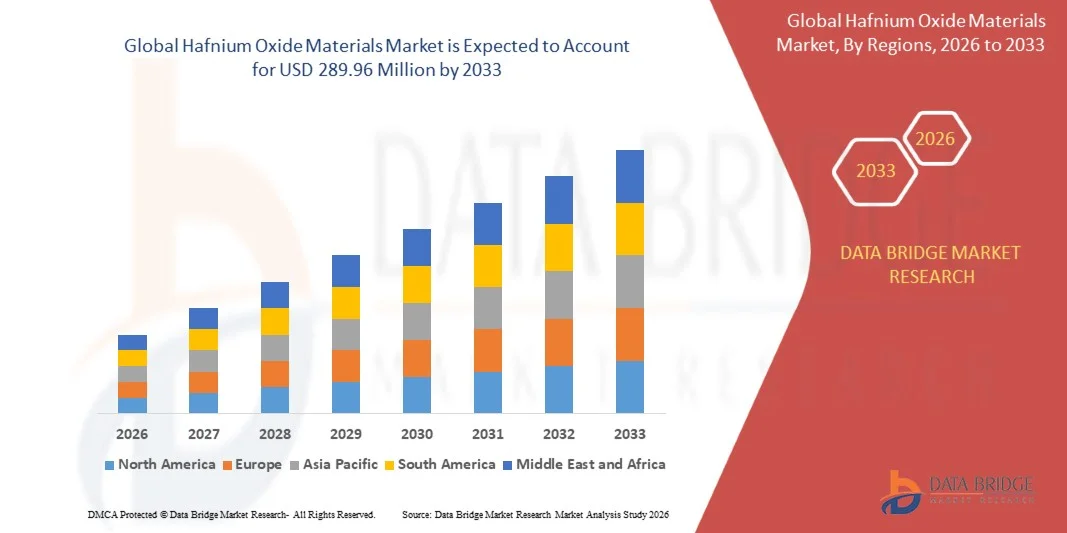
- As per Data Bridge Market Research analysis, the hafnium oxide materials market was valued at USD 146.38 million in 2025 and is projected to reach USD 289.96 million by 2033, growing at a CAGR of 8.92% from 2026 to 2033.
- The market is experiencing steady growth driven by increasing demand for high-k dielectric materials in semiconductor manufacturing, expanding use of hafnium oxide in optical coatings and advanced ceramics, and rising adoption across aerospace, defense, and nuclear applications.
- The growing adoption of advanced semiconductor nodes, together with continuous investments in next-generation memory technologies and high-performance electronic devices, is accelerating the consumption of high-purity hafnium oxide materials. Hafnium oxide is increasingly utilized in gate dielectric films, optical coatings, and high-temperature ceramic applications owing to its excellent dielectric constant, thermal stability, and corrosion resistance, supporting sustained market expansion across electronics and advanced manufacturing industries.
Market Size & Forecast
- Global Market Value (2025): USD 146.38 Million
- Expected Market Value (2033): USD 289.96 Million
- Forecast CAGR (2026–2033): 8.92%
- Leading Region in 2025: North America
- Fastest Growing Region: Asia Pacific
What are the Major Takeaways of the Hafnium Oxide Materials Market?
- North America dominated the hafnium oxide materials market with the largest revenue share of 48.0% in 2025, supported by strong demand from semiconductor fabrication, aerospace & defense industries, and advanced materials manufacturing.
- Asia-Pacific is expected to be the fastest-growing region at a CAGR of 7.4% from 2026 to 2033, fueled by expanding semiconductor manufacturing capacity, increasing investments in advanced electronics, and rising demand across China, Japan, South Korea, Taiwan, and India
- The powder segment led the market with a 46.9% share in 2025, driven by its extensive utilization as the primary raw material for semiconductor manufacturing, advanced ceramics, optical coatings, and high-temperature refractory applications
- Nanoparticles are the fastest-growing product type, projected to register a CAGR of 9.3%, reflecting the surge in research and commercialization of nanoscale electronic materials and advanced functional coatings.
- The atomic layer deposition (ALD) segment dominated the processing technology category with a 44.7% revenue share in 2025, led by its ability to deposit ultra-thin, highly uniform, and conformal hafnium oxide films required for advanced semiconductor devices
- Semiconductor gate dielectrics accounted for 34.7% of the market share in 2025, preferred by the widespread adoption of hafnium oxide as a high-k dielectric material in advanced complementary metal-oxide-semiconductor technologies.
- The ReRAM/memristors segment is the fastest-growing application category, with a CAGR of 10.8%, driven by increasing development of next-generation non-volatile memory technologies.
Report Scope and Hafnium Oxide Materials Market Segmentation
|
Attributes |
Hafnium Oxide Materials Key Market Insights |
|
Segments Covered |
|
|
Countries Covered |
North America
Europe
Asia-Pacific
Middle East and Africa
South America
|
|
Key Market Players |
|
|
Market Opportunities |
|
|
Value Added Data Infosets |
In addition to the insights on market scenarios such as market value, growth rate, segmentation, geographical coverage, and major players, the market reports curated by the Data Bridge Market Research also include import export analysis, production capacity overview, production consumption analysis, price trend analysis, climate change scenario, supply chain analysis, value chain analysis, raw material/consumables overview, vendor selection criteria, PESTLE Analysis, Porter Analysis, and regulatory framework. |
What is the Key Trend in the Hafnium Oxide Materials Market?
- The adoption of ferroelectric hafnium oxide materials is accelerating as semiconductor manufacturers pursue low-power, high-density non-volatile memory technologies compatible with advanced complementary metal-oxide-semiconductor fabrication processes.
- For instance, in March 2025, researchers published wafer-scale integration of crystalline undoped HfO₂-based ferroelectrics demonstrating ultrafast switching performance for next-generation memory devices and scalable semiconductor manufacturing.
- High-performance hafnium oxide thin films enable excellent dielectric properties, improved scalability, and enhanced endurance required for advanced memory, logic, and embedded semiconductor applications.
- Research organizations and semiconductor developers are expanding investigations into hafnium oxide-based ferroelectric devices to improve storage density, energy efficiency, and complementary metal-oxide-semiconductor compatibility.
- For instance, in February 2025, Fraunhofer IPMS published a comprehensive review highlighting ferroelectric hafnium oxide as a transformative material for memories, sensors, and nanoelectronic systems.
- As semiconductor manufacturers continue prioritizing high-performance memory technologies and device miniaturization, adoption of high-purity hafnium oxide materials is expected to accelerate across advanced electronics manufacturing.
What are the Key Drivers of the Hafnium Oxide Materials Market?
- The rapid scaling of advanced semiconductor technologies has significantly increased demand for high-purity hafnium oxide as a high-k dielectric material for next-generation logic and memory devices.
- For instance, in March 2025, IEEE researchers highlighted hafnium oxide-based ferroelectric memories as promising storage-class memory solutions offering scalability, low energy consumption, and complementary metal-oxide-semiconductor compatibility.
- Semiconductor manufacturers and materials developers are investing in advanced deposition technologies to improve dielectric performance, device reliability, and transistor scaling for future integrated circuits.
- For instance, in March 2025, the Chinese Academy of Sciences reported new findings on hafnium oxide phase transitions supporting future low-power electronic and memory device development.
- With semiconductor manufacturers increasingly relying on advanced dielectric materials to enable transistor miniaturization and high-performance computing, hafnium oxide materials will remain indispensable for future electronic devices.
Which Factors are Challenging the Growth of the Hafnium Oxide Materials Market?
- High-purity hafnium oxide production requires complex separation, purification, and thin-film processing technologies, substantially increasing manufacturing costs and limiting commercial-scale supply availability.
- These production complexities increase material costs for semiconductor manufacturers while restricting broader adoption across cost-sensitive electronics and industrial applications.
- For instance, in July 2025, researchers highlighted that stabilizing the ferroelectric phase in hafnium oxide remains technically challenging because of interface engineering and metastable crystal structures.
- Material processing complexity and stringent purity requirements continue to challenge large-scale commercialization, particularly for advanced semiconductor nodes requiring highly reliable dielectric performance.
- For instance, in March 2025, researchers from the Fraunhofer IPMS published a perspective highlighting that ferroelectric hafnium oxide devices continue to face reliability challenges, including fatigue, imprint, retention degradation, and variability, which must be overcome before widespread commercial deployment in memory and neuromorphic applications.
- These manufacturing and material engineering challenges continue restricting broader commercialization despite rising demand from semiconductor, memory, and advanced nanoelectronics applications worldwide.
How is the Hafnium Oxide Materials Market Segmented?
The hafnium oxide materials market is segmented on the basis of product type, processing technology, application, and purity.
- By Product Type
On the basis of product type, the hafnium oxide materials market is segmented into powder, sputtering target, pellets, granules, nanoparticles, and others. The powder segment dominated the market with 46.9% revenue share in 2025, due to its extensive utilization as the primary raw material for semiconductor manufacturing, advanced ceramics, optical coatings, and high-temperature refractory applications. Hafnium oxide powder offers excellent chemical stability, high melting point, and superior dielectric properties, making it the preferred material for high-k dielectric film production. It is widely used in research laboratories and industrial-scale manufacturing because of its processing flexibility. The availability of multiple purity grades further expands its commercial adoption across diverse end-use industries. Growing demand from the semiconductor sector continues to reinforce the segment's leading position. Its compatibility with various thin-film deposition techniques also contributes to widespread market acceptance.
The nanoparticles segment is expected to witness the fastest growth at a CAGR of 9.3% from 2026 to 2033, driven by increasing research and commercialization of nanoscale electronic materials and advanced functional coatings. Hafnium oxide nanoparticles provide enhanced surface area, improved dielectric performance, and superior catalytic characteristics compared with conventional materials. Their expanding use in next-generation memory devices, biomedical coatings, and nanocomposite ceramics is accelerating demand. Continuous investment in nanotechnology research is creating new application opportunities worldwide. The rapid development of miniaturized electronic devices is further supporting market growth. Increasing focus on high-performance materials is expected to sustain strong demand throughout the forecast period.
- By Processing Technology
On the basis of processing technology, the hafnium oxide materials market is segmented into atomic layer deposition (ALD), chemical vapor deposition (CVD), physical vapor deposition (PVD), thermal spray, and others. The atomic layer deposition (ALD) segment dominated the market with 44.7% revenue share in 2025, owing to its ability to deposit ultra-thin, highly uniform, and conformal hafnium oxide films required for advanced semiconductor devices. ALD enables precise thickness control at the atomic scale, making it the preferred manufacturing technology for high-k dielectric gate oxides and memory applications. The technology supports next-generation transistor scaling and improved device reliability. Increasing production of advanced logic and memory chips continues to strengthen demand. Semiconductor manufacturers widely adopt ALD because of its excellent film quality and process repeatability. Continuous investments in semiconductor fabrication facilities further reinforce its dominant position.
The physical vapor deposition (PVD) segment is projected to register the fastest growth at a CAGR of 8.6% from 2026 to 2033, driven by rising demand for hafnium oxide thin films in optical coatings, sensors, and advanced electronic components. PVD offers high deposition rates, excellent coating adhesion, and cost-effective large-area processing for industrial applications. Expanding adoption in display technologies and precision optical equipment is creating significant growth opportunities. Technological advancements in sputtering equipment are improving coating performance and manufacturing efficiency. Increasing industrial demand for durable protective coatings is also supporting market expansion. Growing investment in advanced materials manufacturing is expected to accelerate segment growth.
- By Application
On the basis of application, the hafnium oxide materials market is segmented into semiconductor gate dielectrics, DRAM & memory devices, optical coatings, high-k dielectric films, ReRAM/memristors, catalysts, refractory materials, radiation-resistant coatings, advanced ceramics, and others. The semiconductor gate dielectrics segment dominated the market with 34.7% revenue share in 2025, due to the widespread adoption of hafnium oxide as a high-k dielectric material in advanced complementary metal-oxide-semiconductor technologies. Hafnium oxide effectively reduces leakage current while enabling continued transistor miniaturization for advanced integrated circuits. Continuous demand for high-performance processors, artificial intelligence chips, and consumer electronics is driving segment growth. Semiconductor manufacturers increasingly rely on hafnium oxide to improve power efficiency and device performance. Ongoing investments in advanced semiconductor fabrication facilities continue to support demand. Its critical role in modern transistor architecture maintains the segment's market leadership.
The ReRAM/memristors segment is anticipated to witness the fastest growth at a CAGR of 10.8% from 2026 to 2033, owing to increasing development of next-generation non-volatile memory technologies. Hafnium oxide exhibits excellent resistive switching behavior, making it a preferred material for emerging memory architectures. Growing investments in artificial intelligence hardware, neuromorphic computing, and edge devices are accelerating commercialization. Research institutions and semiconductor companies continue developing high-density memory solutions using hafnium oxide materials. Increasing demand for faster and energy-efficient data storage technologies is further supporting market growth. Continued technological innovation is expected to drive rapid expansion of this segment.
- By Purity
On the basis of purity, the hafnium oxide materials market is segmented into 99% purity, 99.9% purity, 99.99% (high purity), and ultra-high purity (>99.99%). The 99.99% (high purity) segment dominated the market with 41.4% revenue share in 2025, because advanced semiconductor manufacturing requires extremely low impurity levels to ensure high electrical performance and manufacturing reliability. High-purity hafnium oxide minimizes contamination during thin-film deposition and enhances dielectric performance in integrated circuits. It is widely utilized in semiconductor fabrication, optical coatings, and precision electronic components. Increasing investments in advanced chip manufacturing continue driving demand for premium-grade materials. Manufacturers prioritize consistent purity to meet stringent quality standards for next-generation devices. Strong adoption across high-value electronics applications reinforces the segment's leading position.
The ultra-high purity (>99.99%) segment is projected to witness the fastest growth at a CAGR of 9.5% from 2026 to 2033, driven by increasing demand from cutting-edge semiconductor nodes, quantum computing research, and advanced memory technologies. Ultra-high purity hafnium oxide provides superior electrical characteristics and exceptional process consistency for highly sophisticated electronic devices. Growing investments in artificial intelligence processors and advanced logic chips are supporting adoption. Research organizations continue expanding development of high-performance electronic materials requiring extremely low contamination levels. The increasing complexity of semiconductor manufacturing is creating substantial demand for ultra-high purity grades. Continuous technological advancement is expected to sustain strong growth in this segment.
Which Region Holds the Largest Share of the Hafnium Oxide Materials Market?
- North America dominated the hafnium oxide materials market with the largest revenue share of 48.0% in 2025, supported by strong demand from semiconductor fabrication, aerospace & defense industries, and advanced materials manufacturing.
- The region also benefits from increasing adoption of high-k dielectric materials for advanced semiconductor devices, rising investments in next-generation memory technologies, and growing demand for hafnium oxide across electronics, optical coatings, and nuclear applications. Continuous expansion of domestic semiconductor manufacturing and government initiatives supporting advanced materials production continue to strengthen North America's leadership position in the global market.
U.S. Hafnium Oxide Materials Market Insight
The U.S. hafnium oxide materials market is witnessing strong growth due to rising investments in domestic semiconductor manufacturing, advanced defense technologies, and next-generation memory device development. The country's well-established semiconductor ecosystem, supported by major integrated device manufacturers and research institutions, continues to drive demand for high-purity hafnium oxide used in high-k dielectric films and advanced logic devices. In addition, the U.S. CHIPS and Science Act provides USD 52.7 billion to strengthen domestic semiconductor manufacturing and materials supply chains, further accelerating demand for advanced dielectric materials such as hafnium oxide.
Asia-Pacific Hafnium Oxide Materials Market Insight
The Asia-Pacific hafnium oxide materials market is expected to witness rapid growth, driven by expanding semiconductor fabrication capacity, increasing electronics manufacturing, and rising investments in advanced materials production across China, Japan, South Korea, and Taiwan. Growing demand for artificial intelligence processors, memory chips, and high-performance consumer electronics continues to support regional market expansion. In addition, Taiwan, South Korea, Japan, and China collectively account for the majority of global semiconductor manufacturing capacity, significantly boosting demand for high-purity hafnium oxide used in advanced semiconductor fabrication.
Japan Hafnium Oxide Materials Market Insight
The Japan hafnium oxide materials market is witnessing consistent growth due to increasing investments in advanced semiconductor materials, precision electronics, and high-performance memory technologies. Japanese electronics manufacturers and research organizations continue expanding development of next-generation semiconductor devices utilizing high-k dielectric materials including hafnium oxide. Moreover, Japan approved the Rapidus semiconductor project with multi-billion-yen government support to establish advanced 2 nm semiconductor manufacturing, strengthening long-term demand for ultra-high-purity hafnium oxide materials.
China Hafnium Oxide Materials Market Insight
The China hafnium oxide materials market is growing rapidly, driven by expanding domestic semiconductor manufacturing, increasing investments in advanced electronic materials, and strong government support for semiconductor self-sufficiency. Growing production of integrated circuits, memory devices, and advanced logic chips is significantly increasing demand for high-purity hafnium oxide used in high-k dielectric applications. Furthermore, China's National Integrated Circuit Industry Investment Fund ("Big Fund") continues investing billions of dollars in semiconductor manufacturing and materials localization, supporting rapid market expansion.
U.K. Hafnium Oxide Materials Market Insight
e The U.K. hafnium oxide materials market is experiencing steady growth, supported by increasing investments in semiconductor research, quantum technologies, and advanced materials innovation. Universities and research institutes are actively developing hafnium oxide-based ferroelectric memory devices and nanoelectronic applications. Furthermore, the U.K. National Semiconductor Strategy commits up to USD 1.33 billion over the next decade to strengthen semiconductor research, innovation, and supply chain resilience, supporting future demand for advanced dielectric materials.
Germany Hafnium Oxide Materials Market Insight
The Germany hafnium oxide materials market is expanding steadily due to the country's strong semiconductor manufacturing base, advanced materials research capabilities, and growing investments in microelectronics. German research institutes and semiconductor companies continue developing advanced hafnium oxide thin-film technologies for logic, memory, and automotive electronics. Germany is also a major beneficiary of the European Chips Act, with substantial investments supporting new semiconductor fabrication facilities and advanced materials development, further driving demand for high-purity hafnium oxide.
Which are the Top Companies in Hafnium Oxide Materials Market?
The hafnium oxide materials industry is primarily led by well-established companies, including:
- American Elements (U.S.)
- Edgetech Industries LLC (U.S.)
- MATERION CORPORATION (U.S.)
- Goodfellow Corporation (U.S.)
- Stanford Advanced Materials (U.S.)
- Kurt J. Lesker Company (U.S.)
- ALB Materials Inc. (U.S.)
- Thermo Fisher Scientific Inc. (U.S.)
- Merck KGaA (Germany)
- MSE Supplies (U.S.)
- EVOCHEM Advanced Materials GmbH (Germany)
- Treibacher Industrie AG (Austria)
- Goodfellow Cambridge Limited (U.K.)
- TANAKA Kikinzoku Kogyo K.K. (Japan)
- FUJIFILM Electronic Materials Co., Ltd. (Japan)
- Tosoh Corporation (Japan)
- Hunan Huawei Jingcheng Material Technology Co., Ltd. (China)
- XI'AN FUNCTION MATERIAL GROUP CO., LTD. (China)
- Zhiyue New Materials Co., Ltd. (China)
What are Latest Developments in Hafnium Oxide Materials Market?
- In September 2025, Nagoya University announced the world's first halogen-free atomic-layer etching process for hafnium oxide films at room temperature. The breakthrough enables highly precise HfO₂ processing for advanced semiconductor manufacturing while reducing environmental impact and manufacturing costs.
- In May 2025, NY CREATES and Fraunhofer IPMS signed a Joint Development Agreement (JDA) to advance 300 mm ferroelectric memory device development. The collaboration focuses on engineering and evaluating next-generation HfO₂-based ferroelectric memory technologies, strengthening commercialization of CMOS-compatible non-volatile memory devices for semiconductor applications.
- In March 2025, researchers from the Chinese Academy of Sciences and Southwest Jiaotong University resolved the long-standing debate regarding low-pressure phase transitions in hafnium oxide. The findings improve understanding of HfO₂ ferroelectric behavior and support the development of low-power memory devices and advanced semiconductor technologies.
- In May 2024, Lawrence Berkeley National Laboratory and the University of California, Berkeley developed ultrahigh-energy-density microcapacitors using engineered hafnium oxide and zirconium oxide thin films. The technology is compatible with existing semiconductor manufacturing processes and supports future on-chip energy storage applications.
- In January 2024, researchers at the University of Rochester reported a breakthrough method for manipulating ferroelectric hafnium oxide, enabling improved stabilization of its ferroelectric phase for next-generation high-performance computing and non-volatile memory applications. The work advances commercialization of HfO₂-based memory technologies.

- Interactive Data Analysis Dashboard
- Company Analysis Dashboard for high growth potential opportunities
- Research Analyst Access for customization & queries
- Competitor Analysis with Interactive dashboard
- Latest News, Updates & Trend analysis
- Harness the Power of Benchmark Analysis for Comprehensive Competitor Tracking
Global Hafnium Oxide Materials Market, Supply Chain Analysis and Ecosystem Framework
To support market growth and help clients navigate the impact of geopolitical shifts, DBMR has integrated in-depth supply chain analysis into its Global Hafnium Oxide Materials Market research reports. This addition empowers clients to respond effectively to global changes affecting their industries. The supply chain analysis section includes detailed insights such as Global Hafnium Oxide Materials Market consumption and production by country, price trend analysis, the impact of tariffs and geopolitical developments, and import and export trends by country and HSN code. It also highlights major suppliers with data on production capacity and company profiles, as well as key importers and exporters. In addition to research, DBMR offers specialized supply chain consulting services backed by over a decade of experience, providing solutions like supplier discovery, supplier risk assessment, price trend analysis, impact evaluation of inflation and trade route changes, and comprehensive market trend analysis.
Data collection and base year analysis are done using data collection modules with large sample sizes. The stage includes obtaining market information or related data through various sources and strategies. It includes examining and planning all the data acquired from the past in advance. It likewise envelops the examination of information inconsistencies seen across different information sources. The market data is analysed and estimated using market statistical and coherent models. Also, market share analysis and key trend analysis are the major success factors in the market report. To know more, please request an analyst call or drop down your inquiry.
The key research methodology used by DBMR research team is data triangulation which involves data mining, analysis of the impact of data variables on the market and primary (industry expert) validation. Data models include Vendor Positioning Grid, Market Time Line Analysis, Market Overview and Guide, Company Positioning Grid, Patent Analysis, Pricing Analysis, Company Market Share Analysis, Standards of Measurement, Global versus Regional and Vendor Share Analysis. To know more about the research methodology, drop in an inquiry to speak to our industry experts.
Data Bridge Market Research is a leader in advanced formative research. We take pride in servicing our existing and new customers with data and analysis that match and suits their goal. The report can be customized to include price trend analysis of target brands understanding the market for additional countries (ask for the list of countries), clinical trial results data, literature review, refurbished market and product base analysis. Market analysis of target competitors can be analyzed from technology-based analysis to market portfolio strategies. We can add as many competitors that you require data about in the format and data style you are looking for. Our team of analysts can also provide you data in crude raw excel files pivot tables (Fact book) or can assist you in creating presentations from the data sets available in the report.













