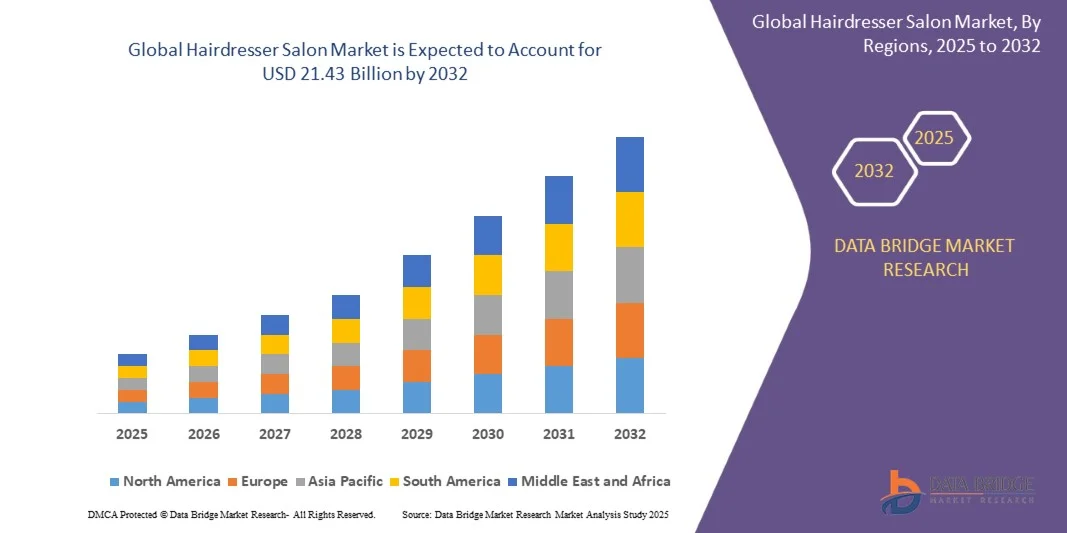
Hairdresser Salon Market Size
- The Hairdresser Salon Market size was valued at USD 14.29 billion in 2024 and is expected to reach USD 21.43 billion by 2032, growing at a CAGR of 5.20% during the forecast period.
- Market expansion is being driven by rising consumer focus on personal grooming, fashion trends, and self-care, along with increasing disposable income across emerging economies.
- Additionally, the rise of online booking platforms, influencer-driven marketing, and premium salon services is accelerating demand, positioning hairdresser salons as a key component of the global beauty and wellness industry.
Hairdresser Salon Market Analysis
- Hairdresser salons, offering professional services such as hair cutting, styling, coloring, and treatments, are becoming essential components of the global beauty and wellness industry, driven by rising consumer focus on personal grooming, fashion, and self-care across both urban and suburban areas.
- The growing demand for hairdresser salon services is primarily fueled by increasing disposable incomes, evolving beauty standards, social media influence, and a rising preference for premium and personalized hair care experiences.
- North America dominated the Hairdresser Salon Market with the largest revenue share of 32.6% in 2024, characterized by a mature salon industry, high consumer spending on beauty services, and strong brand presence of major salon chains, particularly in the U.S., which continues to lead in demand for luxury and organic hair care services.
- Asia-Pacific is expected to be the fastest-growing region in the Hairdresser Salon Market during the forecast period due to rapid urbanization, growing middle-class population, and increasing awareness of international beauty trends and grooming standards.
- The hair cutting segment dominated the market with the largest revenue share of 43.2% in 2024, owing to its universal demand across genders, age groups, and geographies.
Report Scope and Hairdresser Salon Market Segmentation
|
Attributes |
Hairdresser Salon Key Market Insights |
|
Segments Covered |
|
|
Countries Covered |
North America
Europe
Asia-Pacific
Middle East and Africa
South America
|
|
Key Market Players |
|
|
Market Opportunities |
|
|
Value Added Data Infosets |
In addition to the insights on market scenarios such as market value, growth rate, segmentation, geographical coverage, and major players, the market reports curated by the Data Bridge Market Research also include in-depth expert analysis, pricing analysis, brand share analysis, consumer survey, demography analysis, supply chain analysis, value chain analysis, raw material/consumables overview, vendor selection criteria, PESTLE Analysis, Porter Analysis, and regulatory framework. |
Hairdresser Salon Market Trends
“Personalization and Automation Through AI and Smart Technologies”
- A significant and accelerating trend in the Hairdresser Salon Market is the growing integration of artificial intelligence (AI) and smart technologies to deliver personalized and seamless salon experiences. This evolution is fundamentally transforming how salons operate and how services are delivered to customers.
- For instance, AI-powered consultation tools are being implemented in modern salons to analyze customer hair types, suggest suitable hairstyles or treatments, and even simulate results in real-time using augmented reality (AR). Platforms like ModiFace and Perfect Corp enable salons to offer virtual try-ons and personalized recommendations, enhancing customer confidence and engagement.
- AI-driven booking systems are also on the rise, learning from user behavior to suggest ideal appointment times, preferred stylists, or popular services. Chatbots integrated into salon websites and apps now handle customer queries, manage bookings, and send reminders—reducing manual workload and improving client satisfaction.
- The integration of CRM tools with AI analytics is enabling salons to better understand customer preferences, frequency of visits, and spending patterns—allowing for highly targeted promotions and loyalty programs that drive retention and revenue.
- This trend toward intelligent, data-driven, and tech-enhanced salon operations is redefining consumer expectations in the beauty industry. As a result, key players such as Ulta Beauty and Toni & Guy are investing heavily in digital transformation, integrating AI tools across consultation, booking, and post-visit follow-up processes.
- The growing demand for personalized, convenient, and tech-enabled salon experiences is accelerating adoption across both high-end chains and independent salons, especially in urban centers and digitally connected markets.
Hairdresser Salon Market Dynamics
Driver
Growing Demand Driven by Beauty Awareness and Lifestyle Shifts
- The rising awareness of personal grooming, self-care, and appearance—particularly among younger demographics—is a major driver fueling demand in the Hairdresser Salon Market. Shifting beauty standards, increased influence from social media platforms, and a growing emphasis on individual presentation in both personal and professional settings are significantly boosting salon service uptake.
- For instance, the popularity of platforms like Instagram, TikTok, and YouTube has made hairstyles and hair transformations highly visible and aspirational, encouraging consumers to seek regular salon visits to stay updated with the latest trends. This is especially evident in urban centers and among Gen Z and Millennial consumers.
- As disposable incomes continue to rise—especially in emerging economies across Asia-Pacific and Latin America—more consumers are prioritizing premium hair care services, including color treatments, keratin smoothing, scalp care, and personalized styling. This shift from basic to value-added services is reshaping salon offerings globally.
- Furthermore, the rise of franchise-based salon chains and the expansion of tech-enabled booking platforms are making salon services more accessible and consistent in quality. The convenience of scheduling appointments via apps, digital loyalty programs, and online stylist portfolios adds to the growing preference for professional salon services over at-home alternatives.
- The desire for hygienic, relaxing, and customized experiences has also become more pronounced post-pandemic, driving demand for salons that provide sanitized environments and high-quality, personalized service. Brands like Lakme Salon, Ulta Beauty, and Toni & Guy are leveraging this demand through upscale service menus and in-salon product recommendations, enhancing both customer satisfaction and revenue streams.
Restraint/Challenge
“High Staff Turnover and Rising Operational Costs”
- A major challenge in the Hairdresser Salon Market is the persistent issue of high staff turnover and rising operational costs, which significantly impact profitability and consistency in service quality across both independent salons and larger chains.
- For Instance, hairdressers and stylists often change workplaces due to better pay opportunities, lack of career progression, or work-life imbalance, creating instability for salon owners and loyalty concerns among clients. This churn disrupts client-stylist relationships—an essential factor in repeat business and customer retention in the salon industry.
- In addition, the cost of running a modern salon—including rent in premium locations, utility bills, salon equipment, high-end hair care products, and compliance with hygiene regulations—has increased substantially in recent years. Salons must also invest in digital booking platforms, CRM systems, and marketing tools to remain competitive in an increasingly tech-driven environment.
- Moreover, training and upskilling staff to stay current with the latest hair techniques, trends, and customer service standards require time and investment. In many regions, especially developing markets, access to formal training programs remains limited, further exacerbating the skills gap and affecting service consistency.
- While some salons are adopting freelance or booth rental models to manage costs, this can reduce managerial control over brand standards and customer experience. Similarly, cost-saving measures may compromise service quality, leading to negative reviews and client attrition in a competitive industry.
- Addressing these challenges requires a strategic focus on employee retention programs, flexible staffing models, investment in vocational training, and leveraging technology to automate and streamline operations. For long-term sustainability, the industry must also work toward balancing affordability with high service standards and consistent client experiences.
Hairdresser Salon Market Scope
The market is segmented on the basis of type, gender, service channel, and application.
- By Type
On the basis of type, the Hairdresser Salon Market is segmented into hair cutting, hair coloring, hair styling, hair treatment, and others. The hair cutting segment dominated the market with the largest revenue share of 43.2% in 2024, owing to its universal demand across genders, age groups, and geographies. Hair cutting services form the core offering of nearly every salon and are considered a basic grooming necessity, leading to steady and consistent footfall. These services also require lower material costs compared to other treatments, enhancing profitability for salon operators.
The Hair Coloring segment is expected to witness the fastest CAGR from 2025 to 2032, driven by fashion trends, the rising popularity of personalized color treatments, and increased experimentation among millennials and Gen Z consumers. High-margin specialty services such as balayage, ombré, and root shadowing are further driving growth in this segment, particularly in urban markets.
- By Gender
On the basis of gender, the Hairdresser Salon Market is segmented into male, female, and unisex. The female segment held the largest market share of 58.7% in 2024, driven by higher frequency of salon visits, greater average spend per appointment, and wider demand for diverse services such as coloring, styling, and treatments. Women’s salons also tend to offer a broader portfolio of services, which supports higher revenue generation per customer.
The Unisex segment is anticipated to experience the fastest CAGR from 2025 to 2032, due to the growing trend of inclusive salon environments that cater to all genders under one roof. Unisex salons offer operational flexibility, shared infrastructure, and broader customer appeal, especially in urban areas. Consumers increasingly prefer the convenience of multi-service salons, and salon chains are expanding unisex formats to tap into larger market segments.
- By Service Channel
On the basis of service channel, the Hairdresser Salon Market is segmented into Franchise Salons, Independent Salons, and Online Booking Platforms. Independent Salons dominated the market with the largest revenue share of 49.5% in 2024, due to their widespread presence, local customer loyalty, and flexibility in service offerings. These salons often cater to neighborhood demand and are especially prevalent in emerging markets where brand penetration is still developing.
The Online Booking Platforms segment is expected to witness the fastest growth from 2025 to 2032, driven by digital transformation and increasing consumer preference for convenience and real-time service availability. Platforms like StyleSeat, Booksy, and salon-specific apps enable easy appointment booking, service customization, and digital payments—reshaping the way consumers interact with salons. This growth is further supported by younger consumers who favor tech-enabled, on-demand beauty services.
- By Application
On the basis of application, the Hairdresser Salon Market is segmented into personal care, fashion industry, entertainment industry, and others. The personal care segment held the largest market share of 61.4% in 2024, reflecting the consistent demand for routine grooming and self-care across all age groups. Increasing awareness of personal hygiene, professional appearance, and wellness culture has turned hairdresser services into a lifestyle essential for both men and women.
The Entertainment Industry is projected to grow at the fastest CAGR during 2025–2032, fueled by the rising demand for on-demand hair styling, coloring, and creative looks for television, film, theatre, and digital content creation. Salons that cater to celebrities, influencers, and production teams are seeing an uptick in demand for high-end, customized hair services that reflect current visual trends. This growth is especially prominent in markets like the U.S., South Korea, and India, where entertainment industries are rapidly expanding.
Hairdresser Salon Market Regional Analysis
- North America dominated the Hairdresser Salon Market with the largest revenue share of 32.6% in 2024, driven by rising consumer focus on personal grooming, high disposable incomes, and a well-established network of both independent and franchise salon chains.
- Consumers in the region prioritize professional hair care services, with increasing demand for advanced treatments, customized coloring, and premium styling experiences. The influence of beauty influencers, celebrity trends, and social media continues to shape consumer expectations and drive frequent salon visits.
- This strong market performance is further supported by a culture that values appearance, a growing male grooming segment, and the expansion of unisex and high-end salons across urban and suburban areas. Additionally, the presence of major players such as Ulta Beauty, Great Clips, and Sport Clips reinforces North America’s leadership, as these brands invest in digital booking systems, loyalty programs, and personalized services to meet evolving consumer needs.
U.S. Hairdresser Salon Market Insight
The U.S. Hairdresser Salon Market captured the largest revenue share of 78% in 2024 within North America, fueled by a high demand for professional grooming services, a fashion-forward population, and the presence of major salon chains and beauty retailers. The growing influence of social media and celebrity culture has led to increased spending on hair coloring, styling, and premium treatments. Additionally, the expansion of unisex and franchise salons, combined with the widespread use of online booking and loyalty platforms, is enhancing customer convenience and driving repeat business. The market is further supported by high disposable incomes, diverse demographics, and a strong beauty services infrastructure.
Europe Hairdresser Salon Market Insight
The Europe Hairdresser Salon Market is projected to expand at a substantial CAGR throughout the forecast period, driven by rising personal grooming awareness, an aging population seeking regular hair care, and an increasing number of salons offering personalized and eco-friendly services. Demand is particularly strong in countries like France, Germany, and Italy, where beauty services are deeply rooted in lifestyle and culture. The region also sees strong growth in male grooming services and natural/organic hair treatments. Technological integration, such as digital appointments and AI-based consultation tools, is also contributing to enhanced customer experience and market expansion.
U.K. Hairdresser Salon Market Insight
The U.K. Hairdresser Salon Market is anticipated to grow at a noteworthy CAGR during the forecast period, supported by a strong focus on self-care and grooming across age groups. The rise of fashion-conscious consumers and the growing demand for diverse hairstyling services, including afro and textured hair care, is expanding the market. Additionally, the rise in freelance stylists and mobile salons, coupled with increased online visibility and digital engagement, is reshaping how salon services are accessed. The U.K.’s highly urbanized population and a robust beauty retail ecosystem further fuel growth across both independent and franchise salons.
Germany Hairdresser Salon Market Insight
The Germany Hairdresser Salon Market is expected to expand at a considerable CAGR during the forecast period, driven by a growing focus on sustainable beauty solutions, rising salon visits among men, and demand for professional treatments. German consumers favor salons offering natural hair products, vegan formulas, and chemical-free treatments, prompting operators to adapt to green beauty trends. Germany’s strong vocational training system ensures a highly skilled stylist workforce, contributing to consistent service quality. In addition, increasing digital transformation among salons, including online appointment booking and customer management tools, is improving operational efficiency and customer engagement.
Asia-Pacific Hairdresser Salon Market Insight
The Asia-Pacific Hairdresser Salon Market is poised to grow at the fastest CAGR of 24% during the forecast period (2025–2032), led by rapid urbanization, a rising middle class, and evolving beauty standards in countries such as China, India, Japan, and South Korea. Social media influence, K-beauty trends, and increasing focus on self-expression through hairstyles are encouraging consumers to spend more on professional salon services. In addition, the expansion of mall-based and franchise salon chains is making services more accessible in tier 2 and tier 3 cities. Government initiatives supporting skill development and entrepreneurship in the beauty sector are also boosting market growth.
Japan Hairdresser Salon Market Insight
The Japan Hairdresser Salon Market is gaining momentum due to the country’s strong culture of grooming, high service standards, and demand for innovative salon experiences. The market is characterized by high-frequency salon visits, particularly among women and working professionals, who seek meticulous cutting and styling services. Japan's aging population is also contributing to increased demand for gentle hair care treatments and home-based services. Moreover, salons in Japan are early adopters of smart mirrors, AR consultations, and cashless payment systems, integrating technology to deliver personalized and convenient experiences, further driving market development.
China Hairdresser Salon Market Insight
The China Hairdresser Salon Market accounted for the largest market revenue share in Asia-Pacific in 2024, supported by a booming beauty industry, rising disposable incomes, and strong demand for trend-based hair services. Urban millennials and Gen Z consumers are driving a surge in fashion-conscious salon visits, particularly for coloring, styling, and digital perm services. The rapid expansion of franchise salon models and tech-integrated platforms like Meituan and Xiaohongshu are transforming how consumers discover and book salon services. Furthermore, China’s position as a global manufacturing hub for beauty products and tools enhances salon affordability and accessibility.
Hairdresser Salon Market Share
The Hairdresser Salon industry is primarily led by well-established companies, including:
- Chatters Canada (Canada)
- Dessange International (France)
- Drybar LLC (U.S.)
- Fantastic Sams (U.S.)
- Great Clips (U.S.)
- Lakme Salon (India)
- MasterCuts (U.S.)
- Paul Mitchell Schools (U.S.)
- Ratner Companies (U.S.)
- Regis Corporation (U.S.)
- Seva Beauty (U.S.)
- Snip-its (U.S.)
- Sports Clips (U.S.)
- The Lounge Hair Salon (Canada)
- Toni & Guy (U.K.)
- Ulta Beauty Inc. (U.S.)
What are the Recent Developments in Hairdresser Salon Market?
- In April 2023, L’Oréal Group, a global leader in beauty and personal care, launched a strategic initiative in South Africa focused on expanding its salon professional division with innovative haircare and styling products tailored to local hair types and preferences. This move highlights the company’s dedication to delivering customized beauty solutions while strengthening its presence in the rapidly growing Hairdresser Salon Market. By combining global expertise with local market insights, L’Oréal aims to elevate salon experiences and boost professional haircare adoption.
- In March 2023, TIGI Professional, a renowned haircare brand based in the UK, introduced a new line of eco-friendly styling products designed specifically for salon use in commercial and educational settings. The launch emphasizes TIGI’s commitment to sustainability and innovation in haircare, offering salons safer, high-performance solutions that appeal to environmentally conscious consumers. This development showcases TIGI’s focus on advancing salon offerings while supporting the professional haircare sector.
- In March 2023, Shiseido Professional successfully partnered with leading urban salons in Tokyo to roll out advanced digital booking and consultation tools aimed at enhancing customer engagement and streamlining salon operations. This initiative reflects Shiseido’s focus on integrating technology and beauty services to deliver a modern, efficient salon experience. The collaboration highlights the growing role of digital innovation in shaping the future of hairdressing markets in metropolitan areas.
- In February 2023, SalonCentric, a major distributor of professional salon products in the United States, announced a strategic collaboration with regional hairdressing associations to create a dedicated online platform for educational resources and product launches. This partnership is designed to empower salon professionals with the latest industry knowledge and access to innovative products, helping salons enhance service quality and operational efficiency. The initiative underlines SalonCentric’s commitment to supporting growth and innovation in the salon industry.
- In January 2023, Wella Professionals, a leader in hair color and styling solutions under the Coty Inc. umbrella, unveiled its latest range of smart hair color systems at the International Beauty Expo 2023. These systems incorporate augmented reality (AR) technology to help stylists customize hair color consultations and improve client satisfaction. The launch demonstrates Wella’s dedication to integrating cutting-edge technology into salon services, offering hairdressers enhanced creativity, precision, and customer engagement.

- Interactive Data Analysis Dashboard
- Company Analysis Dashboard for high growth potential opportunities
- Research Analyst Access for customization & queries
- Competitor Analysis with Interactive dashboard
- Latest News, Updates & Trend analysis
- Harness the Power of Benchmark Analysis for Comprehensive Competitor Tracking
Data collection and base year analysis are done using data collection modules with large sample sizes. The stage includes obtaining market information or related data through various sources and strategies. It includes examining and planning all the data acquired from the past in advance. It likewise envelops the examination of information inconsistencies seen across different information sources. The market data is analysed and estimated using market statistical and coherent models. Also, market share analysis and key trend analysis are the major success factors in the market report. To know more, please request an analyst call or drop down your inquiry.
The key research methodology used by DBMR research team is data triangulation which involves data mining, analysis of the impact of data variables on the market and primary (industry expert) validation. Data models include Vendor Positioning Grid, Market Time Line Analysis, Market Overview and Guide, Company Positioning Grid, Patent Analysis, Pricing Analysis, Company Market Share Analysis, Standards of Measurement, Global versus Regional and Vendor Share Analysis. To know more about the research methodology, drop in an inquiry to speak to our industry experts.
Data Bridge Market Research is a leader in advanced formative research. We take pride in servicing our existing and new customers with data and analysis that match and suits their goal. The report can be customized to include price trend analysis of target brands understanding the market for additional countries (ask for the list of countries), clinical trial results data, literature review, refurbished market and product base analysis. Market analysis of target competitors can be analyzed from technology-based analysis to market portfolio strategies. We can add as many competitors that you require data about in the format and data style you are looking for. Our team of analysts can also provide you data in crude raw excel files pivot tables (Fact book) or can assist you in creating presentations from the data sets available in the report.