


Hairy Cell Leukemia Drug Market Size
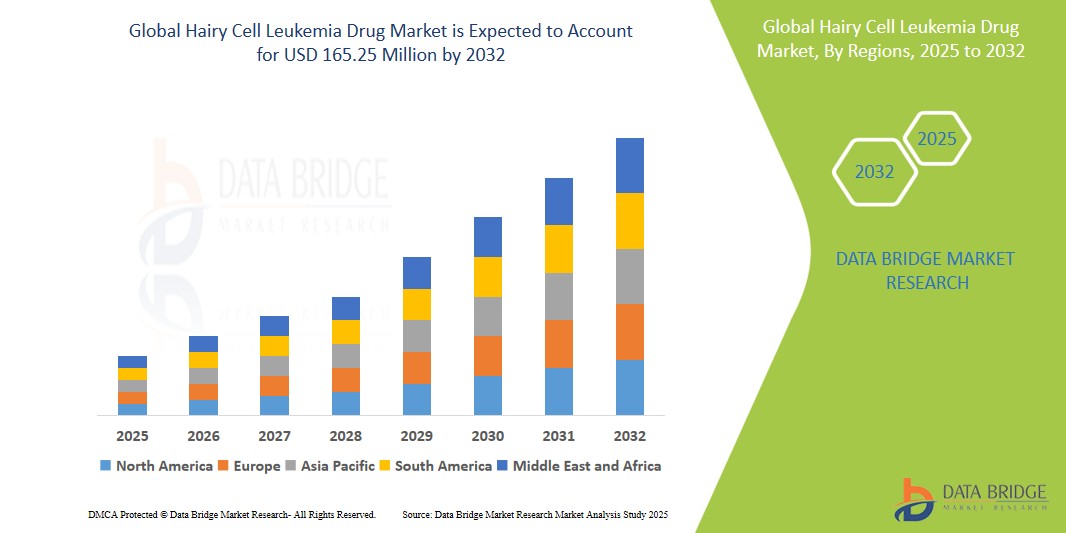
- The global hairy cell leukemia drug market size was valued at USD 115.25 million in 2024 and is projected to reach USD 165.25 million by 2032, growing at a CAGR of 5.2% during the forecast period
- This growth is driven by increasing incidence of hairy cell leukemia, ongoing research and development efforts, and growing awareness about early cancer diagnosis and treatment options
Hairy Cell Leukemia Drug Market Analysis
- Hairy cell leukemia (HCL) is a rare, slow-growing cancer of the blood in which the bone marrow produces abnormal B lymphocytes. Treatment includes chemotherapy, immunotherapy, and targeted therapy—each aimed at improving survival rates and quality of life
- The market is primarily driven by innovative therapeutic approaches, increasing FDA approvals, and rising research into targeted mechanisms of action such as purine nucleoside analogs, recombinant interferons, and CD22-directed cytotoxins
- North America is expected to dominate the hairy cell leukemia drug market due to its strong clinical research infrastructure, high healthcare expenditure, and early adoption of advanced therapeutics
- Asia-Pacific is anticipated to register the fastest growth during the forecast period, attributed to increasing healthcare access, growing awareness about rare cancers, and supportive government initiatives for oncology treatments
- The chemotherapy segment continues to hold a major share of the market, accounting for approximately 48.3% in 2024, owing to its longstanding clinical use, established treatment protocols, and relative cost-effectiveness.
Report Scope and Hairy Cell Leukemia Drug Market Segmentation
|
Attributes |
Hairy Cell Leukemia Drug Key Market Insights |
|
Segments Covered |
|
|
Countries Covered |
North America
Europe
Asia-Pacific
Middle East and Africa
South America
|
|
Key Market Players |
|
|
Market Opportunities |
|
|
Value Added Data Infosets |
In addition to the insights on market scenarios such as market value, growth rate, segmentation, geographical coverage, and major players, the market reports curated by the Data Bridge Market Research also include import export analysis, production capacity overview, production consumption analysis, price trend analysis, climate change scenario, supply chain analysis, value chain analysis, raw material/consumables overview, vendor selection criteria, PESTLE Analysis, Porter Analysis, and regulatory framework. |
Hairy Cell Leukemia Drug Market Trends
“Advancements in Targeted Therapies & Personalized Medicine”
- A prominent trend in the evolution of hairy cell leukemia (HCL) treatments is the growing focus on targeted therapies and personalized medicine. These treatments, such as BRAF inhibitors and CD22-directed cytotoxins, are designed to specifically target cancerous cells, minimizing side effects and enhancing therapeutic efficacy
- The integration of genetic profiling and biomarker testing is enabling more personalized treatment plans that offer better outcomes and fewer adverse effects. This trend is driving the demand for novel, targeted drugs and contributing to the market’s growth
- For instance, BRAF inhibitors like vemurafenib have shown significant promise in targeting mutated cells in HCL patients, offering a more focused approach compared to traditional chemotherapy.
- These advancements are transforming HCL treatment paradigms, improving survival rates, and enhancing patients’ quality of life
Hairy Cell Leukemia Drug Market Dynamics
Driver
“Rising Incidence of Hairy Cell Leukemia and Advancements in Treatment Protocols”
- The increasing diagnosis and incidence of hairy cell leukemia (HCL) are significantly driving demand for HCL-specific drugs. With HCL being a rare yet impactful cancer, the need for innovative therapeutic options is rising, especially as treatment protocols evolve
- Research advancements and the development of targeted therapies are reshaping treatment outcomes. As a result, patients are experiencing fewer side effects, leading to improved treatment adherence and better overall prognosis
For instance,
- A 2024 study published by the National Cancer Institute indicated a growing number of diagnosed cases globally, spurring further research investment and clinical trials to improve treatment methods for this rare cancer
- With the increase in diagnostic precision and early detection of HCL, the demand for specific treatments, such as purine nucleoside analogs and monoclonal antibodies, is set to rise, further boosting market growth
Opportunity
“Emerging Role of Combination Therapies in Hairy Cell Leukemia Treatment”
- Combination therapies that include both targeted drugs and immunotherapy are showing significant potential in enhancing treatment outcomes for HCL patients. This approach could help address the limited efficacy of monotherapies and reduce relapse rates
- Ongoing research into BRAF and CD22-targeting combinations may open doors to more effective treatments, reducing reliance on traditional chemotherapy
For instance,
- Clinical trials are increasingly focusing on combining vemurafenib (BRAF inhibitor) with rituximab (anti-CD20 monoclonal antibody), showing promising results in improving progression-free survival rates in patients with refractory HCL
- This trend of combining therapies represents an opportunity for pharmaceutical companies to bring novel, dual-therapy products to the market, boosting both efficacy and market penetration.
Restraint/Challenge
“High Treatment Costs and Access Barriers in Emerging Markets”
- The high cost of innovative HCL drugs presents a significant challenge to the broader adoption of these therapies, particularly in emerging markets where healthcare budgets are limited.
- Targeted therapies and monoclonal antibodies often come with significant price tags, making them less accessible to patients in regions with underdeveloped healthcare systems. This is a particular concern for low-income countries and smaller clinics that are unable to afford cutting-edge treatments, resulting in disparities in treatment availability.
For instance,
- In 2024 article published by the World Health Organization (WHO) reported that the high costs of targeted therapies for HCL were limiting their widespread use in regions like Africa and Asia-Pacific, where healthcare infrastructure struggles to support the procurement of expensive cancer drugs
- Such cost-related challenges are likely to impede the growth of the market, particularly in areas where affordable healthcare access is a priority. Innovative pricing models and partnerships with governments may be needed to overcome these barriers
Hairy Cell Leukemia Drug Market Scope
The market is segmented on the basis therapy type, treatment type, mechanism of action type, route of administration and end user.
|
Segmentation |
Sub-Segmentation |
|
By Therapy Type |
|
|
By Treatment Type |
|
|
By Mechanism of Action Type |
|
|
By Route of Administration |
|
|
By End-Users |
|
Chemotherapy Segment is Projected to Dominate the Market in 2025
In 2025, the chemotherapy segment is expected to dominate the Hairy Cell Leukemia drug market with the largest market share of approximately 48.3% due to its longstanding use and proven efficacy. Chemotherapy, particularly the use of purine nucleoside analogs such as cladribine and pentostatin, continues to be the standard treatment for HCL due to its ability to induce remission and improve survival rates. The high prevalence of HCL and the well-established nature of chemotherapy contribute to its market dominance. As a result, it remains the preferred treatment modality, especially in regions with limited access to more advanced targeted therapies.
Targeted Therapy Segment is Expected to Account for the Largest Share During the Forecast Period in the market
The targeted therapy segment is expected to account for the largest share of the Hairy Cell Leukemia drug market during the forecast period, with a projected market share of 37.4% . The segment’s growth is driven by the increased adoption of novel treatments like BRAF inhibitors (e.g., vemurafenib) and CD22-directed cytotoxins. These targeted therapies offer higher precision, fewer side effects, and better patient outcomes compared to traditional chemotherapy. As personalized treatments gain traction, the targeted therapy segment will continue to expand, especially in developed regions with advanced healthcare infrastructure and access to cutting-edge treatments.
Hairy Cell Leukemia Drug Market Regional Analysis
“North America Holds the Largest Share in the Hairy Cell Leukemia Drug Market”
- North America dominates the Hairy Cell Leukemia (HCL) drug market, driven by advanced healthcare infrastructure, high adoption of novel therapies, and a strong presence of key market players.
- The U.S. holds a significant share due to the high demand for innovative treatments, rising awareness of HCL, and increasing prevalence of hematologic cancers. The region benefits from a well-established healthcare system and widespread access to cutting-edge medical treatments.
- The availability of favorable reimbursement policies, as well as increased investments in research & development by leading pharmaceutical companies, further strengthens the market.
- Additionally, the U.S. is home to a large number of hematologists and oncology specialists, contributing to the effective diagnosis and treatment of HCL. The adoption of targeted therapies and immunotherapies is also expanding, fostering continued market growth in the region.
“Asia-Pacific is Projected to Register the Highest CAGR in the Hairy Cell Leukemia Drug Market”
- The Asia-Pacific region is expected to witness the highest growth rate in the Hairy Cell Leukemia drug market during the forecast period, driven by rapid healthcare infrastructure development, increasing awareness about hematologic cancers, and rising diagnostic and treatment volumes.
- Countries such as China, India, and Japan are emerging as key markets due to the growing aging population, which is more susceptible to cancers like HCL and other blood disorders.
- Japan, with its advanced healthcare technology and increasing number of oncologists and hematologists, remains a crucial market for HCL drug therapies. The country is adopting novel targeted treatments and BRAF inhibitors to improve the clinical outcomes for HCL patients.
- China and India, with their large populations and rising cases of hematologic malignancies, are witnessing increasing investments from both the public and private sectors in modern medical facilities and innovative drug therapies. The expanding presence of global pharmaceutical companies, along with improving access to modern treatments, is further driving market growth in these regions
Hairy Cell Leukemia Drug Market Share
The market competitive landscape provides details by competitor. Details included are company overview, company financials, revenue generated, market potential, investment in research and development, new market initiatives, global presence, production sites and facilities, production capacities, company strengths and weaknesses, product launch, product width and breadth, application dominance. The above data points provided are only related to the companies' focus related to market.
The Major Market Leaders Operating in the Market Are:
- AstraZeneca (U.K.)
- Amgen Inc (U.S.)
- Johnson & Johnson Services, Inc. (U.S.)
- F. Hoffmann-La Roche Ltd (Switzerland)
- Pfizer Inc (U.S.)
- Dr. Reddy’s Laboratories Ltd (India)
- Astellas Pharma Inc (Japan)
- Merck & Co., Inc (U.S.)
- Novartis AG (Switzerland)
- GlaxoSmithKline plc (U.K.)
- Takeda Pharmaceutical Company Limited (Japan)
- CELGENE CORPORATION (U.S.)
- DAIICHI SANKYO COMPANY, LIMITED (Japan)
- Bayer AG (Germany)
- Gilead Sciences, Inc (U.S.)
- AbbVie Inc (U.S.)
- Eli Lilly and Company (U.S.)
- Sumitomo Dainippon Pharma Co., Ltd (Japan)

- Interactive Data Analysis Dashboard
- Company Analysis Dashboard for high growth potential opportunities
- Research Analyst Access for customization & queries
- Competitor Analysis with Interactive dashboard
- Latest News, Updates & Trend analysis
- Harness the Power of Benchmark Analysis for Comprehensive Competitor Tracking
Data collection and base year analysis are done using data collection modules with large sample sizes. The stage includes obtaining market information or related data through various sources and strategies. It includes examining and planning all the data acquired from the past in advance. It likewise envelops the examination of information inconsistencies seen across different information sources. The market data is analysed and estimated using market statistical and coherent models. Also, market share analysis and key trend analysis are the major success factors in the market report. To know more, please request an analyst call or drop down your inquiry.
The key research methodology used by DBMR research team is data triangulation which involves data mining, analysis of the impact of data variables on the market and primary (industry expert) validation. Data models include Vendor Positioning Grid, Market Time Line Analysis, Market Overview and Guide, Company Positioning Grid, Patent Analysis, Pricing Analysis, Company Market Share Analysis, Standards of Measurement, Global versus Regional and Vendor Share Analysis. To know more about the research methodology, drop in an inquiry to speak to our industry experts.
Data Bridge Market Research is a leader in advanced formative research. We take pride in servicing our existing and new customers with data and analysis that match and suits their goal. The report can be customized to include price trend analysis of target brands understanding the market for additional countries (ask for the list of countries), clinical trial results data, literature review, refurbished market and product base analysis. Market analysis of target competitors can be analyzed from technology-based analysis to market portfolio strategies. We can add as many competitors that you require data about in the format and data style you are looking for. Our team of analysts can also provide you data in crude raw excel files pivot tables (Fact book) or can assist you in creating presentations from the data sets available in the report.












