


Hallermann-Streiff Syndrome Market Size
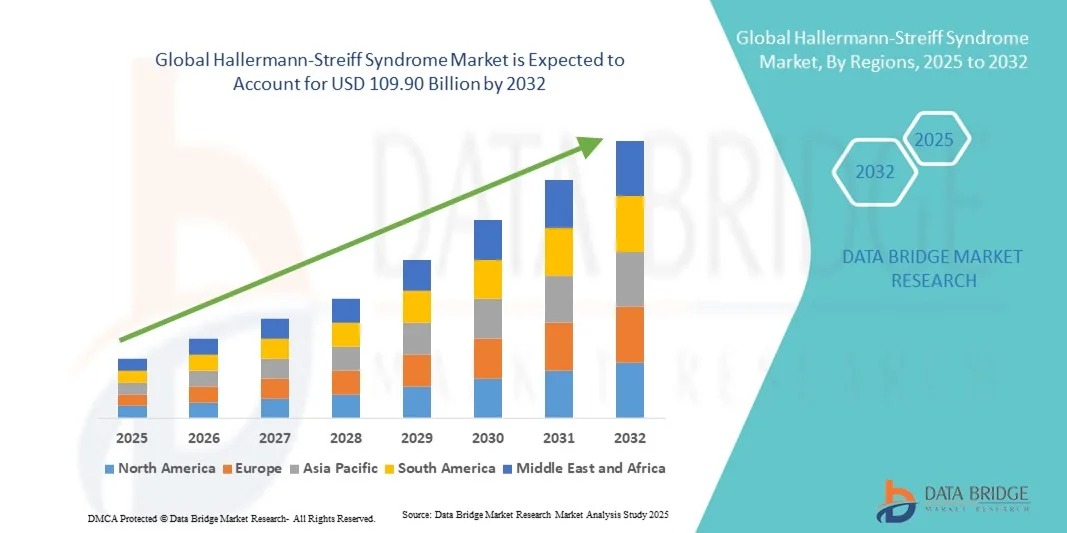
- The global Hallermann-Streiff Syndrome market size was valued at USD 64.93 billion in 2024 and is expected to reach USD 109.90 billion by 2032, at a CAGR of 6.80% during the forecast period
- The market growth is largely fueled by the growing advancements in genetic research, improved diagnostic capabilities, and increased awareness regarding rare congenital disorders, leading to early detection and better management of Hallermann-Streiff Syndrome across healthcare systems globally
- Furthermore, rising investments in research and development, along with technological innovations in gene sequencing, 3D craniofacial imaging, and precision medicine, are accelerating the development of targeted therapies and specialized surgical interventions for Hallermann-Streiff Syndrome, thereby significantly boosting the industry’s growth
Hallermann-Streiff Syndrome Market Analysis
- Hallermann-Streiff Syndrome, a rare congenital condition characterized by craniofacial abnormalities, dental defects, and vision problems, is witnessing increasing research focus due to advancements in genetic testing and rare disease diagnosis. Early intervention programs and supportive therapies are enhancing patient outcomes and fueling market growth
- The rising prevalence of genetic counseling, improved neonatal screening, and collaborations between academic institutions and biotech firms are key factors driving the expansion of the hallermann-streiff syndrome treatment market globally
- North America dominated the hallermann-streiff syndrome market with the largest revenue share of 41.3% in 2024, attributed to advanced healthcare infrastructure, high adoption of genetic testing technologies, and the presence of leading research organizations and biotechnology firms focusing on rare disorders. The U.S. continues to be a major contributor due to strong funding for orphan drug development and improved diagnostic accessibility
- Asia-Pacific is expected to be the fastest-growing region in the hallermann-streiff syndrome market during the forecast period, driven by increasing healthcare investments, growing awareness about rare genetic conditions, and expanding access to advanced diagnostic services in countries like China, Japan, and India
- The Hutchinson-Gilford Progeria Syndrome (HGPS) segment accounted for the largest market share of 46.2% in 2024, due to its close biological and phenotypic relationship with HSS
Report Scope and Hallermann-Streiff Syndrome Market Segmentation
|
Attributes |
Hallermann-Streiff Syndrome Key Market Insights |
|
Segments Covered |
|
|
Countries Covered |
North America
Europe
Asia-Pacific
Middle East and Africa
South America
|
|
Key Market Players |
|
|
Market Opportunities |
|
|
Value Added Data Infosets |
In addition to the insights on market scenarios such as market value, growth rate, segmentation, geographical coverage, and major players, the market reports curated by the Data Bridge Market Research also include in-depth expert analysis, patient epidemiology, pipeline analysis, pricing analysis, and regulatory framework. |
Hallermann-Streiff Syndrome Market Trends
Enhanced Research and Therapeutic Advancements Through AI and Genetic Integration
- A significant and accelerating trend in the global hallermann-streiff syndrome (HSS) market is the growing integration of artificial intelligence (AI), advanced genomics, and bioinformatics tools into research and clinical diagnostics. This integration is transforming how rare genetic disorders like HSS are studied, diagnosed, and potentially treated
- For instance, leading genetic research organizations are adopting AI-driven sequencing platforms to enhance the identification of gene mutations associated with HSS. These platforms analyze large genomic datasets to detect rare variants, improving the precision of diagnosis and enabling personalized therapeutic planning
- AI integration also supports the prediction of phenotypic outcomes based on genetic mutations, aiding clinicians in better understanding disease progression. Furthermore, machine learning algorithms are increasingly being used to identify potential therapeutic targets and drug repurposing opportunities for managing HSS symptoms
- The collaboration between biotechnology firms and academic research centers is fostering advancements in molecular modeling and protein-structure analysis, which are essential for developing gene therapies and targeted interventions. Such developments are enabling researchers to accelerate the discovery process and improve patient management strategies
- This trend toward AI-assisted genomics and digital health integration is redefining the research landscape for rare congenital syndromes. Consequently, pharmaceutical and biotech companies are increasingly investing in AI-based platforms to streamline data analysis and optimize preclinical research, paving the way for more effective therapeutic solutions in the coming years
- The demand for precision diagnostics and individualized treatment approaches driven by AI and genetic technologies is rapidly increasing across both developed and emerging regions, as healthcare providers aim to improve the quality of care for rare disease patients
Hallermann-Streiff Syndrome Market Dynamics
Driver
Rising Research Focus and Awareness of Rare Genetic Disorders
- The growing awareness of rare genetic syndromes, coupled with increasing research investments in the field of congenital disorders, is a key driver of growth in the hallermann-streiff syndrome market
- For instance, in March 2024, several European rare disease consortia announced funding programs to accelerate genomic research into ultra-rare disorders, including HSS, focusing on novel diagnostic and therapeutic approaches
- The surge in initiatives by rare disease foundations, patient advocacy groups, and national genomic programs has enhanced the visibility of HSS and encouraged early diagnosis and data sharing
- In addition, the global increase in research collaborations between hospitals, universities, and biotech firms is fostering a stronger pipeline of clinical studies and potential gene therapy innovations
- The rising availability of whole-genome sequencing, improved molecular testing capabilities, and government incentives for orphan disease research have further strengthened the market outlook. The trend toward personalized medicine and genetic counseling is also contributing significantly to the growing adoption of advanced diagnostic procedures for HSS
Restraint/Challenge
Limited Treatment Availability and High Research Costs
- Despite increasing scientific progress, the hallermann-streiff syndrome market faces substantial challenges due to the limited availability of approved therapeutic options and the high cost of research associated with ultra-rare diseases
- The small patient population and the complexity of clinical trials for genetic disorders make it difficult for companies to achieve commercial viability, leading to slow progress in drug development
- Furthermore, the high expenses involved in genetic testing, advanced imaging, and molecular diagnostics limit accessibility for patients, particularly in low- and middle-income countries
- For instance, the costs associated with comprehensive genome sequencing and targeted therapy research can exceed the budgets of smaller research institutions and patient families
- Another key restraint is the lack of standardized clinical data and global patient registries, which hampers large-scale studies and comparative analysis
- Addressing these challenges will require greater collaboration between governments, non-profit organizations, and biotech companies, along with policy incentives to reduce research costs and improve funding accessibility for ultra-rare disease research
- While technological progress continues, overcoming economic and logistical barriers remains essential for achieving sustainable growth in the hallermann-streiff syndrome market
Hallermann-Streiff Syndrome Market Scope
The market is segmented on the basis of Characteristics, Synonyms, Related Disorders, and Diagnosis.
- By Characteristics
On the basis of characteristics, the Hallermann-Streiff Syndrome market is segmented into Brachycephaly, Dyscephaly, Hypoplastic Mandible, Palate, and Others. The Brachycephaly segment dominated the market with the largest revenue share of 41.8% in 2024, driven by its strong diagnostic relevance and high prevalence in HSS patients. Brachycephaly represents one of the earliest identifiable craniofacial deformities, allowing clinicians to detect the disorder at birth through non-invasive imaging. Radiological precision in capturing cranial abnormalities has enhanced the segment’s clinical importance. Continuous improvements in 3D craniofacial mapping and AI-based imaging tools are also contributing to accurate phenotype-genotype correlation. The segment benefits from growing awareness among pediatric specialists and the incorporation of brachycephalic markers into clinical diagnostic protocols. Furthermore, ongoing research on cranial morphogenesis and its link to rare congenital disorders reinforces the segment’s dominance.
The Hypoplastic Mandible segment is expected to witness the fastest CAGR of 21.3% from 2025 to 2032, propelled by advancements in mandibular reconstruction and genetic research. Increased attention toward jaw underdevelopment as a defining indicator of HSS has accelerated innovation in 3D surgical modeling and regenerative therapies. The growing application of personalized implants and AI-assisted diagnostic imaging for mandibular correction supports its rise. Research collaborations focusing on craniofacial gene regulation and bone morphogenesis pathways have also expanded. In addition, the integration of digital orthodontics and tissue engineering solutions enhances its clinical and research appeal. The segment’s expansion is further driven by the growing need for precision-based diagnosis and corrective treatment solutions in pediatric and rare genetic disorders.
- By Synonyms
On the basis of synonyms, the Hallermann-Streiff Syndrome market is categorized into Francois Dyscephaly Syndrome, Hallermann-Streiff-Francois Syndrome, HSS, Oculomandibulodyscephaly With Hypotrichosis, and Oculomandibulofacial Syndrome. The Hallermann-Streiff-Francois Syndrome (HSFS) segment dominated the market with the largest share of 38.5% in 2024, owing to its broad clinical recognition and global use in scientific literature. The HSFS term is most frequently cited in research publications, clinical trials, and medical databases, strengthening its position as the standard classification for the disorder. This nomenclature benefits from consistent usage by genetic research consortia, diagnostic centers, and rare disease registries. High inclusion in diagnostic coding systems and genomic studies ensures its relevance in healthcare databases. In addition, awareness programs by rare disease foundations often use HSFS terminology, amplifying visibility and research funding. Continuous advancements in molecular diagnosis and phenotype profiling further strengthen its presence. The consistent use of HSFS across clinical and academic fields reinforces its dominant role in disease identification and treatment research.
The Oculomandibulofacial Syndrome segment is projected to grow at the fastest CAGR of 20.9% during 2025–2032, fueled by increasing recognition of its phenotypic overlap with HSS and other craniofacial disorders. This synonym is gaining prominence due to the growing integration of precision medicine approaches in genetic diagnostics. Researchers are increasingly focusing on ocular and mandibular traits to distinguish subtypes of craniofacial anomalies, enhancing clinical classification accuracy. Improvements in genetic sequencing and AI-assisted pattern recognition have also accelerated this segment’s growth. In addition, emerging collaborations among rare disease research institutes and the expansion of patient registries are providing new diagnostic insights. Increased use of this term in regional registries and comparative genomic studies further contributes to its growing relevance. The segment’s advancement highlights the expanding scope of interdisciplinary genetic research in craniofacial syndromes.
- By Related Disorders
On the basis of related disorders, the Hallermann-Streiff Syndrome market is segmented into Hutchinson-Gilford Progeria Syndrome, Wiedemann-Rautenstrauch Syndrome, Seckel Syndrome, and Others. The Hutchinson-Gilford Progeria Syndrome (HGPS) segment accounted for the largest market share of 46.2% in 2024, due to its close biological and phenotypic relationship with HSS. Both conditions share similar growth and aging abnormalities, attracting joint research efforts. The HGPS segment benefits from extensive funding for progeroid research, especially in the field of genetic mutation analysis and anti-aging therapeutics. Studies targeting LMNA gene mutations and nuclear envelope instability are contributing to parallel insights into HSS pathology. The expansion of patient registries and clinical studies on progeria-linked syndromes strengthens this segment’s dominance. Pharmaceutical developments such as farnesyltransferase inhibitors and RNA-based treatments have also raised awareness of genetic overlaps. Furthermore, progeria-focused foundations and global collaborations have indirectly supported HSS-focused genetic studies. The segment remains integral to understanding shared disease mechanisms and advancing potential therapeutic interventions.
The Wiedemann-Rautenstrauch Syndrome segment is expected to record the fastest CAGR of 22.1% from 2025 to 2032, driven by advancements in early-life progeroid syndrome research. Increasing access to next-generation sequencing technologies is enabling clearer differentiation and overlap analysis between HSS and this disorder. Growing awareness among clinicians about neonatal progeroid features has improved diagnostic precision. Collaboration between European and Asian research centers has also enhanced knowledge sharing in the field of early-onset progeroid syndromes. In addition, bioinformatics and proteomics studies are uncovering shared pathways, expanding the understanding of cellular senescence. Supportive funding from genetic research programs and improved patient data registries further aid this segment’s progress. As genomic studies become more comprehensive, this segment is expected to continue its rapid expansion in the rare disease research landscape.
- By Diagnosis
On the basis of diagnosis, the Hallermann-Streiff Syndrome market is segmented into Radiographic, Ophthalmologic, and Dental Studies. The Radiographic segment dominated the market with the largest revenue share of 49.7% in 2024, attributed to its essential role in detecting skeletal abnormalities and craniofacial deformities characteristic of HSS. Radiographic imaging, including 3D CT and MRI, provides comprehensive visualization of bone structures, facilitating early diagnosis and precise monitoring of disease progression. Continuous innovation in imaging modalities such as AI-driven image reconstruction and digital radiography has increased diagnostic efficiency. Hospitals and research centers heavily rely on radiographic assessments to document cranial dysmorphologies. Furthermore, standardization of imaging guidelines and improved accessibility in developing regions have strengthened this segment’s dominance. The growing adoption of automated diagnostic tools for rare skeletal syndromes continues to reinforce radiography’s leading position in HSS diagnostics.
The Ophthalmologic segment is projected to grow at the fastest CAGR of 23.4% during 2025–2032, fueled by increased focus on the ocular manifestations of HSS such as cataracts, microphthalmia, and optic nerve anomalies. Advances in pediatric ophthalmology and imaging technologies such as optical coherence tomography (OCT) are improving the precision of eye-related diagnosis. Growing interdisciplinary collaboration between ophthalmologists and geneticists is also driving early identification of ocular abnormalities associated with HSS. In addition, awareness campaigns and screening initiatives for congenital eye disorders are boosting diagnosis rates. Integration of AI-based retinal imaging and tele-ophthalmology solutions has further enhanced accessibility to specialized care. The segment benefits from a surge in clinical research targeting genetic links between ocular malformations and craniofacial syndromes. With ongoing innovation in optical diagnostics and genetic screening, this segment is poised for robust expansion.
Hallermann-Streiff Syndrome Market Regional Analysis
- North America dominated the hallermann-streiff syndrome market with the largest revenue share of 41.3% in 2024, attributed to advanced healthcare infrastructure, high adoption of genetic testing technologies, and the presence of leading research organizations and biotechnology firms focusing on rare disorders
- The region’s strong regulatory framework for orphan drug approvals and active participation of patient advocacy groups have also supported market growth
- Increasing investments in genomic sequencing and personalized medicine further enhance early diagnosis and targeted treatment options. The U.S. continues to be a major contributor due to strong funding for orphan drug development and improved accessibility to advanced diagnostic services
U.S. Hallermann-Streiff Syndrome Market Insight
The U.S. hallermann-streiff syndrome market captured the largest revenue share in 2024 within North America. Growth is primarily fueled by government initiatives supporting rare disease research and the presence of major biotechnology and pharmaceutical companies investing in novel treatment options. The country’s robust healthcare system, high patient awareness, and widespread adoption of next-generation sequencing technologies enable timely diagnosis. In addition, collaborations between research institutions and clinical networks are accelerating clinical trials and precision therapy development for rare congenital disorders such as Hallermann-Streiff Syndrome.
Europe Hallermann-Streiff Syndrome Market Insight
The Europe hallermann-streiff syndrome market is projected to witness steady growth during the forecast period, supported by increasing funding for rare disease research, strong clinical infrastructure, and the expansion of national genetic testing programs. European countries are implementing initiatives such as cross-border collaborations to enhance early diagnosis and improve patient management. The growing involvement of academic institutions and biotechnology companies in orphan drug development is expected to further drive the regional market. The region also benefits from supportive healthcare policies and the presence of dedicated centers for congenital disorder research.
U.K. Hallermann-Streiff Syndrome Market Insight
The U.K. hallermann-streiff syndrome market is anticipated to grow at a significant CAGR during the forecast period, driven by national genomic initiatives such as Genomics England, which aims to improve early detection of rare genetic disorders. Increasing research collaborations between the National Health Service (NHS) and private biotech companies are fostering advancements in genetic diagnostics and novel therapeutic options. In addition, the U.K.’s robust healthcare framework and emphasis on precision medicine are expected to enhance diagnosis and treatment accessibility for patients with Hallermann-Streiff Syndrome.
Germany Hallermann-Streiff Syndrome Market Insight
The Germany hallermann-streiff syndrome market is expected to expand considerably over the coming years due to its strong biomedical research ecosystem and the growing integration of genetic testing into routine clinical practice. Government and academic initiatives promoting rare disease awareness, combined with collaborations between biotech startups and university hospitals, are boosting diagnostic rates. Germany’s focus on personalized healthcare, advanced genomic infrastructure, and comprehensive healthcare coverage contribute significantly to its market expansion for rare congenital syndromes.
Asia-Pacific Hallermann-Streiff Syndrome Market Insight
Asia-Pacific hallermann-streiff syndrome market is expected to be the fastest-growing region in the Hallermann-Streiff Syndrome market during the forecast period, driven by increasing healthcare investments, growing awareness about rare genetic conditions, and expanding access to advanced diagnostic services in countries such as China, Japan, and India. Rising government support for genomic medicine, coupled with rapid improvements in healthcare infrastructure, is enhancing the identification and management of rare diseases. The region’s increasing participation in international clinical studies and biotechnology innovation is further supporting its strong growth trajectory.
Japan Hallermann-Streiff Syndrome Market Insight
The Japan hallermann-streiff syndrome market is witnessing accelerated growth due to the country’s well-established genetic research framework and focus on precision medicine. The integration of whole-genome sequencing in clinical practice and government funding for rare disease research programs are driving early diagnosis and better clinical management. Japan’s collaborations between universities, hospitals, and pharmaceutical firms are fostering the development of novel treatment strategies for congenital and rare genetic conditions.
China Hallermann-Streiff Syndrome Market Insight
The China hallermann-streiff syndrome market accounted for the largest revenue share within the Asia-Pacific region in 2024. Growth is primarily attributed to expanding national genomic research initiatives, increasing healthcare expenditure, and the rapid development of biopharmaceutical capabilities. The government’s push toward enhancing rare disease registries and clinical networks is improving diagnosis rates. In addition, strong domestic manufacturing and research capabilities are facilitating access to advanced testing and treatment options, making China a key growth engine for the regional market.
Hallermann-Streiff Syndrome Market Share
The Hallermann-Streiff Syndrome industry is primarily led by well-established companies, including:
• F. Hoffmann-La Roche Ltd. (Switzerland)
• Pfizer Inc. (U.S.)
• Novartis AG (Switzerland)
• GlaxoSmithKline plc (U.K.)
• Johnson & Johnson Services, Inc. (U.S.)
• Sanofi S.A. (France)
• AbbVie Inc. (U.S.)
• Merck & Co., Inc. (U.S.)
• Takeda Pharmaceutical Company Limited (Japan)
• AstraZeneca plc (U.K.)
• Teva Pharmaceutical Industries Ltd. (Israel)
• Bayer AG (Germany)
• Bristol Myers Squibb (U.S.)
• Amgen Inc. (U.S.)
Latest Developments in Global Hallermann-Streiff Syndrome Market
- In March 2022, a peer-reviewed case report described the successful use of non-invasive ventilation (NIV) in an infant with HSS complicated by early and severe obstructive sleep apnea syndrome (OSAS). The report emphasized the critical role of airway monitoring and the potential to defer tracheostomy by employing modern respiratory support in early childhood
- In October 2022, a dental-medicine journal published a case of a 5-year-old girl with HSS that revealed previously unreported pulp calcifications and absence of the mandibular condyle, highlighting new dimensions of dental anomalies in HSS and calling for updated management guidance in pediatric dentistry
- In February 2023, a psychiatry/neurology case report focused on a 32-year-old male with HSS who experienced acute psychosis. The document underscored neuropsychiatric care as a neglected dimension of HSS management and advocated for integrated mental-health screening in rare cranio-facial syndromes
- In July 2024, an imaging and craniofacial morphology study published data from 26 HSS patients, reporting that 38% presented with proportionate short stature and over 65% had complex dental anomalies. The work supported calls for standardized multi-disciplinary databases to better capture phenotypic variability
- In November 2024, a corrigendum to a 2022 respiratory case study noted that patient-photos were removed post-publication to comply with privacy concerns, underscoring evolving ethical standards for rare-disease case reporting and the importance of patient consent in visible syndromic disorder documentation

- Interactive Data Analysis Dashboard
- Company Analysis Dashboard for high growth potential opportunities
- Research Analyst Access for customization & queries
- Competitor Analysis with Interactive dashboard
- Latest News, Updates & Trend analysis
- Harness the Power of Benchmark Analysis for Comprehensive Competitor Tracking
Data collection and base year analysis are done using data collection modules with large sample sizes. The stage includes obtaining market information or related data through various sources and strategies. It includes examining and planning all the data acquired from the past in advance. It likewise envelops the examination of information inconsistencies seen across different information sources. The market data is analysed and estimated using market statistical and coherent models. Also, market share analysis and key trend analysis are the major success factors in the market report. To know more, please request an analyst call or drop down your inquiry.
The key research methodology used by DBMR research team is data triangulation which involves data mining, analysis of the impact of data variables on the market and primary (industry expert) validation. Data models include Vendor Positioning Grid, Market Time Line Analysis, Market Overview and Guide, Company Positioning Grid, Patent Analysis, Pricing Analysis, Company Market Share Analysis, Standards of Measurement, Global versus Regional and Vendor Share Analysis. To know more about the research methodology, drop in an inquiry to speak to our industry experts.
Data Bridge Market Research is a leader in advanced formative research. We take pride in servicing our existing and new customers with data and analysis that match and suits their goal. The report can be customized to include price trend analysis of target brands understanding the market for additional countries (ask for the list of countries), clinical trial results data, literature review, refurbished market and product base analysis. Market analysis of target competitors can be analyzed from technology-based analysis to market portfolio strategies. We can add as many competitors that you require data about in the format and data style you are looking for. Our team of analysts can also provide you data in crude raw excel files pivot tables (Fact book) or can assist you in creating presentations from the data sets available in the report.












