


Handheld Backscatter X-Ray Devices Market Size
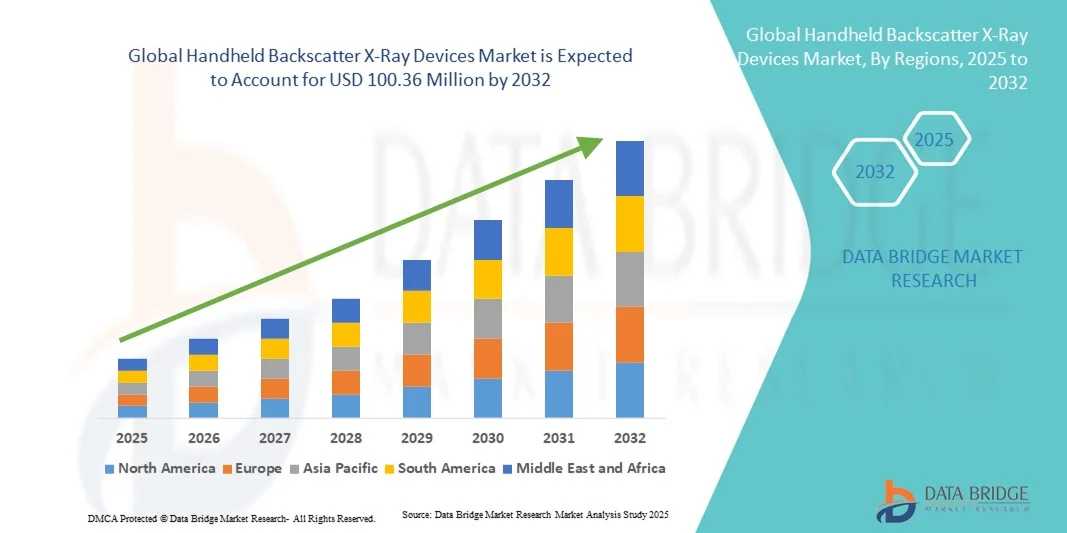
- The global handheld backscatter X-Ray devices market size was valued at USD 62.03 Million in 2024 and is expected to reach USD 100.36 Million by 2032, at a CAGR of 6.20% during the forecast period
- The market growth is largely fueled by the increasing adoption of advanced security screening technologies and continuous technological innovations in portable X-ray imaging systems. The development of compact, handheld backscatter X-ray devices is enhancing accessibility, speed, and efficiency in airports, border security, and law enforcement applications
- Furthermore, rising demand for non-invasive, real-time threat detection solutions and the need for rapid screening in high-traffic areas are driving the adoption of Handheld Backscatter X-Ray Devices. These converging factors are accelerating the uptake of Handheld Backscatter X-Ray Devices solutions, thereby significantly boosting the industry's growth
Handheld Backscatter X-Ray Devices Market Analysis
- The handheld backscatter X-Ray devices market is witnessing robust growth, driven by increasing adoption in security, defense, and law enforcement sectors, as well as technological advancements improving portability, detection accuracy, and operational efficiency
- These devices are becoming integral for threat detection at airports, border checkpoints, and high-security facilities, providing non-intrusive inspection capabilities and enhancing overall safety
- North America dominated the handheld backscatter X-Ray devices market with the largest revenue share of 42.5% in 2024, supported by early adoption of advanced security technologies, strong government and commercial investments in public safety, and the presence of leading market players. The U.S. experienced significant growth in deployments, particularly at airports, transportation hubs, and defense installations, driven by innovations in lightweight, high-resolution X-ray systems and AI-based threat detection
- Asia-Pacific is expected to be the fastest-growing region in the handheld backscatter X-Ray devices market during the forecast period, attributed to rising investments in security infrastructure, increasing urbanization, and growing awareness of non-intrusive screening technologies in countries such as China, India, and Japan. Expanding applications in border security, critical infrastructure, and public events are accelerating market adoption in this region
- The Cancers / Tumors segment dominated the handheld backscatter X-Ray devices market with the largest market revenue share of 44.5% in 2024, driven by the critical need for early detection, precise localization, and intraoperative imaging during oncological procedures
Report Scope and Handheld Backscatter X-Ray Devices Market Segmentation
|
Attributes |
Handheld Backscatter X-Ray Devices Key Market Insights |
|
Segments Covered |
|
|
Countries Covered |
North America
Europe
Asia-Pacific
Middle East and Africa
South America
|
|
Key Market Players |
|
|
Market Opportunities |
|
|
Value Added Data Infosets |
In addition to the insights on market scenarios such as market value, growth rate, segmentation, geographical coverage, and major players, the market reports curated by the Data Bridge Market Research also include in-depth expert analysis, pricing analysis, brand share analysis, consumer survey, demography analysis, supply chain analysis, value chain analysis, raw material/consumables overview, vendor selection criteria, PESTLE Analysis, Porter Analysis, and regulatory framework. |
Handheld Backscatter X-Ray Devices Market Trends
Enhanced Convenience Through Portability and Advanced Imaging
- A significant and accelerating trend in the global handheld backscatter X-Ray devices market is the development of compact, portable, and high-resolution systems that enable rapid detection and screening in diverse environments such as airports, border security, law enforcement, and industrial settings. The portability of these devices allows operators to conduct inspections efficiently without requiring fixed installations or large equipment setups
- For instance, modern handheld backscatter X-ray devices allow security personnel to detect concealed objects, explosives, and contraband in real time, ensuring faster throughput at checkpoints. Devices are designed ergonomically to reduce operator fatigue and improve handling during prolonged use
- Advances in imaging technology and software analytics have enhanced detection accuracy, allowing high-resolution visualization of objects concealed in luggage, parcels, or on personnel. Some devices now incorporate multi-energy scanning to differentiate between organic and inorganic materials for precise threat identification
- Integration with wireless and cloud-based reporting systems allows collected images to be transmitted instantly to centralized monitoring stations for analysis and record-keeping, improving operational efficiency
- The trend towards portable, high-sensitivity, and user-friendly backscatter X-ray devices is reshaping expectations for security and inspection operations. Consequently, companies are developing devices with features such as rapid scanning, adjustable imaging modes, and long battery life for extended field use
- The demand for handheld backscatter X-ray devices that combine accuracy, speed, and ease of use is growing rapidly across both public and private security sectors, as organizations increasingly prioritize operational efficiency, safety, and minimal disruption to workflow
Handheld Backscatter X-Ray Devices Market Dynamics
Driver
Growing Need for Enhanced Security Screening Across Multiple Sectors
- Rising security concerns at airports, border checkpoints, critical infrastructure, and public venues are driving the demand for portable X-ray inspection devices
- For instance, in May 2024, Rapiscan Systems introduced a next-generation handheld backscatter device with enhanced detection sensitivity for explosives and contraband, aimed at improving screening efficiency in public security operations. Such innovations by key manufacturers are expected to fuel market growth in the forecast period
- The need for rapid, non-invasive, and reliable inspection methods is increasing due to heightened global security requirements and regulatory standards
- Handheld backscatter X-ray devices reduce inspection time compared to traditional screening methods while providing high-resolution images for accurate threat detection
- Portability allows operators to perform screening in remote locations, temporary checkpoints, and high-traffic areas, expanding their operational scope
- Advances in imaging software, real-time analytics, and threat recognition algorithms enhance device reliability and effectiveness
- Law enforcement agencies, defense organizations, and private security firms are increasingly adopting these devices to strengthen surveillance and control measures
- The devices also facilitate safer inspection of vehicles, luggage, cargo, and parcels without the need for full-scale baggage scanners
- Continuous innovation, including ergonomic designs, lightweight components, and extended battery life, supports broader adoption in field operations
- Overall, the growing emphasis on security, operational efficiency, and regulatory compliance is propelling the handheld backscatter X-ray devices market forward
Restraint/Challenge
High Cost and Technical Complexity
- The high initial cost of advanced handheld backscatter X-ray devices can limit adoption, especially among smaller security agencies or organizations with budget constraints
- Training requirements for safe and effective operation, including radiation safety protocols, add complexity and additional costs
- Regulatory approvals and certifications vary across regions, potentially delaying deployment and increasing compliance costs for manufacturers
- Concerns regarding radiation exposure, though minimal in modern devices, require strict adherence to safety standards, which can slow adoption
- Maintenance, calibration, and software updates contribute to operational expenses, impacting overall affordability
- Some security operators may prefer conventional screening methods due to familiarity and lower initial investment, despite the technological advantages of handheld devices
- Device reliability in harsh environmental conditions, such as extreme temperatures or high humidity, is a consideration that can hinder usage in certain regions
- While technological advancements are improving usability and reducing weight, the perceived complexity may still deter inexperienced users
- Ongoing education, training, and demonstration of operational efficiency are essential to overcome adoption barriers
- Overall, addressing cost, technical, and regulatory challenges will be crucial for sustained growth in the handheld backscatter X-ray devices market
Handheld Backscatter X-Ray Devices Market Scope
The market is segmented on the basis of indication and end user.
- By Indication
On the basis of indication, the handheld backscatter X-Ray devices market is segmented into orthopedic, cancers / tumors, cardiovascular diseases (CVD), pneumonia, dental, and others. The Cancers / Tumors segment dominated the largest market revenue share of 44.5% in 2024, driven by the critical need for early detection, precise localization, and intraoperative imaging during oncological procedures. Hospitals and specialized cancer centers widely adopt handheld backscatter X-ray devices for tumor detection, mapping, and surgical guidance. The high resolution, portability, and non-invasive nature of these devices enhance clinical efficiency and patient safety. Continuous technological advancements such as improved detector sensitivity, real-time imaging, and enhanced software analytics contribute to their widespread usage. The segment benefits from increasing global cancer prevalence and rising awareness of early diagnostic practices. Regulatory approvals and reimbursement policies favoring advanced imaging procedures support market dominance. In addition, the compact design allows use in outpatient clinics and mobile diagnostic units. Overall, handheld backscatter X-ray devices for cancer detection are in high demand due to clinical necessity, operational efficiency, and improved patient outcomes.
The Orthopedic segment is expected to witness the fastest CAGR of 20.8% from 2025 to 2032, fueled by growing adoption for intraoperative imaging, fracture assessments, and musculoskeletal evaluations. Handheld devices provide rapid bedside imaging for orthopedic surgeons, improving workflow efficiency and patient care. Portability allows use in emergency rooms, orthopedic wards, and remote clinics. Technological advancements such as adjustable energy settings, real-time image processing, and lightweight ergonomic designs facilitate precision and ease of use. Increasing incidence of bone injuries, trauma cases, and degenerative conditions drive demand in hospitals and specialty clinics. Integration with digital reporting platforms enhances diagnostic accuracy and facilitates faster decision-making. Training programs for clinical staff and reduced radiation exposure further support adoption. Growing awareness among healthcare providers about portable imaging benefits accelerates uptake. Regulatory approvals for advanced orthopedic imaging devices encourage expansion. Overall, orthopedic applications are rapidly growing due to efficiency, precision, and broad clinical applicability.
- By End User
On the basis of end user, the handheld backscatter X-Ray devices market is segmented into customs and border protection, law enforcement, critical infrastructure, military and defense, and other end users. The customs and border protection segment accounted for the largest market revenue share of 46.3% in 2024, driven by the increasing need for efficient inspection of luggage, cargo, and parcels at airports, seaports, and land borders. Portable backscatter X-ray devices enable rapid detection of contraband, explosives, and smuggled goods, improving security and throughput. High-resolution imaging, ease of portability, and real-time reporting capabilities make them the preferred choice for customs agencies worldwide. The segment benefits from stringent government regulations, growing global trade, and rising security concerns. Continuous product innovations, such as multi-energy scanning and wireless data transfer, enhance operational effectiveness. Devices are compatible with mobile monitoring units and law enforcement protocols. Growing investments in advanced security technologies support market dominance. The segment also benefits from training and support services provided by manufacturers, ensuring efficient device utilization. Overall, customs and border protection agencies are the primary end users due to operational demand and regulatory compliance requirements.
The Military and Defense segment is expected to witness the fastest CAGR of 21.5% from 2025 to 2032, driven by the need for portable, rapid, and high-precision inspection tools for field operations, checkpoints, and defense facilities. Handheld backscatter X-ray devices provide non-invasive screening of vehicles, equipment, and personnel, improving safety and operational efficiency. Lightweight and ergonomic designs enable long-duration use in diverse environments. Multi-energy detection and real-time imaging enhance threat identification and decision-making. Adoption is increasing in military bases, forward operating locations, and mobile units due to operational flexibility. Technological enhancements, such as integrated analytics, improved detector sensitivity, and wireless reporting, accelerate usage. Training and field support programs provided by manufacturers enhance adoption rates. Rising global defense budgets and increasing focus on homeland security contribute to market growth. The devices’ ability to improve safety and reduce inspection time further drives adoption. Overall, the military and defense segment is expanding rapidly due to operational necessity and technological advancement.
Handheld Backscatter X-Ray Devices Market Regional Analysis
- North America dominated the handheld backscatter X-Ray devices market with the largest revenue share of 42.5% in 2024
- This growth is supported by early adoption of advanced security technologies, strong government and commercial investments in public safety, and the presence of leading market players
- The market experienced significant growth in deployments, particularly at airports, transportation hubs, and defense installations, driven by innovations in lightweight, high-resolution X-ray systems, AI-assisted threat detection, and improved portability for field operations
U.S. Handheld Backscatter X-Ray Devices Market Insight
The U.S. handheld backscatter X-Ray devices market captured the largest revenue share in North America in 2024, fueled by increasing demand for rapid, non-intrusive screening solutions and the growing focus on public safety. High adoption rates in airports, seaports, and border checkpoints, along with the integration of advanced imaging technologies, have driven market expansion. The rising need for point-of-care security screening and real-time threat detection in critical infrastructures further supports robust market growth.
Europe Handheld Backscatter X-Ray Devices Market Insight
The Europe handheld backscatter X-Ray devices market is projected to expand at a notable CAGR throughout the forecast period, primarily driven by stringent security regulations and the growing need for enhanced inspection capabilities in public and commercial spaces. Urbanization, increasing investments in safety infrastructure, and adoption of advanced imaging solutions are fostering the uptake of handheld X-ray devices. Countries such as Germany, France, and the U.K. are witnessing significant growth in the deployment of these devices at airports, border checkpoints, and mass transit systems.
U.K. Handheld Backscatter X-Ray Devices Market Insight
The U.K. handheld backscatter X-Ray devices market is expected to grow at a steady CAGR during the forecast period, driven by increasing demand for portable, high-resolution screening devices in transportation hubs, government facilities, and public events. Rising security concerns, coupled with regulatory mandates for enhanced inspection systems, are encouraging widespread adoption of handheld X-ray technologies. The development of compact, user-friendly, and AI-assisted devices further propels market expansion in the region.
Germany Handheld Backscatter X-Ray Devices Market Insight
The Germany handheld backscatter X-Ray devices market is anticipated to expand at a strong CAGR during the forecast period, supported by technological advancements, heightened security awareness, and robust investments in public safety. The country’s focus on innovation and high-quality standards promotes the integration of high-resolution portable X-ray systems in airports, border security, and defense sectors.
Asia-Pacific Handheld Backscatter X-Ray Devices Market Insight
The Asia-Pacific handheld backscatter X-Ray devices market is poised to grow at the fastest CAGR during the forecast period of 2025 to 2032. This growth is fueled by rising investments in security infrastructure, increasing urbanization, and heightened awareness of non-intrusive screening technologies in countries such as China, India, and Japan. Expanding applications in border security, critical infrastructure, and public events are accelerating market adoption in the region.
Japan Handheld Backscatter X-Ray Devices Market Insight
The Japan handheld backscatter X-Ray devices market is gaining traction due to the country’s high-tech culture, rapid urbanization, and growing focus on public safety. The increasing deployment of handheld X-ray devices at airports, train stations, and large public venues is driving market growth. Technological advancements, including lightweight designs and AI-assisted imaging, are enhancing the efficiency and accuracy of threat detection in the region.
China Handheld Backscatter X-Ray Devices Market Insight
The China handheld backscatter X-Ray devices market accounted for the largest revenue share in Asia-Pacific in 2024, attributed to the country’s expanding investments in public safety, growing healthcare and transportation infrastructure, and increasing awareness of non-intrusive security solutions. The push towards smart cities, the need for efficient border and facility screening, and domestic manufacturing of advanced X-ray systems are key factors propelling market growth.
Handheld Backscatter X-Ray Devices Market Share
The Handheld Backscatter X-Ray Devices industry is primarily led by well-established companies, including:
- Rapiscan Systems (U.S.)
- Viken Detection (U.S.)
- NUCTECH COMPANY LIMITED (China)
- Tek84, Inc. (U.S.)
- Videray Technologies (U.S.)
- Scanna MSC Ltd. (U.K.)
- Astrophysics Inc. (U.S.)
- Smiths Detection Group Ltd. (U.K.)
- Adani Systems Inc. (U.S.)
- American Science & Engineering Inc. (U.S.)
- 3DX-Ray Ltd. (U.K.)
- Pexray Oy (Finland)
- Quantum-RX (U.S.)
- Uni X-rays (U.S.)
- Heweiyongtai Sci & Tech (China)
- Kapri Corp. (U.S.)
Latest Developments in Global Handheld Backscatter X-Ray Devices Market
- In October 2022, Videray Technologies announced the launch of the PX Ultra, the industry's first 160 keV handheld backscatter X-ray imager. This device offers enhanced penetration capabilities, allowing operators to identify anomalies through up to 10mm of steel. In addition, the PX Ultra features improved safety with a reduction in radiation scatter and leakage profiles by a factor of two
- In March 2025, Planmeca introduced its first handheld intraoral X-ray device, the Planmeca ProXGO, at the International Dental Show (IDS) in Cologne. This lightweight and easy-to-use device is designed to capture up to 300 intraoral images on a single battery charge, offering space and time-saving chairside efficiency for various dental setting

- Interactive Data Analysis Dashboard
- Company Analysis Dashboard for high growth potential opportunities
- Research Analyst Access for customization & queries
- Competitor Analysis with Interactive dashboard
- Latest News, Updates & Trend analysis
- Harness the Power of Benchmark Analysis for Comprehensive Competitor Tracking
Data collection and base year analysis are done using data collection modules with large sample sizes. The stage includes obtaining market information or related data through various sources and strategies. It includes examining and planning all the data acquired from the past in advance. It likewise envelops the examination of information inconsistencies seen across different information sources. The market data is analysed and estimated using market statistical and coherent models. Also, market share analysis and key trend analysis are the major success factors in the market report. To know more, please request an analyst call or drop down your inquiry.
The key research methodology used by DBMR research team is data triangulation which involves data mining, analysis of the impact of data variables on the market and primary (industry expert) validation. Data models include Vendor Positioning Grid, Market Time Line Analysis, Market Overview and Guide, Company Positioning Grid, Patent Analysis, Pricing Analysis, Company Market Share Analysis, Standards of Measurement, Global versus Regional and Vendor Share Analysis. To know more about the research methodology, drop in an inquiry to speak to our industry experts.
Data Bridge Market Research is a leader in advanced formative research. We take pride in servicing our existing and new customers with data and analysis that match and suits their goal. The report can be customized to include price trend analysis of target brands understanding the market for additional countries (ask for the list of countries), clinical trial results data, literature review, refurbished market and product base analysis. Market analysis of target competitors can be analyzed from technology-based analysis to market portfolio strategies. We can add as many competitors that you require data about in the format and data style you are looking for. Our team of analysts can also provide you data in crude raw excel files pivot tables (Fact book) or can assist you in creating presentations from the data sets available in the report.













