


What is the Handheld Thermal Camera Market Size and Growth Rate?
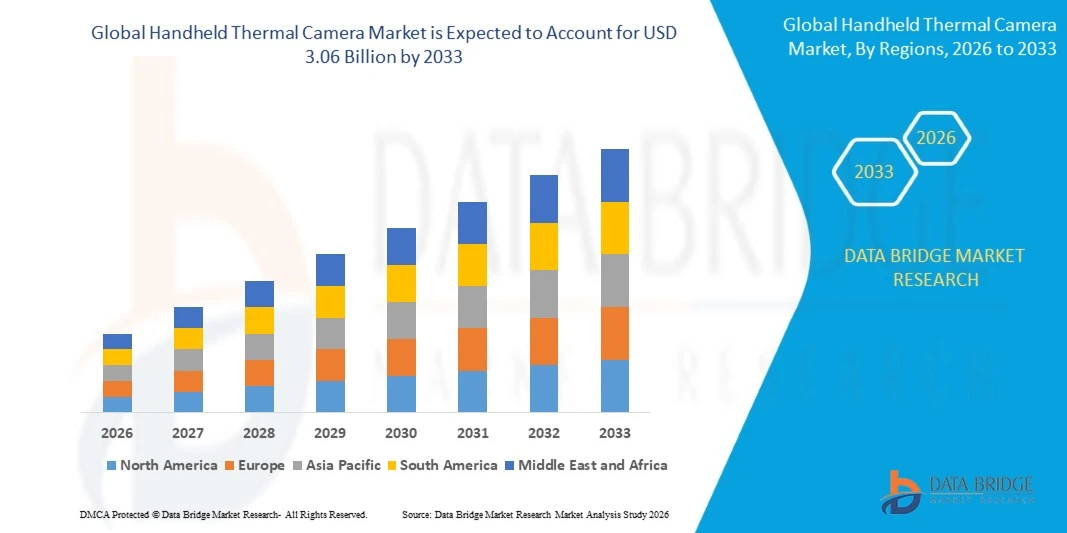
- As per Data Bridge Market Research analysis, the global handheld thermal camera market was valued at USD 1.70 billion in 2025 and is projected to reach USD 3.06 billion by 2033, growing at a CAGR of 7.60% from 2026 to 2033.
- The market is expanding due to the increasing demand for portable and high-performance imaging devices, rising adoption of thermal and infrared imaging across industrial and commercial applications, expanding use in predictive maintenance and building inspection, and growing deployment in security, surveillance, and healthcare diagnostics.
- Handheld thermal cameras are increasingly used across industrial inspection, electrical inspection, predictive maintenance, firefighting, security surveillance, energy audits, mechanical equipment monitoring, and healthcare applications because they enable rapid, non-contact temperature measurement, early fault detection, and portable thermal inspection across diverse environments.
Market Size & Forecast
- Global Market Value (2025): USD 1.70 billion
- Expected Market Value (2033): USD 3.06 billion
- Forecast CAGR (2026–2033): 7.60%
- Leading Region in 2025: Asia-Pacific
- Fastest Growing Region: North America
What are the Major Takeaways of the Handheld Thermal Camera Market?
- Asia-Pacific dominated the global handheld thermal camera market with the largest revenue share of 33.1% in 2025, supported by rapid industrialization, expanding manufacturing activities, increasing adoption of thermal imaging for industrial inspection, growing infrastructure development, and rising demand for security and surveillance solutions.
- North America is expected to be the fastest-growing region, registering a CAGR of 8.1% from 2026 to 2033, driven by increasing adoption of predictive maintenance, industrial automation, smart infrastructure, energy-efficiency initiatives, and advanced thermal inspection technologies.
- The infrared thermal cameras segment dominated the product type category with a market share of 42.6% in 2025, supported by its broad application across industrial inspection, electrical inspection, building inspection, security surveillance, firefighting, and predictive maintenance.
- The smartphone integrated modules segment is expected to be the fastest-growing product type segment, registering a CAGR of 10.4% from 2026 to 2033, driven by increasing demand for portable thermal imaging, smartphone connectivity, cost-effective inspection tools, and convenient field-based diagnostics.
- The uncooled thermal imaging segment dominated the technology category with a market share of 78.3% in 2025, supported by its lower cost, compact design, lower power consumption, operational simplicity, and suitability for industrial, commercial, security, and building inspection applications.
- The cooled thermal imaging segment is expected to be the fastest-growing technology segment, registering a CAGR of 9.2% from 2026 to 2033, driven by increasing demand for high-resolution thermal imaging, long-range detection, advanced surveillance, defense applications, and specialized industrial inspection.
- The industrial inspection segment dominated the application category with a market share of 21.8% in 2025, supported by increasing adoption of thermal cameras for equipment diagnostics, heat-loss detection, machinery inspection, electrical systems monitoring, and predictive maintenance.
Report Scope and Handheld Thermal Camera Market Segmentation
|
Attributes |
Handheld Thermal Camera Key Market Insights |
|
Segments Covered |
|
|
Countries Covered |
North America
Europe
Asia-Pacific
Middle East and Africa
South America
|
|
Key Market Players |
|
|
Market Opportunities |
|
|
Value Added Data Infosets |
In addition to the insights on market scenarios such as market value, growth rate, segmentation, geographical coverage, and major players, the market reports curated by the Data Bridge Market Research also include in-depth expert analysis, geographically represented company-wise production and capacity, network layouts of distributors and partners, detailed and updated price trend analysis and deficit analysis of supply chain and demand. |
What is the Key Trend in the Handheld Thermal Camera Market?
- Increasing integration of artificial intelligence, advanced image processing, wireless connectivity, and smart-device compatibility is becoming a major trend in the global handheld thermal camera market, as manufacturers increasingly develop portable thermal imaging devices that simplify inspection, improve image quality, automate anomaly detection, and enable faster sharing of thermal data. Modern handheld cameras are increasingly designed for industrial electrical inspection, building diagnostics, mechanical inspection, asset reliability, security, and other field applications.
- AI-enabled thermal analysis and automated anomaly detection are gaining importance as users seek to reduce the technical expertise required to interpret thermal images. Newer handheld devices increasingly incorporate image-enhancement technologies and intelligent detection capabilities that can identify thermal abnormalities and convert thermal data into actionable inspection information. HIKMICRO's B21LS, for instance, incorporates Smart SuperScene technology that uses AI to identify issues such as water leaks, insulation gaps, and floor-heating problems.
- For instance, in February 2025, FLIR launched the Ocean Scout Pro, a next-generation handheld thermal monocular designed for public safety professionals and mariners. The device features a 640 × 480 thermal detector and up to 500-meter detection range, demonstrating the continued development of compact, high-performance handheld thermal imaging solutions for situational awareness and search applications.
- Overall, the Handheld Thermal Camera market is increasingly shaped by AI-enabled analytics, improved thermal resolution, advanced image enhancement, wireless connectivity, smartphone integration, long-range detection, and application-specific solutions. Manufacturers are therefore moving toward intelligent and connected handheld thermal imaging platforms that combine portable hardware with automated analysis and digital reporting to improve inspection efficiency, accuracy, and decision-making.
What are the Key Drivers of the Handheld Thermal Camera Market?
- Increasing adoption of predictive maintenance, industrial inspection, and condition-monitoring technologies is becoming a major driver in the global handheld thermal camera market, as industries increasingly use non-contact thermal imaging to identify overheating components, electrical faults, mechanical abnormalities, insulation problems, and potential equipment failures before they result in costly downtime. Handheld thermal cameras provide portable and rapid temperature measurement, enabling maintenance professionals, electricians, building inspectors, and HVAC technicians to conduct inspections efficiently across industrial and commercial environments.
- Integration of thermal imaging with artificial intelligence, multispectral imaging, cloud connectivity, and digital inspection workflows is gaining importance as end users seek faster interpretation, improved diagnostic accuracy, remote collaboration, and automated identification of thermal anomalies. Modern handheld solutions increasingly support image enhancement, wireless connectivity, cloud-based reporting, and integration with mobile devices, strengthening their use in industrial electrical inspection, mechanical inspection, building diagnostics, asset reliability, and energy-efficiency assessments.
- For instance, in February 2025, FLIR launched the Ocean Scout Pro, a next-generation handheld marine thermal monocular designed for public safety professionals and mariners. The device features a 640 × 480 thermal detector, a 500-meter detection range, and a 32-degree field of view, demonstrating continued development of portable thermal imaging solutions for enhanced situational awareness.
- Overall, the handheld thermal camera market is increasingly shaped by predictive maintenance, industrial automation, electrical and mechanical inspection, AI-enabled thermal analysis, smartphone integration, cloud connectivity, energy-efficiency requirements, and demand for portable diagnostic solutions. These developments are encouraging industries to replace conventional inspection approaches with faster, non-contact thermal monitoring solutions that improve early fault detection, operational efficiency, asset reliability, and workplace safety.
What Factors are Challenging the Growth of the Handheld Thermal Camera Market?
- High acquisition costs of advanced thermal imaging systems are a major challenge in the global handheld thermal camera market, particularly for small and medium-sized industrial users. High-resolution sensors, cooled infrared detectors, advanced optics, software, and specialized measurement capabilities increase the overall cost of thermal imaging equipment and can limit adoption among price-sensitive customers.
- Technical limitations related to thermal resolution, accuracy, and environmental conditions create challenges for handheld thermal camera users. Factors such as emissivity, reflected temperatures, atmospheric conditions, distance from the target, and sensor sensitivity can affect measurement accuracy, requiring appropriate calibration, operating knowledge, and interpretation of thermal images.
- For instance, in April 2025, Teledyne FLIR introduced FLIR MIX Starter Kits, a multispectral infrared imaging solution designed to synchronize and align high-speed thermal and visible imagery. The development demonstrates the industry's shift toward combining thermal and visible imaging to provide more detailed and accurate analysis across defense, commercial, and research applications.
- Overall, the handheld thermal camera market is increasingly shaped by the need for higher thermal resolution, accurate temperature measurement, multispectral imaging, AI-enabled analysis, cloud connectivity, portability, and application-specific functionality. Manufacturers and users therefore face challenges related to equipment costs, calibration, operator expertise, interoperability, cybersecurity, environmental measurement conditions, and the integration of advanced imaging technologies into existing inspection and maintenance workflows.
How is the Handheld Thermal Camera Market Segmented?
The global handheld thermal camera market is segmented on the basis of product type, technology, application, profession type, and end user.
- By Product Type
On the basis of product type, the global handheld thermal camera market is segmented into infrared thermal cameras, thermal imaging scopes, thermal monoculars, standalone handheld devices, and smartphone integrated modules. The infrared thermal cameras segment dominated the market with a 42.6% share in 2025, driven by widespread use across industrial inspection, electrical inspection, predictive maintenance, building inspection, security surveillance, and firefighting applications.
The smartphone integrated modules segment is projected to register the fastest growth at a CAGR of 10.4% from 2026 to 2033, supported by increasing demand for portable thermal imaging solutions, smartphone connectivity, cost-effective inspection devices, and convenient field-based thermal diagnostics.
- By Technology
On the basis of technology, the global handheld thermal camera market is segmented into uncooled thermal imaging and cooled thermal imaging. The uncooled thermal imaging segment dominated the market with a 78.3% share in 2025, driven by its relatively lower cost, compact design, lower power consumption, portability, and suitability for industrial, commercial, security, and building inspection applications.
The cooled thermal imaging segment is projected to register the fastest growth at a CAGR of 9.2% from 2026 to 2033, supported by increasing demand for high-resolution imaging, long-range detection, advanced surveillance, defense applications, and specialized industrial inspection.
- By Profession Type
On the basis of profession type, the global handheld thermal camera market is segmented into building inspectors & energy auditors, electricians, and hvac technicians. the building inspectors & energy auditors segment dominated the market with a 44.7% share in 2025, driven by increasing demand for building energy-efficiency assessments, heat-loss detection, insulation inspection, moisture identification, and thermal assessment of residential and commercial buildings.
The HVAC technicians segment is projected to register the fastest growth at a CAGR of 9.5% from 2026 to 2033, supported by increasing adoption of thermal imaging for HVAC diagnostics, temperature variation detection, energy-efficiency assessment, preventive maintenance, and identification of system faults.
- By End User
On the basis of end user, the global handheld thermal camera market is segmented into military defense, law enforcement, industrial, commercial, and others. The industrial segment dominated the market with a 38.9% share in 2025, driven by extensive use of handheld thermal cameras for predictive maintenance, electrical inspection, mechanical equipment monitoring, manufacturing-process monitoring, facility management, and industrial safety.
The commercial segment is projected to register the fastest growth at a CAGR of 9.3% from 2026 to 2033, supported by increasing adoption of thermal imaging for building inspection, energy audits, facility management, HVAC monitoring, commercial property maintenance, and energy-efficiency assessments.
Which Region Holds the Largest Share of the Handheld Thermal Camera Market?
- Asia-Pacific accounted for the largest share of the global handheld thermal camera market, with a revenue share of 33.1% in 2025, supported by rapid industrialization, expanding manufacturing activities, increasing infrastructure development, growing adoption of thermal imaging for industrial inspection, and rising demand for security and surveillance solutions. The region is also benefiting from increasing investments in energy efficiency, predictive maintenance, electrical inspection, and smart infrastructure, which are expanding the application of handheld thermal imaging technologies.
- The region represents the supported by expanding industrial and manufacturing bases, infrastructure development, increasing adoption of condition-monitoring technologies, and growing demand for portable inspection equipment. Handheld thermal cameras are increasingly used for electrical inspection, mechanical equipment monitoring, building diagnostics, energy audits, and industrial maintenance. The availability of compact and connected thermal imaging solutions is also supporting adoption across professional inspection applications.
U.S. Handheld Thermal Camera Market Insight
The U.S. handheld thermal camera market is expanding due to increasing adoption of thermal imaging across industrial inspection, predictive maintenance, electrical diagnostics, security surveillance, firefighting, building inspection, and energy auditing. The market is supported by advanced industrial infrastructure, growing investments in energy efficiency, increasing demand for condition-monitoring technologies, and rising adoption of portable inspection devices. Industrial facilities and commercial buildings are increasingly using handheld thermal cameras to identify equipment faults, electrical abnormalities, heat loss, and maintenance requirements. Technological advancements in infrared sensors, image processing, connectivity, and AI-enabled thermal analysis are further supporting market growth.
Canada Handheld Thermal Camera Market Insight
The Canada handheld thermal camera market is expanding due to increasing adoption of thermal imaging across industrial inspection, electrical maintenance, building diagnostics, energy audits, security surveillance, and predictive maintenance applications. Demand is supported by growing investments in infrastructure modernization, energy efficiency, industrial automation, and workplace safety. Handheld thermal cameras are increasingly used by electricians, HVAC technicians, building inspectors, and industrial maintenance professionals to identify heat loss, electrical faults, equipment abnormalities, and mechanical issues. Growing awareness of non-contact inspection technologies, technological advancements in thermal sensors, and increasing availability of compact and connected imaging devices are expected to further support market growth in Canada.
Asia-Pacific Handheld Thermal Camera Market Insight
The Asia-Pacific handheld thermal camera market is expanding due to rapid industrialization, increasing infrastructure development, growing adoption of predictive maintenance, and rising demand for security and surveillance solutions. Countries such as China, Japan, South Korea, and India are witnessing increased use of thermal imaging across industrial inspection, electrical inspection, energy audits, firefighting, building diagnostics, and mechanical equipment monitoring. Growing investments in smart infrastructure, manufacturing automation, and energy efficiency are further supporting market growth. Increasing availability of compact, portable, and connected thermal cameras is also improving accessibility across commercial, industrial, public safety, and professional inspection applications.
China Handheld Thermal Camera Market Insight
The China handheld thermal camera market is expanding due to rapid industrialization, increasing manufacturing activities, and growing adoption of thermal imaging across industrial inspection, electrical monitoring, predictive maintenance, security surveillance, and energy audits. Strong investments in smart infrastructure, automation, and equipment condition monitoring are supporting demand for portable thermal imaging solutions. China’s expanding electronics and semiconductor manufacturing sectors are also creating opportunities for thermal inspection technologies. Increasing adoption of compact, connected, and AI-enabled thermal cameras is further supporting market growth, while domestic technology development and expanding applications across commercial, industrial, and public safety sectors are strengthening the market outlook.
Japan Handheld Thermal Camera Market Insight
The Japan handheld thermal camera market is expanding due to increasing adoption of thermal imaging across industrial inspection, predictive maintenance, electrical diagnostics, security surveillance, and building energy audits. Japan’s advanced manufacturing sector, strong emphasis on equipment reliability, and growing adoption of automation and smart-factory technologies support demand for portable thermal inspection solutions. The market is further supported by increasing applications in healthcare, firefighting, infrastructure monitoring, and disaster response. Growing demand for compact, high-resolution, and AI-enabled thermal cameras is encouraging manufacturers to develop advanced solutions that improve fault detection, operational efficiency, and real-time monitoring across professional applications.
Germany Handheld Thermal Camera Market Insight
The Germany handheld thermal camera market is expanding due to increasing adoption of thermal imaging technologies across industrial inspection, predictive maintenance, electrical inspection, building diagnostics, and energy audits. Germany’s strong manufacturing and industrial base supports demand for portable thermal cameras for equipment monitoring, fault detection, and energy-efficiency assessment. Growing investments in industrial automation, smart manufacturing, renewable energy infrastructure, and building energy efficiency are further supporting market growth. Increasing adoption of advanced thermal imaging with AI-enabled analysis, improved resolution, and connectivity is also expected to strengthen demand among industrial companies, building inspectors, electricians, and HVAC professionals.
U.K. Handheld Thermal Camera Market Insight
The U.K. handheld thermal camera market is expanding due to increasing adoption of thermal imaging across industrial inspection, electrical maintenance, building diagnostics, security surveillance, energy audits, and predictive maintenance applications. Demand is supported by growing emphasis on energy efficiency, infrastructure maintenance, workplace safety, and early equipment-failure detection. Industrial facilities, building inspectors, electricians, and HVAC technicians are increasingly adopting portable thermal cameras for rapid, non-contact temperature measurement and fault identification. Advancements in infrared sensors, AI-enabled image analysis, wireless connectivity, and compact camera designs are further supporting market growth across commercial, industrial, and public safety applications.
Which are the Top Companies in Handheld Thermal Camera Market?
The handheld thermal camera industry is primarily led by well-established companies, including:
- Teledyne Technologies Incorporated (U.S.)
- Fluke Corporation (U.S.)
- HANGZHOU MICROIMAGE SOFTWARE CO., LTD. (China)
- Testo SE & Co. KGaA (Germany)
- Wuhan Guide Sensmart Tech Co., Ltd. (China)
- InfiRay Technologies Co., Ltd. (China)
- Seek Thermal, Inc. (U.S.)
- Raythink Technology Co., Ltd. (China)
- DALI Technology Co., Ltd. (China)
- HT Instruments S.r.l. (Italy)
- Sonel S.A. (Poland)
- UNI-TREND TECHNOLOGY (CHINA) CO., LTD. (China)
- Zhejiang ULIRVISION Technology Co., LTD (China)
- ThermTec Technology Co., Ltd. (China)
- HTI-Xintai Optoelectronics Technology Co., Ltd. (China)
- SATIR Europe (Germany)
- Opgal Optronic Industries Ltd. (Israel)
- Laserliner (Germany)
- Workswell s.r.o. (Czech Republic)
- Cordex (U.K.)
What are Latest Developments in Handheld Thermal Camera Market?
- In February 2025, Teledyne FLIR launched the FLIR Ocean Scout Pro, a next-generation handheld marine thermal monocular featuring a 640 × 480 thermal detector, 500-meter detection range, and 32-degree field of view. The product targets public safety professionals and mariners, strengthening the use of handheld thermal imaging for situational awareness and low-visibility operations.
- In May 2025, Teledyne FLIR OEM collaborated with AerialOGI and launched AerialOGI-N, an optical gas imaging camera module compatible with handheld and drone platforms. The solution uses a 640 × 512 MWIR camera core and can detect and quantify more than 25 greenhouse gases, including methane and VOCs, supporting industrial gas-leak inspection and emissions monitoring.
- In June 2025, Teledyne FLIR introduced the FLIR PT-Series AI SR, a high-resolution visible and thermal security camera combining 4K visible imaging with thermal imaging and AI-based detection and tracking. The development highlights the growing integration of thermal imaging, artificial intelligence, and multispectral sensing for commercial and industrial security applications.
- In November 2025, FOTRIC launched the TK6 professional handheld thermal camera, featuring 384 × 288 thermal resolution, a ceramic-packaged detector, manual focus, a 3.5-inch HD display, and ±2°C/2% accuracy. With a starting price of USD 699, the launch reflects increasing efforts to make higher-resolution professional thermal imaging more accessible to technicians.
- In March 2026, FOTRIC launched the TK5Kit, a 320 × 240 handheld thermal imaging camera designed for everyday industrial and facility inspections. The USD 899 kit includes rechargeable batteries, carrying cases, and a belt clip, targeting HVAC, electrical, mechanical, and building inspection applications.

- Interactive Data Analysis Dashboard
- Company Analysis Dashboard for high growth potential opportunities
- Research Analyst Access for customization & queries
- Competitor Analysis with Interactive dashboard
- Latest News, Updates & Trend analysis
- Harness the Power of Benchmark Analysis for Comprehensive Competitor Tracking
Global Handheld Thermal Camera Market, Supply Chain Analysis and Ecosystem Framework
To support market growth and help clients navigate the impact of geopolitical shifts, DBMR has integrated in-depth supply chain analysis into its Global Handheld Thermal Camera Market research reports. This addition empowers clients to respond effectively to global changes affecting their industries. The supply chain analysis section includes detailed insights such as Global Handheld Thermal Camera Market consumption and production by country, price trend analysis, the impact of tariffs and geopolitical developments, and import and export trends by country and HSN code. It also highlights major suppliers with data on production capacity and company profiles, as well as key importers and exporters. In addition to research, DBMR offers specialized supply chain consulting services backed by over a decade of experience, providing solutions like supplier discovery, supplier risk assessment, price trend analysis, impact evaluation of inflation and trade route changes, and comprehensive market trend analysis.
Data collection and base year analysis are done using data collection modules with large sample sizes. The stage includes obtaining market information or related data through various sources and strategies. It includes examining and planning all the data acquired from the past in advance. It likewise envelops the examination of information inconsistencies seen across different information sources. The market data is analysed and estimated using market statistical and coherent models. Also, market share analysis and key trend analysis are the major success factors in the market report. To know more, please request an analyst call or drop down your inquiry.
The key research methodology used by DBMR research team is data triangulation which involves data mining, analysis of the impact of data variables on the market and primary (industry expert) validation. Data models include Vendor Positioning Grid, Market Time Line Analysis, Market Overview and Guide, Company Positioning Grid, Patent Analysis, Pricing Analysis, Company Market Share Analysis, Standards of Measurement, Global versus Regional and Vendor Share Analysis. To know more about the research methodology, drop in an inquiry to speak to our industry experts.
Data Bridge Market Research is a leader in advanced formative research. We take pride in servicing our existing and new customers with data and analysis that match and suits their goal. The report can be customized to include price trend analysis of target brands understanding the market for additional countries (ask for the list of countries), clinical trial results data, literature review, refurbished market and product base analysis. Market analysis of target competitors can be analyzed from technology-based analysis to market portfolio strategies. We can add as many competitors that you require data about in the format and data style you are looking for. Our team of analysts can also provide you data in crude raw excel files pivot tables (Fact book) or can assist you in creating presentations from the data sets available in the report.













