


Haptic Technology Market Overview
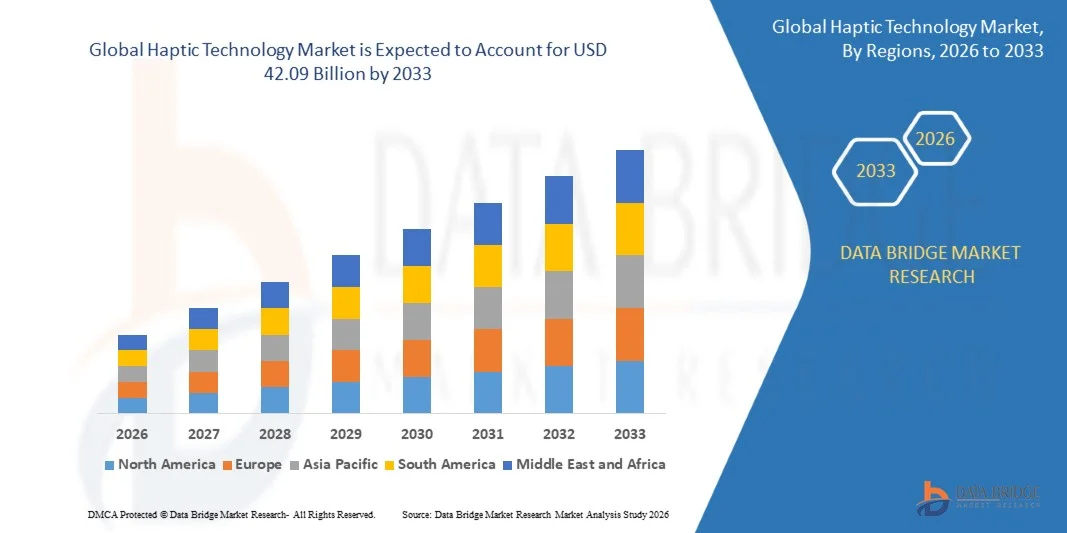
The Haptic Technology Market was valued at USD 14.05 Billion in 2025 and is projected to reach USD 42.09 Billion by 2033, growing at a CAGR of 14.70% from 2026 to 2033. The market is experiencing consistent growth driven by rising demand for immersive user experiences, increasing adoption of smartphones and wearable devices, and rapid expansion of AR/VR and gaming ecosystems. Advancements in actuator technologies, AI-integrated haptic software, and force feedback systems are further supporting market expansion across consumer electronics, automotive, healthcare, and industrial applications.
The increasing global shift toward human-machine interaction enhancement, combined with growing integration of tactile feedback systems in digital devices, is significantly reshaping user interface technologies. Rising demand for realistic simulation environments in gaming, medical training, and automotive infotainment systems is further accelerating adoption. In addition, continuous innovation by leading technology companies in miniaturized, energy-efficient haptic components is strengthening long-term market growth prospects.
Key Market Trends & Insights
- Asia-Pacific dominated the Haptic Technology Market with the largest revenue share of 42% in 2025, supported by strong consumer electronics manufacturing, rapid adoption of smartphones, and expanding gaming and AR/VR ecosystems
- The tactile feedback segment led the market with a 56.2% share in 2025, driven by widespread use in smartphones, touchscreens, and wearable devices
- North America is expected to be the fastest-growing region at a CAGR of 13.3% from 2026 to 2033, fueled by strong demand for immersive gaming experiences, AR/VR technologies, and advanced automotive interfaces
- Gaming is the fastest-growing application type, projected to register a CAGR of 16.1% from 2026 to 2033, supported by rising demand for immersive gaming experiences and realistic sensory feedback systems
- The consumer electronics segment dominated the application category with a 44.7% revenue share in 2025, led by widespread integration of haptic feedback in smartphones, tablets, wearables, and smart devices
- Actuators accounted for 38.4% of the market in 2025, preferred by its critical role in converting electrical signals into physical tactile responses across devices
- The force feedback segment is the fastest-growing feedback category, with a CAGR of 15.3% from 2026 to 2033, driven by increasing demand for highly immersive and realistic simulation experiences
Market Size & Forecast
- Global Market Value (2025): USD 14.05 Billion
- Expected Market Value (2033): USD 42.09 Billion
- Forecast CAGR (2026–2033): 14.70%
- Leading Region in 2025: Asia-Pacific
- Fastest Growing Region: North America
Report Scope and Haptic Technology Market Segmentation
|
Attributes |
Haptic Technology Key Market Insights |
|
Segments Covered |
|
|
Countries Covered |
North America · U.S. · Canada · Mexico Europe · Germany · France · U.K. · Netherlands · Switzerland · Belgium · Russia · Italy · Spain · Turkey · Rest of Europe Asia-Pacific · China · Japan · India · South Korea · Singapore · Malaysia · Australia · Thailand · Indonesia · Philippines · Rest of Asia-Pacific Middle East and Africa · Saudi Arabia · U.A.E. · South Africa · Egypt · Israel · Rest of Middle East and Africa South America · Brazil · Argentina · Rest of South America |
|
Key Market Players |
· Apple Inc. (U.S.) · Google LLC (U.S.) · HAPTION SA (U.S.) · Immersion (U.S.) · 3D Systems, Inc. (U.S.) · Nuance Communications, Inc. (U.S.) · NOVASENTIS, INC. (U.S) · Ultraleap Limited (U.K) · Qualcomm Technologies Inc (U.S.) · ALPS ALPINE CO., LTD. (Japan) · SAMSUNG (South Korea) · Panasonic Corporation (Japan) · Alpine Electronics Inc. (Japan) · NXP Semiconductors (Netherlands) · Polaris Industries, Inc. (U.S.) · FeliCa Networks, Inc. (Japan) · CCL Industries (Canada) · LINTEC Corporation (Japan) · Robert Bosch GmbH (Germany) · Telefonaktiebolaget LM Ericsson (Sweden) |
|
Market Opportunities |
· Expansion of Haptics in Automotive Infotainment and Safety Systems · Growth of Haptic Applications in Healthcare Simulation and Surgical Training · Increasing Adoption of Haptic Technology in Gaming and Wearable Electronics |
|
Value Added Data Infosets |
In addition to the market insights such as market value, growth rate, market segments, geographical coverage, market players, and market scenario, the market report curated by the Data Bridge Market Research team includes in-depth expert analysis, import/export analysis, pricing analysis, production consumption analysis, and pestle analysis. |
Haptic Technology Market Trends
Trend: Rising Integration of Haptic Feedback in AR/VR and Immersive Devices
Haptic Technology Market Trends highlight the rapid integration of haptic feedback systems into AR/VR headsets, gaming controllers, and immersive digital devices to enhance realism and user interaction. The demand for tactile-enabled immersive experiences is growing across gaming, simulation, and training applications, where precise motion and touch feedback significantly improve engagement. Advancements in ultra-compact actuators, ultrasonic haptics, and wearable feedback systems are further accelerating adoption in next-generation devices.
Companies such as Ultraleap Limited and Apple Inc. are actively developing advanced haptic-enabled AR/VR interfaces, including gesture-controlled and spatial interaction systems that enhance immersive digital environments.
Haptic Technology Market Dynamics
Key Market Driver: Increasing Demand for Enhanced Human–Machine Interface Systems
The growing need for intuitive and immersive human–machine interaction is significantly driving the Haptic Technology market, particularly across smartphones, automotive interfaces, gaming systems, and healthcare simulators. Haptic feedback enhances user experience by providing realistic tactile responses in digital environments, improving precision, usability, and engagement. Rising adoption of touch-based interfaces in consumer electronics and automotive infotainment systems is further strengthening market demand.
Major companies such as Immersion Corporation and Qualcomm Technologies Inc are developing advanced haptic solutions integrated into mobile devices and automotive platforms to improve responsiveness and interaction quality across applications.
Key Restraint/Challenge: High Development Cost and Power Consumption Limitations
High development costs and increased power consumption requirements remain a major challenge in the Haptic Technology market, particularly for advanced force feedback and high-precision actuator systems. Complex hardware integration, miniaturization constraints, and continuous power demand in wearable and mobile devices limit large-scale adoption. In addition, balancing performance with energy efficiency remains a key engineering challenge for manufacturers.
Companies such as ALPS ALPINE CO., LTD. and NOVASENTIS, INC. are focusing on low-power actuator designs and optimized haptic drivers to address efficiency constraints while maintaining performance in compact electronic devices.
Key Market Opportunity: Expansion of Haptics in Automotive Infotainment and Safety Systems
The expansion of haptic technology in automotive infotainment and safety systems presents a significant growth opportunity for the market, driven by increasing demand for advanced driver assistance systems (ADAS) and intuitive vehicle interfaces. Haptic feedback is being widely integrated into touchscreens, steering controls, and dashboard interfaces to reduce driver distraction and enhance safety. Automotive OEMs are increasingly adopting tactile warning systems for navigation, lane assistance, and collision alerts.
Companies such as Google LLC and Apple Inc. are advancing in-vehicle interface technologies through digital cockpit platforms and integrated haptic feedback systems, supporting the evolution of smart and connected vehicle ecosystems.
Haptic Technology Market Scope
The haptic technology market is segmented on the basis of component, feedback, application.
- By Component
On the basis of component, the Haptic Technology Market is segmented into microcontrollers, drivers, actuators, software, and others. The Actuators segment dominated the market with the largest share of 38.4% in 2025, driven by its critical role in converting electrical signals into physical tactile responses across devices. Strong adoption in smartphones, gaming controllers, automotive interfaces, and wearable devices is supporting sustained demand. Continuous advancements in miniaturization and energy-efficient actuator designs further enhance performance and integration capability. Increasing deployment in immersive user interfaces across consumer electronics continues to reinforce segment dominance.
The Software segment is projected to register the fastest growth at a CAGR of 14.6% from 2026 to 2033, driven by rising demand for advanced haptic feedback customization and real-time sensory control systems. Growing integration of AI-driven haptic software with AR/VR platforms and gaming ecosystems is enhancing user immersion and responsiveness. Expanding use of cloud-based haptic simulation and SDK platforms is further supporting developer adoption. Increasing focus on personalized tactile experiences across automotive and healthcare applications is accelerating segment expansion.
- By Feedback
On the basis of feedback, the Haptic Technology Market is segmented into tactile feedback and force feedback. The Tactile Feedback segment dominated the market with a share of 56.2% in 2025, driven by widespread use in smartphones, touchscreens, and wearable devices. Its ability to simulate vibration-based sensory responses at low cost makes it highly suitable for mass-market consumer electronics. Continuous improvements in vibration motor technology and haptic precision are further supporting adoption. Growing demand for enhanced user interaction in gaming and mobile applications strengthens its dominant position.
The Force Feedback segment is projected to register the fastest growth at a CAGR of 15.3% from 2026 to 2033, driven by increasing demand for highly immersive and realistic simulation experiences. Expanding use in gaming controllers, surgical simulation systems, and automotive driver-assist interfaces is significantly boosting adoption. Advancements in robotic actuation and precision control systems are improving response accuracy and realism. Rising investments in AR/VR ecosystems and advanced training simulators are further accelerating segment growth.
- By Application
On the basis of application, the Haptic Technology Market is segmented into automotive & transportation, consumer electronics, education & research, gaming, healthcare, engineering, and others. The Consumer Electronics segment dominated the market with the largest share of 44.7% in 2025, driven by widespread integration of haptic feedback in smartphones, tablets, wearables, and smart devices. Increasing consumer demand for immersive and interactive user interfaces is further supporting adoption. Continuous innovation by leading device manufacturers in enhancing touch-based experiences is strengthening market penetration. Expanding global smartphone shipments continue to reinforce segment leadership.
The Gaming segment is projected to register the fastest growth at a CAGR of 16.1% from 2026 to 2033, driven by rising demand for immersive gaming experiences and realistic sensory feedback systems. Growing adoption of VR headsets, advanced controllers, and motion-based gaming systems is significantly enhancing user engagement. Increasing investments by gaming companies in AR/VR ecosystems and next-generation consoles are accelerating technological advancements. Expanding e-sports popularity and interactive entertainment platforms further support rapid segment expansion.
Haptic Technology Market Regional Analysis
Asia-Pacific dominated the haptic technology market and accounted for the largest revenue share of 42% in 2025, supported by strong consumer electronics manufacturing, rapid adoption of smartphones, and expanding gaming and AR/VR ecosystems. The region benefits from large-scale production capabilities in countries such as China, South Korea, and Japan, which host major OEMs and component suppliers driving innovation in haptic modules and actuators. Rising demand for immersive user interfaces in gaming devices, automotive infotainment systems, and wearable electronics is further accelerating regional market expansion. In addition, increasing investments in advanced electronics R&D and semiconductor integration are strengthening Asia-Pacific’s leadership in the global haptic technology landscape.
China Haptic Technology Market Insight
China held the largest share in the Asia-Pacific Haptic Technology market in 2025, driven by its dominant position in consumer electronics manufacturing and strong presence of smartphone and gaming device producers. The country benefits from extensive production of haptic components such as actuators and microcontrollers, supporting large-scale integration into mobile devices and smart wearables. Rapid expansion of AR/VR applications and increasing investments by domestic tech companies in immersive technologies are further boosting demand. In addition, strong export capabilities in electronics manufacturing are reinforcing China’s leadership in global haptic technology supply chains.
India Haptic Technology Market Insight
India is witnessing the fastest growth in the Asia-Pacific region, driven by rising smartphone penetration, expanding gaming industry, and increasing adoption of digital learning and AR/VR platforms. Growing consumer demand for affordable smartphones with advanced tactile feedback features is supporting market expansion. The country is also experiencing increasing investments in electronics manufacturing under government initiatives promoting local production. In addition, rising usage of haptic-enabled applications in education, automotive infotainment, and healthcare simulation is accelerating long-term market growth.
Europe Haptic Technology Market Insight
The Europe Haptic Technology market is expanding steadily, supported by strong adoption in automotive systems, industrial automation, healthcare simulation, and premium consumer electronics. Increasing demand for advanced driver assistance systems and immersive infotainment interfaces in vehicles is significantly driving haptic integration. The region also benefits from strong R&D activities in robotics, medical training systems, and AR/VR applications. In addition, growing focus on precision engineering and user experience enhancement is further supporting adoption across multiple end-use industries.
Germany Haptic Technology Market Insight
Germany accounted for the largest share in the Europe Haptic Technology market in 2025, driven by strong automotive manufacturing and advanced engineering capabilities. The country is a key hub for integrating haptic feedback systems into vehicle dashboards, steering systems, and safety applications to enhance driver interaction. Increasing adoption of Industry 4.0 technologies and robotics in manufacturing is further supporting demand for haptic systems. In addition, strong investments in automotive innovation and human-machine interface technologies are reinforcing Germany’s leadership position in the regional market.
U.K. Haptic Technology Market Insight
The U.K. market is supported by growing demand for haptic-enabled gaming devices, healthcare simulation tools, and advanced wearable technologies. Increasing adoption of VR-based training systems in education and defense sectors is significantly boosting market growth. The country also benefits from a strong gaming industry that is integrating advanced tactile feedback systems to enhance user immersion. In addition, rising investments in digital innovation and AR/VR startups are further supporting expansion of haptic technology applications.
North America Haptic Technology Market Insight
North America is projected to grow at the fastest CAGR of 13.3% from 2026 to 2033, driven by strong demand for immersive gaming experiences, AR/VR technologies, and advanced automotive interfaces. Increasing adoption of haptic systems in healthcare simulation, robotics, and wearable devices is further accelerating regional market growth. The region benefits from strong presence of leading technology companies and continuous innovation in human-machine interaction systems. In addition, rising investments in metaverse platforms and next-generation computing interfaces are significantly boosting demand for haptic technologies.
U.S. Haptic Technology Market Insight
The U.S. accounted for the largest share in the North America Haptic Technology market in 2025, supported by strong presence of leading technology companies and advanced R&D capabilities in AR/VR, gaming, and automotive sectors. High adoption of haptic feedback in smartphones, gaming consoles, and wearable devices is driving sustained demand. The country also benefits from rapid expansion of immersive training systems in healthcare and defense applications. In addition, continuous innovation in AI-driven user interfaces and human-machine interaction technologies is reinforcing the U.S. leadership position in the regional market.
Haptic Technology Market Share
The haptic technology industry is primarily led by well-established companies, including:
- Apple Inc. (U.S.)
- Google LLC (U.S.)
- HAPTION SA (U.S.)
- Immersion (U.S.)
- 3D Systems, Inc. (U.S.)
- Nuance Communications, Inc. (U.S.)
- NOVASENTIS, INC. (U.S)
- Ultraleap Limited (U.K)
- Qualcomm Technologies Inc (U.S.)
- ALPS ALPINE CO., LTD. (Japan)
- SAMSUNG (South Korea)
- Panasonic Corporation (Japan)
- Alpine Electronics Inc. (Japan)
- NXP Semiconductors (Netherlands)
- Polaris Industries, Inc. (U.S.)
- FeliCa Networks, Inc. (Japan)
- CCL Industries (Canada)
- LINTEC Corporation (Japan)
- Robert Bosch GmbH (Germany)
- Telefonaktiebolaget LM Ericsson (Sweden)
Latest Developments in Haptic Technology Market
- In January 2023, OnePlus advanced its smartphone haptic experience by integrating AAC Technologies’ biometric haptic actuator, combining acoustics, optics, and vibration systems to deliver stronger and more precise tactile feedback. This development significantly enhances user interaction in smartphones by improving vibration accuracy, responsiveness, and immersive touch experience. It also strengthens the competitive positioning of premium smartphone manufacturers by accelerating adoption of advanced haptic modules in consumer electronics
- In December 2022, D-BOX Technologies partnered with Track Racer to develop high-fidelity haptic feedback gaming chassis capable of delivering four degrees of freedom. This collaboration enhances the immersive gaming and simulation market by enabling more realistic motion and tactile response systems for professional gaming and training environments. It also supports the expansion of advanced haptic hardware ecosystems in high-end gaming infrastructure, despite high component costs limiting mass adoption
- In June 2022, D-BOX Technologies Inc. and MILA entered into a strategic partnership to integrate artificial intelligence into haptic systems for improved performance and productivity. This initiative significantly impacts the market by enabling smarter, adaptive haptic feedback solutions that enhance precision in simulation, entertainment, and industrial applications. It also accelerates innovation in AI-driven sensory technologies, improving efficiency and customization of tactile experiences across end-use industries
- In January 2022, AAC Technologies launched its ultra-wide linear actuator Cyber Engine designed to enhance haptic performance in smartphones and virtual reality devices. This development improves market dynamics by delivering stronger vibration intensity and more refined tactile feedback, bridging the gap between virtual environments and real-world sensory response. It also strengthens demand for advanced actuator technologies in consumer electronics and AR/VR ecosystems
- In August 2021, Renesas Electronics Corporation acquired Dialog Semiconductor PLC to expand its portfolio in haptic technology, embedded processing, and connectivity solutions. This acquisition significantly impacted the market by strengthening Renesas’ capabilities in integrated haptic driver solutions for automotive and consumer electronics applications. It also enabled broader product integration across LED backlighting and haptic systems, enhancing innovation in human-machine interface technologies and accelerating industry consolidation

- Interactive Data Analysis Dashboard
- Company Analysis Dashboard for high growth potential opportunities
- Research Analyst Access for customization & queries
- Competitor Analysis with Interactive dashboard
- Latest News, Updates & Trend analysis
- Harness the Power of Benchmark Analysis for Comprehensive Competitor Tracking
Data collection and base year analysis are done using data collection modules with large sample sizes. The stage includes obtaining market information or related data through various sources and strategies. It includes examining and planning all the data acquired from the past in advance. It likewise envelops the examination of information inconsistencies seen across different information sources. The market data is analysed and estimated using market statistical and coherent models. Also, market share analysis and key trend analysis are the major success factors in the market report. To know more, please request an analyst call or drop down your inquiry.
The key research methodology used by DBMR research team is data triangulation which involves data mining, analysis of the impact of data variables on the market and primary (industry expert) validation. Data models include Vendor Positioning Grid, Market Time Line Analysis, Market Overview and Guide, Company Positioning Grid, Patent Analysis, Pricing Analysis, Company Market Share Analysis, Standards of Measurement, Global versus Regional and Vendor Share Analysis. To know more about the research methodology, drop in an inquiry to speak to our industry experts.
Data Bridge Market Research is a leader in advanced formative research. We take pride in servicing our existing and new customers with data and analysis that match and suits their goal. The report can be customized to include price trend analysis of target brands understanding the market for additional countries (ask for the list of countries), clinical trial results data, literature review, refurbished market and product base analysis. Market analysis of target competitors can be analyzed from technology-based analysis to market portfolio strategies. We can add as many competitors that you require data about in the format and data style you are looking for. Our team of analysts can also provide you data in crude raw excel files pivot tables (Fact book) or can assist you in creating presentations from the data sets available in the report.













