


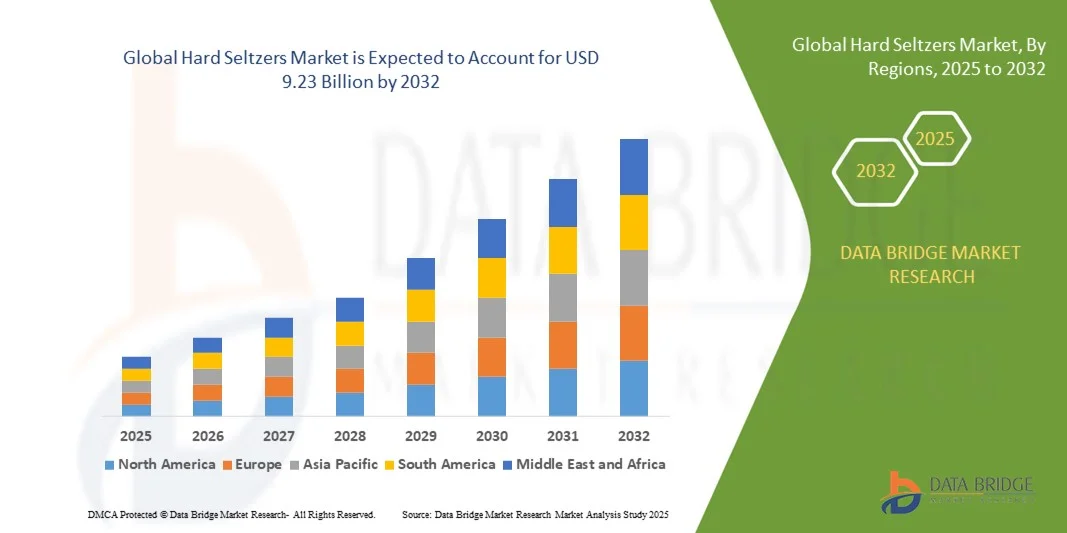
Hard Seltzers Market Size
- The global hard seltzers market size was valued at USD 4.47 billion in 2024 and is expected to reach USD 9.23 billion by 2032, at a CAGR of 9.5% during the forecast period
- The market growth is largely fueled by the increasing consumer preference for low-calorie, gluten-free, and health-conscious alcoholic beverages, combined with the rising popularity of ready-to-drink (RTD) options that offer convenience and variety
- Furthermore, growing experimentation with innovative flavors, premiumization trends, and expanding distribution channels across retail and e-commerce platforms are accelerating the adoption of hard seltzers, thereby significantly boosting the industry’s growth
Hard Seltzers Market Analysis
- Hard seltzers are carbonated alcoholic beverages typically made from fermented sugar or malt, infused with natural flavors and low alcohol by volume (ABV). They are positioned as a lighter, refreshing alternative to traditional beer, wine, and spirits, appealing particularly to health-conscious and younger consumers
- The escalating demand for hard seltzers is primarily driven by increasing awareness of low-calorie drinking options, rising adoption of flavored and premium variants, and the convenience of canned packaging for on-the-go consumption
- North America dominated the hard seltzers market with a share of 56.5% in 2024, due to shifting consumer preferences toward low-calorie, gluten-free alcoholic beverages and the strong cultural trend of “better-for-you” drinking options
- Asia-Pacific is expected to be the fastest growing region in the hard seltzers market during the forecast period due to rapid urbanization, increasing disposable incomes, and growing exposure to Western drinking habits
- Cans segment dominated the market with a market share of 75.5% in 2024, due to their portability, lightweight nature, and convenience for on-the-go consumption. Cans are also cost-effective, offer better product preservation, and are widely preferred in outdoor and social settings. Their recyclability and alignment with sustainability trends further enhance consumer acceptance, while strong branding and eye-catching designs on cans improve visibility on retail shelves, making them the dominant packaging choice in the hard seltzers market
Report Scope and Hard Seltzers Market Segmentation
|
Attributes |
Hard Seltzers Key Market Insights |
|
Segments Covered |
|
|
Countries Covered |
North America
Europe
Asia-Pacific
Middle East and Africa
South America
|
|
Key Market Players |
|
|
Market Opportunities |
|
|
Value Added Data Infosets |
In addition to the insights on market scenarios such as market value, growth rate, segmentation, geographical coverage, and major players, the market reports curated by the Data Bridge Market Research also include in-depth expert analysis, pricing analysis, brand share analysis, consumer survey, demography analysis, supply chain analysis, value chain analysis, raw material/consumables overview, vendor selection criteria, PESTLE Analysis, Porter Analysis, and regulatory framework. |
Hard Seltzers Market Trends
Growing Popularity of New and Exotic Flavors
- The increasing consumer demand for diverse taste experiences is driving innovation in the hard seltzers market, leading to the introduction of new and exotic flavors. Consumers are moving beyond traditional citrus-based options and experimenting with fruit combinations, botanicals, and tropical blends that cater to adventurous preferences
- For instance, White Claw launched limited-edition flavor packs including varieties such as passion fruit and blackberry, directly responding to changing consumer taste trends. This highlights how leading players are expanding portfolios with unique flavor innovations to capture consumer attention and maintain brand loyalty
- Tropical and international fruit-inspired variants such as mango, lychee, and dragon fruit are becoming widely integrated into product offerings. These exotic flavors differentiate brands and also resonate with consumers seeking more personalized and exciting drinking experiences
- The trend is also gaining momentum in seasonal and collaborative product launches, where breweries and beverage companies introduce specialty flavors that appeal to targeted demographics. This strategy helps brands stand out in a fast-growing yet crowded segment by creating limited-edition appeal
- Flavored hard seltzers with infusions of herbs, spices, and botanicals are extending the market appeal beyond younger demographics to include health-conscious adults looking for flavorful but low-calorie alternatives. These innovations offer creative experiences with a balance of taste and wellness
- Ultimately, the strong consumer pull toward flavor diversity and experimentation is redefining the hard seltzer category. Brands that continue to innovate with exotic and premium flavor profiles are best placed to thrive in this competitive and evolving beverage segment
Hard Seltzers Market Dynamics
Driver
Rising Demand for Low-Calorie, Health-Conscious Alcoholic Drinks
- The growing preference for low-calorie, health-conscious alcoholic beverages is a significant driver of the hard seltzers market. Consumers are increasingly aware of calorie intake and alcohol content, prompting them to choose lighter options that complement active and wellness-oriented lifestyles
- For instance, Truly Hard Seltzer has marketed products with only 100 calories and 2 grams of carbs per serving, appealing to consumers who prioritize fitness without sacrificing social drinking experiences. This approach has proven successful in tapping into the health-conscious demographic of millennials and Gen Z
- Low sugar and gluten-free positioning have given hard seltzers a strong advantage over traditional alcohol categories such as beer and cocktails. By offering guilt-free drinking alternatives, brands are meeting consumer needs for balance between indulgence and health maintenance
- The rise of fitness trends, social media influence, and lifestyle branding is further reinforcing demand for healthier beverage choices. Hard seltzers are gaining traction as "better-for-you" alcoholic drinks that align with evolving consumer values
- Overall, the demand for low-calorie drinks is fueling widespread adoption of hard seltzers, establishing them as a mainstream choice for health-oriented consumers. This driver remains central to sustaining growth and expanding the category’s acceptance globally
Restraint/Challenge
High Competition and Market Saturation
- The hard seltzers market faces a significant challenge in the form of high competition and saturation, particularly in developed regions. With multiple brands entering the segment, consumers face an overwhelming variety of options, making it difficult for individual brands to secure long-term loyalty
- For instance, Anheuser-Busch InBev, Constellation Brands, and new craft entrants have all aggressively launched seltzer brands, leading to intense competition in the North American market. This saturation is creating market fragmentation and pressuring margins for both established and emerging players
- The pace of innovation, while attracting consumers initially, also poses challenges in sustaining interest over the long run. Short-lived flavor launches and overwhelming brand choices can dilute consumer engagement and cause brand-switching behaviors within the category
- The entry of traditional beer, wine, and spirits companies into the hard seltzer space further intensifies competition, with large-scale advertising and distribution networks overshadowing smaller players. This emphasis on marketing competition elevates barriers for new entrants seeking visibility
- Ultimately, high competition and saturation are limiting growth rates in mature markets, forcing companies to differentiate through branding, unique flavors, and geographic expansion. Success will depend on how effectively brands can maintain relevance in a crowded and rapidly evolving consumer landscape
Hard Seltzers Market Scope
The market is segmented on the basis of flavour, ABV content, packaging type, and distribution channel.
• By Flavour
On the basis of flavour, the hard seltzers market is segmented into lime, berries, pineapple, grapefruit, orange, blends, and others. The lime segment dominated the largest market revenue share in 2024, primarily due to its broad consumer acceptance as a refreshing, light, and citrus-based option that aligns well with the health-conscious positioning of hard seltzers. Its versatility across both solo consumption and cocktail mixing has made lime the go-to flavour in many markets. Additionally, lime has strong global recognition and preference, allowing brands to scale this flavour easily across diverse geographies.
The blends segment is anticipated to witness the fastest growth rate from 2025 to 2032, fueled by rising consumer demand for novel, exotic, and premiumized flavour experiences. Blended flavours, such as tropical fusions and seasonal variations, appeal to younger consumers seeking experimentation and differentiation. Brands are actively innovating with unique blends that combine multiple fruits, herbs, or botanicals, creating a niche of artisanal and premium offerings. This trend is further accelerated by limited-edition launches and social media-driven marketing campaigns targeting adventurous drinkers.
- By ABV Content
On the basis of ABV content, the hard seltzers market is segmented into 1.0% to 4.9%, 5.0% to 6.9%, and others. The 5.0% to 6.9% segment accounted for the largest revenue share in 2024, supported by its positioning as an alcohol-strength equivalent to traditional beers, thereby appealing to mainstream drinkers shifting towards low-calorie and gluten-free alternatives. This range strikes a balance between light refreshment and a moderate buzz, making it highly attractive to both social drinkers and millennials looking for alternatives to beer and cocktails.
The 1.0% to 4.9% segment is projected to witness the fastest growth rate from 2025 to 2032, as the global rise of mindful drinking and wellness lifestyles fuels demand for lighter alcoholic options. This category particularly appeals to health-conscious consumers, women, and Gen Z, who prefer beverages with lower alcohol intake but still want the social experience of drinking. Growth is also driven by the rising popularity of “sessionable” drinks, allowing consumers to enjoy more beverages without excessive intoxication.
- By Packaging Type
On the basis of packaging type, the hard seltzers market is segmented into bottles and cans. The cans segment dominated the largest market share of 75.5% in 2024, driven by their portability, lightweight nature, and convenience for on-the-go consumption. Cans are also cost-effective, offer better product preservation, and are widely preferred in outdoor and social settings. Their recyclability and alignment with sustainability trends further enhance consumer acceptance, while strong branding and eye-catching designs on cans improve visibility on retail shelves, making them the dominant packaging choice in the hard seltzers market.
The bottles segment is forecasted to witness the fastest growth rate from 2025 to 2032, driven by rising premiumization and the appeal of glass-packaged beverages in upscale retail and hospitality channels. Bottled hard seltzers are increasingly gaining traction in restaurants, bars, and lounges where presentation and aesthetics matter. Premium brands are also experimenting with sustainable glass bottles to reinforce eco-conscious branding, which resonates with environmentally aware consumers.
- By Distribution Channel
On the basis of distribution channel, the hard seltzers market is segmented into store-based and non-store based. The store-based segment dominated the largest revenue share in 2024, with supermarkets, hypermarkets, and liquor stores serving as primary purchase points for consumers. These channels offer wide product visibility, variety, and bulk purchase options, driving higher sales volumes. Store-based retail remains crucial for new product launches and consumer sampling opportunities that strengthen brand loyalty.
The non-store-based segment is expected to register the fastest growth rate from 2025 to 2032, as e-commerce and direct-to-consumer platforms increasingly shape beverage consumption patterns. Online retail allows brands to reach tech-savvy, younger demographics and enables subscription-based models for consistent sales. Convenience, wider product access, and promotional discounts offered by digital platforms are major growth accelerators, particularly in regions with strong online retail penetration.
Hard Seltzers Market Regional Analysis
- North America dominated the hard seltzers market with the largest revenue share of 56.5% in 2024, driven by shifting consumer preferences toward low-calorie, gluten-free alcoholic beverages and the strong cultural trend of “better-for-you” drinking options
- The region’s consumers value convenience, variety in flavors, and alignment with health-conscious lifestyles, making hard seltzers a mainstream choice in both social and casual settings
- High disposable incomes, widespread availability across retail and on-premise channels, and aggressive brand marketing have cemented North America as the leading hub for hard seltzers
U.S. Hard Seltzers Market Insight
The U.S. hard seltzers market captured the largest revenue share in 2024 within North America, fueled by the explosive popularity of flavored alcoholic beverages among millennials and Gen Z. Consumers are drawn to hard seltzers for their lower sugar content and sessionable alcohol strength compared to traditional beer and spirits. Rapid innovation in flavors, seasonal variants, and marketing collaborations have further propelled adoption. Additionally, strong penetration across supermarkets, liquor stores, and online platforms has reinforced the U.S. as the dominant market for hard seltzers globally.
Europe Hard Seltzers Market Insight
The Europe hard seltzers market is projected to expand at a substantial CAGR throughout the forecast period, supported by rising health awareness and the growing shift from high-calorie alcohol to lighter alternatives. European consumers are increasingly embracing hard seltzers for their convenience, refreshing profiles, and alignment with the region’s evolving wellness trends. Growth is also stimulated by the premiumization trend, with brands introducing innovative blends and botanical infusions tailored to European tastes. Both on-trade and off-trade channels are seeing rising demand, particularly in urban centers.
U.K. Hard Seltzers Market Insight
The U.K. hard seltzers market is anticipated to grow at a noteworthy CAGR during the forecast period, driven by the increasing popularity of ready-to-drink beverages and the rising influence of American lifestyle trends. Health-conscious consumers are turning to hard seltzers as lighter, low-sugar alternatives to beer and cider. Strong online retail growth, combined with the rapid adoption of premium canned beverages, continues to stimulate demand in the U.K. The presence of major global brands expanding into the market further enhances its growth trajectory.
Germany Hard Seltzers Market Insight
The Germany hard seltzers market is expected to expand at a considerable CAGR during the forecast period, supported by the country’s growing interest in innovative, wellness-oriented alcoholic drinks. German consumers are becoming increasingly aware of low-carb and gluten-free options, aligning well with the hard seltzers value proposition. The market is witnessing growing penetration in supermarkets and convenience stores, with brands focusing on localized flavors and eco-conscious packaging. Germany’s preference for premium, high-quality beverages is likely to shape the hard seltzers market outlook positively.
Asia-Pacific Hard Seltzers Market Insight
The Asia-Pacific hard seltzers market is poised to grow at the fastest CAGR during the forecast period of 2025 to 2032, driven by rapid urbanization, increasing disposable incomes, and growing exposure to Western drinking habits. Younger demographics across China, Japan, and India are showing strong preference for low-calorie, trendy alcoholic options, making the region a key growth frontier. Expanding e-commerce platforms and supportive government initiatives promoting digitalized retail and healthier lifestyles are also boosting market penetration.
Japan Hard Seltzers Market Insight
The Japan hard seltzers market is gaining momentum due to strong consumer preference for light, refreshing, and innovative beverages. Japan’s culture of convenience, supported by widespread vending machine networks and retail stores, provides an ideal ecosystem for ready-to-drink beverages such as hard seltzers. The demand is further accelerated by the growing appeal of functional and flavored alcohol, alongside innovations targeting younger consumers and the aging population seeking lighter alternatives.
China Hard Seltzers Market Insight
The China hard seltzers market accounted for the largest revenue share in Asia-Pacific in 2024, fueled by the expanding middle class, rising urban drinking culture, and strong domestic manufacturing base. China is witnessing rapid adoption of hard seltzers through both retail and digital platforms, with younger consumers driving experimentation in flavors and premium offerings. The country’s push towards healthier drinking options, combined with the popularity of social drinking in urban centers, positions China as the most significant growth engine for hard seltzers in Asia-Pacific.
Hard Seltzers Market Share
The hard seltzers industry is primarily led by well-established companies, including:
- Truly (U.S.)
- White Claw (Canada)
- Barefoot Cellars (U.S.)
- Anheuser-Busch Companies LLC (U.S.)
- Ficks & Co (U.S.)
- Nude (Canada)
- Kona Brewing Co. (U.S.)
- Lift Bridge Brewing Company (U.S.)
- Bud Light Seltzer (U.S.)
- Venkatramna Industries (India)
- Constellation Brands, Inc. (U.S.)
- Mark Anthony Brands International (Canada)
- The Coca-Cola Company (U.S.)
- Diageo plc (U.K.)
- Heineken N.V. (Netherlands)
- Kopparberg (Sweden)
- Molson Coors Beverage Company (U.S.)
Latest Developments in Global Hard Seltzers Market
- In May 2025, High Noon released “Lucky One Lemonade”, a vodka-based canned lemonade line available in Original, Peach, Blueberry, and Raspberry flavors. This launch reflects the growing shift toward hybrid RTD beverages, bridging the gap between cocktails and hard seltzers. By expanding into non-carbonated, lighter alcoholic options, High Noon strengthens its portfolio diversity and attracts consumers seeking refreshing alternatives, further fueling category growth
- In March 2023, High Noon introduced a tequila-based hard seltzer line in flavors such as lime, grapefruit, passionfruit, and strawberry. The move capitalized on the rising popularity of tequila in the U.S., offering a differentiated alcohol base compared to the traditional malt or sugar-fermented bases. This innovation positioned High Noon as a premium player while pushing the broader hard seltzer market toward more diversified, spirit-based options to meet evolving consumer tastes
- In January 2022, Topo Chico Hard Seltzer launched its new Ranch Water Hard Seltzer in select regional markets alongside its variety pack nationwide. Containing 4.7% ABV and 100 calories per can, this extension expanded the brand’s appeal by tapping into the Texas-inspired “Ranch Water” trend. The nationwide rollout of its variety pack with four flavors broadened accessibility, reinforcing Topo Chico’s competitive positioning in a crowded U.S. hard seltzer market
- In April 2021, HEINEKEN entered the European market with its new hard seltzer brand, Pure Piraña, launching in Austria, Ireland, Netherlands, Portugal, and Spain. Crafted with carbonated purified water and natural flavorings at 4.5% ABV, the brand debuted with three flavors: Lemon Lime, Red Berries, and Grapefruit. This introduction signaled a major global brewer’s commitment to the category, accelerating the expansion of hard seltzers across Europe and raising competition in emerging markets
- In April 2021, Mark Anthony Brands’ White Claw launched its first global marketing campaign in collaboration with creators across the U.S. and international markets. The campaign, focused on capturing spontaneous, authentic moments associated with White Claw, significantly boosted brand visibility worldwide. This strategic branding move reinforced White Claw’s position as a global category leader and encouraged wider adoption of hard seltzers beyond North America

- Interactive Data Analysis Dashboard
- Company Analysis Dashboard for high growth potential opportunities
- Research Analyst Access for customization & queries
- Competitor Analysis with Interactive dashboard
- Latest News, Updates & Trend analysis
- Harness the Power of Benchmark Analysis for Comprehensive Competitor Tracking
Global Hard Seltzers Market, Supply Chain Analysis and Ecosystem Framework
To support market growth and help clients navigate the impact of geopolitical shifts, DBMR has integrated in-depth supply chain analysis into its Global Hard Seltzers Market research reports. This addition empowers clients to respond effectively to global changes affecting their industries. The supply chain analysis section includes detailed insights such as Global Hard Seltzers Market consumption and production by country, price trend analysis, the impact of tariffs and geopolitical developments, and import and export trends by country and HSN code. It also highlights major suppliers with data on production capacity and company profiles, as well as key importers and exporters. In addition to research, DBMR offers specialized supply chain consulting services backed by over a decade of experience, providing solutions like supplier discovery, supplier risk assessment, price trend analysis, impact evaluation of inflation and trade route changes, and comprehensive market trend analysis.
Data collection and base year analysis are done using data collection modules with large sample sizes. The stage includes obtaining market information or related data through various sources and strategies. It includes examining and planning all the data acquired from the past in advance. It likewise envelops the examination of information inconsistencies seen across different information sources. The market data is analysed and estimated using market statistical and coherent models. Also, market share analysis and key trend analysis are the major success factors in the market report. To know more, please request an analyst call or drop down your inquiry.
The key research methodology used by DBMR research team is data triangulation which involves data mining, analysis of the impact of data variables on the market and primary (industry expert) validation. Data models include Vendor Positioning Grid, Market Time Line Analysis, Market Overview and Guide, Company Positioning Grid, Patent Analysis, Pricing Analysis, Company Market Share Analysis, Standards of Measurement, Global versus Regional and Vendor Share Analysis. To know more about the research methodology, drop in an inquiry to speak to our industry experts.
Data Bridge Market Research is a leader in advanced formative research. We take pride in servicing our existing and new customers with data and analysis that match and suits their goal. The report can be customized to include price trend analysis of target brands understanding the market for additional countries (ask for the list of countries), clinical trial results data, literature review, refurbished market and product base analysis. Market analysis of target competitors can be analyzed from technology-based analysis to market portfolio strategies. We can add as many competitors that you require data about in the format and data style you are looking for. Our team of analysts can also provide you data in crude raw excel files pivot tables (Fact book) or can assist you in creating presentations from the data sets available in the report.













