


What is the Hardware Wallets Market Size and Growth Rate?
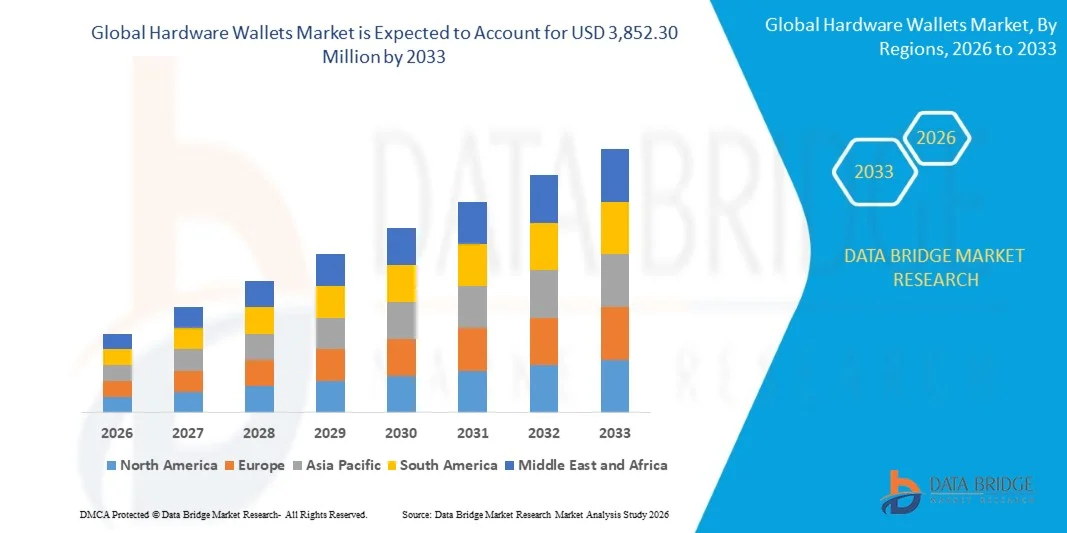
- As per Data Bridge Market Research analysis, the hardware wallets market was valued at USD 630.00 million in 2025 and is projected to reach USD 3,852.30 million by 2033, growing at a CAGR of 25.40% from 2026 to 2033.
- The market is experiencing consistent growth driven by increasing cryptocurrency adoption, rising demand for self-custody solutions, growing concerns over digital-asset security, and the need for secure offline storage of private keys. The shift toward decentralized asset ownership and stronger regulatory requirements for cryptocurrency custody is further supporting market expansion.
- The increasing incidence of cryptocurrency theft, exchange failures, and cybersecurity threats, combined with greater awareness of private-key protection, is compelling individual investors, institutions, and cryptocurrency custodians to adopt hardware wallets. USB-based devices currently lead the market, while Bluetooth-enabled wallets and institutional-grade cold-storage solutions are gaining traction by offering convenient connectivity, enhanced security, and greater control over digital assets.
Market Size & Forecast
- Global Market Value (2025): USD 630.00 Million
- Expected Market Value (2033): USD 3,852.30 Million
- Forecast CAGR (2026–2033): 25.40%
- Leading Region in 2025: North America
- Fastest Growing Region: Asia Pacific
What are the Major Takeaways of the Hardware Wallets Market?
- North America dominated the hardware wallets market with the largest revenue share of 38.95% in 2025, supported by strong cryptocurrency adoption, regulatory clarity, institutional self-custody demand, and growing requirements for secure digital-asset custody.
- Asia-Pacific is expected to be the fastest-growing region at a CAGR of 27.2% from 2026 to 2033, fueled by rising cryptocurrency adoption, expanding digital-asset ecosystems, increasing awareness of cybersecurity, and growing demand for secure self-custody solutions
- The cold wallet segment led the market with a 63.19% share in 2025, driven by its ability to store private keys offline and provide stronger protection against hacking, malware, and phishing attacks.
- Hot wallet is the fastest-growing wallet type, projected to register a CAGR of 22.5%, reflecting the surge in demand for convenient access to digital assets and frequent transaction capabilities.
- The USB segment dominated the connectivity category with a 45.21% revenue share in 2025, led by its established use across leading hardware-wallet devices and its reliable wired connection for cryptocurrency transactions.
- Secure element accounted for 35% of the market share in 2025, preferred by its ability to provide a dedicated hardware environment for protecting sensitive cryptographic information and private keys.
- The biometric authentication segment is the fastest-growing security features category, with a CAGR of 25%, driven by rising cybersecurity concerns and the integration of fingerprint and other biometric technologies into hardware-based digital-asset security solutions.
Report Scope and Hardware Wallets Market Segmentation
|
Attributes |
Hardware Wallets Key Market Insights |
|
Segments Covered |
|
|
Countries Covered |
North America
Europe
Asia-Pacific
Middle East and Africa
South America
|
|
Key Market Players |
|
|
Market Opportunities |
|
|
Value Added Data Infosets |
In addition to the insights on market scenarios such as market value, growth rate, segmentation, geographical coverage, and major players, the market reports curated by the Data Bridge Market Research also include in-depth expert analysis, geographically represented company-wise production and capacity, network layouts of distributors and partners, detailed and updated price trend analysis and deficit analysis of supply chain and demand. |
What is the Key Trend in the Hardware Wallets Market?
- Hardware wallet manufacturers are increasingly integrating advanced secure elements, clear-signing displays, and multi-authorization capabilities to strengthen protection against phishing, transaction manipulation, and physical attacks while improving user confidence in self-custody solutions.
- For instance, in March 2025, Ledger highlighted the growing adoption of Secure Element technology in hardware wallets, noting that Trezor Safe 3 and Safe 5 use an EAL6+ certified Secure Element alongside a microcontroller to strengthen protection against physical attacks.
- Large hardware wallet providers are also expanding from consumer devices into institutional-grade digital-asset custody infrastructure, supporting governance, transaction approvals, auditability, and enterprise self-custody requirements.
- Hardware wallets are increasingly being designed around transaction transparency and human-readable verification, allowing users to verify transaction details directly on trusted hardware screens before signing and reducing exposure to malicious software interfaces.
- For instance, in June 2024, Trezor launched the Trezor Safe 5 featuring a color touchscreen, haptic feedback, an EAL6+ certified Secure Element, and enhanced backup processes, reflecting the industry's shift toward combining stronger security with improved user experience.
- As cryptocurrency ownership expands from individual investors toward institutions, exchanges, and tokenized-asset platforms, hardware wallets are evolving from simple offline-storage devices into comprehensive hardware-enforced security platforms, reinforcing advanced authentication, governance, and transaction-verification technologies as major market trends.
What are the Key Drivers of the Hardware Wallets Market?
- The rapid growth of cryptocurrency ownership and institutional digital-asset adoption has significantly increased demand for secure self-custody solutions capable of protecting private keys from exchange failures, cyberattacks, phishing, and unauthorized access.
- For instance, in February 2025, Ledger reported that institutional adoption of digital assets was accelerating, with Bitcoin increasingly being incorporated into corporate and institutional investment strategies, strengthening demand for secure institutional custody and hardware-backed key management.
- Cryptocurrency exchanges, asset managers, financial institutions, and corporate treasuries are increasingly integrating hardware-backed security with multisignature authorization, role-based governance, transaction verification, and audit controls to reduce operational and counterparty risks.
- The growing value of digital assets combined with increasingly sophisticated attacks on cryptocurrency custody infrastructure is encouraging investors and institutions to adopt offline key storage and hardware-enforced transaction controls as an additional layer of protection.
- For instance, in March 2026, Trezor introduced the Safe 7 with post-quantum security architecture, including SLH-DSA and ML-DSA cryptographic algorithms, demonstrating the industry's response to increasingly sophisticated cybersecurity threats and the need for future-proof private-key protection.
- With cryptocurrency adoption expanding across retail and institutional markets, the need for secure private-key management, self-custody, and transaction authorization will remain a fundamental growth driver for the global hardware wallets market.
Which Factors are Challenging the Growth of the Hardware Wallets Market?
- Hardware wallets remain vulnerable to operational, firmware, supply-chain, and user-related security risks, meaning that physical devices alone cannot eliminate all threats associated with digital-asset custody.
- For instance, in December 2023, Ledger disclosed a security incident in which a former employee was targeted by a phishing attack, allowing attackers to publish a malicious version of the Ledger Connect Kit that could trick users into signing transactions that drained their wallets, highlighting the risks associated with connected software ecosystems.
- These risks can reduce consumer confidence and increase the technical complexity of hardware wallet products, particularly when users must securely manage recovery phrases, firmware updates, device authentication, and transaction verification.
- Hardware wallet users must also remain exposed to risks originating outside the physical device, including compromised applications, malicious interfaces, phishing attacks, and manipulated transaction information presented through connected computers or smartphones.
- These security and usability challenges, together with the technical knowledge required for safe self-custody, can discourage inexperienced cryptocurrency users and increase the need for simpler interfaces, stronger transaction verification, and more robust recovery mechanisms.
- For instance, in January 2024, Trezor disclosed a phishing incident in which an unauthorized email was sent to its newsletter subscribers through a compromised third-party email service, attempting to persuade users to disclose their wallet recovery seeds, demonstrating the continuing vulnerability of hardware-wallet users to social-engineering attacks.
- As hardware wallets increasingly connect with decentralized applications, exchanges, smartphones, and institutional custody platforms, maintaining security across the entire ecosystem rather than only the physical device will remain a major challenge for market participants.
How is the Hardware Wallets Market Segmented?
The hardware wallets market is segmented on the basis of wallet type, connectivity, security features, form factor, and end user.
- By Wallet Type
On the basis of wallet type, the hardware wallets market is segmented into hot wallets and cold wallets. The cold wallet segment dominated the market with a 63.19% share in 2025, owing to its ability to store private keys offline and provide stronger protection against hacking, malware, and phishing attacks. Cold wallets are particularly preferred by cryptocurrency holders seeking long-term storage and greater control over digital assets. Hardware wallets primarily function as cold-storage solutions because signing credentials remain isolated from internet-connected environments. Growing cryptocurrency ownership and increasing awareness of self-custody are supporting demand for cold wallets. Institutional investors and high-value asset holders are also increasingly adopting offline custody solutions to reduce exposure to exchange and cyber risks.
The hot wallet segment is projected to witness faster growth at a CAGR of 22.5% during forecast period, driven by increasing demand for convenient access to digital assets and frequent transaction capabilities. Hot wallets remain connected to the internet, allowing users to conduct transactions quickly and interact with decentralized applications and cryptocurrency exchanges. Their convenience makes them particularly attractive to active traders and users conducting frequent transactions. Increasing integration of mobile applications and Web3 platforms is supporting their adoption. However, greater exposure to online threats means security remains a major consideration for users. Hardware-wallet providers are increasingly combining convenient connectivity with offline key-storage technologies to address this trade-off.
- By Connectivity
On the basis of connectivity, the hardware wallets market is segmented into USB, near-field communication (NFC), bluetooth, and others. The USB segment dominated the market with a 45.21% share in 2025, supported by its established use across leading hardware-wallet devices and its reliable wired connection for cryptocurrency transactions. USB connectivity allows users to connect wallets directly with computers and compatible mobile devices while keeping private keys isolated within the hardware. The technology is widely understood by consumers and generally requires limited configuration. USB-based devices also benefit from relatively simple hardware architectures and broad compatibility with wallet-management software. Their established presence across consumer and professional cryptocurrency custody applications continues to support demand.
The bluetooth segment is expected to register the fastest growth at a CAGR of 26.0% during forecast period, driven by increasing demand for wireless connectivity between hardware wallets and smartphones. Bluetooth enables users to manage and authorize transactions without maintaining a physical wired connection to their devices. This functionality is particularly valuable for mobile-first cryptocurrency users and individuals who frequently manage digital assets through smartphones. Improvements in Bluetooth security and authentication are helping address concerns surrounding wireless communication. Manufacturers are increasingly integrating Bluetooth alongside secure elements and dedicated transaction-confirmation interfaces. Growing smartphone adoption and mobile cryptocurrency applications are further supporting demand.
- By Security Features
On the basis of security features, the hardware wallets market is segmented into secure element, PIN protection, two-factor authentication (2FA), biometric authentication, air-gapped security, and others. The secure element segment dominated the market, with share of 35% in 2025, owing to its ability to provide a dedicated hardware environment for protecting sensitive cryptographic information and private keys. Secure elements are designed to resist physical tampering and unauthorized extraction of stored credentials. Leading hardware-wallet manufacturers increasingly incorporate certified secure elements into premium devices to strengthen protection against sophisticated attacks. The technology is particularly important for users holding significant digital-asset balances and for institutional custody applications. Growing cybersecurity concerns are encouraging manufacturers to enhance hardware-level protection rather than relying solely on software security.
The biometric authentication segment is projected to experience the fastest growth at a CAGR of 25% during forecast period, as hardware-wallet manufacturers increasingly seek to combine strong security with convenient user authentication. Fingerprint and other biometric technologies can provide an additional identity-verification layer before users access sensitive wallet functions. Biometric authentication can reduce dependence on passwords and improve usability for consumers managing digital assets through mobile-connected hardware wallets. Advances in biometric sensors are enabling smaller and more power-efficient implementations. Growing consumer familiarity with biometric authentication through smartphones is also improving acceptance of the technology. Manufacturers are increasingly exploring biometric security as part of multi-layer authentication architectures.
- By Form Factor
On the basis of form factor, the hardware wallets market is segmented into USB stick, card-based wallet, compact device, and others. The USB stick segment dominated the market with share of 45% in 2025, owing to its compact design, portability, and established compatibility with computers and cryptocurrency-management platforms. USB-stick hardware wallets can be carried easily and typically provide straightforward transaction signing through a physical device. Their familiar form factor also reduces the learning curve for new cryptocurrency users. Manufacturers can integrate secure elements, display interfaces, buttons, and authentication mechanisms within relatively small devices. The format is suitable for both individual cryptocurrency holders and professional users requiring portable private-key storage.
The card-based wallet segment is expected to witness the fastest growth at a CAGR of 25% during forecast period, as users increasingly seek thinner and more portable hardware-wallet designs that resemble familiar payment cards. Card-based devices can provide convenient storage and authentication while fitting easily into wallets and everyday-carry environments. NFC technology can further enhance their usability by enabling contactless interaction with compatible smartphones. Their discreet form factor may appeal to users who want to carry digital-asset security without a conventional USB-style device. Increasing convergence between cryptocurrency payments, digital identity, and tokenized assets is creating additional applications for card-based security devices. Improvements in embedded secure elements and contactless communication are supporting product innovation.
- By End User
On the basis of end user, the hardware wallets market is segmented into retail and enterprise. The retail segment dominated the market with a 71.43% share in 2025, supported by the large number of individual cryptocurrency holders seeking direct control over their private keys. Retail users increasingly use hardware wallets to protect assets from exchange failures, phishing, malware, and unauthorized account access. The growing popularity of Bitcoin, Ethereum, stablecoins, and other digital assets is expanding the potential consumer base. Hardware wallets provide retail investors with an offline custody option that does not require them to leave assets permanently on centralized exchanges. Increasing awareness of self-custody and private-key security is further encouraging adoption.
The enterprise segment is projected to register the fastest growth at a CAGR of 26.9% during forecast period, as corporations, financial institutions, cryptocurrency businesses, and institutional investors increasingly require sophisticated digital-asset custody controls. Enterprise users require stronger governance mechanisms, including multisignature authorization, role-based permissions, transaction approval workflows, and secure key management. Growing institutional participation in cryptocurrency and tokenized assets is increasing demand for hardware-backed security infrastructure. Regulatory and compliance requirements are also encouraging organizations to establish stronger controls over digital-asset access and custody. Hardware-based security can reduce exposure to unauthorized key access while supporting controlled transaction signing.
Which Region Holds the Largest Share of the Hardware Wallets Market?
- North America dominated the hardware wallets market with the largest revenue share of 38.95% in 2025, supported by strong cryptocurrency adoption, regulatory clarity, institutional self-custody demand, and growing requirements for secure digital-asset custody.
- The region also benefits from increasing institutional adoption of cold-storage solutions, expanding cryptocurrency investment infrastructure, and growing demand for secure private-key management among retail and enterprise users. Regulatory developments in the U.S., including cryptocurrency custody guidance and approvals of spot Bitcoin exchange-traded funds, are further supporting market development. The presence of major digital-asset companies and hardware-wallet providers also strengthens the regional ecosystem. Growing concerns over exchange breaches and cyberattacks are encouraging users to shift toward offline asset protection.
U.S. Hardware Wallets Market Insight
The U.S. hardware wallets market is witnessing strong growth due to rising cryptocurrency ownership, increasing demand for self-custody solutions, and growing concerns regarding digital-asset theft and cybersecurity. The country’s mature cryptocurrency ecosystem, along with increasing adoption of institutional digital-asset custody and hardware-backed security systems, is driving demand across retail and enterprise applications. In addition, growing institutional participation, regulatory developments, and increasing awareness regarding private-key protection are accelerating hardware-wallet adoption among cryptocurrency investors, businesses, and financial institutions.
Asia-Pacific Hardware Wallets Market Insight
The Asia-Pacific hardware wallets market is expected to witness rapid growth, driven by increasing cryptocurrency adoption, expanding digital-asset ecosystems, and rising investments in blockchain infrastructure across countries such as China, Japan, India, and Singapore. Growing awareness regarding cryptocurrency security, increasing smartphone penetration, and rising demand for convenient self-custody solutions are supporting regional market expansion. In addition, the growing adoption of decentralized finance, Web3 applications, and digital assets is accelerating demand for secure hardware-based private-key management across retail and institutional users.
Japan Hardware Wallets Market Insight
The Japan hardware wallets market is witnessing consistent growth due to rising cryptocurrency adoption, advanced blockchain infrastructure, and strong emphasis on digital-asset security. Cryptocurrency investors, exchanges, and digital-asset businesses are increasingly adopting hardware wallets and secure custody solutions to protect private keys and reduce exposure to cyber threats. Moreover, increasing integration of hardware-based security with mobile applications and growing interest in Web3 and tokenized assets are further contributing to market growth.
China Hardware Wallets Market Insight
The China hardware wallets market is growing rapidly, driven by the country’s strong blockchain ecosystem, expanding digital-asset technology development, and increasing demand for secure cryptographic key-management solutions. Growing adoption of blockchain applications and hardware-based security technologies across technology and enterprise environments is supporting market demand. In addition, increasing development of digital-asset infrastructure, secure-element technologies, and blockchain applications is strengthening China’s position as an important market for hardware security and cryptocurrency-related technologies.
U.K. Hardware Wallets Market Insight
The U.K. hardware wallets market is experiencing steady growth, supported by increasing cryptocurrency investment, growing demand for self-custody solutions, and expanding institutional digital-asset activities. Increasing awareness of private-key security and growing adoption of hardware-backed custody solutions are contributing to market growth among individual and enterprise users. Furthermore, the development of cryptocurrency regulations, increasing institutional participation, and integration of secure authentication technologies are strengthening the U.K. as a key European market for hardware wallets.
Germany Hardware Wallets Market Insight
The Germany hardware wallets market is expanding steadily due to increasing cryptocurrency adoption, growing institutional interest in digital assets, and strong emphasis on cybersecurity and regulated digital-asset custody. Cryptocurrency investors, financial institutions, and blockchain businesses are increasingly utilizing hardware wallets and hardware-backed security solutions for private-key protection and transaction authorization. Continuous advancements in secure-element technology, multisignature authentication, and institutional custody infrastructure, along with Germany’s established financial and technology ecosystem, are further driving market growth.
Which are the Top Companies in Hardware Wallets Market?
The hardware wallets industry is primarily led by well-established companies, including:
- Ledger SAS (France)
- Tangem AG (Switzerland)
- ELLIPAL Limited (Hong Kong)
- Keystone Technology Co., Ltd. (Hong Kong)
- ONEKEY LIMITED (Hong Kong)
- Shift Crypto AG (Switzerland)
- CoolWallet. (Taiwan)
- NGRAVE NV (Belgium)
- IoTrust Co., Ltd. (South Korea)
- Arculus (U.S.)
- GridPlus, Inc. (U.S.)
- Foundation Devices, Inc. (U.S.)
- Coinkite Inc. (Canada)
- SecuX Technology Inc. (Taiwan)
- SafePal Limited (Seychelles)
- Blockstream Corporation Inc. (Canada)
- Bitkey, Inc. (U.S.)
- Cypherock Technologies Pvt. Ltd. (India)
What are Latest Developments in Hardware Wallets Market?
- In October 2025, Trezor launched the Trezor Safe 7, a new-generation hardware wallet featuring the company’s first fully auditable Secure Element, TROPIC01, along with a quantum-ready security architecture and wireless connectivity. The device was designed to strengthen transparency in hardware security while preparing digital-asset users for emerging cryptographic threats. The launch also expanded Trezor’s focus on combining advanced security with convenient mobile connectivity, reflecting continued innovation in hardware-based digital-asset protection.
- In January 2025, Trezor launched the limited-edition Trezor Safe 5 Freedom Edition as part of its financial-sovereignty campaign. The device was based on the Trezor Safe 5 platform and combined the company’s hardware security features with a limited-edition design. Trezor also committed to donating USD 10 from every device sold to Trezor Academy, supporting Bitcoin education in underserved regions. The initiative demonstrated how hardware-wallet manufacturers were expanding product launches beyond technical specifications into broader cryptocurrency education and financial-sovereignty initiatives
- In July 2024, Ledger launched Ledger Flex, positioning it as the entry point to its next-generation hardware-wallet lineup. The device introduced a 2.8-inch E Ink touchscreen designed to make transaction information easier to view and verify while maintaining hardware-backed self-custody. Ledger positioned the product around improving usability without compromising security, demonstrating the growing emphasis on touchscreen interfaces and clearer transaction verification in hardware wallets.
- In June 2024, Trezor launched the Trezor Safe 5, introducing a color touchscreen, haptic feedback, and an EAL6+ certified Secure Element to its hardware-wallet portfolio. The device was designed to make cryptocurrency self-custody more convenient while maintaining strong protection for users’ private keys. Trezor also introduced enhanced backup capabilities intended to improve recovery security. The launch highlighted the industry’s movement toward combining secure hardware architecture with more intuitive interfaces and improved user experience.
- In January 2023, Ledger introduced Ledger Stax, a new hardware wallet designed by Tony Fadell and featuring a curved E Ink touchscreen. The device was developed to provide a larger interface for viewing and verifying transaction details while maintaining hardware-based protection for digital assets. Its credit-card-inspired form factor and touchscreen interface represented a significant design shift from traditional button-based hardware wallets. The launch reflected the industry’s increasing focus on combining advanced security with improved usability and premium consumer-oriented hardware design.

- Interactive Data Analysis Dashboard
- Company Analysis Dashboard for high growth potential opportunities
- Research Analyst Access for customization & queries
- Competitor Analysis with Interactive dashboard
- Latest News, Updates & Trend analysis
- Harness the Power of Benchmark Analysis for Comprehensive Competitor Tracking
Global Hardware Wallets Market, Supply Chain Analysis and Ecosystem Framework
To support market growth and help clients navigate the impact of geopolitical shifts, DBMR has integrated in-depth supply chain analysis into its Global Hardware Wallets Market research reports. This addition empowers clients to respond effectively to global changes affecting their industries. The supply chain analysis section includes detailed insights such as Global Hardware Wallets Market consumption and production by country, price trend analysis, the impact of tariffs and geopolitical developments, and import and export trends by country and HSN code. It also highlights major suppliers with data on production capacity and company profiles, as well as key importers and exporters. In addition to research, DBMR offers specialized supply chain consulting services backed by over a decade of experience, providing solutions like supplier discovery, supplier risk assessment, price trend analysis, impact evaluation of inflation and trade route changes, and comprehensive market trend analysis.
Data collection and base year analysis are done using data collection modules with large sample sizes. The stage includes obtaining market information or related data through various sources and strategies. It includes examining and planning all the data acquired from the past in advance. It likewise envelops the examination of information inconsistencies seen across different information sources. The market data is analysed and estimated using market statistical and coherent models. Also, market share analysis and key trend analysis are the major success factors in the market report. To know more, please request an analyst call or drop down your inquiry.
The key research methodology used by DBMR research team is data triangulation which involves data mining, analysis of the impact of data variables on the market and primary (industry expert) validation. Data models include Vendor Positioning Grid, Market Time Line Analysis, Market Overview and Guide, Company Positioning Grid, Patent Analysis, Pricing Analysis, Company Market Share Analysis, Standards of Measurement, Global versus Regional and Vendor Share Analysis. To know more about the research methodology, drop in an inquiry to speak to our industry experts.
Data Bridge Market Research is a leader in advanced formative research. We take pride in servicing our existing and new customers with data and analysis that match and suits their goal. The report can be customized to include price trend analysis of target brands understanding the market for additional countries (ask for the list of countries), clinical trial results data, literature review, refurbished market and product base analysis. Market analysis of target competitors can be analyzed from technology-based analysis to market portfolio strategies. We can add as many competitors that you require data about in the format and data style you are looking for. Our team of analysts can also provide you data in crude raw excel files pivot tables (Fact book) or can assist you in creating presentations from the data sets available in the report.













