


What is the Hazelnut Market Size and Growth Rate?
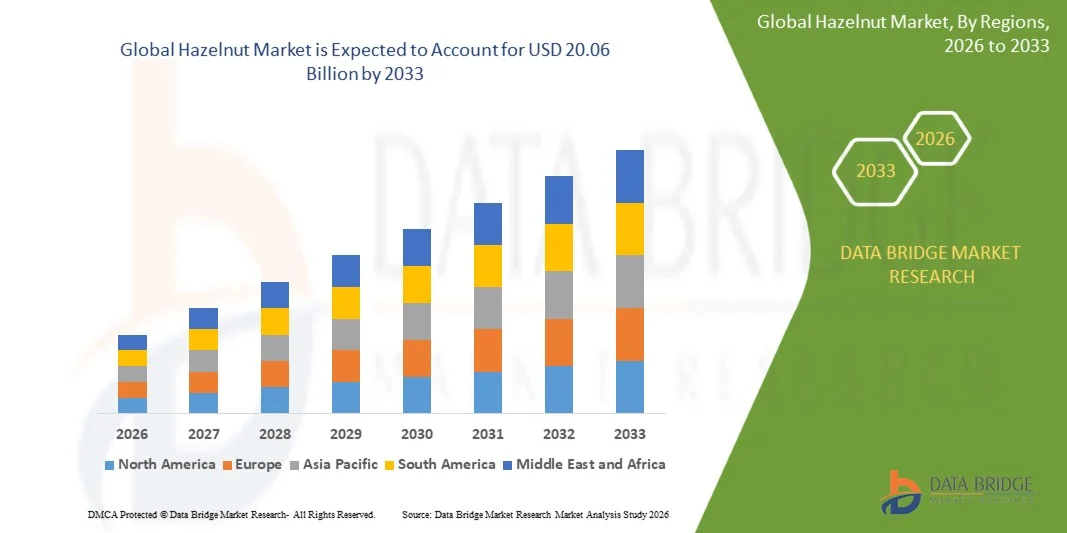
- As per Data Bridge Market Research analysis, the hazelnut market was valued at USD 10.22 billion in 2025 and is projected to reach USD 20.06 billion by 2033, growing at a CAGR of 8.80% from 2026 to 2033.
- The market is experiencing strong growth driven by the rising demand for hazelnuts in chocolate and confectionery products, increasing consumer preference for healthy snacks and plant-based foods, and expanding applications in the bakery, dairy alternatives, and functional food industries.
- Growing investments in sustainable hazelnut cultivation, advancements in processing and value-added products such as hazelnut paste, oil, and flour, along with increasing consumption across emerging economies, are further accelerating market expansion. Additionally, the growing focus on clean-label, nutrient-rich ingredients continues to support long-term demand for hazelnut products.
Market Size & Forecast
- Market Value (2025): USD 10.22 Billion
- Expected Market Value (2033): USD 20.06 Billion
- Forecast CAGR (2026–2033): 8.80%
- Leading Region in 2025: Europe
- Fastest Growing Region: Asia-Pacific
What are the Major Takeaways of the Hazelnut Market?
- Europe dominated the hazelnut market with the largest revenue share of 63.25% in 2025, supported by strong hazelnut production across Turkey and Italy, increasing demand from the chocolate and confectionery industry, well-established processing infrastructure, and rising consumption of hazelnut-based products across Germany, France, Italy, and other European countries.
- Asia-Pacific hazelnut market is expected to witness the fastest growth rate CAGR of 6.73%, from 2026 to 2033, registering a primarily driven by rising consumption of premium chocolates and confectionery products, increasing demand for healthy snacks and plant-based foods, expanding food processing industries, and growing disposable incomes across China, India, Japan, and Southeast Asia.
- The whole/in-shell segment held the largest market revenue share of approximately 45.5% in 2025, driven by its high production volume, strong global trade, extensive use in the chocolate and confectionery industry, growing consumer demand for roasted and whole-kernel snacks.
- The hazelnut oil segment is expected to witness the fastest growth during the forecast period from 2026 to 2033, driven by increasing demand for plant-based edible oils, expanding applications in cosmetics and personal care products, growing utilization in functional foods and nutraceuticals.
- The industrial segment held the largest market revenue share in 2025, driven by extensive utilization of hazelnuts in the production of chocolates, confectionery, bakery products, spreads, dairy alternatives, cereals, and other processed food products.
- The vacuum & cartons box segment is expected to witness the fastest growth during the forecast period from 2026 to 2033, driven by increasing demand for premium packaged hazelnuts, extended shelf life through vacuum packaging, growing exports of value-added products.
Report Scope and Hazelnut Market Segmentation
|
Attributes |
Hazelnut Key Market Insights |
|
Segments Covered |
|
|
Countries Covered |
North America
Europe
Asia-Pacific
Middle East and Africa
South America
|
|
Key Market Players |
|
|
Market Opportunities |
|
|
Value Added Data Infosets |
In addition to the insights on market scenarios such as market value, growth rate, segmentation, geographical coverage, and major players, the market reports curated by the Data Bridge Market Research also include in-depth expert analysis, pricing analysis, brand share analysis, consumer survey, demography analysis, supply chain analysis, value chain analysis, raw material/consumables overview, vendor selection criteria, PESTLE Analysis, Porter Analysis, and regulatory framework. |
What is the Key Trend in the Hazelnut Market?
- The global hazelnut market is witnessing a strategic shift toward supply chain diversification as major confectionery manufacturers seek to reduce dependence on Turkey, which remains the world's largest hazelnut-producing country. Increasing concerns regarding climate variability, crop volatility, and supply disruptions are encouraging companies to explore alternative cultivation regions, including the U.S., Italy, Chile, and Georgia.
- The key trend shaping the market is the increasing investment by leading food companies in agricultural research, farmer partnerships, and regional cultivation programs to develop climate-resilient hazelnut varieties and strengthen local supply networks. These initiatives are focused on improving yield stability, enhancing sustainability, and reducing supply chain risks associated with concentrated production regions.
- For instance, in December 2024, Ferrero Hazelnut Company, part of Ferrero Group, announced a USD 350,000 investment to support hazelnut research and production development in the U.S. The funding included USD 180,000 for Oregon State University and USD 170,000 for Rutgers University to advance research programs, support growers, and promote sustainable hazelnut cultivation. The initiative aligns with Ferrero’s broader strategy to strengthen hazelnut sourcing in regions such as Oregon’s Willamette Valley and the eastern U.S.
- As global hazelnut buyers continue investing in regional cultivation, research collaborations, and sustainable farming practices, supply diversification and climate-resilient production are expected to remain key trends influencing the long-term development of the global hazelnut market.
What are the Key Drivers of the Hazelnut Market?
- Growing consumer preference for plant-based foods and beverages is expanding the application scope of hazelnuts beyond traditional confectionery and bakery products. Rising demand for premium plant-based beverages, flavored dairy alternatives, and specialty coffee products is encouraging manufacturers to incorporate hazelnut ingredients due to their distinctive flavor profile, creamy texture, and nutritional value.
- A key driver of the hazelnut market is the increasing launch of hazelnut-based products targeting specialty beverage and foodservice applications. Manufacturers are focusing on value-added formulations such as hazelnut milk, coffee creamers, and plant-based alternatives to capture demand from consumers seeking premium and differentiated products.
- For instance, in September 2025, International Food introduced Hazelnut Oat Milk, a plant-based beverage developed for coffee and hospitality applications. The product was designed to provide a rich flavor profile and smooth texture for baristas, restaurants, and hotels seeking innovative plant-based beverage options.
- As food and beverage manufacturers continue expanding hazelnut applications across plant-based beverages, specialty foods, and premium consumer products, rising demand for innovative hazelnut-based formulations is expected to support market growth during the forecast period.
Which Factors are Challenging the Hazelnut Market?
- The high geographical concentration of hazelnut production remains a major challenge for the global market, as Turkey accounts for a significant share of worldwide hazelnut supply. Dependence on a limited number of growing regions increases vulnerability to climate-related disruptions, crop diseases, and fluctuations in global supply and pricing.
- The key challenge affecting the hazelnut market is climate variability in major production regions, particularly Turkey’s Black Sea region, where frost events, irregular rainfall patterns, and extreme weather conditions can significantly impact crop yields. Supply fluctuations caused by unfavorable weather conditions can create price volatility and increase procurement costs for confectionery, bakery, and food ingredient manufacturers.
- For instance, in 2025, severe spring frost events affected agricultural production in Turkey, including hazelnut-growing regions, raising concerns regarding reduced yields and tighter global supply availability. The impact of adverse weather conditions highlighted the vulnerability of the global hazelnut supply chain to climate-related disruptions.
- Until production regions become more diversified and growers adopt advanced climate-resilient cultivation practices, supply volatility, weather-related crop losses, and price fluctuations are expected to remain key challenges affecting the global hazelnut market.
How is the Hazelnut Market Segmented?
The hazelnut market is segmented on the basis of form, category, shape, origin, packaging, application, and distribution channel.
- By Form
On the basis of form, the hazelnut market is segmented into whole/in-shell hazelnut, natural hazelnut, diced hazelnut, paste hazelnut, blanched hazelnut, roasted hazelnut, sliced hazelnut, hazelnut oil, hazelnut meal, and others. The whole/in-shell segment held the largest market revenue share of approximately 45.5% in 2025, driven by its high production volume, strong global trade, extensive use in the chocolate and confectionery industry, growing consumer demand for roasted and whole-kernel snacks, and its widespread utilization as the primary raw material for producing hazelnut paste, blanched kernels, diced and sliced hazelnuts, hazelnut oil, and other value-added ingredients.
The hazelnut oil segment is expected to witness the fastest growth during the forecast period from 2026 to 2033, driven by increasing demand for plant-based edible oils, expanding applications in cosmetics and personal care products, growing utilization in functional foods and nutraceuticals, and rising consumer preference for premium, nutrient-rich natural ingredients.
- By Category
On the basis of category, the hazelnut market is segmented into conventional and organic. The conventional segment held the largest market revenue share in 2025, driven by its widespread availability, higher production volumes, lower production costs, and strong demand from the chocolate, confectionery, bakery, and food processing industries, where consistent supply and cost efficiency remain critical.
The organic segment is expected to witness the fastest growth during the forecast period from 2026 to 2033, driven by increasing consumer preference for clean-label and chemical-free food products, rising awareness of sustainable farming practices, growing demand for certified organic ingredients, and the expanding presence of organic food products across retail and e-commerce channels.
- By Shape
On the basis of shape, the hazelnut market is segmented into round kernels, almond kernels, pointed kernels, and others. The round kernels segment held the largest market revenue share in 2025, driven by its superior quality, uniform appearance, high kernel yield, and extensive use in premium chocolates, confectionery, bakery products, and whole-nut snack applications.
The almond kernels segment is expected to witness the fastest growth during the forecast period from 2026 to 2033, driven by increasing demand from the confectionery and food processing industries for elongated kernels, expanding applications in value-added food products, and rising consumer preference for premium and visually appealing nut ingredients.
- By Origin
On the basis of origin, the hazelnut market is segmented into Akcakoca, Levant, Giresun, and others. The Levant segment held the largest market revenue share in 2025, driven by its high production volume, widespread cultivation across Turkey's Black Sea region, consistent kernel quality, and strong supply to global chocolate, confectionery, and food processing industries.
The Giresun segment is expected to witness the fastest growth during the forecast period from 2026 to 2033, driven by increasing global demand for premium-quality hazelnuts, its superior flavor and higher oil content, growing utilization in high-end confectionery products, and rising exports to international food manufacturers.
- By Packaging
On the basis of packaging, the hazelnut market is segmented into vacuum & cartons box, bags, pouches, plastic or metal drums, and others. The bags segment held the largest market revenue share in 2025, driven by their cost-effectiveness, ease of transportation, suitability for bulk storage, and widespread use by processors, wholesalers, and exporters for domestic and international hazelnut trade.
The vacuum & cartons box segment is expected to witness the fastest growth during the forecast period from 2026 to 2033, driven by increasing demand for premium packaged hazelnuts, extended shelf life through vacuum packaging, growing exports of value-added products, and rising consumer preference for high-quality, freshness-preserving packaging solutions.
- By Application
On the basis of application, the hazelnut market is segmented into industrial, food service industry, and household/retail. The industrial segment held the largest market revenue share in 2025, driven by extensive utilization of hazelnuts in the production of chocolates, confectionery, bakery products, spreads, dairy alternatives, cereals, and other processed food products. Strong demand from food manufacturers and ingredient processors continues to support the segment's dominance.
The household/retail segment is expected to witness the fastest growth during the forecast period from 2026 to 2033, driven by increasing consumer preference for healthy snacks, growing demand for premium packaged nuts, rising adoption of plant-based diets, and expanding availability of hazelnut products through supermarkets and online retail channels.
Which Region Holds the Largest Share of the Hazelnut Market?
Europe Hazelnut Market Insight
- Europe dominated the hazelnut market with the largest revenue share of 63.25% in 2025, supported by strong hazelnut production across Turkey and Italy, increasing demand from the chocolate and confectionery industry, well-established processing infrastructure, and rising consumption of hazelnut-based products across Germany, France, Italy, and other European countries.
- The region also benefits from a mature food processing sector, expanding exports of premium hazelnut products, increasing investments in sustainable cultivation and processing technologies, and the presence of leading confectionery manufacturers. The growing demand for healthy snacks, bakery products, and plant-based food ingredients continues to strengthen Europe's leadership position in the global market.
Germany Hazelnut Market Insight
The Germany hazelnut market is expanding steadily due to strong demand from the chocolate, confectionery, bakery, and snack industries, increasing consumer preference for healthy and plant-based food products, and the growing use of hazelnuts in premium spreads and functional foods. Rising imports of processed hazelnuts and continuous product innovation by food manufacturers are contributing significantly to market growth.
U.K. Hazelnut Market Insight
The U.K. hazelnut market is gaining momentum owing to increasing consumption of premium confectionery, bakery products, and healthy snacks, along with rising demand for plant-based and clean-label food ingredients. Growing retail availability of hazelnut-based products, expanding applications in dairy alternatives and breakfast foods, and increasing consumer awareness of the nutritional benefits of nuts are supporting the continued expansion of the market.
Asia-Pacific Hazelnut Market Insight
Asia-Pacific hazelnut market is expected to witness the fastest growth rate CAGR of 6.73%, from 2026 to 2033, registering a primarily driven by rising consumption of premium chocolates and confectionery products, increasing demand for healthy snacks and plant-based foods, expanding food processing industries, and growing disposable incomes across China, India, Japan, and Southeast Asia. Increasing investments in modern retail channels, greater availability of imported hazelnut products, and rising consumer awareness of the nutritional benefits of nuts are further accelerating market growth. In addition, continuous product innovation in hazelnut-based beverages, spreads, bakery products, and functional foods, along with the rapid expansion of e-commerce distribution channels, is expected to strengthen the region's position as one of the fastest-growing markets during the forecast period.
Japan Hazelnut Market Insight
The Japan hazelnut market is witnessing steady growth due to increasing demand for premium chocolates, confectionery products, bakery items, and healthy snacks, along with rising consumer preference for plant-based and functional foods. Food manufacturers are increasingly utilizing hazelnuts in spreads, beverages, desserts, and snack products. Furthermore, continuous product innovation, growing imports of high-quality hazelnuts, and the country's strong demand for premium food ingredients are supporting continued market expansion.
China Hazelnut Market Insight
The China hazelnut market is growing rapidly, driven by rising consumption of premium confectionery and bakery products, increasing disposable incomes, and expanding demand for healthy nuts and plant-based food ingredients. The widespread adoption of hazelnuts in chocolates, dairy alternatives, snack foods, and functional nutrition products, combined with the rapid expansion of modern retail and e-commerce channels, is significantly boosting market demand. In addition, growing investments in food processing, increasing imports of premium hazelnuts, and changing consumer dietary preferences are positioning China as one of the fastest-growing markets for hazelnuts globally.
North America Hazelnut Market Insight
The North America hazelnut market is witnessing steady growth due to increasing demand for premium chocolates, confectionery products, healthy snacks, and plant-based food ingredients. Rising consumer awareness of the nutritional benefits of hazelnuts, expanding applications in bakery products, dairy alternatives, and functional foods, and the growing popularity of clean-label products are supporting market expansion. Furthermore, increasing domestic production in the United States, strong investments in food processing, and the expanding presence of premium hazelnut-based products across retail and e-commerce channels continue to drive the growth of the regional market.
U.S. Hazelnut Market Insight
The U.S. hazelnut market is experiencing steady growth due to increasing consumer demand for premium chocolates, bakery products, healthy snacks, and plant-based food ingredients. Rising utilization of hazelnuts in confectionery, nut spreads, dairy alternatives, and functional foods, along with growing awareness of their nutritional benefits, is driving market expansion. Furthermore, increasing domestic hazelnut cultivation, continuous product innovation, and the expanding availability of hazelnut-based products through supermarkets, specialty stores, and e-commerce platforms are supporting the continued growth of the market.
Which are the Top Companies in Hazelnut Market?
The hazelnut industry is primarily led by well-established companies, including:
- Ferrero International S.A. (Luxembourg)
- Olam International Limited (Singapore)
- Balsu Gıda Sanayi ve Ticaret A.Ş. (Turkey)
- Poyraz Poyraz Hazelnut Integrated Industry and Trade Inc. (Turkey)
- Chelmer Foods Limited (U.K.)
- Kanegrade Ltd. (U.K.)
- Royal Nut Company (Australia)
- Oregon Hazelnut Company (U.S.)
- Northwest Hazelnut Company (U.S.)
- Hazelnut Growers of Oregon (U.S.)
- Aydin Kuruyemis Sanayi ve Ticaret A.Ş. (Turkey)
- Durak Fındık Sanayi ve Ticaret A.Ş. (Turkey)
- Stelliferi & Itavex S.p.A. (Italy)
- Nuts.com, Inc. (U.S.)
- The Ludlow Nut Company Ltd. (U.K.)
What are Latest Developments in Hazelnut Market?
- In December 2025, Barista, an Indian coffee chain, introduced a limited-edition festive café menu featuring hazelnut-based beverages and desserts. The seasonal lineup included a hazelnut chocolate tart, dry latte, and crunchy frappe, reflecting the growing consumer demand for hazelnut-flavored premium beverages and confectionery products in India's food service sector.
- In November 2024, The Turkish Hazelnut Exporters Association announced a strategic collaboration with Reliance Retail to expand the availability of Turkish hazelnuts in India. Through this partnership, consumers across Maharashtra, Delhi, Punjab, and Gujarat gained improved access to premium imported hazelnuts, supporting higher consumption and strengthening Turkey's export presence in the Indian market.
- In November 2024, Ferrero International S.A. invested USD 180,000 in Oregon State University and USD 160,000 in Rutgers University to support research on hazelnut disease resistance, climate resilience, and sustainable farming practices. The initiative aims to strengthen hazelnut cultivation in North America, improve long-term crop productivity, and diversify Ferrero's global hazelnut supply chain beyond traditional sourcing regions.
- In August 2024, The Turkish Hazelnut Exporters Associations, in partnership with the Nuts and Dry Fruits Council of India (NDFCI), launched the four-year "Miracle Nut" campaign to promote Turkish hazelnuts across India. The campaign focuses on increasing consumer awareness of the nutritional benefits of hazelnuts, expanding their use in food products, and strengthening export opportunities in one of the world's fastest-growing consumer markets.
- In February 2024, Chosen Foods introduced a chocolate hazelnut spread made with 100% pure avocado oil and 40% less sugar than leading brands. The product launch reflects the growing demand for healthier, clean-label, and premium nut-based spreads, while strengthening the company's presence in the functional and better-for-you food segment.

- Interactive Data Analysis Dashboard
- Company Analysis Dashboard for high growth potential opportunities
- Research Analyst Access for customization & queries
- Competitor Analysis with Interactive dashboard
- Latest News, Updates & Trend analysis
- Harness the Power of Benchmark Analysis for Comprehensive Competitor Tracking
Global Hazelnut Market, Supply Chain Analysis and Ecosystem Framework
To support market growth and help clients navigate the impact of geopolitical shifts, DBMR has integrated in-depth supply chain analysis into its Global Hazelnut Market research reports. This addition empowers clients to respond effectively to global changes affecting their industries. The supply chain analysis section includes detailed insights such as Global Hazelnut Market consumption and production by country, price trend analysis, the impact of tariffs and geopolitical developments, and import and export trends by country and HSN code. It also highlights major suppliers with data on production capacity and company profiles, as well as key importers and exporters. In addition to research, DBMR offers specialized supply chain consulting services backed by over a decade of experience, providing solutions like supplier discovery, supplier risk assessment, price trend analysis, impact evaluation of inflation and trade route changes, and comprehensive market trend analysis.
Data collection and base year analysis are done using data collection modules with large sample sizes. The stage includes obtaining market information or related data through various sources and strategies. It includes examining and planning all the data acquired from the past in advance. It likewise envelops the examination of information inconsistencies seen across different information sources. The market data is analysed and estimated using market statistical and coherent models. Also, market share analysis and key trend analysis are the major success factors in the market report. To know more, please request an analyst call or drop down your inquiry.
The key research methodology used by DBMR research team is data triangulation which involves data mining, analysis of the impact of data variables on the market and primary (industry expert) validation. Data models include Vendor Positioning Grid, Market Time Line Analysis, Market Overview and Guide, Company Positioning Grid, Patent Analysis, Pricing Analysis, Company Market Share Analysis, Standards of Measurement, Global versus Regional and Vendor Share Analysis. To know more about the research methodology, drop in an inquiry to speak to our industry experts.
Data Bridge Market Research is a leader in advanced formative research. We take pride in servicing our existing and new customers with data and analysis that match and suits their goal. The report can be customized to include price trend analysis of target brands understanding the market for additional countries (ask for the list of countries), clinical trial results data, literature review, refurbished market and product base analysis. Market analysis of target competitors can be analyzed from technology-based analysis to market portfolio strategies. We can add as many competitors that you require data about in the format and data style you are looking for. Our team of analysts can also provide you data in crude raw excel files pivot tables (Fact book) or can assist you in creating presentations from the data sets available in the report.













