


Hazmat Packaging Market Size
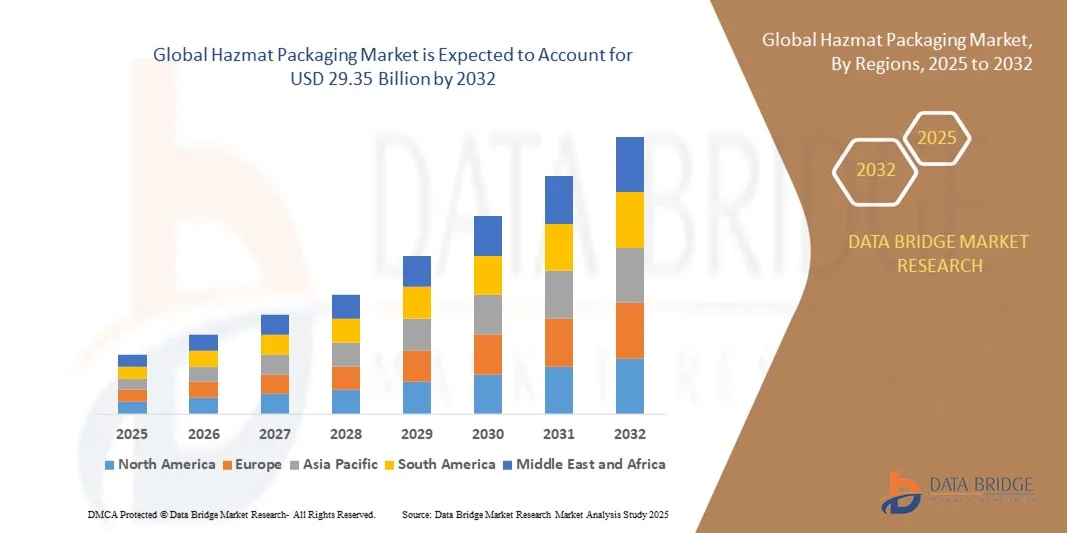
- The global hazmat packaging market size was valued at USD 13.40 billion in 2024 and is expected to reach USD 29.35 billion by 2032, at a CAGR of 10.3% during the forecast period
- The market growth is largely fueled by increasing industrialization, expanding chemical, pharmaceutical, and petrochemical sectors, and the rising need for safe and compliant transportation of hazardous materials across global supply chains
- Furthermore, stringent regulatory standards for hazardous material handling, growing awareness of workplace and environmental safety, and the demand for durable, UN-certified packaging solutions are driving the adoption of advanced hazmat packaging. These factors collectively accelerate market growth and strengthen the industry's focus on safe and sustainable packaging solutions
Hazmat Packaging Market Analysis
- Hazmat packaging, designed for the secure storage and transportation of hazardous liquids, solids, gases, and other regulated materials, is increasingly critical across industrial, chemical, pharmaceutical, and logistics sectors due to its ability to prevent leaks, contamination, and accidents
- The escalating demand for hazmat packaging is primarily fueled by rising industrial output, regulatory compliance requirements, and a growing emphasis on environmental protection and safety during transport, driving the adoption of advanced, durable, and compliant packaging solutions worldwide
- North America dominated the hazmat packaging market with a share of 42.4% in 2024, due to stringent regulatory standards for hazardous materials handling and a mature industrial and chemical sector
- Asia-Pacific is expected to be the fastest growing region in the hazmat packaging market during the forecast period due to rapid industrialization, rising chemical production, and expanding logistics networks in countries such as China, India, and Japan
- Metal segment dominated the market with a market share of 41.7% in 2024, due to its superior strength, durability, and resistance to chemical reactions. Metal packaging is widely used for storing and transporting flammable liquids, corrosives, and toxic substances due to its ability to withstand extreme temperatures and mechanical stress. The reliability of metal drums and containers in high-risk industrial environments has established them as the preferred choice among manufacturers and logistics providers. Compatibility with recycling and reuse programs further supports their market leadership
Report Scope and Hazmat Packaging Market Segmentation
|
Attributes |
Hazmat Packaging Key Market Insights |
|
Segments Covered |
|
|
Countries Covered |
North America
Europe
Asia-Pacific
Middle East and Africa
South America
|
|
Key Market Players |
|
|
Market Opportunities |
|
|
Value Added Data Infosets |
In addition to the insights on market scenarios such as market value, growth rate, segmentation, geographical coverage, and major players, the market reports curated by the Data Bridge Market Research also include import export analysis, production capacity overview, production consumption analysis, price trend analysis, climate change scenario, supply chain analysis, value chain analysis, raw material/consumables overview, vendor selection criteria, PESTLE Analysis, Porter Analysis, and regulatory framework. |
Hazmat Packaging Market Trends
Rising Shift Toward Sustainable Hazmat Packaging
- The hazmat packaging market is undergoing a notable transformation with the growing shift toward sustainable materials and eco-friendly production processes. As environmental regulations tighten and companies adopt greener logistics practices, the demand for recyclable and reusable hazmat packaging solutions is gaining strong momentum
- For instance, Greif, Inc. and Mauser Packaging Solutions have introduced sustainable hazmat containers made from high-density polyethylene (HDPE) and post-consumer recycled plastics. These solutions meet UN certification standards while reducing carbon emissions and landfill waste across chemical and pharmaceutical supply chains
- The increasing emphasis on environmental compliance and corporate sustainability has encouraged manufacturers to develop lightweight, recyclable, and energy-efficient packaging solutions. Recycled metal drums, fiberboard boxes, and hybrid plastic containers are replacing conventional single-use materials in regulated transport applications
- In addition, advanced material science innovations are enabling the production of bio-based and multi-layer barrier materials offering the same strength and chemical resistance as traditional packaging. These developments support safe transportation of hazardous liquids and solids while meeting eco-centric design objectives
- Companies are also implementing circular economy models, where used hazmat containers are collected, reconditioned, and reintroduced into supply cycles. This approach reduces waste and also ensures full regulatory traceability and lifecycle accountability
- Overall, the rising shift toward sustainable hazmat packaging reflects the increasing alignment between safety, compliance, and environmental stewardship. This trend is expected to shape the future market landscape as industries continue to prioritize robust and eco-efficient packaging systems for hazardous goods transportation
Hazmat Packaging Market Dynamics
Driver
Rising Demand for Safe and Compliant Hazardous Material Handling
- The growing complexity of global chemical trade and increased regulatory scrutiny are driving strong demand for secure and compliant hazmat packaging. Industries dealing with hazardous liquids, flammable materials, and toxic substances rely on advanced containers designed to prevent leaks, contamination, and environmental exposure
- For instance, SCHÜTZ GmbH & Co. KGaA and Berry Global Inc. have introduced UN-certified intermediate bulk containers (IBCs) and drums equipped with impact-resistant linings and tamper-evident closures. These packaging systems have been widely adopted by chemical, agriculture, and oil industries to ensure safe material transport and storage
- Safe packaging plays an essential role in maintaining compliance with international standards such as ADR, IATA, and IMDG. Manufacturers are prioritizing material durability, leak-proof design, and thermal resistance to meet these strict safety requirements across global logistics networks
- In addition, the proliferation of e-commerce and global distribution of chemicals and pharmaceuticals has intensified the need for standardized packing solutions that ensure consistent product safety during shipment and handling
- As environmental and safety regulations continue to evolve, the demand for innovative hazmat packaging materials combining strength, sustainability, and cost efficiency remains high. This growing requirement reinforces the industry’s commitment to balancing safety compliance and logistical efficiency across critical applications
Restraint/Challenge
High Cost of UN-Certified Packaging
- The high cost associated with UN-certified hazmat packaging materials and testing procedures represents a significant barrier to widespread adoption, particularly for small-scale manufacturers and chemical exporters. Certification processes require rigorous testing to ensure compliance with safety and transport regulations, increasing overall production costs
- For instance, manufacturers producing UN-certified drums and IBCs through companies such as Mauser Packaging Solutions and Greif, Inc. face rising expenses due to stringent quality control, testing protocols, and certification renewals. These processes ensure reliability but elevate unit costs for mass distribution
- Specialized materials such as high-density polyethylene, corrosion-resistant metals, and multi-layer barrier films further add to production costs. The integration of advanced safety seals and traceability labels also increases processing and equipment investment requirements
- In addition, the cost burden is intensified by global supply chain fluctuations, freight charges, and frequent updates to compliance standards. Small and mid-sized producers may find it challenging to maintain price competitiveness while meeting international hazmat packaging regulations
- Ultimately, overcoming this challenge will require innovation in lightweight materials, cost-efficient manufacturing, and collaborative certification frameworks. Streamlined regulatory processes and scalable testing methods will be essential to making UN-certified hazmat packaging more affordable and accessible across global markets
Hazmat Packaging Market Scope
The market is segmented on the basis of content type, material, product, and end-use.
- By Content Type
On the basis of content type, the Hazmat Packaging market is segmented into flammable and combustible liquids, explosives, gases, flammable and combustible solids, oxidizing substances and organic peroxides, toxic and infectious substances, radioactive materials, corrosives, miscellaneous hazardous materials, and others. The flammable and combustible liquid segment dominated the market with the largest revenue share in 2024, driven by the high global demand for safely transporting industrial chemicals, fuels, and solvents. Packaging solutions in this segment are designed to meet stringent regulatory standards, ensuring leak-proof and fire-resistant containment. Manufacturers focus on robust materials and secure closures, providing reliability during storage and transit. The compatibility of these packages with various transportation modes, including road, rail, and sea, further strengthens their dominance. The market also sees strong adoption due to rising industrialization and the need for safe handling of high-risk liquids.
The explosives segment is anticipated to witness the fastest growth rate from 2025 to 2032, fueled by increasing mining, construction, and defense activities worldwide. Specialized packaging solutions for explosives ensure safety during handling and transportation, minimizing risk of accidental detonation. Growing infrastructure projects and expanding defense budgets in emerging economies contribute to rising demand. Advanced packaging features, such as shock-absorbing inserts and tamper-evident seals, enhance safety compliance and drive adoption in high-risk industries.
- By Material
On the basis of material, the Hazmat Packaging market is segmented into metal, fiber, corrugated paper, and plastic. The metal segment dominated the market with the largest share of 41.7% in 2024, driven by its superior strength, durability, and resistance to chemical reactions. Metal packaging is widely used for storing and transporting flammable liquids, corrosives, and toxic substances due to its ability to withstand extreme temperatures and mechanical stress. The reliability of metal drums and containers in high-risk industrial environments has established them as the preferred choice among manufacturers and logistics providers. Compatibility with recycling and reuse programs further supports their market leadership.
The plastic segment is expected to witness the fastest growth from 2025 to 2032, fueled by its lightweight nature, cost-effectiveness, and adaptability for various shapes and sizes. Plastic packaging solutions offer chemical resistance, leak-proof properties, and ease of handling, making them ideal for chemicals, pharmaceuticals, and hazardous liquids. Advancements in high-density polyethylene (HDPE) and polymer composites enable safer and more sustainable packaging, driving increasing adoption across industries globally.
- By Product
On the basis of product, the Hazmat Packaging market is segmented into drums and pails, IBCs, cartons, boxes, canes, flexi tanks, bottles, and others. The drums and pails segment dominated the market in 2024, driven by their versatility, standardized sizes, and compliance with international safety regulations. These products are preferred for transporting flammable liquids, corrosives, and toxic substances, providing secure containment with minimal leakage risk. Their durability and compatibility with automated filling and handling systems make them highly efficient for industrial operations. Manufacturers are increasingly incorporating tamper-evident and reusable designs, further reinforcing their market leadership.
The IBC (Intermediate Bulk Container) segment is anticipated to witness the fastest growth from 2025 to 2032, fueled by increasing demand for bulk storage and transportation of hazardous liquids and chemicals. IBCs provide efficient space utilization, reduced handling costs, and compliance with strict safety standards. Industries such as chemicals, pharmaceuticals, and paints are adopting IBCs for their convenience in storage, easy stacking, and compatibility with automated processes. Advanced designs with built-in secondary containment systems enhance safety, driving rapid adoption globally.
- By End-Use
On the basis of end-use, the Hazmat Packaging market is segmented into chemicals and petrochemicals, paints and dyes, oil and gas, industrial chemicals, freight and logistics, automotive, lubricants and oils, pharmaceuticals, agriculture and horticulture, and others. The chemicals and petrochemicals segment dominated the market in 2024, driven by high-volume transportation of hazardous liquids, acids, solvents, and industrial chemicals. Regulatory compliance, safety in transit, and robust packaging solutions are key factors supporting this segment’s dominance. Rising industrial production, chemical exports, and global trade contribute to sustained demand for specialized packaging. Packaging manufacturers continue to innovate with corrosion-resistant and reinforced containers to meet stringent international standards.
The pharmaceuticals segment is expected to witness the fastest growth from 2025 to 2032, fueled by increasing production and distribution of active pharmaceutical ingredients (APIs), vaccines, and hazardous drug formulations. Safe and compliant packaging solutions ensure protection against contamination, leakage, and temperature variations. The growth of e-pharmacy, cold chain logistics, and global healthcare supply chains further drives demand. Advanced labeling, tamper-evident seals, and eco-friendly materials contribute to accelerated adoption in the pharmaceutical sector.
Hazmat Packaging Market Regional Analysis
- North America dominated the hazmat packaging market with the largest revenue share of 42.4% in 2024, driven by stringent regulatory standards for hazardous materials handling and a mature industrial and chemical sector
- Companies and consumers in the region prioritize compliance, safety, and durable packaging solutions for transporting chemicals, flammable liquids, and other hazardous substances
- Strong infrastructure, advanced logistics networks, and high awareness of global safety standards are fueling demand for certified packaging solutions, establishing Hazmat Packaging as a critical requirement across chemicals, pharmaceuticals, and petrochemicals industries
U.S. Hazmat Packaging Market Insight
The U.S. market captured the largest revenue share in North America in 2024, driven by large-scale chemical production, industrial manufacturing, and regulatory compliance requirements. Growing emphasis on safe storage and transportation of flammable, toxic, and corrosive substances supports the demand for advanced packaging solutions. Moreover, initiatives to reduce environmental risks, combined with increasing e-commerce shipments of regulated chemicals, further propel market growth.
Europe Hazmat Packaging Market Insight
The Europe market is projected to grow at a steady CAGR during the forecast period, supported by stringent EU regulations for hazardous material transportation and increasing industrial output. Rising awareness of workplace and environmental safety, along with urbanization and expansion of chemical and pharmaceutical industries, is boosting the adoption of certified Hazmat Packaging. The region witnesses growth across multiple end-use sectors, including chemicals, oil and gas, and logistics.
U.K. Hazmat Packaging Market Insight
The U.K. market is expected to expand at a notable CAGR, driven by growing compliance requirements and increasing chemical, pharmaceutical, and logistics activities. Concerns regarding safety, environmental protection, and handling of hazardous substances are encouraging companies to adopt robust and regulatory-compliant packaging solutions. The U.K.’s strong manufacturing base and e-commerce logistics infrastructure further support market growth.
Germany Hazmat Packaging Market Insight
Germany’s market is anticipated to grow steadily during the forecast period, fueled by industrial regulations, high awareness of occupational safety, and a well-developed chemicals sector. Manufacturers and logistics providers prefer high-quality, durable packaging solutions that comply with both EU and local safety standards. Demand for innovative, sustainable, and reusable Hazmat Packaging is also rising in Germany, especially for chemical and pharmaceutical shipments.
Asia-Pacific Hazmat Packaging Market Insight
The Asia-Pacific market is poised to grow at the fastest CAGR during 2025–2032, driven by rapid industrialization, rising chemical production, and expanding logistics networks in countries such as China, India, and Japan. Increasing awareness of hazardous material safety, government initiatives for industrial compliance, and growth in pharmaceuticals and petrochemicals are driving demand. In addition, APAC is emerging as a manufacturing hub for advanced packaging solutions, improving affordability and accessibility for regional markets.
Japan Hazmat Packaging Market Insight
Japan’s market growth is fueled by the country’s strict industrial safety regulations, high-tech manufacturing standards, and emphasis on environmental compliance. The adoption of certified packaging solutions is supported by chemical, pharmaceutical, and logistics sectors. Growing demand for secure, tamper-proof, and reusable packaging for hazardous materials is further propelling market expansion.
China Hazmat Packaging Market Insight
China accounted for the largest revenue share in Asia-Pacific in 2024, attributed to rapid industrialization, expanding chemical and pharmaceutical industries, and increasing awareness of safety and regulatory compliance. The push towards standardized packaging for hazardous materials, combined with government regulations and a growing middle class in manufacturing and logistics, is driving market growth. Affordable domestic solutions and strong local manufacturing capabilities further strengthen China’s position in the Hazmat Packaging market.
Hazmat Packaging Market Share
The hazmat packaging industry is primarily led by well-established companies, including:
- SIA FLEXITANKS (Ireland)
- Hoover CS (U.S.)
- SCHÜTZ GmbH & Co. KGaA (Germany)
- BWAY Corporation (U.S.)
- THIELMANN (Germany)
- Eagle Manufacturing (U.S.)
- Patrick Kelly Drums (U.S.)
- Balmer Lawrie Co Ltd (India)
- Clouds Drums Dubai LLC (U.A.E.)
- Sicagen (India)
- GREAT WESTERN CONTAINERS INC (U.S.)
- Myers Container (U.S.)
- TPL Plastech Limited (India)
- Peninsula Drums (U.S.)
- The Cary Company (U.S.)
- Milford Barrel (U.S.)
- Orlando Drum (U.S.)
- Uline (U.S.)
- BIG VALLEY (U.S.)
- Air Sea Containers, Inc (U.S.)
- BASCO, Inc. (U.S.)
- LPS Industries (U.S.)
Latest Developments in Global Hazmat Packaging Market
- In March 2024, Greif, Inc. completed its acquisition of Ipackchem Group SAS, a move that strengthens its global footprint in the hazardous materials packaging sector. This strategic acquisition enhances Greif’s portfolio by adding specialized chemical packaging solutions and expands its distribution capabilities in Europe and other international markets. The integration of Ipackchem’s expertise in UN-certified packaging is expected to bolster Greif’s competitive position and accelerate growth in industrial, chemical, and logistics applications
- In 2024, Mauser Packaging Solutions launched a new line of UN-certified hazmat drums featuring advanced leak-proof technology and full compliance with updated international regulations. This development reinforces Mauser’s leadership in the global hazmat packaging market by addressing rising demand for safe, reliable, and regulation-compliant containers. The new drum line is poised to improve safety standards across chemical and industrial sectors, while also appealing to logistics and pharmaceutical companies seeking secure transport solutions
- In October 2023, Stora Enso collaborated with Sweden-based partners FrostPharma and Mälarplast to develop the WoodSafe hazardous waste container line, made from tall oil-based polypropylene and Nordic woody fibers. The launch of seven container sizes for healthcare facilities highlights a shift toward sustainable and environmentally friendly packaging solutions in the hazmat segment. This innovation strengthens Stora Enso’s market positioning by combining safety, UN-certification compliance, and sustainability, catering to growing demand for eco-conscious industrial and healthcare packaging solutions
- In October 2023, Berry Global introduced 20- and 25-liter containers made from 35% recycled material, featuring UN Approval for the transport of hazardous liquids in five out of six tested models. This initiative reflects the increasing focus on sustainability and regulatory compliance within the hazmat packaging market. By integrating recycled materials while maintaining UN certification, Berry Global meets evolving environmental standards and also addresses the demand for safer and more eco-friendly chemical transport solutions, enhancing its market appeal in industrial and logistics sectors
- In November 2022, Novvia Group acquired Auberst Inc., a California-based distributor of plastic and metal rigid packaging solutions. This acquisition expanded Novvia’s footprint on the U.S. West Coast and strengthened its distribution network for hazardous materials packaging. By integrating Auberst’s portfolio, Novvia is better positioned to meet growing regional demand for UN-certified containers, rigid drums, and other hazmat packaging solutions, driving growth in chemical, pharmaceutical, and industrial sectors across North America

- Interactive Data Analysis Dashboard
- Company Analysis Dashboard for high growth potential opportunities
- Research Analyst Access for customization & queries
- Competitor Analysis with Interactive dashboard
- Latest News, Updates & Trend analysis
- Harness the Power of Benchmark Analysis for Comprehensive Competitor Tracking
Global Hazmat Packaging Market, Supply Chain Analysis and Ecosystem Framework
To support market growth and help clients navigate the impact of geopolitical shifts, DBMR has integrated in-depth supply chain analysis into its Global Hazmat Packaging Market research reports. This addition empowers clients to respond effectively to global changes affecting their industries. The supply chain analysis section includes detailed insights such as Global Hazmat Packaging Market consumption and production by country, price trend analysis, the impact of tariffs and geopolitical developments, and import and export trends by country and HSN code. It also highlights major suppliers with data on production capacity and company profiles, as well as key importers and exporters. In addition to research, DBMR offers specialized supply chain consulting services backed by over a decade of experience, providing solutions like supplier discovery, supplier risk assessment, price trend analysis, impact evaluation of inflation and trade route changes, and comprehensive market trend analysis.
Data collection and base year analysis are done using data collection modules with large sample sizes. The stage includes obtaining market information or related data through various sources and strategies. It includes examining and planning all the data acquired from the past in advance. It likewise envelops the examination of information inconsistencies seen across different information sources. The market data is analysed and estimated using market statistical and coherent models. Also, market share analysis and key trend analysis are the major success factors in the market report. To know more, please request an analyst call or drop down your inquiry.
The key research methodology used by DBMR research team is data triangulation which involves data mining, analysis of the impact of data variables on the market and primary (industry expert) validation. Data models include Vendor Positioning Grid, Market Time Line Analysis, Market Overview and Guide, Company Positioning Grid, Patent Analysis, Pricing Analysis, Company Market Share Analysis, Standards of Measurement, Global versus Regional and Vendor Share Analysis. To know more about the research methodology, drop in an inquiry to speak to our industry experts.
Data Bridge Market Research is a leader in advanced formative research. We take pride in servicing our existing and new customers with data and analysis that match and suits their goal. The report can be customized to include price trend analysis of target brands understanding the market for additional countries (ask for the list of countries), clinical trial results data, literature review, refurbished market and product base analysis. Market analysis of target competitors can be analyzed from technology-based analysis to market portfolio strategies. We can add as many competitors that you require data about in the format and data style you are looking for. Our team of analysts can also provide you data in crude raw excel files pivot tables (Fact book) or can assist you in creating presentations from the data sets available in the report.













