


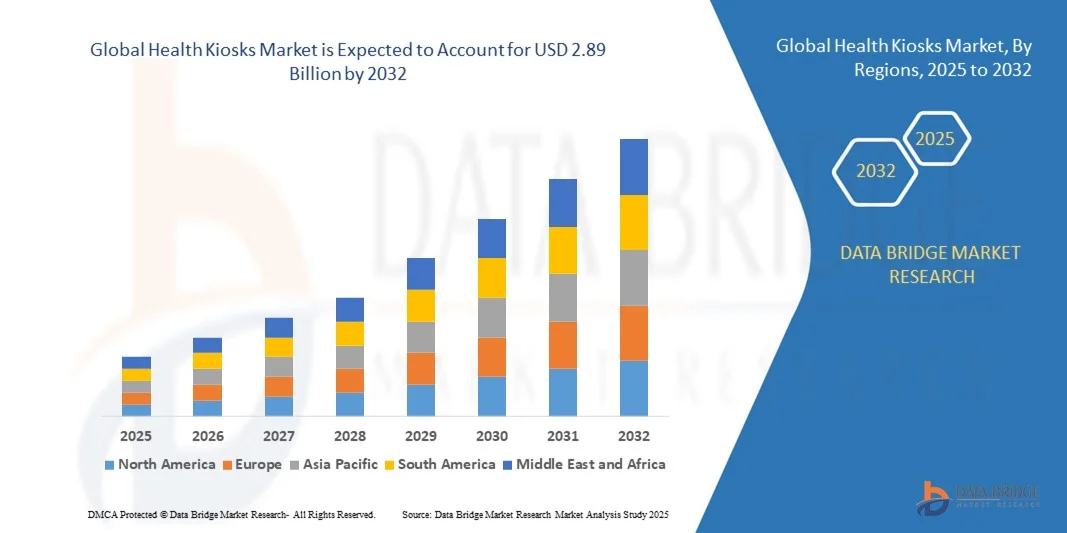
Global Health Kiosks Market Size
- The global health kiosks market size was valued at USD 1.07 billion in 2024 and is projected to reach USD 2.89 billion by 2032, growing at a CAGR of 13.20% during the forecast period.
- Market growth is driven by the increasing need for accessible, cost-effective, and real-time healthcare services, especially in underserved and remote regions, prompting the widespread deployment of health kiosks.
- Additionally, advancements in AI, telemedicine, and biometric technology are enhancing kiosk capabilities, offering convenient diagnostics, health monitoring, and virtual consultations fueling rapid adoption across hospitals, clinics, and public health settings.
Global Health Kiosks Market Analysis
- Health kiosks, which offer digital access to essential healthcare services such as vital sign monitoring, patient registration, and teleconsultations, are becoming integral to modern healthcare infrastructure across both public and private sectors due to their affordability, accessibility, and ability to reduce the burden on healthcare providers
- The growing demand for health kiosks is primarily driven by increasing healthcare digitization, rising patient awareness, and the need for efficient and contactless health service delivery particularly post-pandemic
- North America Dominated the global health kiosks market with the largest revenue share of 39.7% in 2024, owing to robust healthcare infrastructure, early adoption of telehealth solutions, and strong government initiatives to improve healthcare accessibility, with the U.S. witnessing significant growth in deployments across pharmacies, clinics, and community centers
- Asia-Pacific is projected to be the fastest-growing region in the health kiosks market during the forecast period, driven by expanding healthcare access, growing investment in health tech, and increasing urban population demanding convenient care solutions
- The check-in kiosks segment dominated the market with the largest revenue share of 36.4% in 2024, driven by its widespread adoption in hospitals and clinics for automating patient registration, reducing wait times, and improving workflow efficiency
Report Scope and Global Health Kiosks Market Segmentation
|
Attributes |
Health Kiosks Key Market Insights |
|
Segments Covered |
|
|
Countries Covered |
North America
Europe
Asia-Pacific
Middle East and Africa
South America
|
|
Key Market Players |
|
|
Market Opportunities |
|
|
Value Added Data Infosets |
In addition to the insights on market scenarios such as market value, growth rate, segmentation, geographical coverage, and major players, the market reports curated by the Data Bridge Market Research also include in-depth expert analysis, pricing analysis, brand share analysis, consumer survey, demography analysis, supply chain analysis, value chain analysis, raw material/consumables overview, vendor selection criteria, PESTLE Analysis, Porter Analysis, and regulatory framework. |
Global Health Kiosks Market Trends
Enhanced Accessibility Through AI and Telehealth Integration
- A significant and accelerating trend in the global Health Kiosks Market is the increasing integration of artificial intelligence (AI) with telehealth platforms and digital health ecosystems, aimed at delivering smarter, faster, and more accessible patient care. This fusion of technologies is enhancing diagnostic accuracy, personalizing healthcare services, and reducing wait times for basic consultations and screenings.
- For Instance, AI-powered kiosks can now conduct preliminary health assessments by analyzing symptoms, vital signs, and patient history—then triaging cases to appropriate care pathways or healthcare providers. Companies like Olea Kiosks are integrating AI modules into their solutions to enable real-time health monitoring and predictive analytics for chronic disease management.
- AI algorithms in health kiosks can also recognize patterns over time, enabling proactive health recommendations, automated reminders for screenings or medications, and more accurate tracking of patient vitals. Some advanced models incorporate facial recognition and thermal imaging to identify users and detect early signs of illness, contributing to preventive care.
- The integration of telemedicine capabilities within health kiosks allows patients in remote or underserved areas to instantly connect with physicians via secure video conferencing—bridging the healthcare access gap. This is especially impactful in rural settings where medical facilities are scarce.
- Moreover, the inclusion of voice-assisted interfaces in kiosks enhances usability for elderly patients and individuals with disabilities, enabling hands-free operation and multilingual support. Voice-enabled kiosks can guide users step-by-step through health screenings, appointment bookings, and virtual consults, improving patient experience and adherence.
- This trend toward intelligent, interactive, and highly accessible kiosks is redefining expectations for public health engagement. As a result, companies such as XIPHIAS and NCR Corp. are actively developing AI-integrated kiosk solutions with remote diagnostics, EHR connectivity, and voice-based navigation to meet growing demand across hospitals, pharmacies, and community health centers.
Global Health Kiosks Market Dynamics
Driver
Growing Need Due to Increasing Healthcare Accessibility Gaps and Digitization Initiatives
-
The rising global demand for accessible and efficient healthcare services—particularly in underserved, rural, and high-traffic urban areas—is a major driver behind the accelerated adoption of health kiosks. These self-service systems enable quicker access to basic healthcare functions, including vital checks, registration, teleconsultation, and health information dissemination.
- For Instance, in March 2024, NCR Corporation partnered with a major U.S. hospital network to deploy AI-enabled health kiosks across pharmacies and outpatient centers, aiming to reduce wait times and improve patient flow. Initiatives like these are expected to fuel market growth in the coming years.
- As healthcare systems face increasing pressure due to aging populations, clinician shortages, and growing patient volumes, health kiosks present a scalable solution that supports decentralization of services and enhances patient convenience.
- Moreover, the expansion of national healthcare digitization strategies—such as India’s Ayushman Bharat Digital Mission and similar eHealth initiatives in Africa and Southeast Asia—is making health kiosks a key component of digital health infrastructure.
- The ability of kiosks to integrate with electronic health records (EHR), offer real-time health assessments, and facilitate remote consultations through telemedicine platforms is driving demand in hospitals, pharmacies, corporate offices, and community centers alike.
- The rise in health-conscious behavior, particularly post-COVID-19, has further reinforced consumer preference for contactless, self-guided health solutions. The convenience of 24/7 availability, multilingual support, and minimal human intervention has solidified health kiosks as a valuable front-line tool in modern healthcare delivery.
Restraint/Challenge
Concerns Regarding Data Privacy, Device Maintenance, and Infrastructure Readiness
- Despite their growing popularity, data security and patient privacy concerns pose a significant challenge to widespread adoption of health kiosks. These systems handle sensitive health data and are often connected to hospital networks, making them potential targets for cyberattacks or unauthorized data access.
- For instance, several healthcare providers have reported vulnerabilities in third-party kiosk software that failed to encrypt patient input data or lacked adequate authentication protocols—leading to increased scrutiny over compliance with standards like HIPAA and GDPR.
- Ensuring strong encryption, secure cloud storage, regular software updates, and physical device security is critical for protecting patient trust and complying with regional data protection regulations.
- In addition to privacy concerns, high initial setup and maintenance costs, particularly for AI-enabled or telemedicine-equipped kiosks, can be a deterrent—especially in lower-income regions. While basic models may be more affordable, advanced features like integrated diagnostics, video consultations, and biometric authentication increase deployment complexity and cost.
- Furthermore, infrastructure limitations, such as poor internet connectivity, unstable power supply, and lack of trained personnel to maintain kiosks, can restrict their effective implementation in rural or remote settings.
- Overcoming these barriers will require public-private partnerships, subsidized health tech programs, ongoing device innovation, and expanded infrastructure development to ensure kiosks can function optimally across diverse geographies.
Global Health Kiosks Market Scope
The health kiosks market is segmented on the basis of product type and end-user.
- By Product Type
On the basis of product type, the health kiosks market is segmented into electronic medical record (EMR) management, telemedicine kiosks, informative kiosks, check-in kiosks, wayfinding kiosks, and others. The Check-in Kiosks segment dominated the market with the largest revenue share of 36.4% in 2024, driven by its widespread adoption in hospitals and clinics for automating patient registration, reducing wait times, and improving workflow efficiency. These kiosks streamline the administrative process and allow patients to update insurance details and personal information with minimal human interaction.
The telemedicine kiosks segment is projected to witness the fastest CAGR from 2025 to 2032, fueled by the global expansion of virtual healthcare services and increasing demand for remote consultations. These kiosks enable real-time communication with healthcare professionals, making them essential for rural or underserved regions. Integration with diagnostic devices and AI further enhances their utility in delivering comprehensive care.
- By End Users
On the basis of end users, the health kiosks market is segmented into Clinics, Hospitals, Laboratories, Pharma Stores, and Others. The Hospitals segment accounted for the largest market revenue share of 41.8% in 2024, as these facilities continue to adopt self-service kiosks for patient check-ins, queue management, appointment scheduling, and health data input. Hospitals benefit from increased operational efficiency, reduced administrative burden, and improved patient throughput by integrating kiosks across departments and lobbies.
The Pharma Stores segment is expected to register the fastest CAGR from 2025 to 2032, driven by rising partnerships between healthcare providers and retail pharmacies to expand kiosk installations. These kiosks offer services such as health screening, prescription refills, and telepharmacy consultations, improving healthcare access for walk-in customers. The trend toward decentralizing basic healthcare functions and improving customer engagement in the retail pharmacy space is a key factor behind this growth.
Global Health Kiosks Market Regional Analysis
- North America dominated the health kiosks market with the largest revenue share of 39.7% in 2024, driven by rising demand for digital healthcare solutions, increased focus on patient engagement, and the widespread adoption of telemedicine and self-service technologies.
- Consumers and healthcare providers in the region prioritize speed, convenience, and accessibility, leading to broad deployment of health kiosks in hospitals, clinics, pharmacies, and corporate wellness centers. These kiosks offer services such as check-in, vital signs monitoring, and virtual consultations—reducing wait times and improving care delivery.
- This growth is further supported by robust healthcare infrastructure, favorable government policies promoting health IT, and high awareness of digital health tools. Additionally, the presence of leading kiosk manufacturers and technology providers in the U.S. and Canada contributes to innovation and adoption, positioning health kiosks as a preferred solution for enhancing operational efficiency and patient satisfaction across various healthcare settings.
U.S. Health Kiosks Market Insight
The U.S. health kiosks market captured the largest revenue share of 79.5% in 2024 within North America, driven by the rapid integration of digital technologies in healthcare delivery and the increasing focus on patient self-service. Healthcare providers are leveraging kiosks to streamline check-in processes, improve data accuracy, and enhance operational efficiency. The strong push for telehealth expansion, supported by favorable government policies and reimbursement frameworks, is further accelerating adoption. Widespread use in pharmacies, hospitals, and corporate wellness programs, coupled with rising consumer demand for convenience and contactless services, is solidifying the U.S. as a leading market for health kiosks.
Europe Health Kiosks Market Insight
The Europe health kiosks market is projected to grow at a substantial CAGR throughout the forecast period, fueled by the region’s focus on healthcare digitalization, aging populations, and the need to reduce hospital congestion. Countries across Europe are implementing health kiosks in both public and private sectors to improve accessibility and patient flow. The integration of kiosks with electronic health records (EHRs) and multilingual interfaces enhances usability across diverse populations. Additionally, rising investments in telemedicine and preventive care, particularly in Germany, France, and the UK, are supporting the expansion of kiosk-based healthcare solutions across hospitals and community health hubs.
U.K. Health Kiosks Market Insight
The U.K. health kiosks market is expected to grow at a noteworthy CAGR during the forecast period, driven by the National Health Service’s (NHS) increasing adoption of digital health technologies to alleviate pressure on general practitioners and clinics. Health kiosks are being deployed to manage appointment scheduling, patient triage, and digital health records access, particularly in urban and high-demand areas. The growing use of kiosks in pharmacies and walk-in centers, coupled with the public's acceptance of self-service healthcare models, is encouraging further investment in this segment.
Germany Health Kiosks Market Insight
The Germany health kiosks market is anticipated to grow at a considerable CAGR, supported by the country's strong emphasis on healthcare efficiency, innovation, and data privacy. With well-developed infrastructure and a push towards digital healthcare under Germany's eHealth initiative, kiosks are increasingly utilized for check-ins, health screenings, and patient education. The integration of kiosks with secure national health databases and digital insurance platforms reflects the country's commitment to maintaining privacy while improving access to care. Furthermore, smart hospital projects and the aging population are key factors driving adoption.
Asia-Pacific Health Kiosks Market Insight
The Asia-Pacific health kiosks market is expected to register the fastest CAGR of 23.8% during the forecast period from 2025 to 2032. The region is experiencing rapid urbanization, rising healthcare demand, and government initiatives promoting digital health in countries like China, India, and Japan. As healthcare infrastructure expands, health kiosks are emerging as scalable tools to bridge gaps in care, particularly in rural and underserved regions. Increasing investment in telehealth platforms, combined with affordable kiosk manufacturing capabilities in the region, is contributing to greater accessibility and cost-effectiveness.
Japan Health Kiosks Market Insight
The Japan health kiosks market is growing steadily, driven by the country’s tech-savvy population and aging demographic. With a strong emphasis on preventive healthcare, kiosks are being integrated into clinics, pharmacies, and wellness centers to support health monitoring and remote consultations. The demand for AI-enabled, multilingual, and elderly-friendly kiosks is rising, particularly as healthcare facilities look to improve service efficiency amid workforce shortages. Japan's leadership in robotics and automation is also influencing the development of advanced kiosk solutions tailored to local needs.
China Health Kiosks Market Insight
The China health kiosks market accounted for the largest revenue share in Asia-Pacific in 2024, fueled by large-scale healthcare reforms, rising consumer awareness, and the government's push towards smart healthcare infrastructure. With strong support for telemedicine, digital hospital programs, and urban health access, kiosks are increasingly installed in community clinics, public spaces, and pharmacies. Domestic tech giants and startups are actively innovating kiosk designs with AI, facial recognition, and cloud-based services, making China a key hub for both deployment and manufacturing of health kiosks.
Global Health Kiosks Market Share
The Health Kiosks industry is primarily led by well-established companies, including:
- NCR Corp. (U.S.)
- XIPHIAS Group (India)
- Olea Kiosks Inc. (U.S.)
- Diebold Nixdorf Inc. (U.S.)
- Nexcom International Co. Ltd. (Taiwan)
- Fabcon Inc. (United States)
- Zebra Technology Corp. (U.S.)
- JCM Global (Japan)
- Glory Ltd. (Japan)
- KIOSK Information System (U.S.)
What are the Recent Developments in Global Health Kiosks Market?
- In May 2023, NCR Corporation, a global leader in self-service and payment technologies, launched a new generation of AI-enabled health kiosks in collaboration with a major U.S. hospital network. These kiosks are designed to streamline patient check-ins, gather preliminary health data, and offer virtual consultations, significantly reducing administrative workload and improving patient flow. The initiative demonstrates NCR’s strategic focus on integrating intelligent technologies into healthcare and reinforcing its leadership in the global Health Kiosks Market.
- In April 2023, Olea Kiosks Inc., a U.S.-based manufacturer of custom self-service kiosks, introduced a modular telemedicine kiosk platform tailored for rural healthcare deployments and corporate wellness programs. This next-generation kiosk includes integrated diagnostic tools, high-resolution video conferencing, and ADA-compliant features, ensuring accessibility for diverse patient populations. The launch showcases Olea’s dedication to addressing healthcare access disparities through adaptable, scalable kiosk solutions.
- In March 2023, XIPHIAS Software Technologies, an Indian technology company, partnered with several state governments to deploy over 1,000 health kiosks across primary health centers and public hospitals. These kiosks support electronic health record management, health education, and teleconsultations in regional languages. The initiative supports India’s broader digital health mission and illustrates XIPHIAS’s commitment to improving healthcare access in rural and underserved communities through technology.
- In February 2023, Diebold Nixdorf Inc. expanded its healthcare offerings by unveiling a series of secure, multi-functional kiosks designed for pharmacies and outpatient clinics in Europe. These kiosks offer services such as prescription refills, appointment booking, and basic diagnostics. The expansion highlights Diebold Nixdorf’s push into the healthcare sector, combining its expertise in secure transaction systems with the rising demand for patient-centric digital health services.
- In January 2023, Zebra Technologies Corporation announced a partnership with a leading U.S. pharmacy chain to integrate its barcode-enabled kiosks for medication management and patient intake. These kiosks automate prescription verification and provide medication information, aiming to reduce errors and enhance operational efficiency. The collaboration underlines Zebra’s strategic goal to bring automation and traceability to healthcare environments, aligning with broader trends in digital transformation across the health sector.

- Interactive Data Analysis Dashboard
- Company Analysis Dashboard for high growth potential opportunities
- Research Analyst Access for customization & queries
- Competitor Analysis with Interactive dashboard
- Latest News, Updates & Trend analysis
- Harness the Power of Benchmark Analysis for Comprehensive Competitor Tracking
Data collection and base year analysis are done using data collection modules with large sample sizes. The stage includes obtaining market information or related data through various sources and strategies. It includes examining and planning all the data acquired from the past in advance. It likewise envelops the examination of information inconsistencies seen across different information sources. The market data is analysed and estimated using market statistical and coherent models. Also, market share analysis and key trend analysis are the major success factors in the market report. To know more, please request an analyst call or drop down your inquiry.
The key research methodology used by DBMR research team is data triangulation which involves data mining, analysis of the impact of data variables on the market and primary (industry expert) validation. Data models include Vendor Positioning Grid, Market Time Line Analysis, Market Overview and Guide, Company Positioning Grid, Patent Analysis, Pricing Analysis, Company Market Share Analysis, Standards of Measurement, Global versus Regional and Vendor Share Analysis. To know more about the research methodology, drop in an inquiry to speak to our industry experts.
Data Bridge Market Research is a leader in advanced formative research. We take pride in servicing our existing and new customers with data and analysis that match and suits their goal. The report can be customized to include price trend analysis of target brands understanding the market for additional countries (ask for the list of countries), clinical trial results data, literature review, refurbished market and product base analysis. Market analysis of target competitors can be analyzed from technology-based analysis to market portfolio strategies. We can add as many competitors that you require data about in the format and data style you are looking for. Our team of analysts can also provide you data in crude raw excel files pivot tables (Fact book) or can assist you in creating presentations from the data sets available in the report.













