


Healthcare Automatic Identification and Data Capture Market Overview
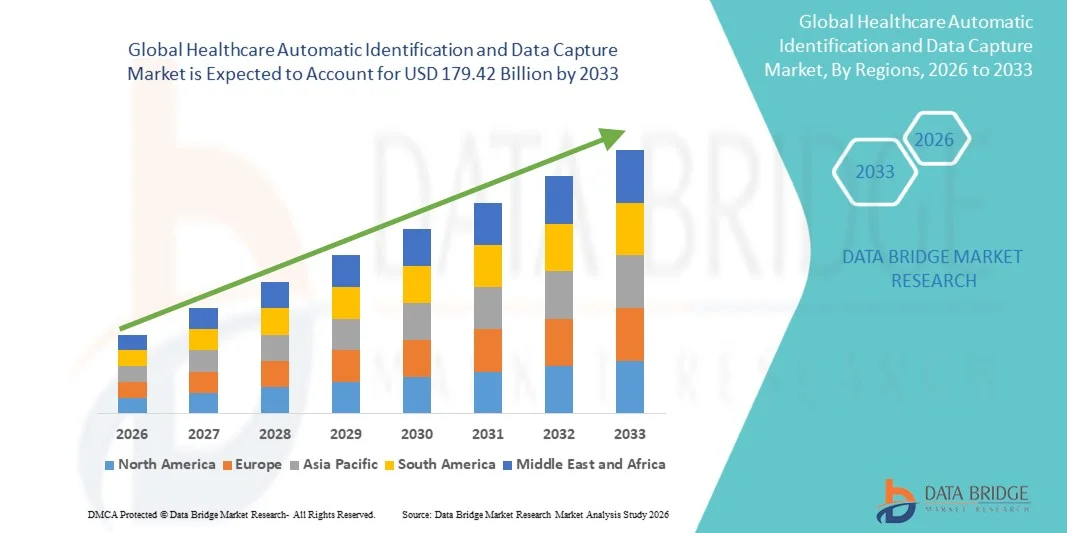
As per Data Bridge Market Research Analysis th Healthcare Automatic Identification and Data Capture Market was valued at USD 38.79 billion in 2025 and is projected to reach USD 179.42 billion by 2033, growing at a CAGR of 21.10% from 2026 to 2033. The market is witnessing steady expansion driven by the increasing need for patient safety, reduction in medical errors, and improved efficiency in hospital workflows. Rising adoption of barcode systems, RFID technology, biometric identification, and real-time location systems (RTLS) across healthcare facilities is further accelerating market growth, supported by the growing digitization of healthcare infrastructure worldwide.
The increasing pressure on healthcare providers to ensure accurate patient identification, streamline inventory management, and comply with regulatory standards is significantly boosting the adoption of automatic identification and data capture solutions. In addition, the expansion of electronic health records (EHR) systems, coupled with the rising volume of patient data and hospital automation initiatives, is encouraging hospitals, laboratories, and pharmacies to integrate AIDC technologies. These systems enable faster data processing, enhanced traceability of medical assets, and improved operational efficiency across the healthcare ecosystem.
Key Market Trends & Insights
- North America dominated the Healthcare Automatic Identification and Data Capture Market with the largest revenue share of 38.62% in 2025, supported by advanced healthcare IT infrastructure, strong hospital digitization, and widespread adoption of EHR-integrated tracking systems.
- The Barcode segment led the market with a 42.15% share in 2025, driven by its low implementation cost, high accuracy, and widespread adoption across hospitals, pharmacies, and diagnostic laboratories.
- Asia-Pacific is expected to be the fastest-growing region at a CAGR of 8.1% from 2026 to 2033, fueled by rapid hospital digitization, expanding healthcare infrastructure, and increasing adoption of RFID and mobile-based tracking systems in China, India, and Southeast Asia.
- RFID are the fastest-growing technology type, projected to register a CAGR of 7.9%, reflecting the surge in demand for real-time tracking of patients, medical equipment, and pharmaceutical inventory.
- The Scanners segment dominated the product category with a 40.87% revenue share in 2025, led by their essential role in barcode reading, patient verification, and medication tracking across clinical environments.
- Patient Management accounted for 39.64% of the market, preferred by increasing demand for accurate patient identification, reduced medical errors, and improved clinical workflow efficiency.
- The Medication Management segment is the fastest-growing application, with a CAGR of 8.2%, driven by increasing focus on preventing medication errors and ensuring drug traceability across the supply chain.
Market Size & Forecast
- Global Market Value (2025): USD 38.79 Billion
- Expected Market Value (2033): USD 179.42 Billion
- Forecast CAGR (2026–2033): 21.10%
- Leading Region in 2025: North America
- Fastest Growing Region: Asia Pacific
Report Scope and Healthcare Automatic Identification and Data Capture Market Segmentation
|
Attributes |
Healthcare Automatic Identification and Data Capture Key Market Insights |
|
Segments Covered |
|
|
Countries Covered |
North America · U.S. · Canada · Mexico Europe · Germany · France · U.K. · Netherlands · Switzerland · Belgium · Russia · Italy · Spain · Turkey · Rest of Europe Asia-Pacific · China · Japan · India · South Korea · Singapore · Malaysia · Australia · Thailand · Indonesia · Philippines · Rest of Asia-Pacific Middle East and Africa · Saudi Arabia · U.A.E. · South Africa · Egypt · Israel · Rest of Middle East and Africa South America · Brazil · Argentina · Rest of South America |
|
Key Market Players |
· Zebra Technologies Corporation (U.S.) · Honeywell International Inc. (U.S.) · Datalogic S.p.A. (Italy) · SATO Holdings Corporation (Japan) · Cognex Corporation (U.S.) · Impinj, Inc. (U.S.) · Avery Dennison Corporation (U.S.) · Identiv, Inc. (U.S.) · Advantech Co., Ltd. (Taiwan) · Siemens Healthineers AG (Germany) · GE HealthCare (U.S.) · BD (U.S.) · Philips Healthcare (Netherlands) · Fujitsu Limited (Japan) · Omron Corporation (Japan) · Panasonic Holdings Corporation (Japan) · Toshiba Tec Corporation (Japan) · Zebra MotionWorks (U.S.) · Stanley Healthcare (U.S.) · Gaumard Scientific Company (U.S.) |
|
Market Opportunities |
· Expansion of RFID and RTLS integration in smart hospitals · Rising opportunity in AI-powered AIDC platforms that combine barcode/RFID data with predictive analytics · Growing adoption of mobile-based and cloud-enabled identification solutions |
|
Value Added Data Infosets |
In addition to the insights on market scenarios such as market value, growth rate, segmentation, geographical coverage, and major players, the market reports curated by the Data Bridge Market Research also include in-depth expert analysis, patient epidemiology, pipeline analysis, pricing analysis, and regulatory framework. |
Healthcare Automatic Identification and Data Capture Market Trends
Trend: Expansion of RFID and Barcode Integration in Smart Healthcare Systems
Healthcare providers are increasingly deploying integrated barcode and RFID-based tracking systems to improve patient identification accuracy, streamline medication administration, and enhance real-time visibility of medical assets across hospitals and laboratories. The integration of AIDC with electronic health records and hospital information systems enables seamless data flow, reducing manual errors and improving clinical workflow efficiency. For instance, in March 2024, large hospital networks expanded RFID-enabled smart ward systems to track patients and critical equipment in real time across multiple departments.
Healthcare Automatic Identification and Data Capture Market Dynamics
Key Market Driver: Rising Demand for Patient Safety and Healthcare Digitization
The growing emphasis on reducing medical errors, preventing misidentification, and improving operational efficiency is driving widespread adoption of automatic identification technologies across healthcare facilities. Increasing implementation of digital healthcare infrastructure, coupled with regulatory requirements for traceability in pharmaceuticals and clinical workflows, is accelerating market growth. For instance, in July 2023, several hospital systems expanded barcode-based medication administration programs to improve accuracy in patient drug delivery and reduce adverse drug events.
Key Restraint/Challenge: High Implementation and Integration Costs in Healthcare Facilities
A major restraint in the healthcare AIDC market is the significant cost associated with deploying and integrating advanced identification systems, including RFID infrastructure, software platforms, and interoperability with legacy hospital systems. Smaller healthcare providers and clinics often face financial and technical barriers in adopting full-scale automation solutions, limiting market penetration in cost-sensitive regions. For instance, in February 2025, multiple mid-sized hospitals in emerging markets delayed RFID rollout projects due to high upfront installation and system integration expenses.
Key Market Opportunity: Integration of AI and Cloud-Based AIDC Platforms in Healthcare Ecosystems
The integration of artificial intelligence and cloud computing with automatic identification systems presents a strong opportunity to enhance predictive analytics, real-time patient monitoring, and supply chain optimization in healthcare environments. AI-enabled AIDC platforms can improve decision-making, automate inventory tracking, and support large-scale data interoperability across multi-facility hospital networks. For instance, in November 2024, cloud-based AIDC solutions were deployed in hospital groups to centralize patient tracking and improve pharmaceutical supply chain visibility across distributed healthcare systems.
Healthcare Automatic Identification and Data Capture Market Scope
The healthcare automatic identification and data capture market is segmented on the basis of technology, product, application, and end-user.
- By Technology
On the basis of technology, the Healthcare Automatic Identification and Data Capture Market is segmented into barcode, RFID, biometrics, and smart cards. The Barcode segment dominated the market with a 42.15% share in 2025, owing to its low implementation cost, high accuracy, and widespread adoption across hospitals, pharmacies, and diagnostic laboratories. Barcode systems are extensively used for patient identification, specimen tracking, and medication administration due to their simplicity and compatibility with existing hospital information systems. They require minimal infrastructure investment, making them suitable for both large and small healthcare facilities. Continuous improvements in 2D barcode scanning and mobile-based scanning solutions are further enhancing efficiency. Integration with electronic health records (EHR) systems is strengthening workflow automation and reducing human errors. Despite limitations in real-time tracking capability, barcode technology remains the most widely deployed identification method in healthcare globally.
The RFID segment is expected to witness the fastest growth at a CAGR of 7.9% from 2026 to 2033, driven by increasing demand for real-time tracking of patients, medical equipment, and pharmaceutical inventory. RFID technology enables contactless, automated identification, significantly improving operational efficiency in high-volume hospital environments. It is increasingly being used in smart hospitals for asset tracking, surgical instrument management, and patient monitoring systems. Advancements in tag miniaturization and cost reduction are accelerating adoption across mid-sized healthcare facilities. Integration with IoT-enabled healthcare systems is further enhancing visibility and traceability. Growing emphasis on reducing medical errors and improving supply chain transparency is also supporting rapid expansion of RFID solutions.
- By Product
On the basis of product, the Healthcare Automatic Identification and Data Capture Market is segmented into scanners, mobile computers, and software. The Scanners segment dominated the market with a 40.87% share in 2025, due to their essential role in barcode reading, patient verification, and medication tracking across clinical environments. Handheld and fixed scanners are widely deployed in hospitals for fast and accurate data capture at the point of care. Their affordability, ease of use, and compatibility with multiple healthcare systems make them the most commonly adopted hardware component. Continuous innovation in imaging technology and wireless connectivity is improving scanning speed and accuracy. Scanners are also increasingly integrated with hospital information systems to streamline workflow automation. Despite being hardware-dependent, they remain the backbone of AIDC infrastructure in healthcare settings globally.
The Software segment is projected to register the fastest growth at a CAGR of 7.5% from 2026 to 2033, driven by increasing demand for analytics-driven healthcare operations and real-time data management. AIDC software enables integration of barcode, RFID, and biometric data into centralized hospital systems, improving decision-making and operational efficiency. Growing adoption of cloud-based platforms is enhancing scalability and interoperability across multi-facility healthcare networks. AI-powered analytics tools are further supporting predictive inventory management and patient flow optimization. Rising focus on reducing administrative burden and improving clinical accuracy is accelerating software adoption. Continuous digital transformation of healthcare systems is making software the most dynamic growth segment in the market.
- By Application
On the basis of application, the Healthcare Automatic Identification and Data Capture Market is segmented into patient management, asset management, inventory management, facility management, medication management, and specimen management. The Patient Management segment dominated the market with a 39.64% share in 2025, driven by increasing demand for accurate patient identification, reduced medical errors, and improved clinical workflow efficiency. Hospitals widely use AIDC systems for patient wristband identification, admission tracking, and treatment verification. Integration with EHR systems ensures seamless data synchronization across departments. Rising patient volumes in hospitals are further increasing reliance on automated identification systems. Regulatory mandates for patient safety and traceability are also supporting adoption. This segment remains critical for improving healthcare quality and reducing operational risks.
The Medication Management segment is expected to witness the fastest growth at a CAGR of 8.2% from 2026 to 2033, driven by increasing focus on preventing medication errors and ensuring drug traceability across the supply chain. AIDC technologies are widely used for barcode-assisted medication administration and RFID-enabled drug tracking. Hospitals are adopting automated dispensing systems integrated with AIDC solutions to improve accuracy and efficiency. Growing concerns over counterfeit drugs and regulatory compliance requirements are further driving adoption. Integration with pharmacy management systems is enhancing real-time visibility of drug usage. Rising emphasis on patient safety and pharmaceutical supply chain transparency is accelerating segment growth.
- By End-User
On the basis of end-user, the Healthcare Automatic Identification and Data Capture Market is segmented into logistics, healthcare, BFSI, manufacturing, and retail. The Healthcare segment dominated the market with a 44.28% share in 2025, owing to widespread adoption of AIDC technologies in hospitals, laboratories, and pharmacies for patient tracking, inventory control, and workflow automation. Healthcare facilities increasingly rely on barcode and RFID systems to improve operational accuracy and reduce administrative errors. Integration with hospital information systems and EHR platforms is further enhancing efficiency. Rising regulatory pressure for patient safety and traceability is accelerating deployment across healthcare institutions. Continuous digital transformation of healthcare infrastructure is strengthening segment dominance. The segment benefits from large-scale investments in smart hospital technologies and automation systems.
The Logistics segment is expected to witness the fastest growth at a CAGR of 7.8% from 2026 to 2033, driven by increasing demand for efficient pharmaceutical supply chain management and real-time tracking of medical products. AIDC systems are widely used in cold chain monitoring, warehouse automation, and distribution tracking of drugs and medical devices. Growing e-commerce pharmacy models are further boosting demand for accurate logistics solutions. Integration of RFID and IoT technologies is improving supply chain visibility and reducing losses. Rising focus on minimizing delays and ensuring product authenticity is accelerating adoption. Expanding global healthcare distribution networks are further supporting rapid segment growth.
Healthcare Automatic Identification and Data Capture Market Regional Analysis
North America dominated the Healthcare Automatic Identification and Data Capture Market with the largest revenue share of 38.62% in 2025, supported by advanced healthcare IT infrastructure, strong hospital digitization, and widespread adoption of EHR-integrated tracking systems. The region also benefits from advanced hospital automation systems, early adoption of RFID and barcode technologies, and the presence of leading healthcare IT and AIDC solution providers. Increasing focus on reducing medication errors, improving supply chain traceability, and enhancing operational efficiency continues to strengthen North America’s leadership position in the global market.
U.S. Healthcare Automatic Identification and Data Capture Market Insight
The U.S. healthcare automatic identification and data capture market is witnessing strong growth due to increasing investments in healthcare digitization, patient safety initiatives, and advanced hospital automation systems. The country’s highly developed healthcare infrastructure, along with widespread adoption of electronic health records (EHR), RFID, barcode, and RTLS technologies, is driving demand across hospitals, pharmacies, and diagnostic laboratories. In addition, growing emphasis on reducing medication errors and improving clinical workflow efficiency is accelerating AIDC adoption across healthcare providers and integrated delivery networks.
Europe Healthcare Automatic Identification and Data Capture Market Insight
The Europe healthcare automatic identification and data capture market remains a major contributor to global revenue, driven by strong regulatory frameworks, widespread digital health adoption, and increasing focus on patient safety standards. The extensive use of barcode and RFID systems in hospital workflows, pharmaceutical tracking, and laboratory management is supporting market expansion across the region. Increasing investments in smart hospital infrastructure, coupled with stringent traceability requirements and high healthcare quality standards, continue to enhance AIDC adoption throughout Europe.
U.K. Healthcare Automatic Identification and Data Capture Market Insight
The U.K. healthcare automatic identification and data capture market is experiencing steady growth, supported by rising adoption of digital healthcare systems, NHS modernization programs, and increasing demand for efficient patient identification solutions. Expanding use of barcode-based medication administration and RFID-enabled asset tracking is contributing to improved hospital efficiency and reduced operational errors. Furthermore, integration of cloud-based healthcare IT systems and analytics-driven solutions is enhancing data accuracy and workflow automation across healthcare facilities.
Germany Healthcare Automatic Identification and Data Capture Market Insight
The Germany healthcare automatic identification and data capture market is expanding steadily due to strong healthcare infrastructure, advanced medical technology adoption, and increasing focus on hospital digitalization. Hospitals, laboratories, and pharmaceutical companies are increasingly utilizing barcode and RFID systems for patient identification, inventory control, and specimen tracking. Continuous advancements in healthcare automation, coupled with government support for digital health transformation and strict regulatory compliance requirements, are further driving market growth in Germany.
Asia-Pacific Healthcare Automatic Identification and Data Capture Market Insight
The Asia-Pacific healthcare automatic identification and data capture market is expected to witness rapid growth, driven by increasing healthcare infrastructure development, rising patient volumes, and expanding digital health initiatives across countries such as China, India, and Japan. Growing awareness of patient safety, increasing adoption of cost-effective barcode and RFID solutions, and rising investment in smart hospital projects are supporting regional market expansion. In addition, the growing presence of large healthcare networks and government-led digitization programs is accelerating AIDC adoption across the region.
Japan Healthcare Automatic Identification and Data Capture Market Insight
The Japan healthcare automatic identification and data capture market is witnessing consistent growth due to advanced healthcare systems, aging population demands, and strong focus on medical accuracy and efficiency. Hospitals and pharmaceutical companies are increasingly adopting RFID, barcode, and smart card technologies for patient tracking, medication safety, and inventory management. Moreover, integration of robotics, IoT, and AI-driven healthcare systems is further improving automation and operational efficiency in clinical environments.
China Healthcare Automatic Identification and Data Capture Market Insight
The China healthcare automatic identification and data capture market is growing rapidly, driven by expanding healthcare infrastructure, rising hospital digitization, and strong government support for smart healthcare initiatives. Increasing adoption of barcode and RFID technologies across hospitals, pharmacies, and laboratories is significantly improving patient identification and supply chain transparency. In addition, rising investments in healthcare IT systems, growing demand for efficient hospital operations, and rapid technological advancements are positioning China as one of the fastest-growing markets for AIDC solutions globally.
Top Companies in Healthcare Automatic Identification and Data Capture Market
The Healthcare Automatic Identification and Data Capture industry is primarily led by well-established companies, including:
- Zebra Technologies Corporation (U.S.)
- Honeywell International Inc. (U.S.)
- Datalogic S.p.A.. (Italy)
- SATO Holdings Corporation (Japan)
- Cognex Corporation (U.S.)
- Impinj, Inc. (U.S.)
- Avery Dennison Corporation (U.S.)
- Identiv, Inc. (U.S.)
- Advantech Co., Ltd. (Taiwan)
- Siemens Healthineers AG (Germany)
- GE HealthCare (U.S.)
- BD (U.S.)
- Philips Healthcare (Netherlands)
- Fujitsu Limited (Japan)
- Omron Corporation (Japan)
- Panasonic Holdings Corporation (Japan)
- Toshiba Tec Corporation (Japan)
- Zebra MotionWorks (U.S.)
- Stanley Healthcare (U.S.)
- Gaumard Scientific Company (U.S.)
Latest Developments in Healthcare Automatic Identification and Data Capture Market
- In March 2025, Identiv and Novanta announced a strategic partnership to expand RFID-based healthcare OEM solutions, focusing on improving medical device and pharmaceutical traceability through advanced RFID inlays, tags, and reader technologies. The collaboration aims to enhance interoperability, patient safety, and supply chain visibility while supporting scalable and secure adoption of AIDC solutions across healthcare manufacturing ecosystems
- In March 2025, Identiv launched ID-Brain dual-frequency RFID inlays combining NFC and UHF technologies to enhance pharmaceutical traceability and healthcare supply chain transparency. The solution enables seamless product authentication across consumer and industrial scanning environments, reducing complexity while improving interoperability, security, and efficiency in healthcare AIDC systems
- In November 2024, Kontakt.io introduced disposable BLE RTLS tags for healthcare applications, enabling cost-effective real-time tracking of short-life medical assets, patient records, and clinical supplies within hospitals. The innovation bridges the gap between traditional RFID and high-cost RTLS systems by providing scalable and affordable visibility solutions for healthcare providers seeking improved asset utilization and operational efficiency
- In July 2024, Kontakt.io launched an AI-enabled patient flow RTLS solution designed to improve hospital operational efficiency by tracking patients in real time from admission to discharge using ultra-small wearable tags. The system integrates AI analytics with RTLS and hospital information systems, helping healthcare providers identify bottlenecks, optimize resource utilization, and enhance workflow efficiency across clinical environments
- In April 2024, Identiv showcased advanced RFID and IoT healthcare solutions at RFID Journal LIVE!, highlighting innovations in medication tracking, cold chain monitoring, and hospital asset management. These solutions are designed to improve traceability, reduce operational inefficiencies, and enhance patient safety while supporting scalable deployment of IoT-enabled AIDC systems in healthcare environments

- Interactive Data Analysis Dashboard
- Company Analysis Dashboard for high growth potential opportunities
- Research Analyst Access for customization & queries
- Competitor Analysis with Interactive dashboard
- Latest News, Updates & Trend analysis
- Harness the Power of Benchmark Analysis for Comprehensive Competitor Tracking
Data collection and base year analysis are done using data collection modules with large sample sizes. The stage includes obtaining market information or related data through various sources and strategies. It includes examining and planning all the data acquired from the past in advance. It likewise envelops the examination of information inconsistencies seen across different information sources. The market data is analysed and estimated using market statistical and coherent models. Also, market share analysis and key trend analysis are the major success factors in the market report. To know more, please request an analyst call or drop down your inquiry.
The key research methodology used by DBMR research team is data triangulation which involves data mining, analysis of the impact of data variables on the market and primary (industry expert) validation. Data models include Vendor Positioning Grid, Market Time Line Analysis, Market Overview and Guide, Company Positioning Grid, Patent Analysis, Pricing Analysis, Company Market Share Analysis, Standards of Measurement, Global versus Regional and Vendor Share Analysis. To know more about the research methodology, drop in an inquiry to speak to our industry experts.
Data Bridge Market Research is a leader in advanced formative research. We take pride in servicing our existing and new customers with data and analysis that match and suits their goal. The report can be customized to include price trend analysis of target brands understanding the market for additional countries (ask for the list of countries), clinical trial results data, literature review, refurbished market and product base analysis. Market analysis of target competitors can be analyzed from technology-based analysis to market portfolio strategies. We can add as many competitors that you require data about in the format and data style you are looking for. Our team of analysts can also provide you data in crude raw excel files pivot tables (Fact book) or can assist you in creating presentations from the data sets available in the report.













