


Healthcare Facilities Management Market Size
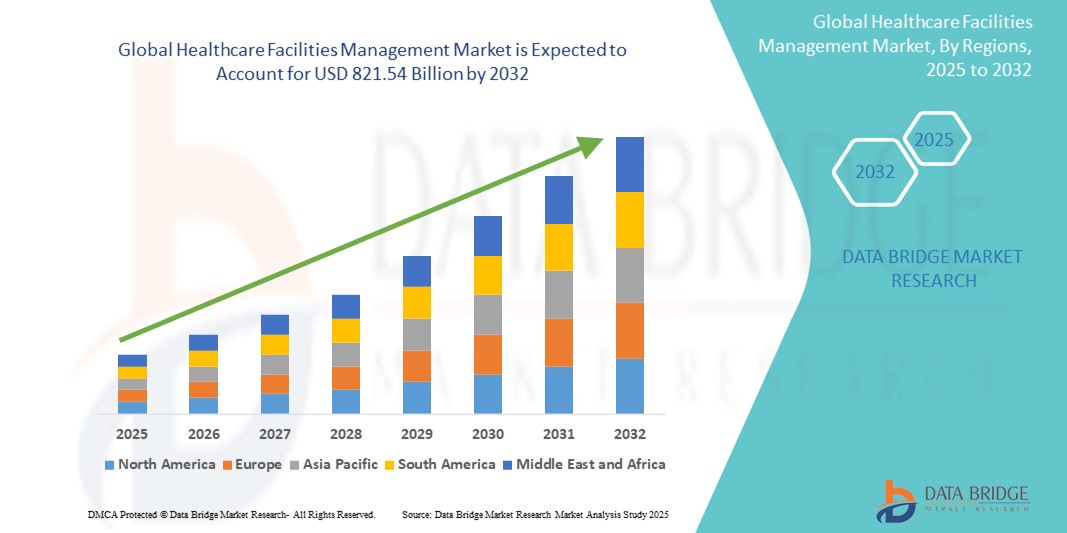
- The global healthcare facilities management market size was valued at USD 353.93 billion in 2024 and is expected to reach USD 821.54 billion by 2032, at a CAGR of 11.10% during the forecast period
- The market growth is largely fueled by the growing adoption of advanced technologies and digitalization within healthcare infrastructures, driving the demand for efficient, integrated, and scalable facilities management solutions across hospitals, clinics, and other medical institutions
- Furthermore, the rising need for enhanced patient safety, regulatory compliance, cost-effectiveness, and energy-efficient operations is positioning healthcare facilities management as a vital component of modern healthcare systems. These converging factors are accelerating the uptake of healthcare facilities management solutions, thereby significantly boosting the industry's growth
Healthcare Facilities Management Market Analysis
- Healthcare facilities management, encompassing services such as maintenance, cleaning, catering, security, and waste management, is becoming an increasingly vital component of modern healthcare operations, driven by the need for streamlined, compliant, and patient-centric facility environments
- The escalating demand for these services is primarily fueled by the growing complexity of healthcare infrastructures, rising patient volumes, increasing focus on operational efficiency, and stringent regulatory requirements
- North America dominated the healthcare facilities management market with the largest revenue share of 39.6% in 2024, attributed to advanced healthcare infrastructure, high healthcare spending, and a strong presence of leading service providers. The U.S. leads the regional growth due to increased adoption of integrated facilities management systems, especially in hospitals and long-term care facilities
- Asia-Pacific is expected to be the fastest-growing region in the healthcare facilities management market during the forecast period, driven by increasing urbanization, expansion of healthcare infrastructure, rising health awareness, and growing government investments in healthcare facilities
- Hard services segment dominated the healthcare facilities management market with a market share of 44.8% in 2024, owing to the critical importance of maintaining functional healthcare environments that directly impact patient safety and operational continuity
Report Scope and Healthcare Facilities Management Market Segmentation
|
Attributes |
Healthcare Facilities Management Key Market Insights |
|
Segments Covered |
|
|
Countries Covered |
North America
Europe
Asia-Pacific
Middle East and Africa
South America
|
|
Key Market Players |
|
|
Market Opportunities |
|
|
Value Added Data Infosets |
In addition to the insights on market scenarios such as market value, growth rate, segmentation, geographical coverage, and major players, the market reports curated by the Data Bridge Market Research also include in-depth expert analysis, pricing analysis, brand share analysis, consumer survey, demography analysis, supply chain analysis, value chain analysis, raw material/consumables overview, vendor selection criteria, PESTLE Analysis, Porter Analysis, and regulatory framework. |
Healthcare Facilities Management Market Trends
“Enhanced Convenience Through Intelligent Automation and System Integration”
- A significant and accelerating trend in the global healthcare facilities management market is the growing adoption of intelligent automation and integration with digital control platforms, enhancing convenience and operational efficiency in healthcare environments
- For instance, modern healthcare facilities are increasingly deploying facility management platforms that connect with centralized systems for lighting, climate control, energy use, and security—allowing seamless operation and monitoring through unified dashboards or mobile apps
- Intelligent systems are capable of learning patterns in facility usage, optimizing HVAC operations, and sending alerts for unusual activities or maintenance needs. These smart platforms also improve resource allocation and help reduce downtime in critical healthcare infrastructure
- Seamless integration with digital management systems enables administrators to control and monitor multiple facility operations from a single interface—streamlining workflows, reducing response times, and enhancing safety and hygiene standards
- This shift towards smarter, automated, and interconnected facilities is reshaping operational expectations in healthcare institutions. As a result, companies are developing advanced solutions that offer features such as predictive maintenance, automated compliance tracking, and real-time performance analytics
- The demand for intelligent and integrated facility management solutions is rising rapidly across hospitals, specialty clinics, and long-term care centers, as healthcare providers prioritize efficiency, safety, and patient-centered environments
Healthcare Facilities Management Market Dynamics
Driver
“Growing Need Due to Rising Regulatory Pressures and Healthcare Infrastructure Expansion”
- The increasing emphasis on hygiene, safety, and operational efficiency in healthcare environments—coupled with the rapid expansion of medical infrastructure globally—is a significant driver fueling demand for healthcare facilities management services
- For instance, in April 2024, Medxcel announced new AI-driven facilities management solutions designed to enhance compliance and reduce operational costs in hospitals across the U.S. Such strategic innovations by key players are expected to accelerate the growth of the Healthcare Facilities Management industry during the forecast period
- As healthcare providers face growing pressure to meet stringent regulatory and accreditation standards, comprehensive facilities management solutions offer services such as environmental cleanliness, HVAC maintenance, waste disposal, and equipment upkeep to support compliance and improve patient outcomes
- Furthermore, the rise in hospital construction projects and the modernization of existing medical facilities—especially in emerging economies—is significantly boosting the need for outsourced and technology-enabled facilities management
- The integration of digital tools for remote monitoring, predictive maintenance, and real-time reporting provides added convenience and transparency for healthcare administrators, thereby increasing adoption
- The ability to streamline multiple services under a unified facilities management platform, reduce operational disruptions, and enhance patient and staff satisfaction is further propelling the demand across public and private healthcare institutions
Restraint/Challenge
“Concerns Regarding Data Privacy, Compliance, and High Operational Costs”
- Concerns around data privacy, especially in relation to managing sensitive patient information and building automation systems, pose a significant challenge for broader adoption of technology-integrated healthcare facilities management services
- For instance, breaches in connected facility platforms or poorly secured IoT-based management tools can lead to data leaks or system disruptions, heightening anxieties among hospital administrators about cybersecurity and regulatory non-compliance
- Addressing these concerns requires robust data protection strategies, including encrypted systems, HIPAA-compliant infrastructure, secure authentication, and frequent updates—without which many facilities may be reluctant to upgrade their traditional operations
- In addition, the high initial investment in implementing comprehensive facilities management systems—particularly those using AI, cloud platforms, or advanced analytics—can be a barrier for smaller hospitals or clinics operating under tight budgets
- While cost-effective solutions are emerging, especially in the Asia-Pacific region, the perceived expense of outsourcing or digitizing facilities management remains a concern for many healthcare providers
- Overcoming these challenges through stronger data governance frameworks, public-private partnerships, staff training, and scalable, affordable service packages will be essential to support sustainable growth in the healthcare facilities management market
Healthcare Facilities Management Market Scope
The market is segmented on the basis of location, services, setting, and end user.
• By Location
On the basis of location, the healthcare facilities management market is segmented into on-site facility management and off-site facility management. the on-site facility management segment held the largest market revenue share of 67.3% in 2024, as healthcare institutions prioritize real-time service delivery for critical operations and patient safety.
The off-site facility management segment is expected to register the fastest CAGR of 9.8% from 2025 to 2032, driven by growing adoption of remote and automated facility management solutions for cost-efficiency.
• By Services
On the basis of services, the healthcare facilities management market is segmented into hard services, construction services, and energy services. The hard services segment dominated with a revenue share of 44.8% in 2024, as services such as HVAC, electrical, mechanical, and fire safety systems remain essential to hospital operations.
The energy services segment is projected to grow at the fastest CAGR of 10.6% from 2025 to 2032, due to increased sustainability efforts and energy optimization programs.
• By Setting
On the basis of setting, the healthcare facilities management market is segmented into acute, post-acute, and non-acute settings. The acute setting segment held the largest revenue share of 52.1% in 2024, driven by demand for complex facility support in hospitals and trauma centers.
The post-acute setting segment is projected to grow at the fastest CAGR of 9.2% from 2025 to 2032, as aging populations and chronic disease cases increase the need for rehabilitation and long-term care.
• By End User
On the basis of end user, the healthcare facilities management market is segmented into hospitals and clinics, ambulatory service centers, long-term healthcare facilities, and others. The hospitals and clinics segment accounted for the largest market share of 49.5% in 2024, reflecting the scale and complexity of services required in inpatient settings.
The long-term healthcare facilities segment is expected to witness the fastest growth, with a projected CAGR of 9.9% from 2025 to 2032, fueled by increased investment in eldercare infrastructure.
Healthcare Facilities Management Market Regional Analysis
- North America dominated the healthcare facilities management market with the largest revenue share of 39.6% in 2024, attributed to advanced healthcare infrastructure, high healthcare spending, and a strong presence of leading service providers
- The U.S. leads the regional growth due to increased adoption of integrated facilities management systems, especially in hospitals and long-term care facilities
- The region’s high healthcare spending and demand for integrated facilities management systems are boosting market expansion, particularly in large hospital chains and long-term care institutions
U.S. Healthcare Facilities Management Market Insight
The U.S. healthcare facilities management market captured the largest revenue share of 81% within North America in 2024, representing 32.08% of the global market. This leadership is driven by strong regulatory compliance requirements, rising investments in smart hospital infrastructure, and increasing outsourcing of non-core services. The market is further propelled by automation trends and a focus on improving patient environments through digitally enabled facility management.
Europe Healthcare Facilities Management Market Insight
The Europe healthcare facilities management market accounted for 27.4% of the global market share in 2024, fueled by rapid adoption of energy-efficient and sustainable facility solutions. Key drivers include stricter regulatory frameworks, increasing prevalence of infectious disease control protocols, and the rising number of private healthcare providers.
U.K. Healthcare Facilities Management Market Insight
The U.K. healthcare facilities management market contributed 6.9% to the European market in 2024, with growth being propelled by NHS-backed reforms focused on outsourcing, digitization, and infrastructure renewal. The increasing reliance on third-party FM providers and the need for efficient management of aging hospitals and clinics are accelerating demand. The market is projected to grow at a CAGR of 10.8% during the forecast period.
Germany Healthcare Facilities Management Market Insight
The Germany healthcare facilities management market held 8.4% of the Europe market share in 2024, supported by the country's emphasis on high-performance building management systems and green healthcare infrastructure. As digital transformation continues to influence facility planning and maintenance, the market is expected to grow, with both public and private hospitals investing in advanced FM platforms and compliance-oriented services.
Asia-Pacific Healthcare Facilities Management Market Insight
The Asia-Pacific healthcare facilities management market is poised to grow at the fastest CAGR of 11.0% from 2025 to 2032. This growth is driven by rapid urbanization, infrastructure investments, and government healthcare reform initiatives in countries such as China, India, and Southeast Asia. The rising number of hospitals, combined with smart city projects and increased healthcare outsourcing, is creating significant opportunities for FM providers across the region.
Japan Healthcare Facilities Management Market Insight
The Japan healthcare facilities management market held a 3.8% share of the Asia-Pacific market in 2024, bolstered by a strong demand for technologically advanced, aging-friendly healthcare infrastructure. Japan’s focus on automation, cleanliness, and infection control aligns with the country’s demographic needs. The market is expected to grow, supported by digital integration and enhanced quality standards across hospital networks.
China Healthcare Facilities Management Market Insight
The China healthcare facilities management market led the Asia-Pacific market with a 38.6% share in 2024, accounting for 7.02% of the global market. This dominance is attributed to expansive healthcare investments, rapid urban development, and the rollout of smart city and public-private partnership (PPP) projects. With an increasing number of hospitals being built or upgraded, China’s healthcare FM market is projected to expand at a CAGR of 12.6%, driven by a strong domestic service provider base and widespread adoption of AI-driven facilities management platforms.
Healthcare Facilities Management Market Share
The healthcare facilities management industry is primarily led by well-established companies, including:
- ABM Industries Incorporated (U.S.)
- Aramark (U.S.)
- Ecolab (U.S.)
- ISS (Denmark)
- Sodexo (France)
- Compass Group PLC (U.K.)
- Jones Lang LaSalle IP, Inc. (U.S.)
- Medxcel (U.S.)
- Mitie Group plc (U.K.)
- IBM (U.S.)
- Serco (U.K.)
- VANGUARD RESOURCES (U.S.)
- UEM Edgenta Berhad (Malaysia)
- SMS Integrated Facility Services Private Limited (India)
- Oracle (U.S.)
- Planon (Netherlands)
- Accruent (U.S.)
- OCS Group Holdings Ltd. (U.K.)
Latest Developments in Global Healthcare Facilities Management Market
- In June 2025, Primech AI deployed its HYTRON LITE autonomous bathroom-cleaning robot at one of Singapore's largest public hospitals. The robot is powered by NVIDIA's Jetson Orin AI platform and aims to automate hygiene maintenance in high-traffic healthcare environments. This initiative marks a major advancement in integrating robotics and AI in healthcare facilities management, promoting efficiency, consistency, and infection control while addressing labor shortages in hospital maintenance operations
- In February 2025, the U.S. Census Bureau reported that healthcare construction spending rose to USD 69.8 billion, a 2.1% year-over-year increase, driven by demand for modernized, tech-enabled medical facilities. This trend reflects a continued commitment to capital investment in healthcare infrastructure, particularly in hospital expansions and upgrades that support smart technologies and sustainable FM practices
- In January 2025, TeleTracking Technologies, a U.S.-based healthcare operations firm, announced partnerships with multiple hospitals to implement real-time occupancy tracking, automated patient flow solutions, and centralized command centers. These technologies aim to improve facility utilization, reduce wait times, and enhance emergency preparedness—solidifying TeleTracking’s position as a key enabler of smart healthcare facilities management
- In December 2024, the U.S. Department of Health and Human Services (HHS) proposed new regulations mandating enhanced cybersecurity standards for healthcare facilities following several high-profile data breaches. These regulations are expected to drive increased demand for secure building systems, access control solutions, and IT-integrated FM services—placing cybersecurity at the forefront of healthcare facilities planning and operations

- Interactive Data Analysis Dashboard
- Company Analysis Dashboard for high growth potential opportunities
- Research Analyst Access for customization & queries
- Competitor Analysis with Interactive dashboard
- Latest News, Updates & Trend analysis
- Harness the Power of Benchmark Analysis for Comprehensive Competitor Tracking
Data collection and base year analysis are done using data collection modules with large sample sizes. The stage includes obtaining market information or related data through various sources and strategies. It includes examining and planning all the data acquired from the past in advance. It likewise envelops the examination of information inconsistencies seen across different information sources. The market data is analysed and estimated using market statistical and coherent models. Also, market share analysis and key trend analysis are the major success factors in the market report. To know more, please request an analyst call or drop down your inquiry.
The key research methodology used by DBMR research team is data triangulation which involves data mining, analysis of the impact of data variables on the market and primary (industry expert) validation. Data models include Vendor Positioning Grid, Market Time Line Analysis, Market Overview and Guide, Company Positioning Grid, Patent Analysis, Pricing Analysis, Company Market Share Analysis, Standards of Measurement, Global versus Regional and Vendor Share Analysis. To know more about the research methodology, drop in an inquiry to speak to our industry experts.
Data Bridge Market Research is a leader in advanced formative research. We take pride in servicing our existing and new customers with data and analysis that match and suits their goal. The report can be customized to include price trend analysis of target brands understanding the market for additional countries (ask for the list of countries), clinical trial results data, literature review, refurbished market and product base analysis. Market analysis of target competitors can be analyzed from technology-based analysis to market portfolio strategies. We can add as many competitors that you require data about in the format and data style you are looking for. Our team of analysts can also provide you data in crude raw excel files pivot tables (Fact book) or can assist you in creating presentations from the data sets available in the report.













