


Healthcare Imaging Informatics Software Market Overview
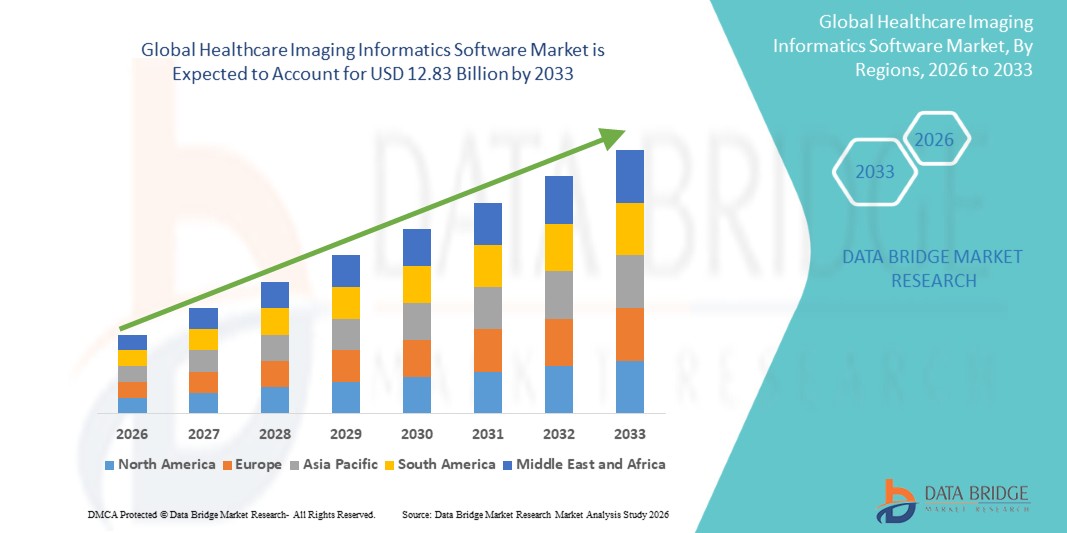
As per Data Bridge Market Research analysis The Healthcare Imaging Informatics Software Market was valued at USD 5.57 billion in 2025 and is projected to reach USD 12.83 billion by 2033, growing at a CAGR of 11.00% from 2026 to 2033. The market is witnessing steady growth driven by the increasing volume of medical imaging procedures, rising adoption of digital healthcare infrastructure, and growing demand for efficient image management, storage, and diagnostic workflow optimization across healthcare facilities.
The growing prevalence of chronic diseases, expanding use of advanced diagnostic imaging modalities, and increasing focus on integrated healthcare information systems are encouraging hospitals, diagnostic centers, and specialty clinics to invest in imaging informatics solutions. Picture Archiving and Communication Systems (PACS), Vendor Neutral Archives (VNA), Radiology Information Systems (RIS), and AI-enabled imaging analytics platforms are increasingly being deployed to enhance clinical decision-making, improve interoperability, streamline radiology workflows, and support data-driven patient care in both on-premise and cloud-based healthcare environments.
Key Market Trends & Insights
- North America dominated the Healthcare Imaging Informatics Software Market with the largest revenue share of 38.62% in 2025, supported by widespread adoption of digital imaging technologies, advanced healthcare IT infrastructure, and strong investments in diagnostic workflow optimization.
- The Software segment led the market with a 52.84% share in 2025, driven by to increasing adoption of Picture Archiving and Communication Systems (PACS), Vendor Neutral Archives (VNA), Radiology Information Systems (RIS), and enterprise imaging platforms across healthcare facilities.
- Asia-Pacific is expected to be the fastest-growing region at a CAGR of 8.1% from 2026 to 2033, fueled by expanding healthcare infrastructure, increasing diagnostic imaging volumes, and rapid healthcare digitalization across China, India, and Southeast Asia.
- Services are the fastest-growing component type, projected to register a CAGR of 8.9%, reflecting the surge in demand for implementation, integration, maintenance, consulting, and managed services.
- The Computed Tomography segment dominated the application type category with a 27.46% revenue share in 2025, led by the high volume of CT imaging procedures performed worldwide for trauma assessment, oncology diagnosis, cardiovascular evaluation, and emergency care.
- On-Premise accounted for 57.34% of the market, preferred by strong demand from large hospitals and healthcare networks requiring maximum control over patient data, system customization, and regulatory compliance.
- The Cloud-Based segment is the fastest-growing deployment mode category, with a CAGR of 8.4%, driven by increasing demand for scalable storage, remote accessibility, and cost-efficient infrastructure management
Market Size & Forecast
- Global Market Value (2025): USD 5.57 Billion
- Expected Market Value (2033): USD 12.83 Billion
- Forecast CAGR (2026–2033): 11.00%
- Leading Region in 2025: North America
- Fastest Growing Region: Asia Pacific
Report Scope and Healthcare Imaging Informatics Software Market Segmentation
|
Attributes |
Healthcare Imaging Informatics Software Key Market Insights |
|
Segments Covered |
|
|
Countries Covered |
North America · U.S. · Canada · Mexico Europe · Germany · France · U.K. · Netherlands · Switzerland · Belgium · Russia · Italy · Spain · Turkey · Rest of Europe Asia-Pacific · China · Japan · India · South Korea · Singapore · Malaysia · Australia · Thailand · Indonesia · Philippines · Rest of Asia-Pacific Middle East and Africa · Saudi Arabia · U.A.E. · South Africa · Egypt · Israel · Rest of Middle East and Africa South America · Brazil · Argentina · Rest of South America |
|
Key Market Players |
· GE HealthCare (U.S.) · Philips (Netherlands) · Siemens Healthineers AG (Germany) · FUJIFILM Healthcare Americas Corporation (U.S.) · AGFA HealthCare (Belgium) · Sectra AB (Sweden) · Merge Healthcare Incorporated (U.S.) · Intelerad Medical Systems Incorporated (Canada) · INFINITT Healthcare Co., Ltd. (South Korea) · Carestream Health (U.S.) · Novarad Corporation (U.S.) · RamSoft, Inc. (Canada) · Visage Imaging GmbH (Germany) · Esaote S.p.A. (Italy) · Dedalus S.p.A. (Italy) · CANON MEDICAL SYSTEMS CORPORATION (Japan) · Oracle Corporation (U.S.) · Medic Vision Imaging Solutions Ltd. (Israel) · PaxeraHealth Corp. (U.S.) · BridgeHead Software Ltd (U.K.) |
|
Market Opportunities |
· Growing adoption of enterprise imaging platforms that unify radiology, cardiology, pathology, and other imaging data · Expansion of cloud-based medical imaging infrastructure in emerging healthcare systems · Increasing integration of artificial intelligence into imaging workflows |
|
Value Added Data Infosets |
In addition to the insights on market scenarios such as market value, growth rate, segmentation, geographical coverage, and major players, the market reports curated by the Data Bridge Market Research also include in-depth expert analysis, patient epidemiology, pipeline analysis, pricing analysis, and regulatory framework. |
Healthcare Imaging Informatics Software Market Trends
Trend: Growing Adoption of Enterprise Imaging and AI-Driven Diagnostics
Healthcare providers are increasingly adopting enterprise imaging informatics platforms to centralize medical image management, improve clinical collaboration, and streamline diagnostic workflows across departments. The integration of artificial intelligence enables automated image analysis, prioritization of critical cases, and enhanced diagnostic accuracy while reducing reporting turnaround times. Hospitals and diagnostic networks are similarly leveraging advanced informatics solutions to support value-based care initiatives through standardized, data-driven clinical decision-making, while cloud technologies create interoperable environments that facilitate secure image sharing across healthcare ecosystems.
For instance, in March 2025, GE HealthCare expanded its AI-enabled imaging informatics portfolio to improve enterprise imaging workflow orchestration and diagnostic efficiency across multi-site healthcare systems.
Healthcare Imaging Informatics Software Market Dynamics
Key Market Driver: Growing Adoption of Digital Imaging and Interoperable Healthcare Systems
The rapid expansion of diagnostic imaging procedures and electronic health record integration has created substantial demand for advanced imaging informatics software that can manage image archives, clinical workflows, and cross-departmental data exchange in increasingly complex healthcare environments. Hospitals, imaging centers, and healthcare networks are deploying informatics platforms as a core component of their digital transformation strategies, reducing operational inefficiencies, accelerating clinical decision-making, and improving continuity of patient care across distributed healthcare systems.
For instance, in February 2025, Philips enhanced its enterprise imaging solutions to strengthen interoperability between imaging systems and hospital information platforms, supporting more integrated clinical workflows.
Key Restraint/Challenge: High Implementation Complexity and Data Integration Requirements
A significant restraint in the Healthcare Imaging Informatics Software Market is the complexity associated with integrating imaging platforms across diverse healthcare IT environments. Modern solutions must connect PACS, RIS, VNAs, EHR systems, and multiple imaging modalities, demanding substantial investment in deployment, customization, and ongoing system management. The total cost of ownership extends to software upgrades, cybersecurity measures, and interoperability compliance, making implementation challenging for smaller hospitals, outpatient facilities, and resource-constrained healthcare organizations.
For instance, in January 2025, several large healthcare providers undertaking enterprise imaging modernization projects reported extended deployment timelines due to complex legacy system integration requirements, reflecting the broader challenge of large-scale implementation.
Key Market Opportunity: Expansion of Cloud-Based and AI-Powered Imaging Analytics Platforms
The integration of artificial intelligence and cloud computing in imaging informatics presents a significant market opportunity. AI-enabled platforms can automate image interpretation support, provide real-time clinical insights, and facilitate large-scale analysis of imaging datasets for precision medicine initiatives. The development of cloud-native architectures and vendor-neutral data management solutions is further expanding accessibility to advanced imaging capabilities, opening growth opportunities across emerging healthcare markets in Asia-Pacific, Latin America, and the Middle East.
For instance, in April 2025, Oracle Health expanded cloud-based healthcare data and imaging management capabilities to support scalable enterprise imaging deployments and advanced analytics initiatives.
Healthcare Imaging Informatics Software Market Scope
The healthcare imaging informatics software market is segmented on the basis of component, application, deployment type, and end user.
- By Component
On the basis of component, the Healthcare Imaging Informatics Software Market is segmented into software, hardware, and services. The Software segment dominated the market with an estimated 52.84% share in 2025, owing to the increasing adoption of Picture Archiving and Communication Systems (PACS), Vendor Neutral Archives (VNA), Radiology Information Systems (RIS), and enterprise imaging platforms across healthcare facilities. Software solutions serve as the core infrastructure for image acquisition, storage, retrieval, sharing, and analysis. Growing demand for workflow automation and interoperability is accelerating software deployment across hospitals and diagnostic centers. The integration of artificial intelligence and advanced analytics is further enhancing diagnostic accuracy and operational efficiency. Healthcare providers are increasingly prioritizing software investments to support digital transformation initiatives. Continuous innovation and recurring upgrade requirements continue to strengthen the segment’s market leadership.
The Services segment is projected to register the fastest growth at a CAGR of 8.9% from 2026 to 2033, driven by rising demand for implementation, integration, maintenance, consulting, and managed services. Healthcare organizations increasingly require specialized expertise to deploy and optimize complex imaging informatics ecosystems. Growing migration toward cloud-based platforms is creating additional demand for support and managed service offerings. Regulatory compliance requirements and cybersecurity concerns are also increasing the need for professional service providers. Many healthcare institutions are outsourcing technical management functions to reduce operational burdens and improve system performance. The expansion of enterprise imaging projects globally is expected to further accelerate service adoption.
- By Application
On the basis of application, the Healthcare Imaging Informatics Software Market is segmented into digital radiography, ultrasound, magnetic resonance imaging, computed tomography, nuclear imaging, and mammography. The Computed Tomography (CT) segment dominated the market with an estimated 27.46% share in 2025 due to the high volume of CT imaging procedures performed worldwide for trauma assessment, oncology diagnosis, cardiovascular evaluation, and emergency care. CT imaging generates large datasets that require advanced informatics solutions for efficient storage, management, and interpretation. Healthcare providers increasingly rely on imaging informatics software to streamline CT workflow and reporting processes. The growing prevalence of chronic diseases and increasing demand for early diagnosis are supporting CT scan utilization globally. AI-powered image analysis tools are further enhancing the value of CT-related informatics platforms. Continuous technological advancements in multi-slice and high-resolution CT systems continue to drive segment dominance.
The Mammography segment is expected to witness the fastest growth at a CAGR of 9.2% from 2026 to 2033, driven by increasing breast cancer screening initiatives and growing awareness regarding early disease detection. Governments and healthcare organizations worldwide are expanding screening programs to improve diagnostic outcomes and reduce mortality rates. Imaging informatics software plays a critical role in managing large volumes of mammography images and supporting diagnostic interpretation. The adoption of digital breast tomosynthesis and AI-assisted mammography analysis is further accelerating demand. Increasing investments in women's healthcare infrastructure are supporting market expansion. Rising emphasis on preventive healthcare strategies is expected to sustain strong growth in this segment.
- By Deployment Type
On the basis of deployment type, the Healthcare Imaging Informatics Software Market is segmented into web-based, on-premise, and cloud-based. The On-Premise segment led the market with an estimated 57.34% share in 2025, driven by strong demand from large hospitals and healthcare networks requiring maximum control over patient data, system customization, and regulatory compliance. Many healthcare institutions continue to prefer on-premise environments due to concerns regarding data privacy and cybersecurity. These solutions provide high reliability, low latency, and direct integration with existing hospital infrastructure. Large imaging datasets can be managed internally without dependence on external service providers. Established healthcare facilities often possess the resources needed to maintain and upgrade on-premise systems effectively. Strong adoption among major healthcare providers continues to support this segment’s leading position.
The Cloud-Based segment is anticipated to register the fastest growth at a CAGR of 8.4% from 2026 to 2033, fueled by increasing demand for scalable storage, remote accessibility, and cost-efficient infrastructure management. Cloud platforms enable healthcare providers to share medical images across multiple locations and support collaborative clinical decision-making. The growing adoption of telehealth and remote diagnostics is further strengthening demand for cloud-based imaging solutions. Advances in cloud security and regulatory compliance frameworks are reducing barriers to adoption. Healthcare organizations are increasingly seeking flexible deployment models that minimize capital expenditure. Expanding digital health initiatives worldwide are expected to accelerate cloud platform implementation.
- By End User
On the basis of end user, the Healthcare Imaging Informatics Software Market is segmented into hospitals, specialized clinics, and others. The Hospitals segment dominated the market with an estimated 45.27% share in 2025, owing to the high concentration of diagnostic imaging procedures and extensive adoption of enterprise imaging systems. Hospitals manage large volumes of patient imaging data generated from multiple departments, including radiology, cardiology, oncology, and emergency medicine. Imaging informatics software enables centralized image management, workflow optimization, and improved clinical collaboration. Increasing investments in healthcare IT modernization are supporting widespread adoption across hospital networks. The integration of imaging data with electronic health records further enhances clinical efficiency and patient outcomes. Their large operational scale and continuous technology investments reinforce market leadership.
The Specialized Clinics segment is projected to experience the fastest growth at a CAGR of 8.7% from 2026 to 2033, driven by increasing demand for outpatient diagnostic services and specialized medical imaging procedures. These facilities are rapidly adopting advanced imaging informatics platforms to improve productivity and deliver faster diagnostic results. Growing patient preference for cost-effective outpatient care is supporting the expansion of specialized clinics globally. Cloud-based solutions are enabling clinics to access sophisticated imaging capabilities without major infrastructure investments. Rising prevalence of chronic diseases and increased screening activities are generating higher imaging volumes. The need for streamlined workflows and enhanced patient care is expected to accelerate adoption throughout the forecast period.
Healthcare Imaging Informatics Software Market Regional Analysis
North America dominated the Healthcare Imaging Informatics Software Market with the largest revenue share of 38.62% in 2025, supported by widespread adoption of digital imaging technologies, advanced healthcare IT infrastructure, and strong investments in diagnostic workflow optimization. The region also benefits from strong investments in enterprise imaging platforms, high implementation of electronic health records, and growing use of AI-enabled imaging analytics across hospitals, diagnostic centers, and integrated healthcare networks. Increasing focus on interoperability, clinical workflow optimization, and value-based healthcare delivery continues to strengthen North America’s leadership position in the global market.
U.S. Healthcare Imaging Informatics Software Market Insight
The U.S. healthcare imaging informatics software market is witnessing strong growth due to rising investments in healthcare digitalization, enterprise imaging platforms, and AI-powered diagnostic technologies. The country’s advanced healthcare infrastructure, along with increasing adoption of cloud-based imaging solutions and interoperable health information systems, is driving demand across hospitals, diagnostic centers, and specialty care facilities. In addition, growing emphasis on improving clinical workflow efficiency and enhancing diagnostic accuracy is accelerating imaging informatics software adoption across healthcare providers and integrated delivery networks.
Europe Healthcare Imaging Informatics Software Market Insight
The Europe healthcare imaging informatics software market remains a major contributor to global revenue, driven by strong healthcare IT investments, technological innovation, and high demand for advanced imaging management solutions. The widespread use of enterprise imaging platforms, PACS, and AI-enabled diagnostic tools is supporting market expansion across the region. Increasing investments in digital healthcare transformation initiatives, coupled with stringent data management regulations and a highly developed healthcare ecosystem, continue to enhance the adoption of imaging informatics software throughout Europe.
U.K. Healthcare Imaging Informatics Software Market Insight
The U.K. healthcare imaging informatics software market is experiencing steady growth, supported by rising adoption of digital imaging technologies, healthcare modernization programs, and AI-assisted diagnostic solutions. Increasing investments in advanced imaging infrastructure and growing demand for efficient, data-driven clinical workflows are contributing to market growth. Furthermore, integration of cloud computing, artificial intelligence, and interoperability technologies is improving imaging data management and diagnostic efficiency, positioning the U.K. as a key innovation hub in the healthcare imaging informatics software industry.
Germany Healthcare Imaging Informatics Software Market Insight
The Germany healthcare imaging informatics software market is expanding steadily due to the country’s advanced healthcare system, strong medical technology sector, and increasing adoption of next-generation imaging management solutions. Hospitals, diagnostic centers, and research institutions are increasingly utilizing imaging informatics software for image archiving, workflow optimization, and clinical decision support activities. Continuous advancements in AI-enabled diagnostics, cloud integration, and interoperability technologies, along with strong government focus on healthcare innovation and efficiency, are further driving market growth in Germany.
Asia-Pacific Healthcare Imaging Informatics Software Market Insight
The Asia-Pacific healthcare imaging informatics software market is expected to witness rapid growth, driven by increasing healthcare expenditure, expanding diagnostic imaging infrastructure, and rising investments in healthcare IT systems across countries such as China, India, and Japan. Growing awareness regarding early disease detection, rising adoption of advanced imaging technologies, and increasing demand for scalable and cost-effective healthcare solutions are supporting regional market expansion. In addition, the growing presence of digital health initiatives and medical research activities is accelerating imaging informatics software adoption across healthcare and academic sectors.
Japan Healthcare Imaging Informatics Software Market Insight
The Japan healthcare imaging informatics software market is witnessing consistent growth due to rising investments in healthcare digitalization, diagnostic innovation, and advanced medical imaging technologies. Healthcare providers, research institutes, and diagnostic centers are increasingly adopting sophisticated imaging informatics platforms for image management, workflow enhancement, and clinical decision support purposes. Moreover, increasing integration of artificial intelligence and cloud-based technologies and the country’s focus on efficient and high-quality healthcare delivery are further contributing to market growth.
China Healthcare Imaging Informatics Software Market Insight
The China healthcare imaging informatics software market is growing rapidly, driven by increasing healthcare modernization, expanding medical infrastructure, and rising government focus on healthcare digitization and diagnostic efficiency. Growing adoption of AI-enabled imaging analytics and cloud-based informatics platforms across hospitals, diagnostic centers, and healthcare networks is significantly boosting market demand. In addition, rising investments in healthcare IT, increasing awareness regarding early diagnosis, and rapid technological advancements are positioning China as one of the fastest-growing markets for healthcare imaging informatics software globally.
Healthcare Imaging Informatics Software Market Share
The healthcare imaging informatics software industry is primarily led by well-established companies, including:
- GE HealthCare (U.S.)
- Philips (Netherlands)
- Siemens Healthineers AG (Germany)
- FUJIFILM Healthcare Americas Corporation (U.S.)
- AGFA HealthCare (Belgium)
- Sectra AB (Sweden)
- Merge Healthcare Incorporated (U.S.)
- Intelerad Medical Systems Incorporated (Canada)
- INFINITT Healthcare Co., Ltd. (South Korea)
- Carestream Health (U.S.)
- Novarad Corporation (U.S.)
- RamSoft, Inc. (Canada)
- Visage Imaging GmbH (Germany)
- Esaote S.p.A. (Italy)
- Dedalus S.p.A. (Italy)
- CANON MEDICAL SYSTEMS CORPORATION (Japan)
- Oracle Corporation (U.S.)
- Medic Vision Imaging Solutions Ltd. (Israel)
- PaxeraHealth Corp. (U.S.)
- BridgeHead Software Ltd (U.K.)
Latest Developments in Healthcare Imaging Informatics Software Market
- In March 2025, GE HealthCare announced the launch of its Genesis portfolio, a new cloud-based enterprise imaging software-as-a-service (SaaS) suite designed to improve healthcare imaging workflows and accelerate digital transformation. The portfolio includes cloud-enabled edge, storage, vendor-neutral archive (VNA), and data migration capabilities, enabling healthcare organizations to securely manage, store, and access medical imaging data while improving interoperability and operational efficiency across enterprise imaging environments
- In September 2024, Sectra announced a province-wide agreement to deploy its Sectra One Cloud enterprise imaging platform across more than 150 healthcare sites in Québec, Canada, supporting radiology, breast imaging, and orthopaedics. The cloud-based deployment enables secure image sharing, workflow optimization, and improved collaboration across public hospitals, demonstrating the growing adoption of cloud enterprise imaging informatics at large healthcare networks
- In March 2024, Sectra announced that a multi-site U.S. university health network selected its Sectra One Cloud subscription service to manage increasing imaging volumes and strengthen cybersecurity. The fully managed SaaS solution provides enterprise imaging infrastructure, continuous monitoring, software upgrades, and secure access across more than ten hospitals, highlighting the industry's shift toward cloud-based imaging informatics platforms
- In November 2023, FUJIFILM Healthcare Americas showcased enhanced cloud-based Synapse® Enterprise Imaging solutions at the RSNA Annual Meeting, introducing new workflow, integration, and patient engagement capabilities. The updated portfolio strengthens enterprise-wide image management, improves diagnostic workflows, and supports healthcare organizations with scalable imaging informatics solutions across multiple clinical departments
- In April 2023, FUJIFILM Healthcare Americas announced the debut of Synapse Pathology at the HIMSS 2023 Annual Meeting, expanding its enterprise imaging informatics portfolio into digital pathology. The vendor-neutral pathology PACS solution enables centralized management of pathology images and data across multiple healthcare sites, reinforcing the industry's movement toward integrated, enterprise-wide imaging informatics platforms

- Interactive Data Analysis Dashboard
- Company Analysis Dashboard for high growth potential opportunities
- Research Analyst Access for customization & queries
- Competitor Analysis with Interactive dashboard
- Latest News, Updates & Trend analysis
- Harness the Power of Benchmark Analysis for Comprehensive Competitor Tracking
Data collection and base year analysis are done using data collection modules with large sample sizes. The stage includes obtaining market information or related data through various sources and strategies. It includes examining and planning all the data acquired from the past in advance. It likewise envelops the examination of information inconsistencies seen across different information sources. The market data is analysed and estimated using market statistical and coherent models. Also, market share analysis and key trend analysis are the major success factors in the market report. To know more, please request an analyst call or drop down your inquiry.
The key research methodology used by DBMR research team is data triangulation which involves data mining, analysis of the impact of data variables on the market and primary (industry expert) validation. Data models include Vendor Positioning Grid, Market Time Line Analysis, Market Overview and Guide, Company Positioning Grid, Patent Analysis, Pricing Analysis, Company Market Share Analysis, Standards of Measurement, Global versus Regional and Vendor Share Analysis. To know more about the research methodology, drop in an inquiry to speak to our industry experts.
Data Bridge Market Research is a leader in advanced formative research. We take pride in servicing our existing and new customers with data and analysis that match and suits their goal. The report can be customized to include price trend analysis of target brands understanding the market for additional countries (ask for the list of countries), clinical trial results data, literature review, refurbished market and product base analysis. Market analysis of target competitors can be analyzed from technology-based analysis to market portfolio strategies. We can add as many competitors that you require data about in the format and data style you are looking for. Our team of analysts can also provide you data in crude raw excel files pivot tables (Fact book) or can assist you in creating presentations from the data sets available in the report.













