


What is the Healthcare Personal Protective Equipment Market Size and Growth Rate?
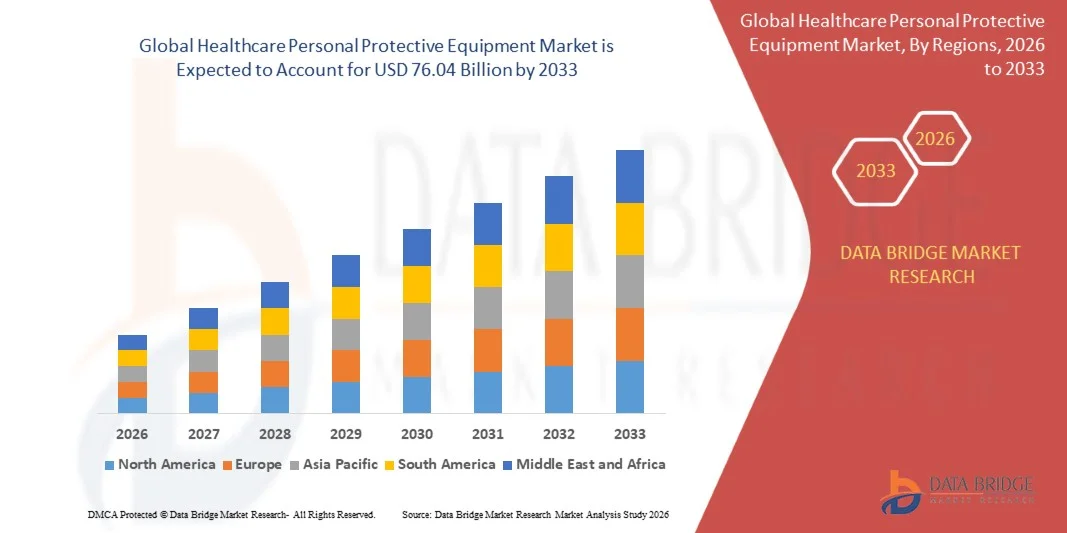
- As per Data Bridge Market Research analysis, the healthcare personal protective equipment market was valued at USD 36.39 billion in 2025 and is projected to reach USD 76.04 billion by 2033, growing at a CAGR of 9.65% from 2026 to 2033.
- The market is experiencing consistent growth driven by increasing awareness of infection prevention, rising healthcare-associated infections, stringent occupational safety regulations, and expanding demand for protective equipment across hospitals, clinics, laboratories, and home healthcare settings.
- The increasing prevalence of infectious diseases globally, combined with stricter healthcare worker safety regulations and greater emphasis on infection-control practices, is compelling healthcare facilities to strengthen PPE procurement and safety protocols. Disposable gloves, masks, protective gowns, and other specialized equipment are increasingly adopted across healthcare settings, offering reliable protection against infectious agents and workplace hazards.
Market Size & Forecast
- Global Market Value (2025): USD 36.39 Billion
- Expected Market Value (2033): USD 76.04 Billion
- Forecast CAGR (2026–2033): 9.65%
- Leading Region in 2025: North America
- Fastest Growing Region: Asia Pacific
What are the Major Takeaways of the Healthcare Personal Protective Equipment Market?
- North America dominated the healthcare personal protective equipment market with the largest revenue share of 33.30% in 2025, supported by stringent healthcare safety regulations, advanced healthcare infrastructure, high healthcare expenditure, and strong demand for protective equipment.
- Asia-Pacific is expected to be the fastest-growing region at a CAGR of 11.8% from 2026 to 2033, fueled by expanding healthcare access, rising patient populations, increased government healthcare spending, and growing adoption of PPE across hospitals, clinics, and home healthcare services.
- The hand protection segment led the market with a 46.6% share in 2025, driven by the extensive use of medical gloves across hospitals, clinics, laboratories, and other healthcare settings.
- Respiratory protection are the fastest-growing product type, projected to register a CAGR of 7.8%, reflecting the surge in concerns regarding airborne infectious diseases and occupational exposure among healthcare workers.
- The polypropylene segment dominated the material type category with a 35% revenue share in 2025, led by its widespread use in disposable medical protective products.
- Standard protection PPE accounted for 40% of the market share in 2025, preferred by healthcare workers for routine patient care, general clinical procedures, and everyday infection-control activities.
- The high-barrier protection PPE segment is the fastest-growing protection level category, with a CAGR of 9.5%, driven by increasing demand for enhanced protection during high-risk medical procedures and infectious disease management.
Report Scope and Healthcare Personal Protective Equipment Market Segmentation
|
Attributes |
Healthcare Personal Protective Equipment Key Market Insights |
|
Segments Covered |
|
|
Countries Covered |
North America
Europe
Asia-Pacific
Middle East and Africa
South America
|
|
Key Market Players |
|
|
Market Opportunities |
|
|
Value Added Data Infosets |
In addition to the insights on market scenarios such as market value, growth rate, segmentation, geographical coverage, and major players, the market reports curated by the Data Bridge Market Research also include import export analysis, production capacity overview, production consumption analysis, price trend analysis, climate change scenario, supply chain analysis, value chain analysis, raw material/consumables overview, vendor selection criteria, PESTLE Analysis, Porter Analysis, and regulatory framework. |
What is the Key Trend in the Healthcare Personal Protective Equipment Market?
- Healthcare providers are increasingly adopting sustainable and reusable PPE to reduce the environmental impact associated with large volumes of disposable gloves, gowns, masks, and other single-use protective equipment.
- For instance, in July 2024, the U.S. healthcare sector increasingly adopted reusable PPE, with the U.S. Department of Health and Human Services, states, and hospital systems developing initiatives to replace single-use gowns and other protective equipment with reusable alternatives. Virginia’s Inova Health System also developed a customized reusable gown using feedback from frontline healthcare workers.
- Manufacturers are increasingly developing reusable, washable, antimicrobial, and skin-friendly protective products that combine infection-control performance with improved comfort and environmental sustainability.
- Smart PPE technologies incorporating sensors and monitoring capabilities are also emerging, enabling healthcare organizations to monitor contamination exposure, hygiene conditions, and worker safety in real time.
- Healthcare facilities are also emphasizing better-fitting and ergonomic PPE designs, as improved comfort can support compliance during extended procedures and reduce the physical burden on healthcare workers.
- For instance, in February 2022, WHO called for greater use of reusable and recyclable PPE after estimating that around 87,000 tonnes of PPE had been ordered through the UN system up to November 2021, most of which was expected to become waste. The organization recommended investment in reusable and recyclable protective equipment to reduce healthcare waste
- As healthcare systems increasingly balance infection prevention with environmental sustainability, advanced reusable, antimicrobial, and smart PPE solutions are expected to gain greater adoption, reinforcing product innovation as a key trend in the healthcare PPE market.
What are the Key Drivers of the Healthcare Personal Protective Equipment Market?
- The increasing prevalence of healthcare-associated infections (HAIs) has significantly increased demand for PPE capable of protecting healthcare workers and patients from infectious pathogens during routine and high-risk medical procedures.
- For instance, in November 2024, WHO reported that healthcare-associated infections (HAIs) remain a daily threat in hospitals and clinics, with an estimated 136 million antibiotic-resistant HAIs occurring globally each year. WHO emphasized stronger infection-prevention and control measures to protect patients and healthcare workers, supporting continued demand for PPE
- Hospitals, diagnostic laboratories, emergency-care facilities, and outpatient centers are strengthening infection-control protocols and PPE procurement programs to reduce occupational exposure and improve healthcare worker safety.
- For instance, in December 2024, WHO reiterated that healthcare facilities can amplify infectious-disease outbreaks and recommended continued access to PPE for healthcare providers, alongside infection-prevention and control measures and preparedness for future disease surges.
- With healthcare systems increasingly prioritizing infection prevention, occupational safety, and preparedness for infectious-disease outbreaks, demand for gloves, masks, gowns, respirators, face shields, and other protective equipment is expected to remain strong, supporting continued expansion of the healthcare PPE market.
Which Factors are Challenging the Growth of the Healthcare Personal Protective Equipment Market?
- High procurement costs and price sensitivity among healthcare providers can restrict the adoption of premium, technologically advanced, and sustainable PPE products, particularly in cost-controlled public healthcare systems.
- For instance, in November 2024, the U.K. Department of Health and Social Care reported that approximately 432,700 pallets of unusable PPE had been disposed of between November 2023 and September 2024, while storing unsuitable PPE was costing around USD 270,316.00 per week.
- Smaller hospitals and healthcare facilities in emerging economies may face limited procurement budgets, supply-chain constraints, and inadequate distribution infrastructure, making consistent access to quality PPE more difficult.
- The extensive reliance on disposable PPE also creates waste-management and sustainability challenges, with WHO reporting that healthcare activities generate substantial hazardous waste and that only 61% of hospitals had basic healthcare-waste services in 2021.
- For instance in October 2024, the U.S. CDC highlighted that healthcare facilities may face PPE shortages when demand increases or supply chains are disrupted, requiring hospitals to implement conservation strategies for masks, respirators, gloves, and other PPE
- These cost, supply-chain, and waste-management challenges continue to restrict adoption in price-sensitive markets, potentially slowing penetration of advanced PPE technologies despite sustained demand for healthcare worker protection and infection control.
How is the Healthcare Personal Protective Equipment Market Segmented?
The healthcare personal protective equipment market is segmented on the basis of product, material type, protection level, and end-use.
- By Product
On the basis of product, the healthcare personal protective equipment market is segmented into protective clothing, respiratory protection, face protection, eye protection, hand protection, and others. The hand protection segment dominated the market with a 46.6% share in 2025, owing to the extensive use of medical gloves across hospitals, clinics, laboratories, and other healthcare settings. Gloves are essential for preventing cross-contamination between healthcare workers and patients during examinations, surgeries, and routine medical procedures. The frequent replacement of disposable gloves also creates recurring demand and supports segment revenues. Increasing awareness regarding hand hygiene and infection prevention is further strengthening adoption. Nitrile and latex gloves are widely used because of their flexibility, barrier properties, and suitability for medical applications.
The respiratory protection segment is projected to register the fastest growth at a CAGR of 7.8% from 2026 to 2033, driven by increasing concerns regarding airborne infectious diseases and occupational exposure among healthcare workers. Respirators, surgical masks, and other respiratory protection products provide an important barrier against infectious particles and respiratory pathogens. Growing emphasis on infection prevention and control programs is encouraging healthcare facilities to maintain adequate respiratory PPE inventories. The emergence of infectious disease outbreaks has also highlighted the importance of respiratory protection preparedness. Improvements in filtration efficiency, breathability, fit, and comfort are supporting the development of advanced respiratory PPE.
- By Material Type
On the basis of material type, the healthcare personal protective equipment market is segmented into polypropylene, polyethylene, nitrile, latex, vinyl, neoprene, polyester, and other advanced materials. The polypropylene segment is expected to dominated the market with 35% share in 2025, supported by its widespread use in disposable medical protective products. Polypropylene offers a lightweight structure, breathability, chemical resistance, and suitability for nonwoven medical applications. It is extensively used in surgical gowns, isolation gowns, masks, coveralls, and other protective clothing. Its relatively low production cost also makes it suitable for high-volume healthcare applications. The material can be engineered to provide different levels of filtration and fluid resistance according to clinical requirements.
The nitrile segment is projected to register the fastest growth at CAGR of 9% during the forecast period, supported by increasing preference for nitrile medical gloves over latex alternatives. Nitrile provides strong resistance to punctures, chemicals, and biological contaminants, making it suitable for healthcare workers handling infectious materials and hazardous substances. The material is also latex-free, reducing concerns associated with natural rubber latex allergies among healthcare workers and patients. Growing demand for examination and surgical gloves is therefore supporting nitrile consumption. Improvements in nitrile glove manufacturing are enabling thinner designs with better tactile sensitivity and flexibility.
- By Protection Level
On the basis of protection level, the healthcare personal protective equipment market is segmented into standard protection PPE, fluid-resistant PPE, high-barrier protection PPE, and chemical & biohazard protection PPE. The standard protection PPE segment is expected to dominated the market with 40% share in 2025, as these products are extensively used during routine patient examinations, general clinical care, and non-invasive healthcare procedures. Standard PPE commonly includes gloves, masks, gowns, and other protective products used during everyday healthcare activities. Their broad applicability creates consistent demand across hospitals, clinics, laboratories, and outpatient facilities. High consumption volumes and frequent replacement requirements further support segment revenues. Healthcare facilities require these products even when there are no major infectious disease outbreaks.
The high-barrier protection PPE segment is projected to register the fastest growth at CAGR of 9.5% during the forecast period, driven by increasing demand for enhanced protection during high-risk medical procedures and infectious disease management. High-barrier gowns, coveralls, gloves, and other products provide stronger resistance against fluids, pathogens, and occupational hazards. Their use is particularly important in intensive care, surgery, emergency treatment, and infectious disease units. Greater awareness of healthcare-associated infections is encouraging facilities to adopt higher-performance protective equipment where exposure risks are elevated. Improvements in barrier fabrics and multilayer protective materials are also enhancing product performance. Government preparedness programs and hospital infection-control protocols are supporting demand for high-level protection.
- By End-Use
On the basis of end-use, the healthcare personal protective equipment market is segmented into hospitals, home healthcare, outpatient and primary care facilities, and others. The hospitals segment dominated the market with a 55.9% share in 2025, supported by high patient volumes, extensive medical procedures, and stringent infection-control requirements. Hospitals consume large quantities of gloves, masks, gowns, eye protection, and other PPE across emergency departments, operating rooms, intensive care units, and general wards. The need to protect healthcare workers from infectious diseases and occupational hazards creates continuous PPE demand. Frequent replacement of disposable products further contributes to recurring procurement. Hospital infection-prevention programs also require healthcare workers to follow defined PPE protocols for different clinical activities.
The home healthcare segment is projected to register the fastest growth at a CAGR of 10.4% from 2026 to 2033, supported by the increasing shift toward home-based medical care and the growing number of patients receiving treatment outside traditional hospitals. Healthcare professionals providing nursing, rehabilitation, chronic disease management, and other services in patients' homes require appropriate PPE to prevent infection transmission. The expansion of elderly care and long-term disease management is increasing the number of home-based healthcare interactions. Portable, lightweight, comfortable, and disposable PPE products are particularly suitable for these environments. Greater awareness of infection prevention among caregivers and family members is also encouraging PPE use in home settings. Growth in decentralized healthcare delivery is further expanding demand for PPE outside hospitals.
Which Region Holds the Largest Share of the Healthcare Personal Protective Equipment Market?
- North America dominated the healthcare personal protective equipment market with the largest revenue share of 33.30% in 2025, supported by stringent healthcare safety regulations, advanced healthcare infrastructure, high healthcare expenditure, and strong demand for protective equipment
- The region also benefits from increasing awareness of infection prevention, established procurement systems, and continued adoption of gloves, isolation gowns, masks, and other protective equipment across hospitals and healthcare settings. Strong regulatory oversight and ongoing healthcare-sector investment continue to strengthen North America’s leadership position in the global market.
U.S. Healthcare Personal Protective Equipment Market Insight
The U.S. healthcare personal protective equipment market is witnessing strong growth due to rising demand for infection-control products, stringent healthcare safety standards, and continued investments in healthcare infrastructure. The country’s well-established healthcare system, along with increasing adoption of advanced gloves, protective clothing, respiratory protection, and other PPE solutions, is driving demand across hospitals, outpatient facilities, and home healthcare settings. In addition, growing emphasis on healthcare worker safety and preparedness for infectious disease outbreaks is accelerating PPE adoption across healthcare facilities.
Asia-Pacific Healthcare Personal Protective Equipment Market Insight
The Asia-Pacific healthcare personal protective equipment market is expected to witness rapid growth, driven by expanding healthcare infrastructure, increasing awareness of infection prevention, and rising investments in medical facilities across countries such as China, India, and Japan. Growing demand for protective clothing, respiratory protection, gloves, and other PPE products is supporting regional market expansion. In addition, increasing healthcare expenditure, strengthening infection-control practices, and growing preparedness for infectious disease outbreaks are accelerating PPE adoption across hospitals and other healthcare settings.
Japan Healthcare Personal Protective Equipment Market Insight
The Japan healthcare personal protective equipment market is witnessing consistent growth due to rising investments in healthcare infrastructure, advanced infection-control practices, and increasing demand for high-quality protective equipment. Hospitals, clinics, laboratories, and healthcare professionals are increasingly adopting gloves, masks, protective clothing, and other PPE solutions to improve workplace safety and reduce infection risks. Moreover, the country’s aging population, focus on healthcare quality, and continued emphasis on efficient infection-prevention measures are further contributing to market growth.
China Healthcare Personal Protective Equipment Market Insight
The China healthcare personal protective equipment market is growing rapidly, driven by expanding healthcare infrastructure, increasing healthcare expenditure, and rising government focus on infection prevention and healthcare worker safety. Growing adoption of protective clothing, respiratory protection, gloves, and other PPE products across hospitals and medical facilities is significantly boosting market demand. In addition, rising investments in healthcare manufacturing, increasing awareness regarding occupational safety, and improvements in domestic PPE production capabilities are positioning China as one of the fastest-growing markets for healthcare personal protective equipment globally.
U.K. Healthcare Personal Protective Equipment Market Insight
The U.K. healthcare personal protective equipment market is experiencing steady growth, supported by rising adoption of infection-control solutions across hospitals, clinics, and other healthcare facilities. Increasing investments in healthcare preparedness and growing demand for reliable protective equipment are contributing to market growth. Furthermore, greater emphasis on healthcare worker safety, sustainable PPE solutions, and effective infection-prevention practices is improving PPE utilization, positioning the U.K. as an important market for healthcare personal protective equipment.
Germany Healthcare Personal Protective Equipment Market Insight
The Germany healthcare personal protective equipment market is expanding steadily due to the country’s strong healthcare infrastructure, advanced medical capabilities, and increasing adoption of high-quality protective equipment. Hospitals, healthcare institutions, laboratories, and medical professionals are increasingly utilizing PPE for infection prevention, occupational safety, and patient-care activities. Continuous advancements in protective materials, growing focus on sustainable healthcare practices, and strong regulatory emphasis on workplace and healthcare safety are further driving market growth in Germany.
Which are the Top Companies in Healthcare Personal Protective Equipment Market?
The healthcare personal protective equipment industry is primarily led by well-established companies, including:
- 3M (U.S.)
- ANSELL LTD (Australia)
- DuPont. (U.S.)
- Honeywell International Inc. (U.S.)
- Kimberly-Clark Corporation (U.S.)
- Cardinal Health, Inc. (U.S.)
- Medline Industries, LP (U.S.)
- Mölnlycke AB (Sweden)
- PAUL HARTMANN AG (Germany)
- DeRoyal Industries, Inc. (U.S.)
- B. Braun SE (Germany)
- TIDI Products, LLC (U.S.)
- AlphaProTech (U.S.)
- Winner Medical Co., Ltd. (China)
- Lakeland Industries, Inc. (U.S.)
- Top Glove Corporation Bhd (Malaysia)
- Owens & Minor, Inc. (U.S.)
- AMD Medicom Inc. (Canada)
- Dynarex Corporation (U.S.)
- Kossan Rubber Industries Bhd (Malaysia)
What are Latest Developments in Healthcare Personal Protective Equipment Market?
- In April 2025, researchers and industry partners launched an exhibition showcasing a newly designed reusable healthcare gown, developed using feedback from nursing professionals and supported by the Arts and Humanities Research Council, Anze Ltd., and Revolution-Zero. The initiative focused on creating a more fit-for-purpose and reusable alternative to conventional disposable gowns, while also exploring PPE repurposing and sustainability. The development highlights the healthcare sector’s growing focus on reusable protective clothing and reducing PPE waste.
- In July 2024, healthcare systems in the U.S. increasingly adopted reusable personal protective equipment, with the U.S. Department of Health and Human Services, states, and hospitals supporting the transition from single-use gowns and other protective products. Virginia’s Inova Health System worked with a sports apparel manufacturer to develop a customized reusable gown based on frontline healthcare-worker feedback. The initiative demonstrated how reusable PPE can support sustainability while improving supply-chain resilience in healthcare settings.
- In May 2023, Revolution-Zero launched a reusable PPE decontamination hub in association with Royal Cornwall Hospital Trust, providing infrastructure for laundering reusable gowns and medical textiles. The initiative was designed to provide a more sustainable and affordable approach to managing reusable PPE within healthcare systems. Healthcare workers from several NHS trusts also participated in trials of reusable isolation gowns, helping refine the products for clinical use. This development reflects increasing efforts to establish circular and reusable PPE systems within healthcare.
- In February 2022, WHO highlighted the growing environmental impact of PPE waste following the COVID-19 response, reporting that large volumes of PPE had been procured globally and calling for greater use of reusable and recyclable protective equipment. The development increased attention toward sustainable PPE procurement and waste management in healthcare systems. It also encouraged manufacturers and healthcare organizations to consider environmental performance alongside infection-control requirements when selecting protective equipment
- In June 2021, Cambridge’s Addenbrooke’s Hospital upgraded healthcare-worker respiratory protection from fluid-resistant surgical masks to FFP3 respirators on COVID-19 wards, following evidence that staff remained at risk of infection. The hospital reported a substantial reduction in hospital-acquired COVID-19 infections among healthcare workers after the change. The development demonstrated the increasing adoption of higher-performance respiratory PPE when conventional protection is insufficient for specific infectious-disease risks.

- Interactive Data Analysis Dashboard
- Company Analysis Dashboard for high growth potential opportunities
- Research Analyst Access for customization & queries
- Competitor Analysis with Interactive dashboard
- Latest News, Updates & Trend analysis
- Harness the Power of Benchmark Analysis for Comprehensive Competitor Tracking
Global Healthcare Personal Protective Equipment Market, Supply Chain Analysis and Ecosystem Framework
To support market growth and help clients navigate the impact of geopolitical shifts, DBMR has integrated in-depth supply chain analysis into its Global Healthcare Personal Protective Equipment Market research reports. This addition empowers clients to respond effectively to global changes affecting their industries. The supply chain analysis section includes detailed insights such as Global Healthcare Personal Protective Equipment Market consumption and production by country, price trend analysis, the impact of tariffs and geopolitical developments, and import and export trends by country and HSN code. It also highlights major suppliers with data on production capacity and company profiles, as well as key importers and exporters. In addition to research, DBMR offers specialized supply chain consulting services backed by over a decade of experience, providing solutions like supplier discovery, supplier risk assessment, price trend analysis, impact evaluation of inflation and trade route changes, and comprehensive market trend analysis.
Data collection and base year analysis are done using data collection modules with large sample sizes. The stage includes obtaining market information or related data through various sources and strategies. It includes examining and planning all the data acquired from the past in advance. It likewise envelops the examination of information inconsistencies seen across different information sources. The market data is analysed and estimated using market statistical and coherent models. Also, market share analysis and key trend analysis are the major success factors in the market report. To know more, please request an analyst call or drop down your inquiry.
The key research methodology used by DBMR research team is data triangulation which involves data mining, analysis of the impact of data variables on the market and primary (industry expert) validation. Data models include Vendor Positioning Grid, Market Time Line Analysis, Market Overview and Guide, Company Positioning Grid, Patent Analysis, Pricing Analysis, Company Market Share Analysis, Standards of Measurement, Global versus Regional and Vendor Share Analysis. To know more about the research methodology, drop in an inquiry to speak to our industry experts.
Data Bridge Market Research is a leader in advanced formative research. We take pride in servicing our existing and new customers with data and analysis that match and suits their goal. The report can be customized to include price trend analysis of target brands understanding the market for additional countries (ask for the list of countries), clinical trial results data, literature review, refurbished market and product base analysis. Market analysis of target competitors can be analyzed from technology-based analysis to market portfolio strategies. We can add as many competitors that you require data about in the format and data style you are looking for. Our team of analysts can also provide you data in crude raw excel files pivot tables (Fact book) or can assist you in creating presentations from the data sets available in the report.













