


Healthcare Transportation Service Market Size
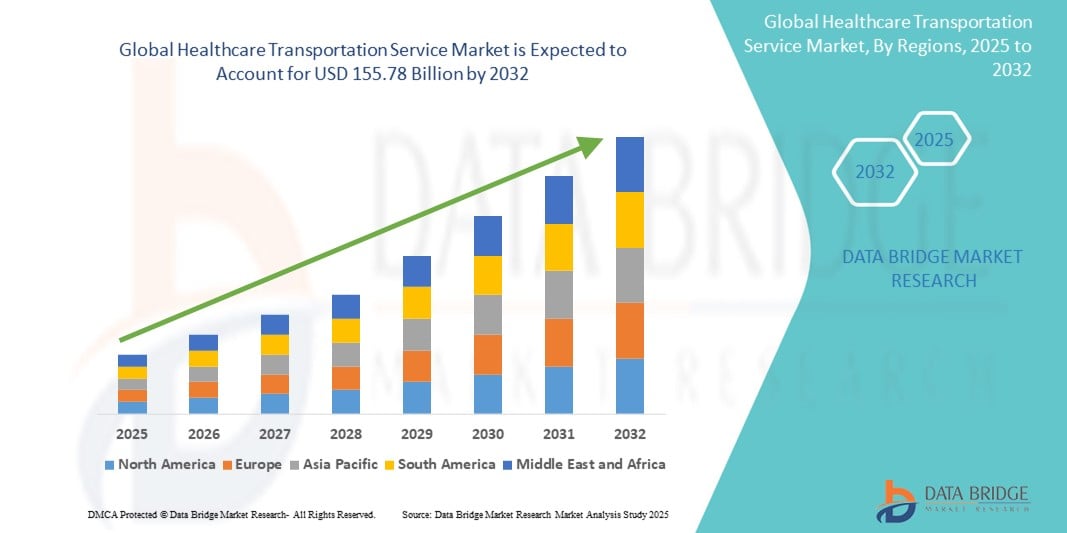
- The global healthcare transportation service market was valued at USD 93.21 billion in 2024 and is expected to reach USD 155.78 billion by 2032
- During the forecast period of 2025 to 2032 the market is likely to grow at a CAGR of 6.60%, primarily driven by the focus on value-based care and patient-centered approach
- This growth is driven by factors such as delivering healthcare services in the comfort of patients' homes
Healthcare Transportation Service Market Analysis
- Healthcare transportation services are vital for ensuring the timely and safe movement of patients, medical equipment, organs, and specimens between healthcare facilities. These services are essential for supporting emergency responses, inter-facility transfers, and home healthcare logistics
- The demand for healthcare transportation is driven by the rising incidence of chronic diseases, increasing geriatric population, and the growing need for accessible and efficient healthcare delivery systems. Emergency medical services (EMS) and non-emergency medical transportation (NEMT) constitute the majority share of the global demand
- The North America region leads the market due to its well-established healthcare infrastructure, strong insurance coverage, and a robust network of public and private healthcare transportation providers
- For instance, the U.S. has seen a steady increase in NEMT utilization, especially among elderly and mobility-impaired populations, with both public programs and private providers expanding services to meet demand
- Globally, healthcare transportation services are considered one of the most critical support systems in the healthcare ecosystem, next to diagnostic services, playing a central role in improving patient outcomes and operational efficiency in healthcare delivery
Report Scope and Healthcare Transportation Service Market Segmentation
|
Attributes |
Healthcare Transportation Service Key Market Insights |
|
Segments Covered |
|
|
Countries Covered |
North America
Europe
Asia-Pacific
Middle East and Africa
South America
|
|
Key Market Players |
|
|
Market Opportunities |
|
|
Value Added Data Infosets |
In addition to the insights on market scenarios such as market value, growth rate, segmentation, geographical coverage, and major players, the market reports curated by the Data Bridge Market Research also include import export analysis, production capacity overview, production consumption analysis, price trend analysis, climate change scenario, supply chain analysis, value chain analysis, raw material/consumables overview, vendor selection criteria, PESTLE Analysis, Porter Analysis, and regulatory framework. |
Healthcare Transportation Service Market Trends
“Adoption of AI and IoT for Smart Healthcare Logistics”
- A key trend shaping the global healthcare transportation service market is the integration of Artificial Intelligence (AI) and Internet of Things (IoT) technologies to optimize logistics and fleet management
- These technologies enhance real-time tracking, predictive maintenance, and route optimization, ensuring faster, safer, and more efficient medical transport services
- For instance, smart ambulances equipped with IoT-enabled devices and AI-powered dashboards can monitor patient vitals during transit, while optimizing routes to reduce response time in critical situations
- AI also enables predictive analytics for better resource allocation and scheduling in non-emergency medical transportation, improving access for patients with chronic illnesses or mobility challenges
- This digital transformation is elevating service efficiency, reducing operational costs, and improving patient care delivery, making smart logistics a driving force in the future of healthcare transportation
Healthcare Transportation Service Market Dynamics
Driver
“Rising Demand Due to Growing Geriatric Population and Chronic Illnesses”
- The increasing global geriatric population, along with a surge in chronic illnesses such as diabetes, cardiovascular diseases, and kidney disorders, is driving the need for reliable and accessible healthcare transportation services
- Elderly individuals and chronically ill patients often require frequent transportation for routine check-ups, treatments, dialysis, and follow-up care, making non-emergency medical transportation (NEMT) essential
- This demographic shift places pressure on healthcare systems to ensure timely and coordinated patient mobility to avoid treatment delays and reduce hospital readmission rates.
- Reliable transportation options improve patient adherence to care plans, resulting in better outcomes and reduced healthcare costs for both providers and patients
For instance,
- In July 2023, according to the article published by Health Management Associates, between 2018 and 2021, approximately 3 to 4 million Medicaid beneficiaries used Non-Emergency Medical Transportation (NEMT) services annually, underscoring its critical role in accessing medically necessary care. This widespread utilization highlights the growing need for reliable transport among chronically ill and elderly patients, reinforcing the demand for comprehensive healthcare transportation solutions and supporting its expansion under Medicaid coverage
- In October 2024, by 2030, 1 in 6 people globally will be aged 60 years or older, totaling over 1.4 billion. This age group is more likely to live with mobility challenges and chronic diseases, increasing the demand for consistent and efficient healthcare transport services
- As healthcare delivery becomes more decentralized with the rise of outpatient care and home healthcare, the role of transportation services becomes even more critical—acting as a key driver for market growth
Opportunity
“Expansion of Home Healthcare and Telemedicine Services”
- The growing shift toward home healthcare and telemedicine is creating significant opportunities for the healthcare transportation service market. As more patients receive care outside traditional clinical settings, the need for efficient transportation of medical personnel, equipment, and diagnostic samples becomes critical.
- Home-based services for elderly and chronically ill patients demand reliable logistics to ensure continuity of care, particularly in rural or underserved regions.
- Additionally, with the rise of telemedicine, support services such as mobile diagnostics, medication delivery, and specimen transport are expanding, opening new revenue streams for healthcare transportation providers.
For instance,
- In April 2022, according to the article published by NCBI, Since the onset of the COVID-19 pandemic, telemedicine healthcare has significantly expanded in the United States and is expected to remain an integral part of medical care. This growth increases the need for healthcare transportation services to support home-based care—such as delivering medical equipment, medications, and transporting lab samples—creating valuable opportunities for service providers in a decentralized care mode
- As healthcare systems continue decentralizing services, transportation providers have the opportunity to become indispensable partners in enabling accessible, patient-centered care across diverse settings.
Restraint/Challenge
“High Operational Costs and Logistical Complexities”
- One of the major challenges in the healthcare transportation service market is the high cost of operations, which includes vehicle maintenance, fuel, specialized medical equipment, and trained personnel
- These expenses are compounded by the need to comply with stringent healthcare and transportation regulations, especially for emergency and critical care transport
- Additionally, managing logistics across urban and rural areas, ensuring on-time arrivals, and coordinating with healthcare providers add layers of complexity that can limit service scalability and profitability
For instance,
- In July 2024, as per MedCity News, NEMT providers, often small businesses operating on thin margins, face serious financial strain due to delayed reimbursements. Without timely payments, many risk shutting down operations, limiting transportation access for vulnerable populations. This highlights the challenge of maintaining financial stability and service continuity in the healthcare transportation service market
- These financial and logistical restraints may hinder the market’s growth potential, especially for smaller providers or those expanding into underserved regions
Healthcare Transportation Service Market Scope
The market is segmented on the basis of type and end user.
|
Segmentation |
Sub-Segmentation |
|
By Type |
|
|
By End-user |
|
Healthcare Transportation Service Market Regional Analysis
“North America is the Dominant Region in the Healthcare Transportation Service Market”
- North America leads the global healthcare transportation service market, supported by its well-established healthcare infrastructure, robust insurance coverage, and widespread use of Non-Emergency Medical Transportation (NEMT) and Emergency Medical Services (EMS)
- The U.S. holds the largest market share due to high healthcare spending, a large aging population, and increased demand for accessible transportation solutions for chronic care patients
- Government programs like Medicaid and Medicare significantly contribute to market growth by funding transportation services for vulnerable populations, including seniors and individuals with disabilities
- The presence of leading service providers, growing adoption of digital dispatch systems, and investments in fleet modernization are further accelerating market development across the region.
“Asia-Pacific is Projected to Register the Highest Growth Rate”
- The Asia-Pacific region is expected to experience the fastest growth in the healthcare transportation service market, driven by rapid urbanization, healthcare infrastructure improvements, and increasing prevalence of chronic diseases
- Countries such as India, China, and Japan are at the forefront due to rising demand for patient-centric care, growing elderly populations, and expanding government healthcare initiatives
- In India and China, the need for both emergency and non-emergency transport services is rising as rural and semi-urban areas gain better healthcare access, supported by expanding ambulance networks and mobile health units
- Japan, with its technologically advanced healthcare system and aging society, shows strong demand for specialized medical transportation, including patient monitoring during transit and home-care support services
- The surge in public-private partnerships, adoption of telemedicine, and integration of smart logistics are expected to further boost the market across Asia-Pacific
Healthcare Transportation Service Market Share
The market competitive landscape provides details by competitor. Details included are company overview, company financials, revenue generated, market potential, investment in research and development, new market initiatives, global presence, production sites and facilities, production capacities, company strengths and weaknesses, product launch, product width and breadth, application dominance. The above data points provided are only related to the companies' focus related to market.
The Major Market Leaders Operating in the Market Are:
- MTM, Inc. (U.S.),
- Dash Xpress (DX) (U.S.),
- ModivCare Solutions, LLC. (U.S.),
- ProHealth Care (U.S.),
- DHL Express (U.S.),
- Goodfaith Medical Transportation Company, Inc. (U.S.),
- WellMed Medical Management Inc. (U.S.),
- Piedmont Healthcare (U.S.),
- Acadian Seaplants Limited (U.S.),
- Aramark (U.S.),
- BY HOPE MEDICAL TRANSPORTATION SERVICE LLC (U.S.),
- Molina Healthcare, Inc. (U.S.),
- Watts Healthcare (U.S.),
- FirstGroup plc (U.S.),
- Centene Corporation (U.S.),
- MEDSPEED (U.S.),
- MTI America (U.S.),
- AMR (U.S.),
- ATS Healthcare (U.S.)
- ERS Transition (U.S.)
Latest Developments in Global Healthcare Transportation Service Market
- In February, DHL Supply Chain announced a USD 200 million investment, to expand its life sciences and healthcare logistics network. The plan includes five new temperature-controlled warehouse facilities in Pennsylvania and North Carolina, increasing its footprint to over 13 million square feet. The move addresses rising pharmaceutical demand and strengthens domestic supply chain resiliency and efficiency.
- On February 17, 2025, FedEx launched its AI-powered FedEx Surround Monitoring and Intervention Solution in Korea. Offering real-time shipment tracking via SenseAware ID, the tool provides predictive analytics, 24/7 support, and proactive disruption management. Available across several APAC markets, it enhances logistics visibility and control for industries like healthcare, aerospace, and high-tech through three customizable service tiers.

- Interactive Data Analysis Dashboard
- Company Analysis Dashboard for high growth potential opportunities
- Research Analyst Access for customization & queries
- Competitor Analysis with Interactive dashboard
- Latest News, Updates & Trend analysis
- Harness the Power of Benchmark Analysis for Comprehensive Competitor Tracking
Data collection and base year analysis are done using data collection modules with large sample sizes. The stage includes obtaining market information or related data through various sources and strategies. It includes examining and planning all the data acquired from the past in advance. It likewise envelops the examination of information inconsistencies seen across different information sources. The market data is analysed and estimated using market statistical and coherent models. Also, market share analysis and key trend analysis are the major success factors in the market report. To know more, please request an analyst call or drop down your inquiry.
The key research methodology used by DBMR research team is data triangulation which involves data mining, analysis of the impact of data variables on the market and primary (industry expert) validation. Data models include Vendor Positioning Grid, Market Time Line Analysis, Market Overview and Guide, Company Positioning Grid, Patent Analysis, Pricing Analysis, Company Market Share Analysis, Standards of Measurement, Global versus Regional and Vendor Share Analysis. To know more about the research methodology, drop in an inquiry to speak to our industry experts.
Data Bridge Market Research is a leader in advanced formative research. We take pride in servicing our existing and new customers with data and analysis that match and suits their goal. The report can be customized to include price trend analysis of target brands understanding the market for additional countries (ask for the list of countries), clinical trial results data, literature review, refurbished market and product base analysis. Market analysis of target competitors can be analyzed from technology-based analysis to market portfolio strategies. We can add as many competitors that you require data about in the format and data style you are looking for. Our team of analysts can also provide you data in crude raw excel files pivot tables (Fact book) or can assist you in creating presentations from the data sets available in the report.













