


What is the Heat Interface Unit Market Size and Growth Rate?
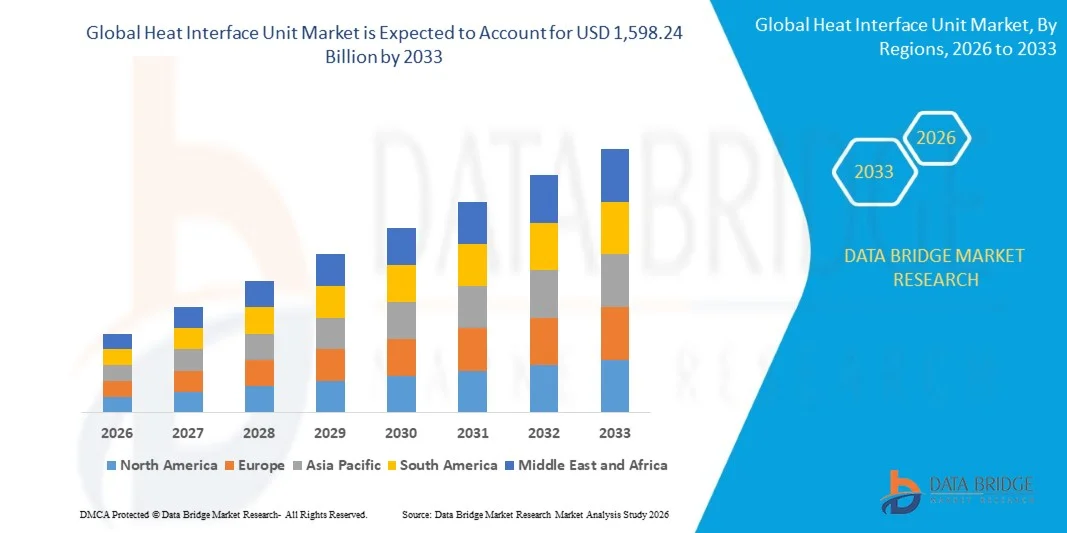
- As per Data Bridge Market Research Analysis the global heat interface unit market size was valued at USD 873.13 billion in 2025 and is expected to reach USD 1,598.24 billion by 2033, at a CAGR of 7.85% during the forecast period
- The market growth is largely fuelled by the increasing adoption of district heating systems and energy-efficient building solutions aimed at reducing carbon emissions and improving thermal efficiency
- Rising investments in smart city infrastructure and sustainable urban development projects are further accelerating the deployment of heat interface units across residential and commercial buildings
Market Size & Forecast
- Global Market Value (2025): USD 873.13 billion
- Expected Market Value (2033): USD 1,598.24 billion
- Forecast CAGR (2026–2033): 7.85%
What are the Major Takeaways of Heat Interface Unit Market?
- The market is witnessing steady growth due to the rising demand for centralized heating solutions that offer improved energy efficiency, cost savings, and ease of maintenance compared to conventional heating systems
- In addition, technological advancements in heat interface units, such as improved heat exchangers and smart monitoring systems, are enhancing performance, reliability, and integration with modern building management systems
- North America dominated the heat interface unit market with the largest revenue share in 2025, driven by the increasing adoption of energy-efficient heating systems and growing investments in sustainable building infrastructure
- Asia-Pacific region is expected to witness the highest growth rate in the global heat interface unit market, driven by rising infrastructure development, growing smart city initiatives, and increasing adoption of sustainable and centralized heating solutions
- The heat exchangers segment held the largest market revenue share in 2025 driven by their critical role in efficient heat transfer between primary and secondary circuits. These components ensure optimal thermal performance, energy efficiency, and reliable heating supply, making them a core element in most heat interface unit systems. Their durability and ability to operate under varying pressure and temperature conditions further strengthen their widespread adoption across district heating applications
Report Scope and Heat Interface Unit Market Segmentation
|
Attributes |
Heat Interface Unit Key Market Insights |
|
Segments Covered |
|
|
Countries Covered |
North America
Europe
Asia-Pacific
Middle East and Africa
South America
|
|
Key Market Players |
|
|
Market Opportunities |
|
|
Value Added Data Infosets |
In addition to the insights on market scenarios such as market value, growth rate, segmentation, geographical coverage, and major players, the market reports curated by the Data Bridge Market Research also include in-depth expert analysis, geographically represented company-wise production and capacity, network layouts of distributors and partners, detailed and updated price trend analysis and deficit analysis of supply chain and demand. |
What is the Key Trend in the Heat Interface Unit Market?
“Growing Adoption of Energy-Efficient and District Heating Systems”
• The increasing emphasis on energy efficiency and carbon reduction is significantly shaping the heat interface unit market, as governments and building developers prioritize sustainable heating solutions. Heat interface units are gaining traction due to their ability to efficiently transfer heat from centralized systems to individual units without the need for separate boilers. This trend is driving their adoption across residential and commercial buildings, encouraging manufacturers to develop advanced and compact systems
• Rising investments in district heating infrastructure and smart city projects are accelerating the deployment of heat interface units globally. Urbanization and the need for efficient energy distribution systems are pushing developers to adopt centralized heating solutions. This is further supported by favorable regulatory frameworks and incentives promoting low-carbon technologies and sustainable construction practices
• Technological advancements are influencing purchasing decisions, with manufacturers focusing on smart controls, improved heat exchangers, and digital monitoring capabilities. These innovations enhance operational efficiency, enable remote monitoring, and reduce maintenance requirements. Companies are also emphasizing integration with building management systems to provide seamless energy control and optimization
• For instance, in 2024, companies such as Danfoss and Siemens AG introduced advanced heat interface units equipped with smart metering and control technologies. These systems were designed to improve energy efficiency and support decarbonization goals in modern buildings. The innovations also enhanced user control and reduced overall heating costs, boosting adoption across new developments
• While demand for heat interface units is increasing, sustained market growth depends on continuous innovation, cost optimization, and compatibility with evolving building standards. Manufacturers are focusing on scalable production, improving system reliability, and developing solutions that balance performance, cost, and energy efficiency for wider adoption
Heat Interface Unit Market Dynamics
Driver
“Increasing Demand for Energy-Efficient Heating Solutions”
• The growing need for energy-efficient and low-emission heating systems is a major driver for the heat interface unit market. These units enable efficient heat distribution from centralized sources, reducing energy wastage and operational costs. This trend aligns with global efforts to reduce carbon footprints and improve energy utilization across buildings
• Expanding adoption in residential complexes, commercial buildings, and district heating networks is influencing market growth. Heat interface units provide reliable heating and hot water supply while eliminating the need for individual boilers, making them an attractive solution for modern infrastructure projects
• Building developers and energy service providers are actively promoting heat interface unit installations through infrastructure upgrades and sustainable construction initiatives. These efforts are supported by regulatory policies and energy efficiency standards, encouraging widespread adoption across developed and emerging markets
• For instance, in 2023, Alfa Laval and Bosch Thermotechnology expanded their product offerings with advanced heat interface units for district heating applications. These developments were driven by increasing demand for efficient thermal solutions, enhancing system performance and reducing energy consumption
• Although the demand for energy-efficient heating supports market growth, broader adoption depends on infrastructure readiness, cost-effectiveness, and integration capabilities. Investments in smart technologies and efficient distribution networks will be essential for long-term market expansion
Restraint/Challenge
“High Installation Costs and Infrastructure Dependency”
• The high initial installation cost of heat interface units and associated infrastructure remains a key challenge, particularly in regions lacking established district heating networks. The requirement for centralized systems and complex installation processes can limit adoption among cost-sensitive developers and end-users
• Awareness and technical expertise related to heat interface units remain limited in certain markets, affecting adoption rates. Many stakeholders are still reliant on traditional heating systems, leading to slower transition despite the long-term benefits offered by heat interface units
• Infrastructure and maintenance challenges also impact market growth, as efficient operation depends on well-developed district heating networks and regular system maintenance. Upgrading existing buildings to accommodate these systems can involve significant costs and technical complexities
• For instance, in 2024, developers in Southeast Asia and Eastern Europe reported slower adoption of heat interface units due to high upfront costs and limited district heating infrastructure. These barriers also affected project feasibility and delayed implementation timelines in several urban development projects
• Overcoming these challenges will require cost reduction strategies, infrastructure development, and increased awareness among stakeholders. Collaboration between governments, energy providers, and manufacturers will be essential to expand adoption and unlock the full potential of the global heat interface unit market
How is the Heat Interface Unit Market Segmented?
The heat interface unit market is segmented into notable segments based on component, product type, and application.
• By Component
On the basis of component, the heat interface unit market is segmented into controllers, heat exchangers, pumps, sensors, and valves. The heat exchangers segment held the largest market revenue share in 2025 driven by their critical role in efficient heat transfer between primary and secondary circuits. These components ensure optimal thermal performance, energy efficiency, and reliable heating supply, making them a core element in most heat interface unit systems. Their durability and ability to operate under varying pressure and temperature conditions further strengthen their widespread adoption across district heating applications.
The controllers segment is expected to witness the fastest growth rate from 2026 to 2033, driven by the increasing adoption of smart heating solutions and building automation systems. Advanced controllers enable precise temperature regulation, remote monitoring, and improved energy management, enhancing overall system efficiency and user convenience. The integration of IoT-based technologies and digital interfaces is also supporting predictive maintenance and operational optimization, making controllers a key focus area for innovation.
• By Product Type
On the basis of product type, the heat interface unit market is segmented into direct HIUs and indirect HIUs. The indirect HIUs segment held the largest market revenue share in 2025 due to their enhanced safety, better pressure control, and ability to separate primary and secondary circuits. These systems are widely preferred in residential and commercial buildings for improved reliability and consistent heating performance. Their capability to reduce the risk of contamination and provide stable temperature control further contributes to their dominant market position.
The direct HIUs segment is expected to witness the fastest growth rate from 2026 to 2033, driven by their cost-effectiveness, compact design, and ease of installation. Direct systems are increasingly adopted in applications where simpler configurations and lower upfront costs are prioritized, particularly in smaller buildings and retrofit projects. Their reduced component requirements and straightforward maintenance processes make them suitable for cost-sensitive developments and rapid deployment scenarios.
• By Application
On the basis of application, the heat interface unit market is segmented into commercial, industrial, and residential. The residential segment held the largest market revenue share in 2025 driven by the rising adoption of district heating systems in apartments and multi-family housing units. Increasing demand for energy-efficient and space-saving heating solutions is further supporting segment growth. Government initiatives promoting sustainable housing and energy conservation are also contributing to the expansion of heat interface unit installations in residential settings.
The commercial segment is expected to witness the fastest growth rate from 2026 to 2033, driven by the expansion of office spaces, hotels, and institutional buildings adopting centralized heating systems. The need for efficient energy management, reduced operational costs, and compliance with sustainability standards is accelerating the adoption of heat interface units in commercial applications. In addition, increasing retrofitting activities in existing commercial infrastructure are creating new opportunities for market growth.
Which Region Holds the Largest Share of the Heat Interface Unit Market?
• North America dominated the heat interface unit market with the largest revenue share in 2025, driven by the increasing adoption of energy-efficient heating systems and growing investments in sustainable building infrastructure
• Consumers and developers in the region highly value the efficiency, reliability, and cost savings offered by heat interface units, particularly in multi-residential and commercial buildings utilizing centralized heating solutions
• This widespread adoption is further supported by strong regulatory frameworks, high awareness of energy conservation, and the presence of advanced building technologies, establishing heat interface units as a preferred heating solution
U.S. Heat Interface Unit Market Insight
The U.S. heat interface unit market captured the largest revenue share in 2025 within North America, fueled by the rising focus on energy-efficient construction and the growing trend of smart buildings. Developers are increasingly adopting centralized heating systems integrated with heat interface units to improve operational efficiency and reduce carbon emissions. The increasing implementation of green building standards and retrofitting of existing infrastructure are further propelling market growth.
Europe Heat Interface Unit Market Insight
The Europe heat interface unit market is expected to witness the fastest growth rate from 2026 to 2033, primarily driven by stringent energy efficiency regulations and the expansion of district heating networks. The region’s strong focus on reducing carbon emissions and promoting sustainable urban development is encouraging the adoption of heat interface units. Increasing renovation activities and demand for efficient heating in residential and commercial buildings are also supporting market expansion.
U.K. Heat Interface Unit Market Insight
The U.K. heat interface unit market is expected to witness significant growth from 2026 to 2033, driven by increasing government initiatives promoting low-carbon heating and district energy systems. Rising awareness regarding energy efficiency and the need to replace traditional heating systems are encouraging adoption. In addition, the country’s growing construction sector and emphasis on sustainable housing are further boosting demand.
Germany Heat Interface Unit Market Insight
The Germany heat interface unit market is expected to witness strong growth from 2026 to 2033, fueled by increasing demand for advanced heating technologies and energy-efficient infrastructure. Germany’s focus on sustainability and innovation is promoting the adoption of heat interface units across residential and commercial sectors. The integration of these systems with modern building management solutions is also gaining traction.
Asia-Pacific Heat Interface Unit Market Insight
The Asia-Pacific heat interface unit market is expected to witness the fastest growth rate from 2026 to 2033, driven by rapid urbanization, rising construction activities, and increasing focus on energy-efficient solutions. Countries such as China, Japan, and South Korea are investing in sustainable infrastructure and smart city projects, boosting the demand for centralized heating technologies and heat interface units.
Japan Heat Interface Unit Market Insight
The Japan heat interface unit market is expected to witness steady growth from 2026 to 2033 due to increasing demand for efficient and compact heating systems. The country’s emphasis on technological innovation and smart infrastructure is supporting the integration of heat interface units in modern buildings. In addition, the need for energy conservation and optimized heating solutions is further driving adoption.
China Heat Interface Unit Market Insight
The China heat interface unit market accounted for a significant market revenue share in Asia Pacific in 2025, attributed to rapid urban development and increasing adoption of district heating systems. Government initiatives promoting energy efficiency and sustainable construction are key factors driving market growth. The availability of cost-effective solutions and strong domestic manufacturing capabilities are further supporting widespread adoption.
Which are the Top Companies in Heat Interface Unit Market?
The Heat Interface Unit industry is primarily led by well-established companies, including:
- Kingspan (Ireland)
- Honeywell International Inc. (U.S.)
- Dutypoint Ltd (U.K.)
- Danfoss (Denmark)
- Bosch (Germany)
- AWI Licensing LLC and AFI Licensing LLC (U.S.)
- Giacomini (Italy)
- Alfa Laval (Sweden)
- Docherty (U.K.)
- Caleffi S.p.A. (Italy)
- Elson (U.K.)
- Essco Controls (U.S.)
- Elco Heating Solutions (U.K.)
- KVM-Conheat (U.K.)
- COMAP International (France)
- Johnson & Starley Ltd (U.K.)
- Emmeti (Italy)
- Heatrae Sadia (U.K.)
What are Latest Developments in Global Heat Interface Unit Market?
- In October 2025, Honeywell International Inc., product innovation, introduced an AI-driven platform to optimize heat interface unit performance in real time, enabling improved energy efficiency, predictive maintenance, and smarter energy management, which enhances user control and accelerates the adoption of intelligent heating solutions across modern buildings
- In September 2025, Vaillant Group, product launch, unveiled a new range of compact and high-efficiency heat interface units tailored for urban residential applications, addressing space constraints and performance requirements, thereby strengthening its market position and supporting the growing demand for efficient urban heating systems
- In August 2025, Trane Technologies, strategic partnership, collaborated with a renewable energy firm to develop hybrid heating solutions integrating heat interface units with solar energy systems, aiming to reduce carbon emissions and enhance energy efficiency, which is expected to drive innovation and set new benchmarks for sustainable heating solutions in the market

- Interactive Data Analysis Dashboard
- Company Analysis Dashboard for high growth potential opportunities
- Research Analyst Access for customization & queries
- Competitor Analysis with Interactive dashboard
- Latest News, Updates & Trend analysis
- Harness the Power of Benchmark Analysis for Comprehensive Competitor Tracking
Global Heat Interface Unit Market, Supply Chain Analysis and Ecosystem Framework
To support market growth and help clients navigate the impact of geopolitical shifts, DBMR has integrated in-depth supply chain analysis into its Global Heat Interface Unit Market research reports. This addition empowers clients to respond effectively to global changes affecting their industries. The supply chain analysis section includes detailed insights such as Global Heat Interface Unit Market consumption and production by country, price trend analysis, the impact of tariffs and geopolitical developments, and import and export trends by country and HSN code. It also highlights major suppliers with data on production capacity and company profiles, as well as key importers and exporters. In addition to research, DBMR offers specialized supply chain consulting services backed by over a decade of experience, providing solutions like supplier discovery, supplier risk assessment, price trend analysis, impact evaluation of inflation and trade route changes, and comprehensive market trend analysis.
Data collection and base year analysis are done using data collection modules with large sample sizes. The stage includes obtaining market information or related data through various sources and strategies. It includes examining and planning all the data acquired from the past in advance. It likewise envelops the examination of information inconsistencies seen across different information sources. The market data is analysed and estimated using market statistical and coherent models. Also, market share analysis and key trend analysis are the major success factors in the market report. To know more, please request an analyst call or drop down your inquiry.
The key research methodology used by DBMR research team is data triangulation which involves data mining, analysis of the impact of data variables on the market and primary (industry expert) validation. Data models include Vendor Positioning Grid, Market Time Line Analysis, Market Overview and Guide, Company Positioning Grid, Patent Analysis, Pricing Analysis, Company Market Share Analysis, Standards of Measurement, Global versus Regional and Vendor Share Analysis. To know more about the research methodology, drop in an inquiry to speak to our industry experts.
Data Bridge Market Research is a leader in advanced formative research. We take pride in servicing our existing and new customers with data and analysis that match and suits their goal. The report can be customized to include price trend analysis of target brands understanding the market for additional countries (ask for the list of countries), clinical trial results data, literature review, refurbished market and product base analysis. Market analysis of target competitors can be analyzed from technology-based analysis to market portfolio strategies. We can add as many competitors that you require data about in the format and data style you are looking for. Our team of analysts can also provide you data in crude raw excel files pivot tables (Fact book) or can assist you in creating presentations from the data sets available in the report.













