


Heating Control System Market Size
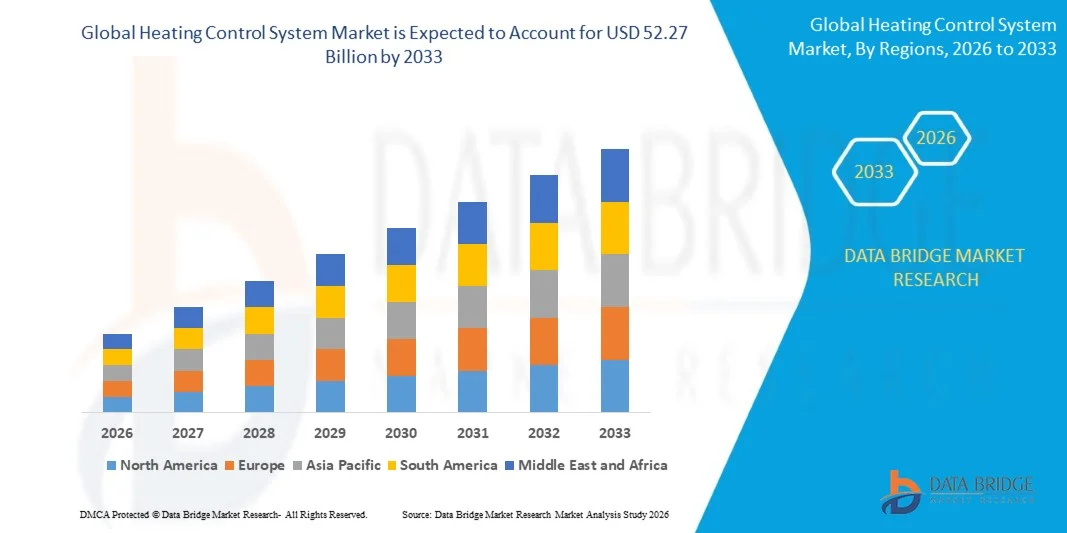
- The global Heating Control System market size was valued at USD 19.8 billion in 2025and is expected to reach USD 52.27 billion by 2033, at a CAGR of 12.9% during the forecast period.
- Market growth is primarily driven by increasing demand for energy-efficient heating solutions, smart home adoption, and rising energy costs.
- Growing awareness regarding carbon emissions and sustainability is significantly accelerating market expansion.
Heating Control System Market Analysis
- Heating control systems enable efficient temperature regulation, energy savings, and enhanced comfort across residential and commercial spaces.
- Demand is rising due to the increasing adoption of smart thermostats, IoT-enabled devices, and automation systems.
- Europe dominated the market with a revenue share of 38.5% in 2025, driven by stringent energy efficiency regulations and high adoption of smart heating systems.
- Asia-Pacific is expected to witness significant growth, supported by urbanization and increasing smart home penetration.
- The hardware segment dominated with 55.2% share in 2025, due to widespread installation of thermostats, sensors, and controllers.
Report Scope and Heating Control System Market Segmentation
|
Attributes |
Heating Control System Key Market Insights |
|
Segments Covered |
· By End-User: Households, Offices, Healthcare, Hospitality, and Industrial Facilities |
|
Countries Covered |
North America · U.S. · Canada · Mexico Europe · Germany · France · U.K. · Netherlands · Switzerland · Belgium · Russia · Italy · Spain · Turkey · Rest of Europe Asia-Pacific · China · Japan · India · South Korea · Singapore · Malaysia · Australia · Thailand · Indonesia · Philippines · Rest of Asia-Pacific Middle East and Africa · Saudi Arabia · U.A.E. · South Africa · Egypt · Israel · Rest of Middle East and Africa South America · Brazil · Argentina · Rest of South America |
|
Key Market Players |
|
|
Market Opportunities |
· Increasing adoption of smart home ecosystems and connected HVAC systems · Growth in retrofit and energy efficiency upgrade projects |
|
Value Added Data Infosets |
In addition to the insights on market scenarios such as market value, growth rate, segmentation, geographical coverage, and major players, the market reports curated by the Data Bridge Market Research also include in-depth expert analysis, geographically represented company-wise production and capacity, network layouts of distributors and partners, detailed and updated price trend analysis and deficit analysis of supply chain and demand. |
Heating Control System Market Trends
“Rise of Smart and IoT-enabled Heating Systems”
- A major trend shaping the global heating control system market is the increasing integration of Internet of Things (IoT) and smart home technologies into heating infrastructure. These systems enable seamless connectivity between thermostats, sensors, HVAC units, and mobile applications, allowing users to monitor and control heating systems remotely with greater precision and convenience.
- The growing adoption of wireless and app-based control systems is transforming how heating systems are managed across residential and commercial environments. These solutions eliminate the need for complex wiring, enable flexible installation, and provide real-time temperature adjustments through smartphones, tablets, and voice-enabled devices.
- The rise of artificial intelligence (AI)-driven energy optimization is significantly enhancing system efficiency. Advanced heating control systems can learn user behavior, occupancy patterns, and environmental conditions to automatically adjust temperature settings, thereby reducing energy consumption and operational costs.
- Increasing deployment of cloud-based heating control platforms is enabling centralized monitoring, data storage, and remote diagnostics. These platforms allow users and facility managers to control multiple heating systems across different locations, improving operational efficiency and enabling predictive maintenance.
- There is a strong and growing emphasis on energy efficiency regulations and green building standards, particularly in developed regions such as Europe and North America. Governments and regulatory bodies are mandating the use of energy-efficient heating technologies, which is accelerating innovation and adoption of advanced heating control systems.
- The expansion of voice-controlled and AI-integrated smart thermostats is further enhancing user experience and convenience. Integration with smart home ecosystems such as voice assistants enables hands-free operation, automated scheduling, and seamless interoperability with other connected devices, making heating systems more intuitive and user-friendly.
Heating Control System Market Dynamics
Driver
“Growing Demand for Energy Efficiency and Smart Homes”
- The rising cost of energy across residential, commercial, and industrial sectors is a major factor driving the adoption of energy-efficient heating control systems. Consumers and organizations are increasingly investing in advanced systems that optimize energy usage and reduce utility expenses.
- Governments worldwide are actively promoting low-carbon technologies and smart energy management solutions through incentives, subsidies, and regulatory frameworks. Policies focused on reducing greenhouse gas emissions and improving building energy performance are significantly boosting market growth.
- The rapid expansion of smart home ecosystems is creating strong demand for connected heating solutions. Modern households are increasingly adopting integrated systems where heating, lighting, and security can be controlled through a single platform, enhancing convenience and energy efficiency.
- Increasing urbanization and infrastructure development, particularly in emerging economies, are driving the installation of modern HVAC and heating control systems in residential complexes, commercial buildings, and smart cities.
- Integration of heating systems with renewable energy sources, such as solar thermal systems and heat pumps, is further supporting market growth. Heating control systems play a critical role in optimizing energy usage in hybrid energy setups, improving sustainability and efficiency.
- The growing focus on building automation and smart infrastructure is encouraging the adoption of advanced heating control technologies in commercial and industrial sectors. These systems enable centralized control, real-time monitoring, and improved energy management across large facilities.
Restraint/Challenge
“High Installation Costs and System Complexity”
- One of the primary challenges in the heating control system market is the high initial cost associated with advanced and smart heating solutions. The cost of devices, installation, system integration, and upgrades can be significant, particularly for residential users and small businesses.
- The integration of modern heating control systems with existing HVAC infrastructure can be complex and expensive. Many buildings operate on legacy systems that require extensive modifications or complete replacement to support advanced control technologies.
- Limited awareness and adoption in developing regions continue to hinder market growth. In many emerging economies, consumers prioritize basic heating solutions over advanced control systems due to cost constraints and lack of technical knowledge.
- The increasing use of connected and IoT-enabled systems has raised concerns regarding data privacy and cybersecurity risks. Heating control systems connected to the internet may be vulnerable to cyberattacks, unauthorized access, and data breaches, which can impact user trust and adoption.
- There is a noticeable shortage of skilled professionals capable of installing, configuring, and maintaining advanced heating control systems. This skill gap can lead to inefficient system deployment, increased operational costs, and reduced system performance.
- Additionally, system implementation may involve temporary disruptions and downtime, especially during retrofitting or upgrading projects, which can impact building operations and discourage adoption among commercial users.
Heating Control System Market Scope
The market is segmented on the basis of component, technology, application, and end-user.
- By Component
On the basis of component, the global Heating Control System Market is segmented into hardware, software, and services.
The hardware segment dominated the market with the largest revenue share in 2025, driven by the widespread deployment of physical components such as thermostats, sensors, controllers, valves, and actuators. These components form the core infrastructure of heating control systems, enabling real-time temperature monitoring, system regulation, and efficient heat distribution across residential, commercial, and industrial environments. Hardware devices are designed to ensure high reliability, precision control, and compatibility with various HVAC systems. The increasing installation of smart thermostats and connected devices in both new constructions and retrofit projects is further strengthening the growth of the hardware segment.
The software segment is expected to witness the fastest growth during the forecast period, fueled by the rising adoption of advanced analytics, automation, and AI-driven optimization tools. Heating control software enables centralized system management, real-time monitoring, predictive maintenance, and energy consumption analysis. These solutions allow users to optimize heating schedules, reduce energy wastage, and enhance system efficiency. The growing integration of cloud computing, IoT platforms, and smart home ecosystems is further accelerating demand for intelligent heating control software solutions.
- By Technology
On the basis of technology, the Heating Control System Market is segmented into smart thermostats, programmable thermostats, wireless heating control systems, IoT-enabled systems, and others.
The smart thermostats segment dominated the market in 2025, driven by high adoption across residential smart homes and modern buildings. These devices offer advanced features such as remote access via mobile applications, adaptive learning capabilities, occupancy detection, and automated scheduling. Smart thermostats enable users to maintain optimal indoor temperatures while minimizing energy consumption, thereby significantly improving energy efficiency and reducing utility costs. Their seamless integration with voice assistants and smart home platforms further enhances their adoption globally.
The IoT-enabled heating control systems segment is expected to witness the fastest growth during the forecast period, driven by the increasing development of connected ecosystems and building automation technologies. IoT-enabled systems facilitate real-time communication between heating devices, sensors, and control platforms, enabling automated adjustments based on environmental conditions and user preferences. These systems support remote diagnostics, predictive maintenance, and enhanced operational efficiency, making them highly suitable for smart buildings, commercial facilities, and industrial applications.
- By application
On the basis of application, the Heating Control System Market is segmented into residential, commercial, and industrial.
The residential segment dominated the market with the largest revenue share in 2025, driven by the rapid adoption of smart home technologies and connected heating devices. Increasing disposable income, growing awareness of energy efficiency, and rising demand for enhanced comfort and convenience are key factors contributing to segment growth. Homeowners are increasingly investing in smart thermostats and automated heating systems to optimize energy usage and improve living standards.
The commercial segment is expected to witness significant growth during the forecast period, supported by stringent energy efficiency regulations and increasing adoption of building automation systems in offices, retail spaces, hotels, and healthcare facilities. Heating control systems in commercial buildings enable centralized management, improved energy efficiency, and compliance with environmental standards. The growing focus on reducing operational costs and carbon emissions is further driving demand in this segment.
- By end-user
On the basis of end-user, the heating control system Market is segmented into households, offices & commercial buildings, healthcare facilities, hospitality, industrial facilities, and others.
The households segment accounted for the largest market revenue share in 2025, owing to the increasing penetration of smart thermostats and home automation systems. Consumers are prioritizing comfort, convenience, and energy savings, leading to widespread adoption of advanced heating control solutions in residential settings. The integration of heating systems with smart home ecosystems is further accelerating growth in this segment.
The healthcare and hospitality segments are expected to witness significant growth during the forecast period, driven by the need for precise temperature control, energy efficiency, and enhanced occupant comfort. In healthcare facilities, maintaining stable temperature conditions is critical for patient safety and equipment performance, while in hospitality, heating control systems play a key role in improving guest experience and operational efficiency.
Heating Control System Market Regional Analysis
- Europe dominated the heating control system market with the largest revenue share in 2025, supported by stringent energy efficiency regulations, strong sustainability initiatives, and high adoption of smart building technologies. The region has been at the forefront of implementing energy-saving policies and promoting low-carbon solutions, which has significantly increased the deployment of advanced heating control systems.
- Countries such as Germany and the U.K. are major contributors to regional growth due to their well-established infrastructure, high awareness of energy efficiency, and strong government support for green building initiatives. The widespread adoption of smart thermostats, building automation systems, and IoT-enabled heating solutions is further strengthening market growth in the region.
U.S. Heating Control System Market Insight
The U.S. heating control system market captured a significant share in North America in 2025, driven by the strong adoption of smart home technologies and energy-efficient HVAC systems. Residential and commercial users are increasingly investing in connected heating solutions to optimize energy consumption and improve comfort.
Companies in the U.S. are actively investing in building automation systems, integrating heating control with lighting, ventilation, and security systems to enable centralized management. Additionally, increasing awareness regarding energy conservation and the presence of leading technology providers are supporting market expansion.
U.K. Heating Control System Market Insight
The U.K. heating control system market is expected to grow at a notable pace during the forecast period, supported by government initiatives focused on carbon neutrality and energy efficiency. Programs promoting smart meters, energy-efficient homes, and sustainable infrastructure are encouraging the adoption of advanced heating control systems.
The rising demand for smart thermostats and automated heating solutions in both residential and commercial buildings is further contributing to market growth.
Germany Heating Control System Market Insight
Germany is anticipated to witness strong growth in the heating control system market, driven by its strong focus on energy-efficient buildings, industrial automation, and sustainable technologies. The country has a well-developed infrastructure and is a leader in adopting advanced HVAC and building automation systems.
Heating control systems are widely used across residential, commercial, and industrial sectors in Germany to improve energy efficiency, reduce emissions, and enhance operational performance.
Asia-Pacific Heating Control System Market Insight
The Asia-Pacific region is expected to witness the fastest growth during the forecast period of 2026 to 2033, driven by rapid urbanization, industrialization, and increasing investments in smart city projects.
Countries such as China, India, Japan, and South Korea are experiencing significant growth due to expanding construction activities, rising middle-class population, and increasing adoption of smart home technologies. The growing demand for energy-efficient solutions and modern infrastructure is further accelerating market expansion in the region.
India Heating Control System Market Insight
The India heating control system market is expected to witness significant growth during the forecast period, driven by increasing adoption of smart homes, energy-efficient appliances, and building automation systems.
Government initiatives supporting infrastructure development, urban housing projects, and smart cities are encouraging the deployment of advanced heating control systems. Additionally, rising consumer awareness regarding energy savings and comfort is contributing to market growth in the country.
Heating Control System Market Share
The heating control system industry is primarily led by well-established companies, including:
- Honeywell International Inc. (U.S.)
- Siemens AG (Germany)
- Schneider Electric SE (France)
- Johnson Controls International plc (Ireland)
- Danfoss A/S (Denmark)
- Emerson Electric Co. (U.S.)
- Bosch Thermotechnology (Germany)
- Resideo Technologies Inc. (U.S.)
- Lennox International Inc. (U.S.)
- Carrier Global Corporation (U.S.)
Recent Developments in Global Heating Control System Market
- In March 2026, leading companies launched advanced AI-powered smart thermostats equipped with predictive temperature control and self-learning capabilities. These systems analyze user behavior and environmental conditions to automatically adjust heating settings, improving energy efficiency and user comfort.
- In January 2026, there was a significant expansion of IoT-enabled HVAC and heating control systems designed for smart buildings. These solutions enable real-time monitoring, remote control, and integration with building management systems, enhancing operational efficiency.
- In February 2026, major players introduced cybersecurity-enabled smart heating solutions incorporating advanced encryption, secure communication protocols, and threat detection features to address growing concerns related to connected systems.
- In December 2025, companies developed next-generation energy-efficient programmable thermostats with improved scheduling capabilities and user-friendly interfaces, supporting energy savings and regulatory compliance.
- In November 2025, there was increased integration of heating control systems with renewable energy sources, such as solar heating and heat pump technologies. These solutions optimize energy utilization and support sustainability goals by reducing reliance on conventional energy sources.

- Interactive Data Analysis Dashboard
- Company Analysis Dashboard for high growth potential opportunities
- Research Analyst Access for customization & queries
- Competitor Analysis with Interactive dashboard
- Latest News, Updates & Trend analysis
- Harness the Power of Benchmark Analysis for Comprehensive Competitor Tracking
Global Heating Control System Market, Supply Chain Analysis and Ecosystem Framework
To support market growth and help clients navigate the impact of geopolitical shifts, DBMR has integrated in-depth supply chain analysis into its Global Heating Control System Market research reports. This addition empowers clients to respond effectively to global changes affecting their industries. The supply chain analysis section includes detailed insights such as Global Heating Control System Market consumption and production by country, price trend analysis, the impact of tariffs and geopolitical developments, and import and export trends by country and HSN code. It also highlights major suppliers with data on production capacity and company profiles, as well as key importers and exporters. In addition to research, DBMR offers specialized supply chain consulting services backed by over a decade of experience, providing solutions like supplier discovery, supplier risk assessment, price trend analysis, impact evaluation of inflation and trade route changes, and comprehensive market trend analysis.
Data collection and base year analysis are done using data collection modules with large sample sizes. The stage includes obtaining market information or related data through various sources and strategies. It includes examining and planning all the data acquired from the past in advance. It likewise envelops the examination of information inconsistencies seen across different information sources. The market data is analysed and estimated using market statistical and coherent models. Also, market share analysis and key trend analysis are the major success factors in the market report. To know more, please request an analyst call or drop down your inquiry.
The key research methodology used by DBMR research team is data triangulation which involves data mining, analysis of the impact of data variables on the market and primary (industry expert) validation. Data models include Vendor Positioning Grid, Market Time Line Analysis, Market Overview and Guide, Company Positioning Grid, Patent Analysis, Pricing Analysis, Company Market Share Analysis, Standards of Measurement, Global versus Regional and Vendor Share Analysis. To know more about the research methodology, drop in an inquiry to speak to our industry experts.
Data Bridge Market Research is a leader in advanced formative research. We take pride in servicing our existing and new customers with data and analysis that match and suits their goal. The report can be customized to include price trend analysis of target brands understanding the market for additional countries (ask for the list of countries), clinical trial results data, literature review, refurbished market and product base analysis. Market analysis of target competitors can be analyzed from technology-based analysis to market portfolio strategies. We can add as many competitors that you require data about in the format and data style you are looking for. Our team of analysts can also provide you data in crude raw excel files pivot tables (Fact book) or can assist you in creating presentations from the data sets available in the report.













