


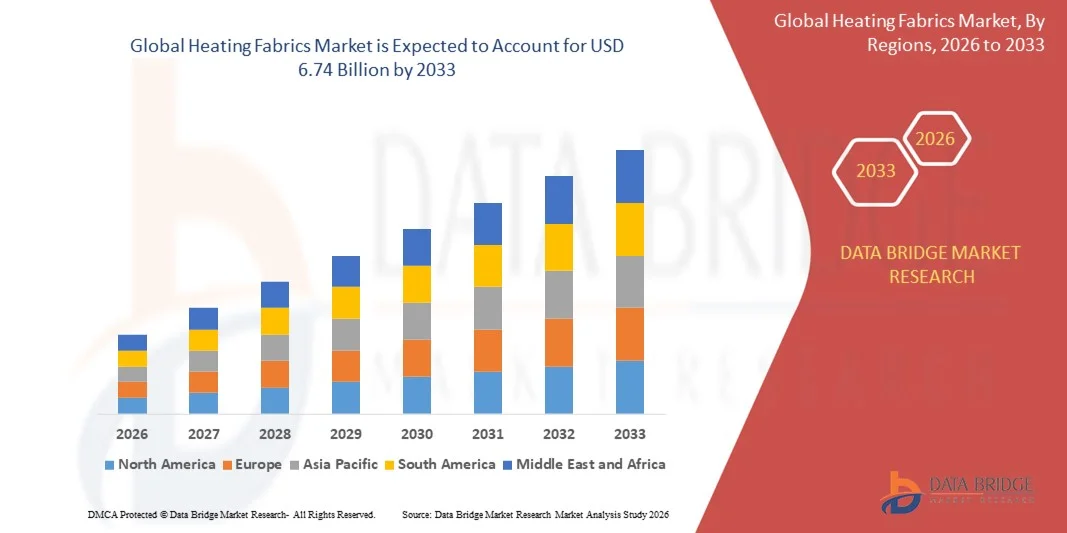
Heating Fabrics Market Size
- The global heating fabrics market size was valued at USD 3.26 billion in 2025 and is expected to reach USD 6.74 billion by 2033, at a CAGR of 9.50% during the forecast period
- The market growth is largely fueled by the increasing adoption of wearable technology, smart garments, and energy-efficient textile solutions across consumer, automotive, and industrial sectors. Rising technological advancements in conductive fibers, flexible heating elements, and integration with IoT-enabled devices are accelerating the use of heating fabrics in both personal and professional applications
- Furthermore, growing consumer demand for personalized comfort, thermal regulation, and ergonomic clothing is positioning heating fabrics as an essential component of modern apparel, automotive interiors, medical devices, and technical textiles. These converging factors are driving the adoption of smart heating textiles, thereby significantly boosting market growth
Heating Fabrics Market Analysis
- Heating fabrics, incorporating conductive yarns or fibers to provide controlled warmth, are becoming increasingly vital in wearable technology, automotive interiors, household applications, medical textiles, and industrial safety gear due to their comfort, energy efficiency, and adaptability
- The escalating demand for heating fabrics is primarily fueled by rising consumer focus on personal comfort and health, technological innovations enabling lightweight and durable fabrics, and increased integration in automotive, medical, and fashion applications, which are expanding the market’s adoption across multiple sectors
- Asia-Pacific dominated the heating fabrics market with a share of 46.36% in 2025, due to increasing adoption of heated garments and technical textiles, rapid growth in automotive and personal care sectors, and strong manufacturing capabilities in textile hubs
- North America is expected to be the fastest growing region in the heating fabrics market during the forecast period due to robust adoption of wearable heating technology, heated automotive components, and medical heating textiles
- Non-disposable segment dominated the market with a market share of 46.1% in 2025, due to its durability, reusability, and suitability for long-term applications in automotive, military, and household products. Non-disposable fabrics are preferred for garments, technical textiles, and medical heating solutions where repeated use and consistent performance are critical. For instance, companies such as Voltaware manufacture reusable heated fabrics for outdoor and industrial protective clothing. The ability to incorporate advanced conductive yarns enhances thermal performance over extended periods. Consumers prioritize non-disposable fabrics due to cost-effectiveness in the long run and environmental considerations
Report Scope and Heating Fabrics Market Segmentation
|
Attributes |
Heating Fabrics Key Market Insights |
|
Segments Covered |
|
|
Countries Covered |
North America
Europe
Asia-Pacific
Middle East and Africa
South America
|
|
Key Market Players |
|
|
Market Opportunities |
|
|
Value Added Data Infosets |
In addition to the insights on market scenarios such as market value, growth rate, segmentation, geographical coverage, and major players, the market reports curated by the Data Bridge Market Research also include import export analysis, production capacity overview, production consumption analysis, price trend analysis, climate change scenario, supply chain analysis, value chain analysis, raw material/consumables overview, vendor selection criteria, PESTLE Analysis, Porter Analysis, and regulatory framework. |
Heating Fabrics Market Trends
Rising Adoption of Smart and Wearable Heating Textiles
- The global heating fabrics market is witnessing a significant trend towards the increasing adoption of smart and wearable heating textiles across multiple sectors, including personal care, fashion, automotive, medical, and industrial applications. The integration of conductive fibers and advanced heating elements into garments and technical textiles is enabling enhanced thermal comfort, energy efficiency, and ergonomic benefits, which are driving widespread consumer interest and industrial utilization
- For instance, Loomia’s Gentoo Flexible Heater allows garments and industrial textiles to operate reliably at extremely low temperatures while maintaining durability through multiple wash cycles, demonstrating the commercial viability of wearable heating solutions
- The growing focus on incorporating heating fabrics into connected devices and IoT-enabled wearables is further fueling market expansion, allowing users to control heat settings through mobile apps and smart controllers for improved convenience and personalized comfort
- Technological advancements in fabric design and integration are facilitating the creation of multifunctional textiles that combine heating functionality with breathability, stretchability, and aesthetic appeal, supporting broader adoption in both consumer and professional applications
- Companies such as KnitWarm are developing stylish and sustainable heated fabrics for fashion and lifestyle applications, highlighting the convergence of technology, design, and functionality in the market
- The increasing awareness of thermal comfort, energy-efficient heating solutions, and the demand for customizable warmth in clothing, automotive interiors, and medical applications are collectively driving the growth of the heating fabrics market
Heating Fabrics Market Dynamics
Driver
Growing Demand for Personalized Comfort and Thermal Regulation
- The rising consumer preference for personalized comfort and regulated thermal experiences is a major driver of the heating fabrics market, as individuals seek garments and technical textiles that provide consistent warmth and ergonomic support
- For instance, in 2024, GENTHERM introduced advanced heated fabrics for automotive seats that allow drivers and passengers to adjust localized heating levels for individual comfort, demonstrating how technological innovation is catering to specific user needs
- The increasing focus on health and wellness, combined with the need for temperature-controlled clothing and medical textiles, is further propelling demand, as heating fabrics can prevent cold-related discomfort and enhance performance in various professional environments
- The growth of wearable technology and smart apparel ecosystems is encouraging manufacturers to integrate heating functionality with sensors, mobile apps, and energy-efficient power sources to provide more sophisticated and user-friendly products
- The expanding applications in automotive, medical, outdoor, and fashion segments, coupled with rising consumer awareness regarding comfort and functionality, are driving sustained growth and shaping the future trajectory of the heating fabrics market
Restraint/Challenge
High Production Costs and Integration Complexity
- High production costs associated with advanced heating fabrics, including conductive yarns, energy-efficient heating elements, and smart integration components, pose a significant challenge to broader market adoption
- For instance, incorporating flexible heating elements and IoT-enabled control systems into wearable textiles by companies such as Loomia increases manufacturing complexity and production expenses, potentially limiting affordability for consumers and smaller enterprises
- The technical challenges of embedding heating systems without compromising fabric flexibility, breathability, and durability add additional barriers for manufacturers, as careful engineering is required to maintain performance while ensuring wearer comfort. Limited standardization across smart textile components and the need for precise quality control further contribute to high production costs and integration difficulties
- The requirement for seamless integration with mobile applications, power sources, and other connected systems can create delays in product development and increase time-to-market for innovative heating fabric solutions
- Overcoming these challenges through process optimization, scalable manufacturing techniques, and cost-effective material sourcing will be essential for enabling widespread adoption and sustaining market growth
Heating Fabrics Market Scope
The market is segmented on the basis of type, material, technology, function, and application.
- By Type
On the basis of type, the heating fabrics market is segmented into woven, knitted, and non-woven fabrics. The woven segment dominated the market with the largest market revenue share of 41.5% in 2025, driven by its superior durability, structural stability, and widespread industrial adoption. Woven heating fabrics are highly preferred for applications requiring consistent heat distribution and mechanical strength, such as automotive and technical textiles. The ability to integrate various conductive fibers seamlessly into the weave enhances thermal efficiency and performance. Consumers and manufacturers often choose woven fabrics for their versatility in both large-scale industrial and household heating applications. The segment’s established supply chains and ease of customization further support its market dominance.
The knitted segment is expected to witness the fastest growth rate of 23.4% from 2026 to 2033, fueled by rising demand in wearable technology and fashion applications. Knitted fabrics offer superior flexibility, stretchability, and comfort, making them ideal for smart garments, personal care, and fashion-forward heating solutions. For instance, companies such as Schoeller Technologies are innovating with electrically heated knitted fabrics for outdoor and sportswear. The segment benefits from growing consumer preference for wearable heating fabrics providing localized warmth and ergonomic comfort. In addition, advancements in knitting techniques allow for complex patterns and embedded heating zones, boosting adoption in clothing and technical textile markets.
- By Material
On the basis of material, the heating fabrics market is segmented into wool, PP, PE, PET, and bio-composites. The wool segment dominated the market with the largest revenue share of 39.7% in 2025, driven by its natural insulation properties, thermal comfort, and biodegradability. Wool-based heating fabrics provide superior warmth retention, making them ideal for personal care, fashion, and medical applications. Consumers often prefer wool due to its sustainability, moisture-wicking ability, and comfort against the skin. The segment also benefits from established production processes and strong availability of high-quality raw wool fibers. Its compatibility with both woven and knitted structures enhances design flexibility across applications.
The PP (polypropylene) segment is anticipated to witness the fastest CAGR from 2026 to 2033, fueled by lightweight, cost-effective, and chemically resistant properties suitable for automotive, industrial, and technical applications. For instance, Toray Industries has been developing PP-based heating fabrics for lightweight automotive seat heating solutions. The material allows for easy integration of conductive yarns while maintaining durability and flexibility. PP fabrics also support mass production, making them attractive for disposable and reusable heating products. Increasing emphasis on high-performance synthetic fibers in industrial applications further drives the growth of PP heating fabrics.
- By Technology
On the basis of technology, the heating fabrics market is segmented into dry-laid and spunmelt technologies. The dry-laid segment dominated the market with the largest revenue share of 44.2% in 2025, driven by its high fiber orientation, uniform heat distribution, and robust mechanical properties. Dry-laid fabrics are widely used in automotive, construction, and technical textile applications due to their structural stability and high thermal efficiency. The process allows precise control of fiber density, ensuring consistent performance across large areas. For instance, manufacturers often use dry-laid heating fabrics in industrial thermal insulation and medical warming systems. Its adaptability to various conductive yarns enhances integration with emerging heating technologies. The durability and reliable performance of dry-laid fabrics further reinforce their market dominance.
The spunmelt segment is expected to witness the fastest growth rate of 22.8% from 2026 to 2033, driven by increasing adoption in disposable personal care and hygiene products. Spunmelt fabrics are lightweight, breathable, and easy to produce at scale, making them suitable for warming pads, thermal garments, and medical heating applications. For instance, Berry Global has been innovating spunmelt heating fabrics for disposable warming solutions. Their ability to combine multiple layers efficiently with embedded heating elements supports localized heating functions. Growing demand for cost-effective, single-use heating fabrics is further contributing to the rapid growth of the spunmelt segment.
- By Function
On the basis of function, the heating fabrics market is segmented into disposable and non-disposable fabrics. The non-disposable segment dominated the market with the largest revenue share of 46.1% in 2025, driven by its durability, reusability, and suitability for long-term applications in automotive, military, and household products. Non-disposable fabrics are preferred for garments, technical textiles, and medical heating solutions where repeated use and consistent performance are critical. For instance, companies such as Voltaware manufacture reusable heated fabrics for outdoor and industrial protective clothing. The ability to incorporate advanced conductive yarns enhances thermal performance over extended periods. Consumers prioritize non-disposable fabrics due to cost-effectiveness in the long run and environmental considerations.
The disposable segment is expected to witness the fastest CAGR from 2026 to 2033, fueled by rising use in healthcare, personal care, and temporary outdoor applications. Disposable heating fabrics are lightweight, low-cost, and convenient, making them ideal for warming pads, therapeutic wraps, and emergency shelters. For instance, 3M has been developing single-use heating textiles for medical and personal care applications. The segment benefits from increasing demand for hygiene-conscious solutions requiring single-use fabrics. Innovations in bio-composites and lightweight conductive layers are enhancing the appeal of disposable heating fabrics for mass-market adoption.
- By Application
On the basis of application, the heating fabrics market is segmented into personal care and hygiene, construction, automotive, medical, commercial, military, technical, household, and fashion and clothing. The automotive segment dominated the market with the largest revenue share of 42.5% in 2025, driven by growing demand for heated seats, steering wheels, and interior surfaces in premium and mid-range vehicles. Automotive heating fabrics provide comfort, energy efficiency, and integration with vehicle electrical systems. For instance, Lear Corporation and Johnson Controls have been integrating smart heating fabrics into car seats to enhance passenger comfort. Increasing vehicle electrification and consumer preference for luxury features further bolster the segment’s growth.
The fashion and clothing segment is expected to witness the fastest CAGR from 2026 to 2033, fueled by rising consumer interest in wearable technology, outdoor apparel, and smart clothing. For instance, companies such as Voltaware and Schoeller Technologies are innovating heated jackets, gloves, and sportswear. Heating fabrics in clothing offer personalized warmth, ergonomic comfort, and integration with battery-powered heating elements. Increasing adoption of stylish, functional, and thermally regulated garments in fashion-forward markets contributes to the segment’s rapid growth. Emerging trends in smart textiles and urban outdoor wear continue to drive demand for heating fabrics in the fashion industry.
Heating Fabrics Market Regional Analysis
- Asia-Pacific dominated the heating fabrics market with the largest revenue share of 46.36% in 2025, driven by increasing adoption of heated garments and technical textiles, rapid growth in automotive and personal care sectors, and strong manufacturing capabilities in textile hubs
- The region’s cost-effective production infrastructure, rising investments in smart textile technologies, and growing exports of innovative heating fabrics are accelerating market expansion
- The availability of skilled labor, supportive government initiatives, and increasing disposable income in developing economies are contributing to higher consumption of heating fabrics in both consumer and industrial applications
China Heating Fabrics Market Insight
China held the largest share in the Asia-Pacific heating fabrics market in 2025, owing to its position as a global textile manufacturing leader and strong presence in smart textile R&D. The country’s robust industrial base, supportive government policies promoting innovation, and efficient export networks for high-tech fabrics are major growth drivers. Demand is further fueled by increasing production of automotive heated interiors, wearable heated garments, and household heating solutions.
India Heating Fabrics Market Insight
India is witnessing the fastest growth in the Asia-Pacific region, fueled by rising consumer adoption of personal care and fashion heating textiles, expanding automotive seat heating demand, and growing industrial use in construction and technical fabrics. Initiatives such as “Make in India” and investment in smart textile parks are supporting domestic production capabilities. In addition, increasing awareness of personal comfort, growing urbanization, and expansion of R&D centers in textile technology are contributing to strong market growth.
Europe Heating Fabrics Market Insight
The Europe heating fabrics market is expanding steadily, supported by high demand for energy-efficient and wearable heating solutions, strong regulatory focus on sustainable textiles, and significant investments in R&D for technical and industrial applications. The region emphasizes quality, innovation, and eco-friendly production processes, particularly for automotive, medical, and fashion segments. Rising integration of heating fabrics into smart clothing and advanced industrial textiles is further driving growth.
Germany Heating Fabrics Market Insight
Germany’s heating fabrics market is driven by its leadership in automotive and industrial textile production, strong R&D ecosystem, and focus on sustainable, high-performance fabrics. The country’s collaboration between research institutions and manufacturers fosters continuous innovation in functional and wearable heating textiles. Demand is particularly strong for automotive interiors, technical fabrics, and specialty medical heating solutions.
U.K. Heating Fabrics Market Insight
The U.K. market is supported by its mature fashion and textile industry, growing adoption of wearable heating fabrics, and increasing focus on domestic innovation in smart textiles. Rising R&D investments, academic-industry collaborations, and attention toward energy-efficient heating fabrics for commercial and personal applications are driving growth. The market benefits from increasing demand for high-quality, ergonomic, and sustainable heated garments and industrial fabrics.
North America Heating Fabrics Market Insight
North America is projected to grow at the fastest CAGR from 2026 to 2033, driven by robust adoption of wearable heating technology, heated automotive components, and medical heating textiles. Strong focus on comfort, safety, and innovative textile materials is boosting demand. In addition, increasing reshoring of textile manufacturing and growing collaboration between technology and textile companies are supporting market expansion.
U.S. Heating Fabrics Market Insight
The U.S. accounted for the largest share in the North America heating fabrics market in 2025, underpinned by its advanced R&D infrastructure, strong automotive and apparel sectors, and significant investment in smart textile solutions. The country’s focus on wearable comfort, high-performance industrial fabrics, and energy-efficient heated solutions is encouraging adoption. Presence of key manufacturers and well-established distribution networks further solidify the U.S.'s leading position in the region.
Heating Fabrics Market Share
The heating fabrics industry is primarily led by well-established companies, including:
- 3M (U.S.)
- DuPont (U.S.)
- Mitsubishi Chemical Corporation (Japan)
- GENTHERM (France)
- Sefar AG (Switzerland)
- TIBTECH Innovations, Industries, Inc. (U.S.)
- Nanostitch (U.S.)
- LiTex Textile & Technology Co., Ltd. (China)
- Heraeus Holding (Germany)
- Gustav Gerster GmbH & Co. KG (Germany)
- Insul.Tecno Group S.r.l. (Italy)
- Bekaert (Belgium)
- KOLON GLOTECH (South Korea)
- Johns Manville (U.S.)
- KCWW (South Korea)
- Freudenberg (Germany)
- Berry Global Inc. (U.S.)
- Glatfelter Corporation (U.S.)
- Suominen Corporation (Finland)
- Fitesa S.A. (Brazil)
- TWE GmbH & Co. KG (Germany)
- Ahlstrom-Munksjö (Finland)
Latest Developments in Global Heating Fabrics Market
- In February 2025, AFFOA showcased the Gentoo Heater in a detailed webinar, highlighting thermal‑chamber test results and practical use-cases in extreme environments. This initiative accelerates market adoption by providing OEMs and textile manufacturers clear insights into integrating high-performance heating fabrics into scalable products. By demonstrating reliability, energy efficiency, and user safety, this event boosts confidence in heated textiles and positions the market to expand rapidly into professional, recreational, and technical apparel sectors. It also encourages early adoption in innovative applications, such as wearable medical heating pads and energy-efficient protective clothing
- In January 2025, Loomia and AFFOA launched the Gentoo Flexible Heater, a TPU‑based heating element capable of operating at extremely low temperatures down to –60 °C. This innovation significantly strengthens the heating fabrics market by enabling ultra-cold applications across outdoor apparel, industrial uniforms, and defense textiles. The heater’s durability and minimal resistance change even after repeated washing enhance the reliability of heated garments, encouraging manufacturers to adopt advanced heating solutions for both consumer and industrial markets. The development also sets a new benchmark for performance, pushing competitors to improve the efficiency and longevity of their heating textiles
- In December 2024, researchers at RWTH Aachen University introduced a modular smart textile integrating conductive fibers, sensors, and control circuits to create localized, energy-optimized heating zones. This development has significant market implications as it allows manufacturers to reduce energy consumption while providing precise, customizable warmth, creating opportunities in indoor, outdoor, and industrial heating applications. By embedding intelligence into fabrics, the innovation enhances product functionality and supports the growth of high-value technical textiles. The research also opens pathways for integrating heating fabrics with smart home systems and wearable technology, driving expansion into premium consumer markets
- In October 2024, KnitWarm presented its latest sustainable heating textiles at Fashion World Tokyo, combining silver-coated conductive yarns with eco-friendly fibers. This product line emphasizes both style and functionality, expanding the application of heated fabrics into the fashion and lifestyle sector. By offering customizable warmth and energy-efficient design, it strengthens consumer interest in wearable heating solutions and positions the market for growth in smart clothing. This development also encourages other textile manufacturers to explore sustainability-focused heating fabrics, potentially transforming industry standards toward eco-conscious innovation
- In October 2024, KnitWarm collaborated with designer Lincoln Szeto to launch a collection of heated garments featuring visually striking designs integrated with functional heat-conductive yarns. This partnership demonstrates the commercial potential of heated textiles in fashion-forward markets, combining comfort, technology, and aesthetic appeal. It highlights a growing trend where heating fabrics are not limited to industrial or technical use but are now being embraced as lifestyle and fashion products. This move drives consumer awareness and adoption, expanding the overall market while inspiring competitors to explore creative and design-driven heating textile solutions

- Interactive Data Analysis Dashboard
- Company Analysis Dashboard for high growth potential opportunities
- Research Analyst Access for customization & queries
- Competitor Analysis with Interactive dashboard
- Latest News, Updates & Trend analysis
- Harness the Power of Benchmark Analysis for Comprehensive Competitor Tracking
Global Heating Fabrics Market, Supply Chain Analysis and Ecosystem Framework
To support market growth and help clients navigate the impact of geopolitical shifts, DBMR has integrated in-depth supply chain analysis into its Global Heating Fabrics Market research reports. This addition empowers clients to respond effectively to global changes affecting their industries. The supply chain analysis section includes detailed insights such as Global Heating Fabrics Market consumption and production by country, price trend analysis, the impact of tariffs and geopolitical developments, and import and export trends by country and HSN code. It also highlights major suppliers with data on production capacity and company profiles, as well as key importers and exporters. In addition to research, DBMR offers specialized supply chain consulting services backed by over a decade of experience, providing solutions like supplier discovery, supplier risk assessment, price trend analysis, impact evaluation of inflation and trade route changes, and comprehensive market trend analysis.
Data collection and base year analysis are done using data collection modules with large sample sizes. The stage includes obtaining market information or related data through various sources and strategies. It includes examining and planning all the data acquired from the past in advance. It likewise envelops the examination of information inconsistencies seen across different information sources. The market data is analysed and estimated using market statistical and coherent models. Also, market share analysis and key trend analysis are the major success factors in the market report. To know more, please request an analyst call or drop down your inquiry.
The key research methodology used by DBMR research team is data triangulation which involves data mining, analysis of the impact of data variables on the market and primary (industry expert) validation. Data models include Vendor Positioning Grid, Market Time Line Analysis, Market Overview and Guide, Company Positioning Grid, Patent Analysis, Pricing Analysis, Company Market Share Analysis, Standards of Measurement, Global versus Regional and Vendor Share Analysis. To know more about the research methodology, drop in an inquiry to speak to our industry experts.
Data Bridge Market Research is a leader in advanced formative research. We take pride in servicing our existing and new customers with data and analysis that match and suits their goal. The report can be customized to include price trend analysis of target brands understanding the market for additional countries (ask for the list of countries), clinical trial results data, literature review, refurbished market and product base analysis. Market analysis of target competitors can be analyzed from technology-based analysis to market portfolio strategies. We can add as many competitors that you require data about in the format and data style you are looking for. Our team of analysts can also provide you data in crude raw excel files pivot tables (Fact book) or can assist you in creating presentations from the data sets available in the report.













