


Heavy Commercial Truck Market Overview
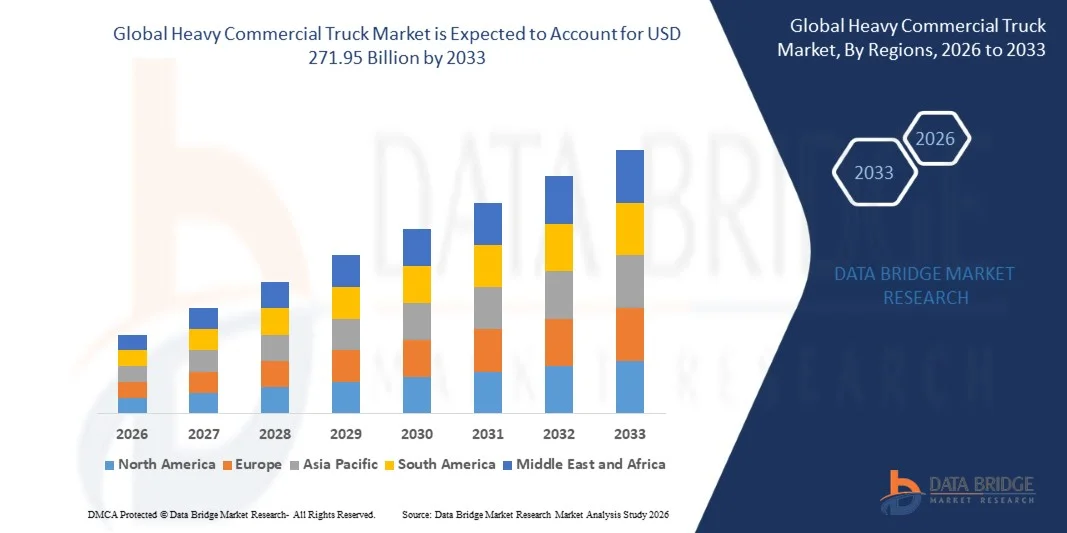
The Heavy Commercial Truck Market was valued at USD 216.36 billion in 2025 and is projected to reach USD 271.95 billion by 2033, growing at a CAGR of 2.90% from 2026 to 2033. The Heavy Commercial Truck Market is experiencing steady growth driven by increasing demand for freight transportation, expansion of e-commerce and logistics networks, infrastructure development activities, and rising adoption of advanced technologies in heavy-duty vehicles. The growing need for efficient goods movement, fleet modernization, and fuel-efficient transportation solutions is encouraging businesses and governments to invest in next-generation heavy commercial trucks.
The increasing focus on reducing carbon emissions, improving operational efficiency, and enhancing road safety, combined with stricter emission regulations worldwide, is accelerating the adoption of electric, hybrid, and alternative-fuel heavy trucks. Advanced driver assistance systems (ADAS), connected fleet solutions, and autonomous driving technologies are further transforming the heavy commercial vehicle landscape, enabling improved fleet management, reduced operating costs, and enhanced safety across logistics, construction, mining, and industrial applications.
Key Market Trends & Insights
- North America dominated the Heavy Commercial Truck Market with the largest revenue share of 34.2% in 2025, supported by strong commercial vehicle demand, well-established logistics networks, increasing fleet modernization, and rising investments in electric and autonomous heavy truck technologies.
- The Diesel segment dominated the market with a 71.9% share in 2025, due to its high efficiency, reliability, long-distance capability, and established fueling infrastructure.
- Asia-Pacific is expected to be the fastest-growing region at a CAGR of 6.9% from 2026 to 2033, fueled by rapid industrialization, infrastructure development, increasing freight movement, government initiatives supporting commercial vehicle production, and rising demand in China, India, and Southeast Asian countries.
- Electric heavy commercial trucks are the fastest-growing technology segment, projected to register a CAGR of 12.1%, supported by stricter emission regulations, fleet electrification initiatives, advancements in battery technology, and increasing investments from truck manufacturers in zero-emission transportation solutions.
- The freight transportation segment dominates the application category with a 52.6% revenue share in 2025, led by increasing demand for efficient goods movement, expansion of logistics and supply chain operations, and rising adoption of heavy trucks for commercial cargo transportation.
Market Size & Forecast
- Global Market Value (2025): USD 216.36 Billion
- Expected Market Value (2033): USD 271.95 Billion
- Forecast CAGR (2026–2033): 2.90%
- Leading Region in 2025: North America
- Fastest Growing Region: Asia-Pacific
Report Scope and Heavy Commercial Truck Market Segmentation
|
Attributes |
Heavy Commercial Truck Key Market Insights |
|
Segments Covered |
|
|
Countries Covered |
North America · U.S. · Canada · Mexico Europe · Germany · France · U.K. · Netherlands · Switzerland · Belgium · Russia · Italy · Spain · Turkey · Rest of Europe Asia-Pacific · China · Japan · India · South Korea · Singapore · Malaysia · Australia · Thailand · Indonesia · Philippines · Rest of Asia-Pacific Middle East and Africa · Saudi Arabia · U.A.E. · South Africa · Egypt · Israel · Rest of Middle East and Africa South America · Brazil · Argentina · Rest of South America |
|
Key Market Players |
• Daimler Truck Holding AG (Germany) |
|
Market Opportunities |
· Growing Adoption of Electric and Alternative-Fuel Heavy Trucks · Expansion of E-Commerce and Global Logistics Networks · Integration of Autonomous Driving and Connected Truck Technologies |
|
Value Added Data Infosets |
In addition to the insights on market scenarios such as market value, growth rate, segmentation, geographical coverage, and major players, the market reports curated by the Data Bridge Market Research also include in-depth expert analysis, geographically represented company-wise production and capacity, network layouts of distributors and partners, detailed and updated price trend analysis and deficit analysis of supply chain and demand. |
Heavy Commercial Truck Market Trends
Trend: Growth in Electrification & Connected Heavy Commercial Trucks
Heavy commercial truck manufacturers are increasingly focusing on electrification, connectivity, and intelligent fleet technologies to improve operational efficiency, reduce emissions, and comply with stringent environmental regulations. Fleet operators are adopting electric and connected heavy trucks for urban logistics, regional transportation, and last-mile applications, supported by advancements in battery technology, telematics, and charging infrastructure. For instance, in 2024, major manufacturers including Daimler Truck AG and Volvo Trucks continued expanding their zero-emission truck portfolios, highlighting the accelerating shift toward sustainable commercial transportation. The integration of real-time vehicle data, predictive maintenance systems, and AI-powered fleet analytics is enabling operators to optimize routes, reduce downtime, and improve total cost of ownership.
Heavy Commercial Truck Market Dynamics
Key Market Driver: Rising Demand for Freight Transportation & Logistics Expansion
The rapid growth of global trade, e-commerce, and supply chain networks is significantly increasing demand for heavy commercial trucks used in long-haul transportation, construction, mining, and industrial logistics. Companies are expanding fleet capacity to support higher freight volumes, while governments are investing in road infrastructure and transportation networks to improve connectivity. According to industry estimates, global road freight activity is expected to continue rising through the decade, particularly in emerging economies where manufacturing expansion and urbanization are increasing demand for goods movement. The growth of organized logistics providers and third-party transportation services is further accelerating adoption of modern heavy trucks equipped with advanced safety, fuel-efficiency, and connectivity features.
Key Restraint/Challenge: High Operating Costs & Regulatory Pressure on Heavy Trucks
A major challenge affecting the Heavy Commercial Truck Market is the high cost associated with vehicle ownership, fuel consumption, maintenance, and compliance with evolving emission regulations. Heavy trucks require significant investment due to expensive components, advanced safety systems, and rising technology integration costs. In addition, stricter emission standards such as Euro 7 Emission Standards in Europe and tightening carbon reduction policies globally are increasing development and manufacturing costs for truck OEMs. The transition toward electric and hydrogen-powered heavy trucks also faces challenges related to high battery costs, limited charging infrastructure, and longer vehicle payback periods, particularly for long-haul applications.
Key Market Opportunity: Expansion of Electric & Autonomous Heavy Truck Technologies
The development of electric, autonomous, and connected heavy commercial trucks presents a major growth opportunity for market participants. OEMs and technology providers are investing heavily in autonomous driving systems, battery-electric platforms, and hydrogen fuel-cell solutions to improve efficiency and reduce emissions in commercial transportation. For example, in 2024, Tesla continued scaling development and deliveries of its Tesla Semi electric truck platform, while companies such as Einride advanced autonomous and electric freight solutions for logistics operations. AI-based driver assistance, platooning technologies, and predictive fleet management systems are expected to create new opportunities by improving safety, reducing fuel consumption, and enabling next-generation freight mobility solutions.
Heavy Commercial Truck Market Scope
The heavy commercial truck market is segmented on the basis of truck type, class, fuel type, and application.
- By Truck Type
On the basis of truck type, the Heavy Commercial Truck Market is segmented into semi-trailer trucks, 18-wheeler trucks, tanker trucks, heavy trucks, flatbed trucks, garbage trucks, dump trucks, and panel trucks. The Semi-Trailer Truck segment dominated the market with a 38.6% share in 2025, owing to its extensive utilization in long-haul freight transportation, logistics networks, and industrial cargo movement. These trucks provide high payload capacity, flexibility, and operational efficiency, making them highly preferred by fleet operators, transportation companies, and logistics providers. The growing expansion of e-commerce, international trade, and cross-border transportation activities is significantly increasing demand for semi-trailer trucks. In addition, advancements in connected vehicle technologies, fuel-efficient engines, and driver assistance systems are enhancing vehicle performance and supporting segment growth. Rising investments in fleet modernization and replacement of aging commercial vehicles are further strengthening the dominance of semi-trailer trucks globally.
The Dump Truck segment is projected to register the fastest growth at a CAGR of 7.1% from 2026 to 2033, driven by increasing demand from construction, mining, infrastructure development, and large-scale industrial projects. Growing urbanization, government investments in roads, bridges, and smart city projects are creating strong demand for heavy-duty material transportation vehicles. Dump trucks are widely used for transporting construction materials, minerals, and waste due to their high durability and carrying capacity. Furthermore, the adoption of autonomous dump trucks, electric powertrains, and advanced telematics solutions is improving productivity and reducing operating costs. Increasing mining activities and the need for efficient material handling solutions are expected to accelerate segment growth during the forecast period.
- By Class
On the basis of class, the Heavy Commercial Truck Market is segmented into Class 5, Class 6, Class 7, and Class 8 trucks. The Class 8 Truck segment dominated the market with a 44.7% share in 2025, supported by its widespread application in long-distance freight transportation, heavy logistics operations, construction, mining, and industrial transportation. Class 8 trucks offer superior horsepower, higher payload capacity, and enhanced durability, making them essential for demanding commercial applications. The increasing volume of freight movement, expansion of logistics infrastructure, and growing demand for heavy-duty transportation solutions are driving adoption of Class 8 trucks. In addition, fleet operators are increasingly investing in modern Class 8 trucks equipped with advanced safety technologies, telematics, automated transmissions, and fuel-efficient systems. Government regulations focused on emission reduction are also encouraging manufacturers to develop cleaner and more efficient Class 8 vehicle solutions.
The Class 7 Truck segment is expected to witness the fastest CAGR of 6.8% from 2026 to 2033, driven by rising demand for medium-heavy commercial vehicles used in regional transportation, urban delivery, waste management, and municipal operations. Increasing growth of last-mile delivery services and urban logistics networks is creating significant opportunities for Class 7 trucks. These vehicles provide a balance between payload capability and maneuverability, making them suitable for diverse commercial applications. In addition, the growing adoption of electric and hybrid Class 7 trucks is supporting market expansion as businesses focus on reducing fuel costs and emissions. Rising demand from construction, utility, and service industries is further contributing to segment growth.
- By Fuel
On the basis of fuel type, the Heavy Commercial Truck Market is segmented into diesel, natural gas, hybrid electric vehicle, and gasoline. The Diesel segment dominated the market with a 71.9% share in 2025, due to its high efficiency, reliability, long-distance capability, and established fueling infrastructure. Diesel-powered trucks continue to be widely adopted across freight transportation, construction, mining, and logistics applications where high torque and continuous operation are required. The availability of extensive diesel service networks, lower initial vehicle costs, and proven performance under heavy-load conditions are supporting segment dominance. In addition, advancements in diesel engine technology, including improved fuel efficiency and emission control systems, are helping manufacturers comply with evolving environmental regulations. Despite increasing adoption of alternative fuels, diesel remains the preferred choice for many heavy commercial applications due to operational reliability and cost advantages.
The hybrid electric vehicle segment is projected to register the fastest growth at a CAGR of 12.4% from 2026 to 2033, driven by increasing focus on vehicle electrification, emission reduction targets, and rising fuel efficiency requirements. Hybrid trucks combine conventional engines with electric power systems to reduce fuel consumption and improve operational performance. Growing government incentives, stricter emission standards, and investments by major truck manufacturers in hybrid technologies are accelerating adoption. Fleet operators are increasingly adopting hybrid trucks to reduce operating expenses and meet sustainability goals. Furthermore, improvements in battery technology, energy management systems, and regenerative braking technologies are enhancing the efficiency and commercial viability of hybrid heavy trucks.
- By Application
On the basis of application, the Heavy Commercial Truck Market is segmented into agriculture, logistics, construction, and mining. The Logistics segment dominated the market with a 42.3% share in 2025, driven by rapid growth in global trade, e-commerce activities, warehouse expansion, and increasing freight transportation requirements. Heavy commercial trucks are essential for supply chain operations due to their ability to transport large volumes of goods over long distances efficiently. The expansion of third-party logistics providers, increasing demand for faster deliveries, and growth of organized transportation networks are supporting segment growth. In addition, logistics companies are adopting connected fleet solutions, GPS tracking, and telematics systems to improve operational efficiency and reduce transportation costs. Rising investments in transportation infrastructure and fleet modernization programs are further strengthening the dominance of the logistics segment.
The Mining segment is expected to witness the fastest CAGR of 7.5% from 2026 to 2033, fueled by increasing mineral demand, expansion of mining activities, and rising investments in infrastructure and industrial development. Heavy commercial trucks are extensively used in mining operations for transporting raw materials, minerals, and overburden materials. The adoption of autonomous mining trucks, electric heavy-duty vehicles, and advanced fleet management technologies is improving productivity and operational efficiency. Growing demand for critical minerals required for renewable energy technologies and electric vehicles is further supporting mining activities worldwide. In addition, mining companies are focusing on sustainable operations, driving demand for fuel-efficient and low-emission heavy trucks.
Heavy Commercial Truck Market Regional Analysis
North America dominated the Heavy Commercial Truck Market and accounted for the largest revenue share of 34.2% in 2025, supported by strong commercial vehicle demand, well-established logistics and transportation networks, and increasing fleet replacement activities across industries. The region benefits from high freight movement, advanced manufacturing capabilities, and rising investments in electric, hydrogen-powered, and autonomous heavy truck technologies. Growing adoption of connected fleet solutions, advanced safety systems, and fuel-efficient vehicles, along with supportive government initiatives focused on emission reduction and transportation efficiency, continues to strengthen North America’s leading position in the global market.
U.S. Heavy Commercial Truck Market Insight
The U.S. heavy commercial truck market is witnessing steady growth due to increasing freight transportation demand, expansion of e-commerce and logistics operations, and rising investments in fleet modernization. The country’s strong trucking industry, advanced highway infrastructure, and presence of major heavy truck manufacturers are driving market expansion. In addition, growing adoption of electric trucks, autonomous driving technologies, telematics, and advanced driver assistance systems (ADAS) is accelerating innovation across commercial transportation, logistics, and industrial applications.
Europe Heavy Commercial Truck Market Insight
The Europe heavy commercial truck market is expanding due to stringent emission regulations, increasing focus on sustainable transportation, and rising adoption of advanced commercial vehicle technologies. Government initiatives supporting low-emission mobility, electrification of heavy-duty vehicles, and carbon reduction targets are encouraging manufacturers to invest in electric and alternative-fuel trucks. The region’s strong automotive manufacturing ecosystem and emphasis on connected and efficient transportation solutions are supporting continued market growth.
U.K. Heavy Commercial Truck Market Insight
The U.K. Heavy commercial truck market is growing steadily, driven by increasing freight transportation requirements, logistics sector expansion, and rising demand for efficient and sustainable commercial vehicles. Government efforts toward reducing transport emissions and promoting zero-emission vehicles are encouraging the adoption of electric and alternative-fuel heavy trucks. Furthermore, advancements in fleet management systems, vehicle connectivity, and autonomous technologies are creating new growth opportunities in the market.
Germany Heavy Commercial Truck Market Insight
The Germany heavy commercial truck market is expanding due to its strong automotive manufacturing base, advanced engineering capabilities, and increasing focus on sustainable heavy-duty transportation. The country is witnessing rising investments in electric trucks, hydrogen fuel cell technologies, and intelligent transportation systems. Leading automotive manufacturers are focusing on developing next-generation heavy commercial vehicles with improved efficiency, lower emissions, and enhanced safety features, supporting market growth.
Asia-Pacific Heavy Commercial Truck Market Insight
The Asia-Pacific heavy commercial truck market is expected to be the fastest-growing region at a CAGR of 6.9% from 2026 to 2033, driven by rapid industrialization, infrastructure development, increasing freight movement, and expanding logistics networks. Countries such as China, India, and Southeast Asian nations are witnessing rising demand for heavy commercial trucks due to growing construction activities, manufacturing expansion, and government initiatives supporting commercial vehicle production. Increasing investments in electric mobility, smart transportation systems, and fleet modernization are further accelerating regional market growth.
Japan Heavy Commercial Truck Market Insight
The Japan heavy commercial truck market is witnessing consistent growth due to advancements in automotive technology, increasing demand for efficient freight transportation, and strong focus on low-emission mobility solutions. The country is investing in electric and hydrogen-powered heavy trucks, autonomous driving technologies, and connected vehicle systems. The presence of established automotive manufacturers and continuous innovation in commercial vehicle technology are supporting market development.
China Heavy Commercial Truck Market Insight
The China heavy commercial truck market is growing rapidly, supported by expanding logistics operations, infrastructure development, industrial growth, and increasing freight transportation demand. Government initiatives promoting new energy vehicles, emission reduction, and domestic commercial vehicle production are accelerating the adoption of electric and alternative-fuel heavy trucks. In addition, China’s strong manufacturing ecosystem, growing e-commerce sector, and investments in autonomous and connected truck technologies are positioning the country as a key growth market globally.
Heavy Commercial Truck Market Share
The Heavy Commercial Truck industry is primarily led by well-established companies, including:
- Daimler Truck Holding AG (Germany)
- Volvo Group (Sweden)
- PACCAR Inc. (U.S.)
- Traton SE (Germany)
- Scania (Sweden)
- MAN Truck & Bus (Germany)
- Hino Motors (Japan)
- Isuzu Motors Limited (Japan)
- Tata Motors (India)
- Ashok Leyland (India)
- Hyundai Motor Company (South Korea)
- Hyundai Translead (U.S.)
- Penske Automotive Group (U.S.)
- Navistar (U.S.)
- International Truck (U.S.)
- Kenworth Truck Company (U.S.)
- Peterbilt Motors Company (U.S.)
- Mack Trucks (U.S.)
- Renault Trucks (France)
- IVECO Group (Italy)
- FAW Group (China)
- Dongfeng Motor Corporation (China)
- Sinotruk (China National Heavy Duty Truck Group) (China)
- Foton Motor Group (China)
- XCMG Group (China)
- BYD Company Limited (China)
- Nikola Corporation (U.S.)
- Tesla, Inc. (U.S.)
- Rivian Automotive (U.S.)
- Hyliion Holdings Corp. (U.S.)
- Volta Trucks (United Kingdom)
- Einride (Sweden)
- Daimler Truck North America (U.S.)
Latest Developments in Heavy Commercial Truck Market
- In May 2024, Volvo Group and Daimler Truck announced plans to establish a joint venture focused on developing a software-defined vehicle platform for heavy-duty commercial vehicles. The initiative aims to accelerate digital transformation in the trucking industry by creating a common operating system and advanced software architecture to enable connected, efficient, and intelligent trucks. The development highlights the industry’s shift toward digitalization, autonomous capabilities, and improved fleet management solutions
- In January 2024, Volvo Trucks announced the launch of new heavy-duty truck models globally, including an updated heavy-duty platform for North America and new truck ranges for Europe, Australia, and other markets. The new portfolio focuses on improved energy efficiency, reduced carbon emissions, and compatibility with electric and renewable fuel technologies. This launch supports Volvo’s strategy to expand sustainable heavy commercial vehicle solutions and move toward a net-zero emission product portfolio
- In November 2024, Daimler Truck started series production of the Mercedes-Benz eActros 600 electric truck for long-distance haulage at its Wörth production facility in Germany. The battery-electric heavy truck is designed for long-distance freight transportation and represents a major step toward electrification of heavy-duty trucking. The model incorporates advanced battery technology and supports the transition toward zero-emission commercial transportation
- In June 2025, Volvo Group and Daimler Truck launched Coretura AB, a joint venture focused on developing software solutions for future commercial vehicles. The company aims to create a software-defined vehicle platform that enables advanced digital applications, connectivity, and intelligent vehicle functions. The development reflects increasing collaboration among major truck manufacturers to accelerate innovation in next-generation heavy commercial vehicles
- In January 2025, Amazon announced an order of 200 Mercedes-Benz eActros 600 electric heavy trucks from Daimler Truck for operations in Germany and the U.K. The deployment represents one of the largest electric heavy truck orders for logistics applications and supports Amazon’s goal of reducing transportation emissions. The trucks are expected to be integrated into high-mileage logistics routes, demonstrating growing commercial adoption of electric heavy-duty vehicles

- Interactive Data Analysis Dashboard
- Company Analysis Dashboard for high growth potential opportunities
- Research Analyst Access for customization & queries
- Competitor Analysis with Interactive dashboard
- Latest News, Updates & Trend analysis
- Harness the Power of Benchmark Analysis for Comprehensive Competitor Tracking
Data collection and base year analysis are done using data collection modules with large sample sizes. The stage includes obtaining market information or related data through various sources and strategies. It includes examining and planning all the data acquired from the past in advance. It likewise envelops the examination of information inconsistencies seen across different information sources. The market data is analysed and estimated using market statistical and coherent models. Also, market share analysis and key trend analysis are the major success factors in the market report. To know more, please request an analyst call or drop down your inquiry.
The key research methodology used by DBMR research team is data triangulation which involves data mining, analysis of the impact of data variables on the market and primary (industry expert) validation. Data models include Vendor Positioning Grid, Market Time Line Analysis, Market Overview and Guide, Company Positioning Grid, Patent Analysis, Pricing Analysis, Company Market Share Analysis, Standards of Measurement, Global versus Regional and Vendor Share Analysis. To know more about the research methodology, drop in an inquiry to speak to our industry experts.
Data Bridge Market Research is a leader in advanced formative research. We take pride in servicing our existing and new customers with data and analysis that match and suits their goal. The report can be customized to include price trend analysis of target brands understanding the market for additional countries (ask for the list of countries), clinical trial results data, literature review, refurbished market and product base analysis. Market analysis of target competitors can be analyzed from technology-based analysis to market portfolio strategies. We can add as many competitors that you require data about in the format and data style you are looking for. Our team of analysts can also provide you data in crude raw excel files pivot tables (Fact book) or can assist you in creating presentations from the data sets available in the report.













