


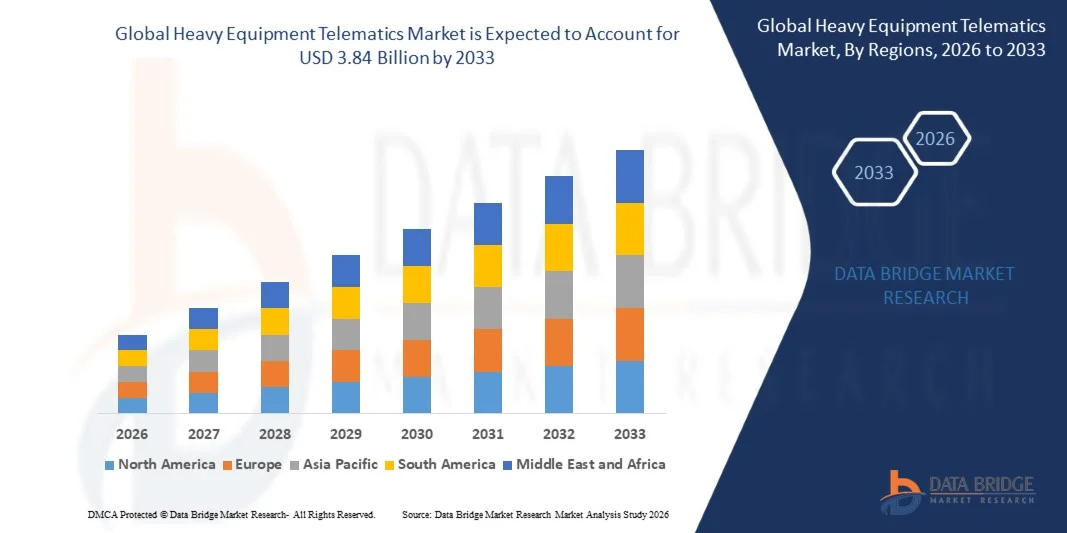
Heavy Equipment Telematics Market Size
- The global heavy equipment telematics market size was valued at USD 1.45 billion in 2025 and is expected to reach USD 3.84 billion by 2033, at a CAGR of 12.90% during the forecast period
- The market growth is largely driven by the increasing adoption of IoT-enabled machinery, fleet connectivity, and automation across construction, mining, and agriculture sectors, enabling operators to streamline performance monitoring, reduce operational downtime, and enhance equipment productivity through real-time insights
- Furthermore, rising demand for fuel management, predictive maintenance, and centralized asset tracking is positioning telematics as a core operational requirement rather than an optional technology, accelerating deployment across both OEM-integrated equipment and aftermarket telematics installations
Heavy Equipment Telematics Market Analysis
- Heavy equipment telematics systems, offering real-time equipment tracking, usage monitoring, fuel analytics, and remote diagnostics, are becoming critical for industries focused on improving operational efficiency and equipment lifecycle performance. These systems help businesses reduce idle time, enhance safety compliance, and optimize fleet utilization, making telematics increasingly valuable in high-capital machinery environments
- The rising adoption of telematics is primarily fueled by infrastructure expansion, stringent regulatory frameworks around emissions and safety reporting, and the growing shift toward digital asset management. The market continues to advance as fleet owners seek better cost control, automation-driven workflows, and intelligent insights to support smarter decision-making and maximize equipment ROI
- North America dominated the heavy equipment telematics market with a share of 46.6% in 2025, due to the increasing adoption of advanced fleet management technologies across construction, mining, and agriculture sectors
- Asia-Pacific is expected to be the fastest growing region in the heavy equipment telematics market during the forecast period due to rapid urbanization, expanding infrastructure projects, and government support for digital transformation in construction and mining operations
- Embedded segment dominated the market with a market share of 48.8% in 2025, due to increasing OEM integration of telematics into construction and mining equipment as standard hardware. Embedded platforms offer improved reliability, seamless connectivity, and better compatibility with advanced software analytics powered by machine learning and predictive diagnostics. The preference for embedded solutions grows as buyers increasingly compare equipment based on digital intelligence and automation readiness. OEMs also use embedded telematics to build recurring value streams through subscription-based service dashboards, maintenance programs, and analytics offerings
Report Scope and Heavy Equipment Telematics Market Segmentation
|
Attributes |
Heavy Equipment Telematics Key Market Insights |
|
Segments Covered |
|
|
Countries Covered |
North America
Europe
Asia-Pacific
Middle East and Africa
South America
|
|
Key Market Players |
|
|
Market Opportunities |
|
|
Value Added Data Infosets |
In addition to the market insights such as market value, growth rate, market segments, geographical coverage, market players, and market scenario, the market report curated by the Data Bridge Market Research team includes in-depth expert analysis, import/export analysis, pricing analysis, production consumption analysis, and pestle analysis. |
Heavy Equipment Telematics Market Trends
“Growing Integration of AI-Enabled Predictive Maintenance Systems”
- The growing integration of AI-enabled predictive maintenance systems is emerging as a defining trend in the heavy equipment telematics market, driven by the need for advanced maintenance accuracy, reduced downtime, and improved lifecycle performance of machinery. These systems analyze real-time operational data such as fuel usage, vibration patterns, hydraulic pressure, and temperature fluctuations to predict failures before they occur, helping operators reduce unexpected operational disruptions and optimize equipment health
- For instance, Caterpillar uses AI-driven analytics in its VisionLink telematics platform to provide predictive insights on engine failures, wear component conditions, and service optimization scheduling, enabling customers to minimize maintenance costs and enhance fleet reliability
- AI-based predictive maintenance enhances decision-making capabilities by transforming raw machine data into actionable insights, supporting smarter service scheduling and fleet planning strategies. With industries prioritizing equipment uptime and operational continuity, AI-driven telematics is becoming a core technology requirement in construction, mining, and agriculture applications
- As demand increases for automation, operational intelligence, and cost-efficient asset management, predictive maintenance adoption will continue to strengthen. This trend signals a shift from traditional monitoring systems toward fully automated and intelligent telematics ecosystems where AI plays a central role in maintaining asset lifespan, optimizing workflows, and improving return on investment
- The accelerating integration of AI into telematics platforms indicates the future direction of the market, positioning predictive automation as a strategic cornerstone for global heavy equipment and large-scale digital fleet operations
Heavy Equipment Telematics Market Dynamics
Driver
“Rising Demand for Real-Time Fleet Visibility and Operational Efficiency”
- The rising demand for real-time fleet visibility and operational efficiency is a key driver accelerating the use of telematics in heavy machinery fleets. Companies seek systems that enable continuous monitoring of equipment utilization, fuel consumption, operator behavior, and machine health to support cost optimization and improve workforce productivity across distributed worksites
- For instance, Trimble’s WorksOS platform supports multi-equipment connectivity and real-time performance tracking, enabling operators to monitor equipment remotely, optimize utilization, and improve operational decision-making across mining and construction fleets
- Real-time visibility empowers fleet owners to automate tracking, reduce idle time, prevent unauthorized usage, and enhance maintenance scheduling accuracy, supporting measurable cost savings. The ability to remotely monitor fleets across large industrial and infrastructure environments further accelerates adoption, particularly as project complexity increases
- With industries increasingly prioritizing automation, operational transparency, and digitalized fleet management, telematics is becoming an essential tool for improving long-term productivity and strengthening operational strategies across equipment-intensive environments
- As organizations continue to modernize their asset management frameworks, demand for intelligent fleet visibility systems will remain central to future growth of the heavy equipment telematics market
Restraint/Challenge
“High Installation and Integration Costs”
- High installation and integration costs remain a significant challenge for widespread adoption of heavy equipment telematics, particularly among small-scale operators and mixed-equipment fleets. Expenses related to hardware installation, software licensing, and data plan subscriptions can limit adoption, especially when integrating older equipment without built-in telematics compatibility
- For instance, retrofitting aftermarket telematics solutions on older machines often requires additional interfaces, connectivity modules, and platform adjustments, increasing deployment complexity and cost burden for fleet owners
- The integration process can also become challenging when managing multi-brand fleets with varying communication protocols, data structures, and compatibility standards, requiring additional system calibration and configuration to achieve seamless interoperability
- Training requirements, platform onboarding, and system maintenance support further contribute to the total cost of ownership, creating barriers for companies operating on limited budgets
- Reducing cost hurdles through modular pricing models, interoperable platforms, and simplified integration frameworks will be essential for achieving broader adoption and long-term market scalability across global fleet operations
Heavy Equipment Telematics Market Scope
The market is segmented on the basis of service, connectivity, sales channel, form factor, hardware, and industry.
• By Service
On the basis of service, the heavy equipment telematics market is segmented into navigation & asset tracking, equipment/fleet maintenance & diagnostics, fuel management, fleet performance reporting, fleet safety, and others. Navigation & asset tracking dominated the market in 2025 due to the growing demand for real-time visibility of equipment across construction, mining, and agriculture operations. Companies focus on reducing equipment theft, unauthorized use, and downtime, which strengthens demand for these services. The adoption of GPS-enabled tracking modules integrated with cloud-based dashboards gives fleet managers accurate utilization insights and helps optimize machine allocation on sites. The segment further benefits from increasing digitalization initiatives among government infrastructure and commercial construction projects to enhance operational transparency and safety compliance.
Fleet safety is expected to witness the fastest growth from 2026 to 2033, fueled by stricter workplace safety regulations and the rising need to minimize on-site accidents involving heavy machinery. Industries such as mining and construction are integrating AI-powered video telematics, operator behavior analysis, geofencing alerts, and fatigue detection to enhance workforce protection. Businesses are increasingly prioritizing insurance-linked safety systems that help reduce claims and operational risks. The shift toward predictive risk prevention, automated safety reporting, and compliance monitoring reinforces the growing adoption of fleet safety solutions in modern telematics environments.
• By Connectivity
On the basis of connectivity, the market is segmented into satellite and cellular (3G/4G and 5G). Cellular connectivity dominated the market in 2025, supported by widespread mobile network availability and advancements in 4G and early 5G implementation across industrial regions. The affordability, faster data transmission capability, and seamless integration with IoT platforms make cellular telematics the preferred choice for heavy equipment OEMs and fleet operators. Cloud-connected platforms leveraging 4G/5G offer real-time diagnostics, location tracking, machine usage monitoring, and maintenance alerts, leading to better operational productivity. The growing ecosystem of connected construction and agricultural machinery further accelerates the use of cellular networks in telematics systems.
Satellite connectivity is projected to witness the fastest growth during the forecast period, driven by high usage in remote mining sites, energy projects, large agricultural farms, and infrastructure development in regions with limited terrestrial cellular coverage. Satellite telematics ensures uninterrupted data transmission, making it essential for safety-critical and mission-critical heavy equipment operations. Increasing demand for autonomous and semi-autonomous equipment in extreme terrains strengthens the importance of satellite-based systems. The integration of low-earth-orbit satellite networks enhances bandwidth reliability, reducing latency challenges and supporting advanced telematics analytics even in isolated environments.
• By Sales Channel
On the basis of sales channel, the market is segmented into new sales and existing fleet. The new sales segment accounted for the largest share in 2025, driven by the increasing installation of factory-fitted telematics systems in new equipment by major OEMs. Manufacturers focus on embedded cloud-connected solutions to enhance value propositions, warranty management, predictive analytics, and machine life tracking. Government mandates for digital monitoring of emissions, equipment usage, and operator safety further accelerate factory integration. The shift toward integrated and interoperable machinery ecosystems reinforces the preference for telematics-enabled equipment during purchase cycles.
The existing fleet segment is expected to grow at the fastest rate from 2026 to 2033 as companies upgrade legacy machinery to improve performance visibility, safety compliance, and fuel efficiency. Affordable aftermarket telematics kits and modular hardware upgrades enable older machines to connect with modern digital platforms without high replacement costs. Demand for retrofit solutions increases as businesses aim to reduce operational costs and extend the lifecycle of costly machinery. The adoption of telematics-based asset optimization programs in rental fleets and mixed-brand operations further drives the accelerated growth of this segment.
• By Form Factor
On the basis of form factor, the market is segmented into embedded and integrated. Embedded systems dominated the market with the largest share of 48.8% in 2025, driven by increasing OEM integration of telematics into construction and mining equipment as standard hardware. Embedded platforms offer improved reliability, seamless connectivity, and better compatibility with advanced software analytics powered by machine learning and predictive diagnostics. The preference for embedded solutions grows as buyers increasingly compare equipment based on digital intelligence and automation readiness. OEMs also use embedded telematics to build recurring value streams through subscription-based service dashboards, maintenance programs, and analytics offerings.
Integrated solutions are anticipated to grow fastest during the forecast period, fueled by rising adoption among existing fleet operators seeking cost-effective modernization. Integrated aftermarket systems provide flexibility to deploy telematics across mixed brands, older machinery, and rental fleets without major modification. Businesses increasingly choose plug-and-play telematics modules to enable preventive maintenance scheduling, operator monitoring, and machine tracking. The growth of interoperability standards, open-platform software ecosystems, and hardware customization drives rapid expansion in this category.
• By Hardware
On the basis of hardware, the market includes telematics control units, GPS receivers, and sensors. Telematics control units (TCU) dominated the market in 2025, driven by their role as the core processing and communication hub of heavy equipment telematics systems. TCUs enable continuous data collection on engine performance, usage hours, fault codes, and operating conditions. Their integration with cloud services, GPS modules, and advanced connectivity networks strengthens their adoption across OEMs and fleet operators. The rising need for predictive maintenance and operational automation continues reinforcing dominance of this hardware component in telematics infrastructure.
Sensors are expected to record the fastest growth rate between 2026 and 2033, fueled by expansion in advanced monitoring, predictive analytics, and real-time machine performance intelligence. Increasing deployment of multi-parameter sensors for hydraulic pressure, vibration, temperature, fuel levels, wear, and load measurement accelerates sensor demand in modern equipment. Sensor-driven telematics enables precision maintenance, energy efficiency, enhanced operator safety, and autonomous machinery development. The shift from basic ECM reporting to intelligent machine-level data insights drives widespread integration of high-accuracy sensing technologies.
• By Industry
On the basis of industry, the market is segmented into construction, mining, and agriculture. Construction dominated the market in 2025, supported by large deployment of telematics-equipped machinery across global infrastructure, transportation, and commercial development projects. Contractors leverage telematics for project progress monitoring, machinery usage optimization, and safety compliance. The increasing use of equipment rentals also drives telematics for billing accuracy, utilization tracking, and theft protection. Digital transformation initiatives across public and private construction programs strengthen long-term adoption.
Mining is expected to witness the fastest growth through 2033, driven by the increasing reliance on telematics for precision operations, worker safety, autonomous fleet control, and productivity optimization in complex and hazardous mining environments. Mining operators deploy advanced telematics to improve asset monitoring, reduce downtime, and enhance compliance with safety and environmental regulations. The adoption of satellite-based connectivity, smart sensors, and real-time analytics supports autonomous haulage systems and remote mine operations.
Heavy Equipment Telematics Market Regional Analysis
- North America dominated the heavy equipment telematics market with the largest revenue share of 46.6% in 2025, driven by the increasing adoption of advanced fleet management technologies across construction, mining, and agriculture sectors
- The strong presence of key telematics providers and OEM integrations is accelerating widespread implementation among equipment owners and rental companies
- Businesses in the region prioritize real-time equipment monitoring, predictive maintenance, and fuel efficiency optimization to reduce operational costs and enhance productivity. The availability of high-performance connectivity infrastructure and growing demand for centralized asset management platforms further supports the rapid integration of telematics systems across fleets
U.S. Heavy Equipment Telematics Market Insight
The U.S. captured the largest revenue share within North America in 2025, fueled by high telematics penetration among construction, oil and gas, and mining industries. Growing investments in large-scale infrastructure development and the rising need to manage heavy machinery across multiple job sites are a major contributor to adoption. In addition, stringent regulatory requirements on emissions monitoring, safety compliance, and equipment utilization reporting are driving companies to deploy telematics for automated data tracking and smarter equipment lifecycle management.
Europe Heavy Equipment Telematics Market Insight
The Europe heavy equipment telematics market is projected to grow at a substantial CAGR throughout the forecast period, supported by strict governmental regulations on fleet safety, emissions reduction, and equipment maintenance documentation. Increasing digitalization across construction and industrial operations is encouraging fleet owners to adopt telematics for seamless data-driven decision-making. The region is witnessing heightened adoption across energy, rail, utility, and infrastructure modernization projects, positioning telematics as a strategic tool for operational efficiency.
U.K. Heavy Equipment Telematics Market Insight
The U.K. heavy equipment telematics market is anticipated to expand at a noteworthy CAGR due to rising demand for connected machinery and real-time monitoring solutions among construction and rental companies. Growing emphasis on cost control, asset theft prevention, and maintenance optimization is encouraging adoption across urban infrastructure projects. The country’s advancement toward smart construction ecosystems and the integration of digital worksite management systems is expected to drive further deployment.
Germany Heavy Equipment Telematics Market Insight
The Germany heavy equipment telematics market is expected to grow at a significant CAGR during the forecast period, propelled by the country’s strong industrial base and focus on engineering-driven automation. Increasing adoption of Industry 4.0 practices and high equipment utilization standards among manufacturers and contractors support telematics implementation. Germany’s emphasis on sustainability, emissions reporting, and enhanced machine intelligence is also accelerating integration with OEM-built smart machinery.
Asia-Pacific Heavy Equipment Telematics Market Insight
The Asia-Pacific region is expected to record the fastest CAGR from 2026 to 2033, driven by rapid urbanization, expanding infrastructure projects, and government support for digital transformation in construction and mining operations. Countries such as China, India, and Japan are increasing implementation of IoT-based machinery tracking systems to improve productivity, reduce downtime, and support equipment automation. The region benefits from rapidly growing manufacturing capacity and competitive pricing, making telematics systems more accessible to large and mid-sized fleet operators.
Japan Heavy Equipment Telematics Market Insight
The Japan market is witnessing accelerating telematics adoption due to the country’s strong focus on automation, robotics, and smart construction technologies. Growing labor shortages and demand for autonomous or semi-autonomous machinery are creating strong interest among contractors to adopt intelligent monitoring platforms. The integration of telematics with IoT ecosystems, digital jobsite mapping, and AI-based analytics is expanding usage in large infrastructure, rail, and public development projects.
China Heavy Equipment Telematics Market Insight
China accounted for the largest revenue share in Asia-Pacific in 2025 due to large-scale infrastructure investments, high equipment density, and strong local telematics manufacturing capabilities. The country’s rapid adoption of smart construction platforms and government-led digitalization initiatives are significantly boosting market growth. Telematics usage is expanding across construction, mining, and smart city development projects, supported by competitive pricing and OEM-integrated machine intelligence systems.
Heavy Equipment Telematics Market Share
The heavy equipment telematics industry is primarily led by well-established companies, including:
- Caterpillar Inc. (U.S.)
- Komatsu Ltd. (Japan)
- Volvo Construction Equipment (Sweden)
- Hitachi Construction Machinery Co., Ltd. (Japan)
- Deere & Company (U.S.)
- Liebherr Group (Germany)
- JCB Ltd. (U.K.)
- Trimble Inc. (U.S.)
- Topcon Corporation (Japan)
- Doosan Infracore (South Korea)
- CNH Industrial N.V. (U.K.)
- Hyundai Construction Equipment Co., Ltd. (South Korea)
- Terex Corporation (U.S.)
- Hexagon AB (Sweden)
- Sandvik AB (Sweden)
Latest Developments in Global Heavy Equipment Telematics Market
- In June 2025, Samsara introduced advanced AI-driven wearables and predictive maintenance capabilities aimed at enhancing fleet safety and operational reliability. This rollout improves situational awareness for frontline workers and strengthens fleet navigation, diagnostics, and repair automation. The development is expected to accelerate AI adoption across the heavy equipment telematics market by enabling organizations to reduce incidents, optimize asset performance, and lower lifecycle operating costs, positioning Samsara as a key innovation leader in connected operations
- In May 2025, Trimble launched Trimble Materials, an integrated procurement and inventory solution designed to unify construction workflows under the Trimble Construction One cloud ecosystem. By bridging communication between project teams, suppliers, and warehouse operations, the launch advances digital site coordination, reduces material delays, and supports data-driven cost management. This development significantly strengthens telematics value by expanding its role beyond equipment tracking into full project-execution intelligence, supporting smarter resource planning and operational transparency
- In May 2025, Topcon entered a strategic Memorandum of Understanding with Vemcon GmbH to expand access to automated 2D-to-3D excavator control systems across EMEA and other global markets. The collaboration enhances accessibility to precision machine guidance and accelerates contractors’ transition to smart construction technologies. With increasing demand for automation and efficiency improvement in earthmoving equipment, this partnership is expected to boost telematics penetration by integrating machine control, remote diagnostics, and operator-assist capabilities into mainstream fleet operations
- In April 2025, HCSS announced the integration of Samsara’s telematics feed into the HCSS Telematics platform, enabling construction firms to centrally manage mixed heavy equipment and road fleets from a unified dashboard. This interoperability upgrade strengthens telematics value by reducing data silos, improving cross-fleet visibility, and supporting automated compliance, maintenance scheduling, and utilization reporting. The integration aligns with growing industry demand for centrally connected ecosystems and is expected to accelerate telematics adoption among medium and large construction enterprises
- In April 2025, ACTIA introduced its Digital Ecosystem, a full lifecycle support platform enabling seamless machine monitoring from manufacturing to field use and maintenance workflows. The solution improves uptime through predictive analytics and strengthens OEM capabilities to deliver connected machine services and aftermarket support. This innovation enhances the role of telematics in lifecycle value creation and positions ACTIA as a strategic enabler of digital-first equipment ecosystems, supporting OEMs and fleet operators adopting intelligent, connected, and data-driven machinery models

- Interactive Data Analysis Dashboard
- Company Analysis Dashboard for high growth potential opportunities
- Research Analyst Access for customization & queries
- Competitor Analysis with Interactive dashboard
- Latest News, Updates & Trend analysis
- Harness the Power of Benchmark Analysis for Comprehensive Competitor Tracking
Data collection and base year analysis are done using data collection modules with large sample sizes. The stage includes obtaining market information or related data through various sources and strategies. It includes examining and planning all the data acquired from the past in advance. It likewise envelops the examination of information inconsistencies seen across different information sources. The market data is analysed and estimated using market statistical and coherent models. Also, market share analysis and key trend analysis are the major success factors in the market report. To know more, please request an analyst call or drop down your inquiry.
The key research methodology used by DBMR research team is data triangulation which involves data mining, analysis of the impact of data variables on the market and primary (industry expert) validation. Data models include Vendor Positioning Grid, Market Time Line Analysis, Market Overview and Guide, Company Positioning Grid, Patent Analysis, Pricing Analysis, Company Market Share Analysis, Standards of Measurement, Global versus Regional and Vendor Share Analysis. To know more about the research methodology, drop in an inquiry to speak to our industry experts.
Data Bridge Market Research is a leader in advanced formative research. We take pride in servicing our existing and new customers with data and analysis that match and suits their goal. The report can be customized to include price trend analysis of target brands understanding the market for additional countries (ask for the list of countries), clinical trial results data, literature review, refurbished market and product base analysis. Market analysis of target competitors can be analyzed from technology-based analysis to market portfolio strategies. We can add as many competitors that you require data about in the format and data style you are looking for. Our team of analysts can also provide you data in crude raw excel files pivot tables (Fact book) or can assist you in creating presentations from the data sets available in the report.













