


What is the Global Helicopter Simulator Market Size and Growth Rate?
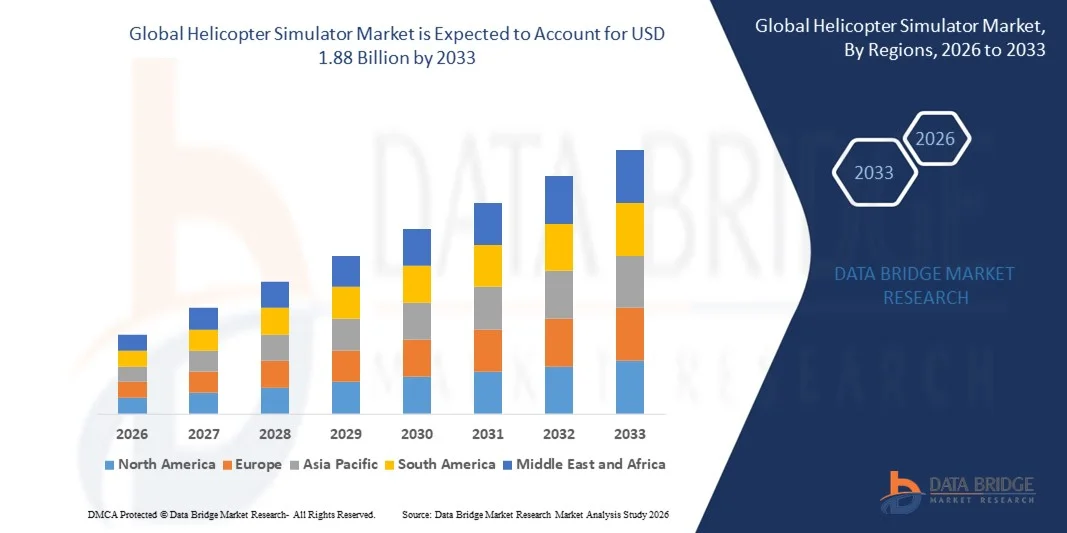
- The global helicopter simulator market size was valued at USD 1.23 billion in 2025 and is expected to reach USD 1.88 billion by 2033, at a CAGR of5.40% during the forecast period
- Increasing concerns about passenger safety, increase in number of helicopters, development of more efficient solutions in order to attract more customer, rising adoption of simulators for helicopter pilot training, rising need for safety of pilots, rising demand for helicopters for commercial activities, emergency medical services, increasing fuel costs are some of the major as well as vital factors which will likely to augment the growth of the helicopter simulator market
What are the Major Takeaways of Helicopter Simulator Market?
- Growing number of technological advancements along with increasing demand for full flight simulators (FFS) and quality of simulation products which will further contribute by generating massive opportunities that will lead to the growth of the helicopter simulator market in the above mentioned projected timeframe
- Increasing cost of the system along with rising number of technical faults which will such asly to act as market restraints factor for the growth of the helicopter simulator
- North America dominated the helicopter simulator market with a 41.89% revenue share in 2025, driven by strong defense modernization programs, growing commercial helicopter operations, and advanced pilot training initiatives across the U.S. and Canada
- Asia-Pacific is projected to register the fastest CAGR of 10.36% from 2026 to 2033, fueled by rapid growth in commercial helicopter operations, rising defense spending, and increasing establishment of pilot training centers across China, Japan, India, South Korea, and Southeast Asia
- The Cockpit segment dominated the market with a 40.2% share in 2025, driven by its central role in pilot training, immersive flight experience, and high fidelity in simulating real-world helicopter operations
Report Scope and Helicopter Simulator Market Segmentation
|
Attributes |
Helicopter Simulator Key Market Insights |
|
Segments Covered |
|
|
Countries Covered |
North America
Europe
Asia-Pacific
Middle East and Africa
South America
|
|
Key Market Players |
|
|
Market Opportunities |
|
|
Value Added Data Infosets |
In addition to the insights on market scenarios such as market value, growth rate, segmentation, geographical coverage, and major players, the market reports curated by the Data Bridge Market Research also include in-depth expert analysis, pricing analysis, brand share analysis, consumer survey, demography analysis, supply chain analysis, value chain analysis, raw material/consumables overview, vendor selection criteria, PESTLE Analysis, Porter Analysis, and regulatory framework. |
What is the Key Trend in the Helicopter Simulator Market?
Rising Adoption of Advanced, PC-Based, and Modular Helicopter Simulators
- The helicopter simulator market is witnessing growing adoption of compact, high-fidelity, and PC-integrated simulators that provide realistic flight experience and support training for complex rotorcraft operations
- Manufacturers are introducing modular, multi-scenario, and software-driven simulators with enhanced visual rendering, motion cues, and immersive interfaces, enabling scalable and cost-efficient pilot training solutions
- Rising demand for portable, flexible, and scenario-adaptable simulators is driving deployment across aviation training centers, defense academies, aerospace R&D labs, and commercial helicopter operators
- For instance, companies such as CAE, FlightSafety International, Thales, and L3Harris Technologies have upgraded their simulator portfolios with advanced motion platforms, immersive VR environments, and cloud-enabled data management
- Increasing need for high-fidelity training, multi-device integration, and operational safety validation is accelerating the shift toward PC-based and networked simulator solutions
- As aviation operations become more complex and digitally integrated, Helicopter Simulators remain essential for realistic pilot training, advanced scenario testing, and operational preparedness
What are the Key Drivers of Helicopter Simulator Market?
- Rising demand for accurate, scalable, and realistic flight simulators to train pilots for complex rotorcraft operations and regulatory compliance
- For instance, in 2025, leading companies such as CAE, FlightSafety International, and L3Harris expanded their simulator offerings with high-fidelity motion systems, enhanced visual realism, and multi-aircraft interoperability
- Increasing adoption of UAVs, advanced helicopters, and hybrid rotorcraft across commercial, defense, and emergency services is boosting demand for training and simulation solutions globally
- Advancements in simulation software, immersive VR, cloud connectivity, and scenario-based learning have strengthened performance, interactivity, and accessibility of helicopter simulators
- Rising integration of AI-based training, flight analytics, and networked operations is creating demand for modular, multi-functional simulator platforms
- Supported by continued investments in pilot training programs, defense modernization, and aviation safety initiatives, the Helicopter Simulator market is expected to witness sustained long-term growth
Which Factor is Challenging the Growth of the Helicopter Simulator Market?
- High costs associated with advanced, multi-axis motion platforms, high-resolution visual systems, and integrated simulator software restrict adoption among smaller training academies and emerging operators
- For instance, during 2024–2025, fluctuations in aerospace component prices and supply chain constraints increased production costs for several global simulator vendors
- Complexity in designing realistic motion cues, visual fidelity, and multi-aircraft scenario simulations requires skilled engineers and extensive testing
- Limited awareness in emerging markets about high-fidelity simulation benefits and regulatory requirements slows adoption
- Competition from partial-flight simulators, VR-based training modules, and desktop simulation solutions creates pricing pressure and reduces product differentiation
- To address these issues, companies are focusing on modular designs, subscription-based training software, cloud connectivity, and scalable platforms to increase global adoption of helicopter simulators
How is the Helicopter Simulator Market Segmented?
The market is segmented on the basis of component, platform, type, and product.
- By Component
On the basis of component, the helicopter simulator market is segmented into Cockpit, Control System, Visual System and Instruments, and Panels. The Cockpit segment dominated the market with a 40.2% share in 2025, driven by its central role in pilot training, immersive flight experience, and high fidelity in simulating real-world helicopter operations. Cockpit assemblies integrate controls, displays, and instrumentation essential for realistic flight scenarios, ensuring accurate training for both commercial and military pilots. High demand from aviation training centers and defense academies supports widespread adoption of advanced cockpit modules.
The Visual System and Instruments segment is expected to grow at the fastest CAGR from 2026 to 2033, fueled by advancements in high-resolution graphics, VR integration, and scenario-based simulation technologies. Increasing focus on immersive training, low-latency feedback, and real-time operational visualization drives the adoption of sophisticated visual systems across global helicopter simulators.
- By Platform
On the basis of platform, the market is segmented into Commercial and Military. The Military segment dominated the market with a 44.5% share in 2025, owing to high investments in pilot training programs, defense modernization, and stringent operational readiness requirements. Military simulators demand high-fidelity systems capable of replicating combat, surveillance, and search-and-rescue missions, often integrating motion platforms, real-time scenario management, and AI-assisted training analytics.
The Commercial segment is projected to grow at the fastest CAGR from 2026 to 2033, driven by increasing global demand for rotorcraft pilot training in corporate, tourism, and emergency service applications. Growth in commercial helicopter operations, rising air mobility services, and regulatory requirements for licensed pilots are accelerating adoption of simulator platforms designed for operational efficiency and cost-effective pilot training.
- By Type
On the basis of type, the Helicopter Simulator market is segmented into Live Simulator and Virtual Simulator. The Live Simulator segment dominated the market with a 41.8% share in 2025, due to its ability to provide hands-on pilot experience with motion-based platforms, realistic cockpit interfaces, and integrated flight controls. Live simulators are widely preferred by military and commercial aviation operators for advanced rotorcraft training, emergency scenario practice, and operational risk mitigation.
The Virtual Simulator segment is expected to grow at the fastest CAGR from 2026 to 2033, supported by the adoption of VR/AR technologies, cloud-based scenario simulation, and remote pilot training solutions. Increasing need for cost-effective, flexible, and scalable training solutions drives investment in virtual simulators across aviation schools, universities, and commercial pilot programs.
- By Product
On the basis of product, the market is segmented into Full Flight Simulators, Fixed Based, and Classroom Trainers. The Full Flight Simulator segment dominated the market with a 43.6% share in 2025, driven by its comprehensive training capabilities, including motion platforms, full cockpit replication, and high-fidelity visual systems. These simulators are extensively used for certification, recurrent training, and advanced mission preparation across defense and commercial sectors.
The Classroom Trainer segment is projected to grow at the fastest CAGR from 2026 to 2033, driven by increasing adoption of software-based, modular, and portable training solutions. Rising demand for cost-efficient training modules, scalable simulator deployments, and integration with online learning platforms supports strong growth of classroom-based helicopter simulator products globally.
Which Region Holds the Largest Share of the Helicopter Simulator Market?
- North America dominated the helicopter simulator market with a 41.89% revenue share in 2025, driven by strong defense modernization programs, growing commercial helicopter operations, and advanced pilot training initiatives across the U.S. and Canada. High adoption of full-flight simulators, classroom trainers, and virtual/augmented reality systems continues to fuel demand in aviation training centers, aerospace R&D facilities, and military academies
- Leading companies in North America are introducing next-generation simulators with high-fidelity motion platforms, realistic cockpit assemblies, immersive visual systems, and integrated software tools, strengthening the region’s technological edge. Continuous investment in defense training, rotorcraft pilot certification programs, and commercial aviation growth supports long-term market expansion
- High concentration of engineering talent, established aerospace ecosystems, and extensive government and private-sector investment in pilot training infrastructure further reinforce North America’s leadership in the market
U.S. Helicopter Simulator Market Insight
The U.S. is the largest contributor in North America, supported by military pilot training programs, commercial rotorcraft operations, and robust aviation R&D. The presence of major defense contractors, simulator manufacturers, and training institutions accelerates adoption of advanced full-flight simulators and classroom-based rotorcraft training solutions. Growing demand for high-fidelity motion platforms, VR/AR-enabled simulators, and comprehensive scenario-based training drives market growth.
Canada Helicopter Simulator Market Insight
Canada contributes significantly to regional growth, driven by increasing demand for both military and civilian pilot training solutions. Expansion of aviation training centers, government-funded aerospace programs, and partnerships with international simulator developers strengthen market adoption. Universities and technical institutes also increasingly deploy virtual and classroom trainers for rotorcraft education, enhancing overall simulator penetration across the country.
Asia-Pacific Helicopter Simulator Market
Asia-Pacific is projected to register the fastest CAGR of 10.36% from 2026 to 2033, fueled by rapid growth in commercial helicopter operations, rising defense spending, and increasing establishment of pilot training centers across China, Japan, India, South Korea, and Southeast Asia. Rising investments in advanced rotorcraft technologies, motion-based simulators, and VR/AR-enabled training solutions further accelerate adoption.
China Helicopter Simulator Market Insight
China is the largest contributor in Asia-Pacific due to expanding defense and commercial aviation programs, large-scale pilot training initiatives, and government support for simulation-based training. Investments in high-fidelity full-flight simulators, immersive visual systems, and virtual rotorcraft training solutions drive strong market growth.
Japan Helicopter Simulator Market Insight
Japan shows steady growth supported by advanced aerospace infrastructure, strong commercial rotorcraft operations, and continuous development of aviation training programs. High adoption of virtual and live simulator technologies, coupled with precision engineering of cockpit and motion platforms, reinforces market expansion.
India Helicopter Simulator Market Insight
India is emerging as a major growth hub, driven by rising domestic rotorcraft operations, defense pilot training programs, and government-backed aerospace initiatives. Expansion of private helicopter operators and training institutions increases demand for both classroom and full-flight simulators.
South Korea Helicopter Simulator Market Insight
South Korea contributes significantly due to high adoption of military and commercial rotorcraft simulators, advancements in motion-based platforms, and investments in immersive VR/AR-based training systems. Rapid development of aviation technology, simulator manufacturing capabilities, and a strong training ecosystem supports sustained market growth.
Which are the Top Companies in Helicopter Simulator Market?
The helicopter simulator industry is primarily led by well-established companies, including:
- Collins Aerospace (U.S.)
- FRASCA International, Inc. (U.S.)
- Textron Inc. (U.S.)
- Indra Sistemas, S.A. (Indra) (Spain)
- ELITE Simulation Solutions (U.S.)
- Thales Group (France)
- FlightSafety International (U.S.)
- L3Harris Technologies, Inc. (U.S.)
- ATC Flight Simulator (U.S.)
- Rheinmetall AG (Germany)
- FLYIT Simulators, Inc. (U.S.)
- CAE Inc. (Canada)
- Airbus S.A.S. (France)
- TRU Simulation + Training Inc. (U.S.)
- RYAN AEROSPACE (U.S.)
- Redbird Flight Simulations, Inc. (U.S.)
- Northrop Grumman Corporation (U.S.)
- CNTECH Co. Ltd. (China)
- Blue Sky Aviation (U.S.)
- VRMotion AG (Switzerland)
What are the Recent Developments in Global Helicopter Simulator Market?
- In January 2025, ELITE Simulation Solutions installed an Open Cockpit Advanced Aviation Training Device, Diamond DA-42, featuring full-motion technology for a private pilot in Switzerland, with a dual-pilot configuration, dynamic control loading, and a 6DOF full-motion system, providing a highly realistic and immersive training experience, highlighting ELITE’s commitment to advancing aviation education globally with FAA-certified simulators, reinforcing its leadership in the helicopter simulator market
- In July 2024, Reiser Simulation and Training GmbH achieved the D3 Flight Model qualification for its H145 Full-Flight Simulator, enabling enhanced pilot training for Swiss Air-Rescue Rega and allowing third-party operators to utilize the simulator, demonstrating significant advancements in helicopter simulation technology, improving training realism and safety, and strengthening Reiser’s competitive position in the market
- In July 2021, CAE Inc. delivered a new full-flight simulator (FFS) to the Canadian Coast Guard, fulfilling the contract signed in February 2016 to support the Fleet Renewal Plan, enhancing operational readiness and pilot training efficiency, thereby reinforcing CAE’s strong presence in the helicopter simulator sector
- In February 2021, Boeing announced an upgrade to its LCT Helicopter simulator to enhance cybersecurity and ensure user safety, while improving the overall accuracy of the device, showcasing Boeing’s focus on advanced simulator technology and long-term reliability, and supporting higher training standards in the industry

- Interactive Data Analysis Dashboard
- Company Analysis Dashboard for high growth potential opportunities
- Research Analyst Access for customization & queries
- Competitor Analysis with Interactive dashboard
- Latest News, Updates & Trend analysis
- Harness the Power of Benchmark Analysis for Comprehensive Competitor Tracking
Data collection and base year analysis are done using data collection modules with large sample sizes. The stage includes obtaining market information or related data through various sources and strategies. It includes examining and planning all the data acquired from the past in advance. It likewise envelops the examination of information inconsistencies seen across different information sources. The market data is analysed and estimated using market statistical and coherent models. Also, market share analysis and key trend analysis are the major success factors in the market report. To know more, please request an analyst call or drop down your inquiry.
The key research methodology used by DBMR research team is data triangulation which involves data mining, analysis of the impact of data variables on the market and primary (industry expert) validation. Data models include Vendor Positioning Grid, Market Time Line Analysis, Market Overview and Guide, Company Positioning Grid, Patent Analysis, Pricing Analysis, Company Market Share Analysis, Standards of Measurement, Global versus Regional and Vendor Share Analysis. To know more about the research methodology, drop in an inquiry to speak to our industry experts.
Data Bridge Market Research is a leader in advanced formative research. We take pride in servicing our existing and new customers with data and analysis that match and suits their goal. The report can be customized to include price trend analysis of target brands understanding the market for additional countries (ask for the list of countries), clinical trial results data, literature review, refurbished market and product base analysis. Market analysis of target competitors can be analyzed from technology-based analysis to market portfolio strategies. We can add as many competitors that you require data about in the format and data style you are looking for. Our team of analysts can also provide you data in crude raw excel files pivot tables (Fact book) or can assist you in creating presentations from the data sets available in the report.













