


What is the HELLP Syndrome Market Size and Growth Rate?
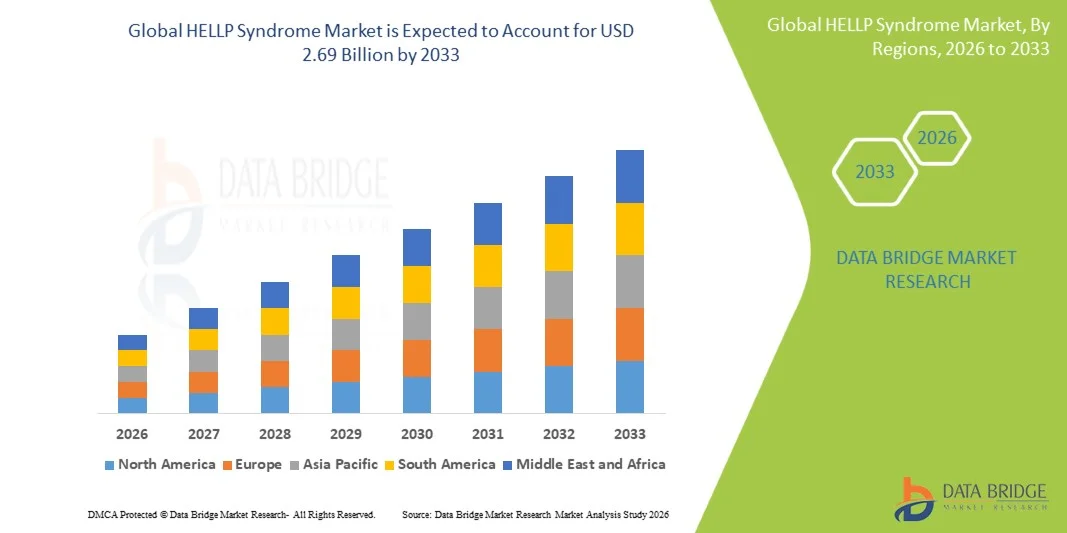
- As per Data Bridge Market Research Analysis the global HELLP Syndrome market size was valued at USD 1.83 billion in 2025and is expected to reach USD 2.69 billion by 2033, at a CAGR of 5.05% during the forecast period
- The market growth is largely fueled by increasing awareness of maternal health complications and advancements in prenatal monitoring technologies, leading to earlier detection and improved clinical management of HELLP Syndrome across hospitals and maternity care settings. Rising investments in obstetric emergency care and maternal healthcare infrastructure are further supporting market expansion
- Furthermore, growing demand for rapid diagnostic solutions, specialized therapeutics, and integrated maternal-fetal care services is establishing HELLP Syndrome management solutions as critical components of modern high-risk pregnancy care. These converging factors are accelerating the uptake of HELLP Syndrome diagnostics and treatment solutions, thereby significantly boosting the industry's growth
Market Size & Forecast
- Global Market Value (2025): USD 1.83 Billion
- Expected Market Value (2033): USD 2.69 Billion
- Forecast CAGR (2026–2033): 5.05%
What are the Major Takeaways of HELLP Syndrome Market?
- HELLP Syndrome, a severe pregnancy-related complication characterized by hemolysis, elevated liver enzymes, and low platelet count, is increasingly recognized as a critical segment within maternal healthcare due to the growing emphasis on early diagnosis, intensive monitoring, and timely intervention across hospitals and obstetric care centers
- The escalating demand for HELLP Syndrome diagnostic and treatment solutions is primarily fueled by rising maternal health awareness, increasing prevalence of hypertensive disorders during pregnancy, advancements in prenatal screening technologies, and improved access to emergency obstetric care, all of which are enhancing maternal and fetal outcomes
- North America dominated the HELLP syndrome market with the largest revenue share of 39.40% in 2025, supported by advanced maternal healthcare infrastructure, high-risk pregnancy management programs, favorable reimbursement systems, and strong presence of specialized hospitals, with the U.S. witnessing substantial growth in early screening, intensive maternal monitoring, and critical care treatment services
- Asia-Pacific is expected to be the fastest growing region in the HELLP syndrome market during the forecast period due to rising healthcare expenditure, improving maternal care facilities, increasing awareness of pregnancy complications, and expanding access to prenatal diagnostics across countries such as China, India, and Japan
- The Consumables & Reagents segment held the largest market revenue share of 63.1% in 2025, driven by frequent use of blood testing kits, liver function reagents, platelet count reagents, and diagnostic laboratory consumables required for repeated monitoring of HELLP Syndrome patients
Report Scope and HELLP Syndrome Market Segmentation
|
Attributes |
HELLP Syndrome Key Market Insights |
|
Segments Covered |
|
|
Countries Covered |
North America
Europe
Asia-Pacific
Middle East and Africa
South America
|
|
Key Market Players |
|
|
Market Opportunities |
|
|
Value Added Data Infosets |
In addition to the insights on market scenarios such as market value, growth rate, segmentation, geographical coverage, and major players, the market reports curated by the Data Bridge Market Research also include in-depth expert analysis, patient epidemiology, pipeline analysis, pricing analysis, and regulatory framework. |
What is the Key Trend in the HELLP Syndrome Market?
“Advancements in Early Diagnosis and Maternal Monitoring Technologies”
- A significant and accelerating trend in the global HELLP Syndrome market is the growing adoption of advanced maternal monitoring technologies, biomarker-based diagnostics, and digital healthcare tools aimed at improving early detection and clinical management of HELLP Syndrome. These innovations are enhancing maternal-fetal outcomes through faster diagnosis and timely intervention
- For instance, hospitals and maternity care centers are increasingly utilizing automated laboratory analyzers and high-risk pregnancy monitoring systems to rapidly assess liver enzyme levels, platelet counts, and hemolysis markers, enabling earlier identification of HELLP Syndrome cases
- Wearable maternal health devices and remote patient monitoring platforms are also gaining traction, allowing clinicians to track blood pressure, symptoms, and pregnancy complications in women at elevated risk of preeclampsia and HELLP Syndrome
- Advances in obstetric imaging, telemedicine consultations, and integrated electronic medical records are improving coordination between obstetricians, hematologists, and intensive care specialists during emergency management
- Increasing research into predictive biomarkers and personalized risk assessment models is supporting the development of more proactive prenatal care strategies for high-risk pregnancies
- This trend toward technology-enabled early diagnosis and multidisciplinary care is reshaping expectations for maternal critical care and pregnancy complication management worldwide
HELLP Syndrome Market Dynamics
Driver
“Rising Maternal Health Awareness and Increasing Incidence of High-Risk Pregnancies”
- Rising awareness regarding maternal health complications and the increasing prevalence of high-risk pregnancies are major drivers supporting the growth of the HELLP Syndrome market. Greater focus on prenatal screening is helping improve early recognition and treatment outcome
- For instance, healthcare systems across developed and emerging markets are expanding high-risk pregnancy monitoring programs for women with hypertension, diabetes, obesity, or prior preeclampsia history, which increases screening rates for HELLP Syndrome-related complications
- Increasing maternal age at pregnancy and higher rates of lifestyle-related conditions are contributing to greater demand for specialized obstetric monitoring and emergency care services
- Government-led maternal mortality reduction initiatives and broader access to prenatal healthcare are further encouraging earlier diagnosis and hospital-based management of severe pregnancy disorders
- In addition, improvements in hospital infrastructure, ICU access, and laboratory testing capabilities are strengthening treatment readiness for HELLP Syndrome cases
Restraint/Challenge
“Limited Awareness, Diagnostic Complexity, and Unequal Access to Emergency Obstetric Care”
- Limited awareness of HELLP Syndrome symptoms among patients and some frontline healthcare providers remains a key challenge, often delaying timely diagnosis and treatment intervention
- For instance, in rural and underserved regions, symptoms such as nausea, headache, abdominal pain, or fatigue may be mistaken for normal pregnancy discomforts, resulting in delayed referral to specialized maternity centers
- Diagnostic complexity due to symptom overlap with preeclampsia, liver disorders, and other pregnancy complications can make early identification difficult without comprehensive laboratory testing
- Unequal access to emergency obstetric care, blood products, intensive care units, and neonatal support services further restricts optimal management outcomes in low-resource settings
- Addressing these challenges through stronger prenatal education, clinician training, and improved access to specialist maternal healthcare services will be essential for long-term market growth
How is the HELLP Syndrome Market Segmented?
The market is segmented on the basis of type, product type, and application.
- By Type
On the basis of type, the HELLP Syndrome market is segmented into Partial HELLP Syndrome (PHS) and Complete HELLP Syndrome. The Complete HELLP Syndrome segment dominated the largest market revenue share of 58.4% in 2025, driven by the higher severity of symptoms and urgent need for intensive clinical management. Complete HELLP Syndrome cases often present with full manifestations of hemolysis, elevated liver enzymes, and low platelet count, requiring immediate hospitalization and advanced monitoring. This drives stronger demand for diagnostic testing, emergency obstetric interventions, and supportive care solutions. Rising maternal health awareness and improved screening protocols are increasing diagnosis rates. Tertiary hospitals are increasingly equipped to manage severe pregnancy complications, supporting segment dominance. Greater clinical focus on reducing maternal and fetal mortality also contributes to market demand. Availability of specialized treatment pathways further strengthens adoption. Increasing incidence of hypertensive pregnancy disorders globally is another major factor. Overall, Complete HELLP Syndrome remains the leading segment due to its high treatment intensity and resource utilization.
The Partial HELLP Syndrome (PHS) segment is expected to witness the fastest growth rate of 9.6% CAGR from 2026 to 2033, driven by rising awareness and improved early-stage diagnosis of incomplete HELLP presentations. Partial HELLP cases are increasingly being identified before progressing to severe complications, creating demand for earlier monitoring and preventive management solutions. Advances in laboratory testing are helping clinicians detect mild platelet and liver abnormalities more efficiently. Growing adoption of prenatal monitoring programs is also supporting growth. Obstetricians are increasingly emphasizing early intervention strategies to improve maternal outcomes. Expansion of healthcare access in emerging markets is boosting diagnosis volumes. Rising investments in maternal-fetal medicine are further accelerating adoption. Increasing awareness campaigns around pregnancy-related complications also support segment expansion. Better clinical guidelines for risk assessment are enhancing detection rates. These factors collectively position Partial HELLP Syndrome as the fastest-growing type segment.
- By Product Type
On the basis of product type, the HELLP Syndrome market is segmented into Instruments and Consumables & Reagents. The Consumables & Reagents segment held the largest market revenue share of 63.1% in 2025, driven by frequent use of blood testing kits, liver function reagents, platelet count reagents, and diagnostic laboratory consumables required for repeated monitoring of HELLP Syndrome patients. Since diagnosis and treatment involve continuous laboratory assessment, consumables are used at a significantly higher volume than instruments. Hospitals and diagnostic centers require recurring procurement of these products, supporting strong revenue generation. Rising pregnancy screening rates are further increasing testing demand. Expansion of pathology labs and emergency diagnostic services also contributes to growth. Manufacturers are launching faster and more accurate reagent solutions for critical care settings. Growing focus on timely maternal diagnosis supports repeat testing frequency. Improved supply chain networks are strengthening availability globally. Overall, consumables and reagents remain the dominant product category.
The Instruments segment is anticipated to witness the fastest growth rate of 10.2% CAGR from 2026 to 2033, driven by increasing demand for advanced hematology analyzers, liver diagnostic systems, and patient monitoring equipment in obstetric emergency care. Hospitals are investing in automated diagnostic instruments to accelerate treatment decisions in critical maternal conditions. Rising healthcare modernization in developing economies is supporting equipment adoption. Integration of AI-enabled analyzers and digital reporting systems is improving workflow efficiency. Increasing number of specialty maternity hospitals is further driving demand. Portable diagnostic instruments are gaining popularity in regional healthcare centers. Government investment in maternal healthcare infrastructure also supports expansion. Growing need for precision diagnostics and rapid turnaround times is strengthening adoption. Technological innovation in multi-parameter analyzers is another key factor. These factors make Instruments the fastest-growing product type segment.
- By Application
On the basis of application, the HELLP Syndrome market is segmented into Hospitals, Specialty Clinics, Diagnostic Centers, and Others. The Hospitals segment accounted for the largest market revenue share of 54.7% in 2025, driven by the fact that HELLP Syndrome is a life-threatening obstetric emergency that often requires inpatient care, emergency delivery, intensive monitoring, and multidisciplinary treatment. Hospitals are the primary centers for diagnosis and management of severe maternal complications. Availability of obstetricians, critical care units, blood transfusion services, and neonatal care supports segment dominance. Increasing institutional deliveries worldwide are also boosting hospital demand. Advanced laboratory infrastructure enables rapid diagnosis and treatment decisions. Rising maternal health investments by governments further strengthen hospital capacity. Hospitals remain the preferred setting for high-risk pregnancies and emergency interventions. Growing awareness of pregnancy complications encourages timely hospital admission. Overall, hospitals continue to dominate due to their comprehensive care capabilities.
The Diagnostic Centers segment is expected to witness the fastest growth rate of 11.1% CAGR from 2026 to 2033, driven by increasing demand for rapid blood testing, prenatal screening, and outsourced pathology services. Diagnostic centers are becoming critical for early identification of liver dysfunction, platelet abnormalities, and hypertension-related pregnancy risks. Growing preference for specialized testing outside hospital settings is supporting market expansion. Technological advancements in automated analyzers are improving turnaround times and test accuracy. Expansion of private diagnostic chains in emerging economies is boosting accessibility. Rising awareness among pregnant women regarding routine prenatal checkups is further driving demand. Partnerships between hospitals and independent laboratories are increasing sample volumes. Affordable testing packages are attracting more patients. Increasing urbanization and healthcare access are also contributing significantly. These factors collectively position Diagnostic Centers as the fastest-growing application segment.
Which Region Holds the Largest Share of the HELLP Syndrome Market?
- North America dominated the HELLP syndrome market with the largest revenue share of 39.40% in 2025, supported by advanced maternal healthcare infrastructure, high-risk pregnancy management programs, favorable reimbursement systems, and the strong presence of specialized hospitals. The region benefits from well-established prenatal screening protocols, rapid emergency obstetric response systems, and access to multidisciplinary maternal-fetal medicine specialists for managing severe pregnancy complication
- Healthcare providers in the region highly prioritize early diagnosis, continuous maternal monitoring, and timely intervention strategies for HELLP Syndrome. Increasing use of advanced laboratory testing, fetal surveillance technologies, and intensive care treatment pathways is further strengthening market growth across hospitals and specialty maternity centers
- This widespread adoption is further supported by high healthcare spending, strong clinician awareness, and expanding access to specialized obstetric critical care services, establishing North America as a leading region for HELLP Syndrome diagnosis and treatment
U.S. HELLP Syndrome Market Insight
The U.S. HELLP syndrome market captured the largest revenue share within North America in 2025, driven by strong maternal healthcare systems and rising adoption of advanced high-risk pregnancy management protocols. The country is witnessing substantial growth in early screening, intensive maternal monitoring, and critical care treatment services for women experiencing severe hypertensive pregnancy disorders. Leading hospitals and maternal-fetal medicine centers are increasingly utilizing rapid diagnostic testing, fetal monitoring systems, and coordinated emergency obstetric care pathways to improve maternal and neonatal outcomes. Continued investments in prenatal health programs and specialist care services are further propelling market growth in the U.S.
Europe HELLP Syndrome Market Insight
The Europe HELLP syndrome market is projected to expand at a substantial CAGR throughout the forecast period, primarily driven by strong public healthcare systems, increasing awareness of pregnancy-related complications, and improved prenatal monitoring services. The region is witnessing rising adoption of evidence-based obstetric care protocols, advanced laboratory diagnostics, and multidisciplinary treatment approaches for severe maternal conditions. Increasing emphasis on maternal mortality reduction and early intervention is contributing significantly to market expansion across Europe.
U.K. HELLP Syndrome Market Insight
The U.K. HELLP syndrome market is anticipated to grow at a noteworthy CAGR during the forecast period, supported by expanding access to prenatal care through the National Health Service (NHS) and growing awareness of high-risk pregnancy complications. Hospitals and maternity centers are increasingly implementing early screening strategies, specialist monitoring programs, and emergency treatment protocols for HELLP Syndrome. Continued focus on improving maternal outcomes and timely diagnosis is expected to stimulate market growth in the U.K.
Germany HELLP Syndrome Market Insight
The Germany HELLP syndrome market is expected to expand at a considerable CAGR during the forecast period, fueled by advanced healthcare infrastructure, strong obstetric care standards, and increasing use of precision diagnostics in maternal medicine. Germany’s well-developed hospital network and emphasis on early intervention support broader adoption of maternal monitoring systems, laboratory screening, and critical care management for pregnancy-related complications. Integrated obstetric and neonatal care pathways are further enhancing treatment outcomes.
Asia-Pacific HELLP Syndrome Market Insight
The Asia-Pacific HELLP syndrome market is poised to grow at the fastest CAGR during the forecast period, driven by rising healthcare expenditure, improving maternal care facilities, increasing awareness of pregnancy complications, and expanding access to prenatal diagnostics across countries such as China, India, and Japan. The region is witnessing growing investments in maternity hospitals, prenatal screening programs, and obstetric emergency care systems. Rising institutional deliveries, improved access to specialist consultations, and government initiatives focused on maternal health are accelerating market growth across both urban and rural settings.
Japan HELLP Syndrome Market Insight
The Japan HELLP syndrome market is gaining momentum due to the country’s advanced healthcare system, strong prenatal care standards, and increasing focus on maternal risk management. Japanese healthcare providers emphasize regular prenatal monitoring, rapid diagnosis of hypertensive disorders, and timely specialist intervention. The use of advanced fetal surveillance and laboratory testing technologies is supporting improved management of HELLP Syndrome across hospitals and maternity centers.
China HELLP Syndrome Market Insight
The China HELLP syndrome market accounted for the largest market revenue share in Asia Pacific in 2025, attributed to expanding maternal healthcare infrastructure, rising pregnancy monitoring awareness, and strong government support for maternal and child health initiatives. China is witnessing rapid growth in tertiary hospitals, maternity centers, and prenatal diagnostic services. Increasing availability of specialist obstetric care, alongside investments in emergency maternal treatment systems, is expected to significantly propel the market in the country.
Which are the Top Companies in HELLP Syndrome Market?
The HELLP Syndrome industry is primarily led by well-established companies, including:
- Hoffmann-La Roche Ltd. (Switzerland)
- Siemens Healthineers AG (Germany)
- Abbott (U.S.)
- Danaher Corporation (U.S.)
- Thermo Fisher Scientific Inc. (U.S.)
- Becton, Dickinson and Company (BD) (U.S.)
- Bio-Rad Laboratories, Inc. (U.S.)
- Quest Diagnostics Incorporated (U.S.)
- Laboratory Corporation of America Holdings (Labcorp) (U.S.)
- Sysmex Corporation (Japan)
- Cardinal Health, Inc. (U.S.)
- Medtronic plc (Ireland)
- GE HealthCare Technologies Inc. (U.S.)
- Koninklijke Philips N.V. (Netherlands)
- Stryker Corporation (U.S.)
- Fresenius SE & Co. KGaA (Germany)
- Baxter International Inc. (U.S.)
- Nihon Kohden Corporation (Japan)
- Drägerwerk AG & Co. KGaA (Germany)
- Boston Scientific Corporation (U.S.)
What are Latest Developments in HELLP Syndrome Market?
- In January 2021, researchers published updated clinical findings emphasizing the importance of rapid diagnosis and early delivery management in HELLP syndrome cases, highlighting improved maternal outcomes through timely intervention and multidisciplinary obstetric care. This development reinforced the growing focus on standardized emergency treatment pathways for severe pregnancy complications
- In October 2021, hospitals in several developed healthcare markets expanded the use of advanced maternal monitoring protocols for high-risk pregnancies, including HELLP syndrome screening through liver enzyme, platelet count, and hemolysis testing. These initiatives supported earlier identification of the syndrome and reduced risks of maternal organ complication
- In August 2022, clinical researchers reported increasing adoption of evidence-based management strategies for HELLP syndrome, including corticosteroid support, blood pressure stabilization, and intensive fetal monitoring. The development reflected growing awareness of the condition’s severity and the need for specialized obstetric treatment centers
- In June 2023, maternal healthcare institutions expanded investment in prenatal diagnostic programs aimed at identifying preeclampsia and HELLP syndrome risk factors earlier in pregnancy. The move supported better pregnancy surveillance and faster referral to tertiary care centers for women with severe hypertensive disorders
- In July 2024, a major systematic review and meta-analysis published in BMC Pregnancy and Childbirth evaluated corticosteroid therapy in HELLP syndrome patients, providing updated evidence on treatment outcomes and helping clinicians refine supportive care strategies for maternal recovery. This publication marked an important evidence-based advancement in HELLP syndrome management
- In June 2024, industry market intelligence reports indicated increasing global interest in HELLP syndrome diagnostics and treatment solutions, driven by rising awareness of maternal health complications, improving prenatal care access, and stronger investments in specialized obstetric services
- In January 2025, researchers published findings in BMC Pregnancy and Childbirth showing therapeutic plasma exchange as a promising treatment option for severe postpartum HELLP syndrome cases unresponsive to conventional supportive therapy. The study highlighted the potential of advanced blood purification techniques in reducing organ failure risks and improving recovery outcomes
- In February 2025, a global systematic review and meta-analysis published in Frontiers in Reproductive Health assessed the worldwide prevalence of preeclampsia, eclampsia, and HELLP syndrome, providing updated epidemiological insights for healthcare planners and supporting future investment in maternal critical care services

- Interactive Data Analysis Dashboard
- Company Analysis Dashboard for high growth potential opportunities
- Research Analyst Access for customization & queries
- Competitor Analysis with Interactive dashboard
- Latest News, Updates & Trend analysis
- Harness the Power of Benchmark Analysis for Comprehensive Competitor Tracking
Data collection and base year analysis are done using data collection modules with large sample sizes. The stage includes obtaining market information or related data through various sources and strategies. It includes examining and planning all the data acquired from the past in advance. It likewise envelops the examination of information inconsistencies seen across different information sources. The market data is analysed and estimated using market statistical and coherent models. Also, market share analysis and key trend analysis are the major success factors in the market report. To know more, please request an analyst call or drop down your inquiry.
The key research methodology used by DBMR research team is data triangulation which involves data mining, analysis of the impact of data variables on the market and primary (industry expert) validation. Data models include Vendor Positioning Grid, Market Time Line Analysis, Market Overview and Guide, Company Positioning Grid, Patent Analysis, Pricing Analysis, Company Market Share Analysis, Standards of Measurement, Global versus Regional and Vendor Share Analysis. To know more about the research methodology, drop in an inquiry to speak to our industry experts.
Data Bridge Market Research is a leader in advanced formative research. We take pride in servicing our existing and new customers with data and analysis that match and suits their goal. The report can be customized to include price trend analysis of target brands understanding the market for additional countries (ask for the list of countries), clinical trial results data, literature review, refurbished market and product base analysis. Market analysis of target competitors can be analyzed from technology-based analysis to market portfolio strategies. We can add as many competitors that you require data about in the format and data style you are looking for. Our team of analysts can also provide you data in crude raw excel files pivot tables (Fact book) or can assist you in creating presentations from the data sets available in the report.












