


What is the Hempcrete Market Size and Growth Rate?
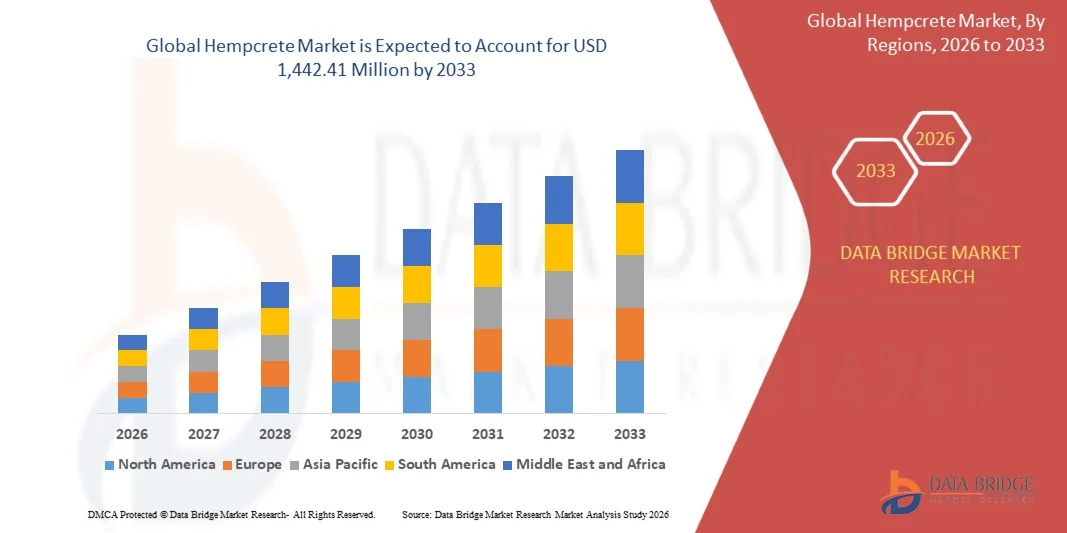
- As per Data Bridge Market Research analysis the hempcrete market was valued at USD 648.92 million in 2025 and is projected to reach USD 1,442.41 million by 2033, growing at a CAGR of 10.50% from 2026 to 2033.
- The market is experiencing consistent growth driven by rising demand for sustainable and low-carbon construction materials, increasing adoption of bio-based building solutions, and growing awareness of hempcrete's thermal insulation, moisture regulation, and energy-efficiency benefits.
- The increasing focus on green building standards, carbon reduction targets, and energy-efficient construction, combined with growing investments in sustainable residential and commercial infrastructure, is encouraging builders, architects, and developers to adopt hempcrete as an environmentally friendly alternative to conventional construction materials.
Market Size & Forecast
- Market Value (2025): USD 648.92 Million
- Expected Market Value (2033): USD 1,442.41 Million
- Forecast CAGR (2026–2033): 10.50%
- Leading Region in 2025: North America
- Fastest Growing Region: Asia-Pacific
What are the Major Takeaways of the Hempcrete Market?
- North America dominated the hempcrete market with the largest revenue share in 2025, supported by growing demand for sustainable construction materials, increasing awareness of low-carbon building practices, and favorable initiatives promoting energy-efficient construction.
- Asia-Pacific hempcrete market is expected to witness the fastest growth rate from 2026 to 2033, supported by rapid urbanization, expanding construction activities, and increasing awareness of sustainable building materials in countries such as China, Japan, and India.
- The hempcrete blocks segment held the largest market revenue share in 2025, driven by their standardized dimensions, ease of installation, and widespread use in residential walls and sustainable low-rise construction.
- The hempcrete insulation segment is projected to register the fastest growth at a CAGR from 2026 to 2033, driven by increasing demand for energy-efficient buildings, green construction materials, and high-performance thermal insulation. Growing adoption of hemp-based insulation in new construction and retrofit projects is accelerating segment expansion.
- The precast segment accounted for a significant market share in 2025, supported by increasing adoption of factory-produced hempcrete blocks and panels that provide consistent dimensions, faster installation, and reduced on-site labor requirements.
- The precast segment is projected to register the fastest growth at a CAGR from 2026 to 2033, driven by the expansion of modular construction and growing demand for efficient prefabricated building solutions.
Report Scope and Hempcrete Market Segmentation
|
Attributes |
Hempcrete Key Market Insights |
|
Segments Covered |
|
|
Countries Covered |
North America
Europe
Asia-Pacific
Middle East and Africa
South America
|
|
Key Market Players |
|
|
Market Opportunities |
|
|
Value Added Data Infosets |
In addition to the insights on market scenarios such as market value, growth rate, segmentation, geographical coverage, and major players, the market reports curated by the Data Bridge Market Research also include import export analysis, production capacity overview, production consumption analysis, price trend analysis, climate change scenario, supply chain analysis, value chain analysis, raw material/consumables overview, vendor selection criteria, PESTLE Analysis, Porter Analysis, and regulatory framework. |
What is the Key Trend in the Hempcrete Market?
- The hempcrete market is witnessing a strong shift toward circular and low-carbon construction solutions, with manufacturers increasingly developing recyclable hemp blocks, bio-based insulation systems, and materials designed to reduce embodied carbon in buildings. The European Commission identifies lime hemp concrete as a carbon-sequestering construction material and highlights its potential to support lower-carbon building practices.
- For instance, in September 2025, IsoHemp launched RecyHemp, described by the company as the world’s first hempcrete recycling line, enabling hemp block offcuts collected from construction sites to be sorted and reintegrated into the production of new hemp blocks.
- Growing demand for energy-efficient buildings is also increasing interest in hempcrete because of its thermal insulation, moisture regulation, acoustic performance, and carbon-storage properties.
- Builders and material manufacturers are expanding the use of hempcrete beyond traditional wall infill into prefabricated blocks, panels, insulation, and retrofit applications, supporting broader adoption across residential and commercial construction.
- As construction companies, architects, and developers increasingly prioritize circular materials, energy efficiency, and lower embodied carbon, the adoption of hempcrete and other hemp-based building materials is expected to accelerate, strengthening its role in sustainable construction and building renovation.
What are the Key Drivers of the Hempcrete Market?
- Increasing government and industry emphasis on reducing building-sector carbon emissions is driving demand for bio-based construction materials such as hempcrete, which can provide insulation while storing biogenic carbon during the building's life.
- For instance, the International Code Council incorporated Appendix BL for Hemp-Lime (Hempcrete) Construction into the 2024 International Residential Code, establishing requirements for hemp-lime as a nonstructural insulation infill material and providing greater technical guidance for residential construction.
- The growing availability of standardized construction requirements is helping architects, builders, and developers assess hempcrete more easily while reducing uncertainty around installation, thermal performance, materials, and testing requirements.
- For instance, Appendix BL specifies hemp-lime thermal resistance values ranging from R-1.20 to R-2.10 per inch depending on material density and requires hemp-lime systems to meet specified testing and performance requirements.
- With regulatory recognition, green-building initiatives, and demand for energy-efficient construction continuing to expand, hempcrete is expected to gain wider acceptance as a low-carbon insulation and wall-infill solution across residential construction and retrofit projects.
Which Factors are Challenging the Growth of the Hempcrete Market?
- Limited structural capability and the need for specialized construction practices remain major challenges for hempcrete adoption, as hemp-lime is generally used as a nonstructural insulation and wall-infill material rather than a conventional load-bearing structural system.
- The International Code Council's Appendix BL specifically limits hemp-lime construction to nonstructural infill applications and requires approved engineered designs for certain building configurations, which can increase design and permitting requirements.
- In addition, fire-resistance performance must be demonstrated through testing for specific hemp-lime wall assemblies, creating additional testing and certification requirements for manufacturers and project developers.
- For instance, the 2024 International Residential Code states that hemp-lime walls do not automatically have a fire-resistance rating and that assemblies must be tested under ASTM E119 or UL 263 to establish the applicable rating.
- These technical, engineering, testing, and regulatory requirements can increase project complexity and limit adoption among conventional builders unfamiliar with bio-based construction methods, particularly in markets where hemp-lime standards and trained installation professionals remain limited.
How is the Hempcrete Market Segmented?
The market is segmented on the basis of product type, form, application, and end-use industry.
- By Product Type
On the basis of product type, the hempcrete market is segmented into hempcrete blocks, hempcrete bricks, hempcrete panels, hempcrete insulation, and others. The hempcrete blocks segment held the largest market revenue share in 2025, driven by their standardized dimensions, ease of installation, and widespread use in residential walls and sustainable low-rise construction.
The hempcrete insulation segment is projected to register the fastest growth at a CAGR from 2026 to 2033, driven by increasing demand for energy-efficient buildings, green construction materials, and high-performance thermal insulation. Growing adoption of hemp-based insulation in new construction and retrofit projects is accelerating segment expansion.
- By Form
On the basis of form, the hempcrete market is segmented into precast, cast-in-place, and spray-applied. The precast segment accounted for a significant market share in 2025, supported by increasing adoption of factory-produced hempcrete blocks and panels that provide consistent dimensions, faster installation, and reduced on-site labor requirements.
The precast segment is projected to register the fastest growth at a CAGR from 2026 to 2033, driven by the expansion of modular construction and growing demand for efficient prefabricated building solutions.
- By Application
On the basis of application, the hempcrete market is segmented into walls, floors, roofs, insulation, and others. The walls segment held the largest market revenue share in 2025, driven by extensive use of hempcrete as non-load-bearing wall infill and its thermal, acoustic, and moisture-regulating properties.
The insulation segment is projected to register the fastest growth at a CAGR from 2026 to 2033, supported by increasing demand for energy-efficient building envelopes and sustainable alternatives to conventional insulation materials. Hempcrete's thermal regulation and low-carbon characteristics are encouraging adoption in residential and commercial construction.
- By End-Use Industry
On the basis of end-use industry, the hempcrete market is segmented into residential, commercial, industrial, and institutional. The residential segment held the largest market revenue share in 2025, supported by rising demand for sustainable homes, energy-efficient construction, and environmentally friendly building materials.
The commercial segment is projected to register the fastest growth at a CAGR from 2026 to 2033, driven by increasing green-building investments, sustainability standards, and the adoption of hempcrete for insulation and non-structural wall applications in offices, retail buildings, warehouses, and other commercial facilities.
Which Region Holds the Largest Share of the Hempcrete Market?
- North America dominated the hempcrete market with the largest revenue share in 2025, supported by growing demand for sustainable construction materials, increasing awareness of low-carbon building practices, and favorable initiatives promoting energy-efficient construction.
- Builders and developers in the region are increasingly adopting hempcrete because of its thermal insulation, moisture regulation, fire resistance, and low environmental impact. The growing emphasis on reducing embodied carbon in buildings, along with rising investments in green construction and renewable materials, is further supporting the adoption of hempcrete across residential and commercial applications.
U.S. Hempcrete Market Insight
U.S. hempcrete market captured the largest revenue share in 2025 within North America, fueled by increasing demand for sustainable building materials and the growing adoption of energy-efficient construction practices. Builders and homeowners are increasingly recognizing hempcrete as an environmentally friendly alternative to conventional insulation and wall-building materials. The expansion of hemp cultivation following regulatory developments, combined with rising interest in carbon-conscious construction and green building certifications, is further supporting market growth. Moreover, increasing investments in sustainable residential and commercial projects are creating new opportunities for hempcrete applications.
Europe Hempcrete Market Insight
Europe hempcrete market is expected to witness the fastest growth rate from 2026 to 2033, primarily driven by stringent environmental regulations, ambitious decarbonization targets, and increasing demand for sustainable construction materials. The region's strong focus on energy-efficient buildings and reducing the carbon footprint of the construction sector is fostering the adoption of hempcrete. European consumers and developers are increasingly attracted to hempcrete because of its thermal performance, breathability, and renewable characteristics. The market is experiencing growing adoption across residential, commercial, and renovation projects, particularly in countries promoting circular and low-carbon construction.
U.K. Hempcrete Market Insight
U.K. hempcrete market is expected to witness the fastest growth rate from 2026 to 2033, driven by increasing emphasis on low-carbon construction and the growing demand for energy-efficient buildings. The country's efforts to reduce building-related carbon emissions are encouraging architects, developers, and homeowners to consider bio-based construction materials such as hempcrete. In addition, growing awareness of natural insulation, improved indoor comfort, and sustainable renovation practices is supporting adoption. The expansion of green building initiatives and increasing interest in environmentally responsible construction are expected to continue stimulating market growth.
Germany Hempcrete Market Insight
Germany hempcrete market is expected to witness the fastest growth rate from 2026 to 2033, fueled by increasing awareness of sustainable construction and the country's strong emphasis on energy efficiency and environmental protection. Germany's well-developed construction sector, combined with stringent building standards and sustainability targets, promotes the adoption of bio-based materials such as hempcrete. The material's thermal insulation, moisture regulation, and low-carbon characteristics align with growing demand for energy-efficient buildings. Furthermore, increasing investments in sustainable housing and renovation projects are creating favorable opportunities for hempcrete adoption.
Asia-Pacific Hempcrete Market Insight
The Asia-Pacific hempcrete market is expected to witness the fastest growth rate from 2026 to 2033, supported by rapid urbanization, expanding construction activities, and increasing awareness of sustainable building materials in countries such as China, Japan, and India. The region's growing focus on energy-efficient infrastructure and reducing construction-related environmental impacts is driving interest in natural and renewable materials. Furthermore, rising investments in green buildings and sustainable urban development are creating new opportunities for hempcrete. As construction industries across APAC increasingly prioritize resource efficiency and low-carbon solutions, the accessibility and adoption of hempcrete are expected to expand.
Japan Hempcrete Market Insight
Japan hempcrete market is expected to witness the fastest growth rate from 2026 to 2033 due to the country's strong emphasis on sustainable construction, energy efficiency, and environmentally responsible building practices. Japanese consumers and developers are increasingly seeking natural materials that can improve thermal performance and indoor comfort while reducing environmental impact. The growing adoption of green buildings and renovation projects is supporting demand for hempcrete in residential and commercial applications. Moreover, Japan's focus on resource-efficient construction and innovative building technologies is expected to create further opportunities for hempcrete adoption.
China Hempcrete Market Insight
The China hempcrete market accounted for the largest market revenue share in Asia Pacific in 2025, attributed to rapid urbanization, expanding construction activities, and increasing government emphasis on green and energy-efficient buildings. China's growing focus on reducing carbon emissions from the construction sector is encouraging the adoption of renewable and low-carbon building materials. Hempcrete is gaining attention for its insulation properties, renewable characteristics, and potential to reduce the environmental footprint of buildings. Furthermore, rising investments in sustainable urban development and green construction are expected to support the expansion of the hempcrete market in China.
Which are the Top Companies in Hempcrete Market?
The hempcrete industry is primarily led by well-established companies, including:
- IsoHemp S.A. (Belgium)
- Americhanvre (U.S.)
- Hemp Block Company Ltd. (U.K.)
- Australian Hemp Masonry Co. (Australia)
- Hempitecture Inc. (U.S.)
- HempBLOCK USA Inc. (U.S.)
- Hemp Eco Systems Group (U.S.)
- UK Hempcrete Ltd. (U.K.)
- Natural Building Store Ltd. (U.K.)
- The Limecrete Company Ltd. (U.K.)
- HempFlax Group B.V. (Netherlands)
- Hemp Building Company (U.S.)
- Hempstone (U.S.)
- Dun Agro Hemp Group (Netherlands)
- Hempcrete Natural Building (U.S.)
What are Latest Developments in Hempcrete Market?
- In July 2026, WITT hosted a practical hempcrete construction workshop in New Zealand as part of the Taranaki Hemp Hub project, supporting local skills development and building a regional hemp-to-construction supply chain.
- In May 2026, the University of Tasmania’s The Forest redevelopment completed what was described as the largest hempcrete installation in the Southern Hemisphere, using locally produced hempcrete alongside mass timber to reduce embodied carbon.
- In June 2026, an Australian hemp processing project in New South Wales secured A USD10 million in government funding to develop large-scale hemp processing infrastructure, supporting the supply of hemp-based building materials and future hempcrete production.
- In February 2026, research published in the Journal of Building Engineering highlighted the potential of 3D-printed hempcrete for complex building geometries and reduced material waste, while identifying structural performance, supply chains, and regulatory frameworks as key factors for commercialization.
- In January 2026, Rensselaer Polytechnic Institute received USD 1 million to establish a hemp manufacturing laboratory in New York focused on advancing carbon-negative building materials, strengthening research and commercialization opportunities for hemp-based construction technologies.

- Interactive Data Analysis Dashboard
- Company Analysis Dashboard for high growth potential opportunities
- Research Analyst Access for customization & queries
- Competitor Analysis with Interactive dashboard
- Latest News, Updates & Trend analysis
- Harness the Power of Benchmark Analysis for Comprehensive Competitor Tracking
Global Hempcrete Market, Supply Chain Analysis and Ecosystem Framework
To support market growth and help clients navigate the impact of geopolitical shifts, DBMR has integrated in-depth supply chain analysis into its Global Hempcrete Market research reports. This addition empowers clients to respond effectively to global changes affecting their industries. The supply chain analysis section includes detailed insights such as Global Hempcrete Market consumption and production by country, price trend analysis, the impact of tariffs and geopolitical developments, and import and export trends by country and HSN code. It also highlights major suppliers with data on production capacity and company profiles, as well as key importers and exporters. In addition to research, DBMR offers specialized supply chain consulting services backed by over a decade of experience, providing solutions like supplier discovery, supplier risk assessment, price trend analysis, impact evaluation of inflation and trade route changes, and comprehensive market trend analysis.
Data collection and base year analysis are done using data collection modules with large sample sizes. The stage includes obtaining market information or related data through various sources and strategies. It includes examining and planning all the data acquired from the past in advance. It likewise envelops the examination of information inconsistencies seen across different information sources. The market data is analysed and estimated using market statistical and coherent models. Also, market share analysis and key trend analysis are the major success factors in the market report. To know more, please request an analyst call or drop down your inquiry.
The key research methodology used by DBMR research team is data triangulation which involves data mining, analysis of the impact of data variables on the market and primary (industry expert) validation. Data models include Vendor Positioning Grid, Market Time Line Analysis, Market Overview and Guide, Company Positioning Grid, Patent Analysis, Pricing Analysis, Company Market Share Analysis, Standards of Measurement, Global versus Regional and Vendor Share Analysis. To know more about the research methodology, drop in an inquiry to speak to our industry experts.
Data Bridge Market Research is a leader in advanced formative research. We take pride in servicing our existing and new customers with data and analysis that match and suits their goal. The report can be customized to include price trend analysis of target brands understanding the market for additional countries (ask for the list of countries), clinical trial results data, literature review, refurbished market and product base analysis. Market analysis of target competitors can be analyzed from technology-based analysis to market portfolio strategies. We can add as many competitors that you require data about in the format and data style you are looking for. Our team of analysts can also provide you data in crude raw excel files pivot tables (Fact book) or can assist you in creating presentations from the data sets available in the report.













