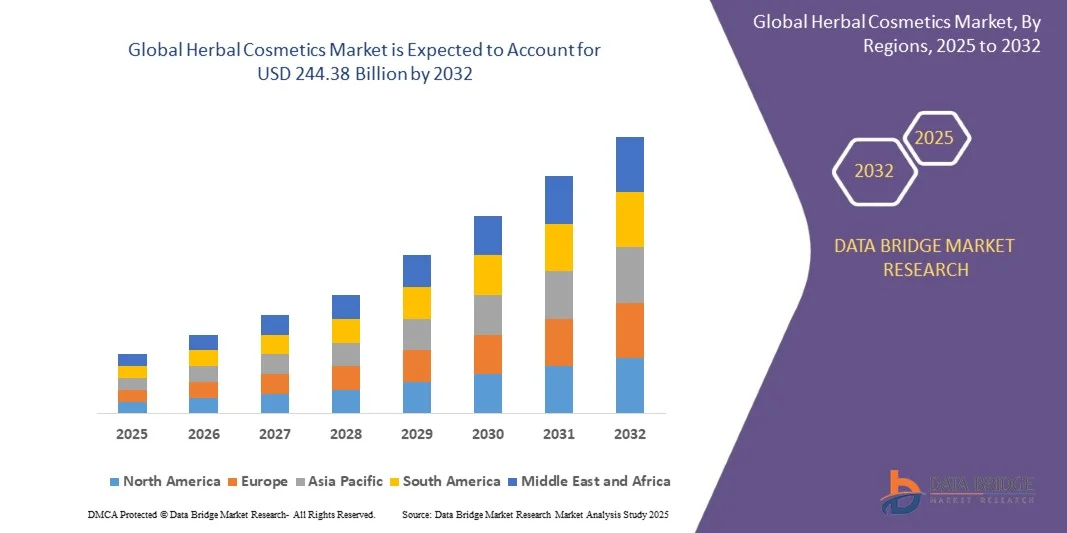
Herbal Cosmetics Market Size
- The global herbal cosmetics market size was valued at USD 90.00 billion in 2024 and is expected to reach USD 244.38 billion by 2032, at a CAGR of 13.30% during the forecast period
- The market growth is largely fuelled by the increasing consumer preference for natural and organic beauty products, coupled with the growing awareness regarding the harmful effects of synthetic ingredients
- Rising disposable incomes and the expansion of e-commerce platforms offering a wide range of herbal cosmetic products are also contributing to market growth
Herbal Cosmetics Market Analysis
- The herbal cosmetics market is witnessing significant expansion owing to the increasing demand for chemical-free skincare, haircare, and personal care products that utilize plant-based ingredients and traditional herbal formulations
- Continuous product innovation by key players, such as herbal-infused creams, oils, and makeup products, combined with marketing strategies emphasizing sustainability and wellness, is driving strong consumer engagement across global markets
- North America dominated the herbal cosmetics market with the largest revenue share of 38.65% in 2024, driven by the rising preference for natural, chemical-free, and sustainable beauty products among consumers in the region
- Asia-Pacific region is expected to witness the highest growth rate in the global herbal cosmetics market, driven by increasing urbanization, rising consumer awareness about chemical-free products, and expanding e-commerce distribution networks
- The skin care segment held the largest market revenue share in 2024, driven by the rising demand for natural and chemical-free products addressing skin concerns such as aging, pigmentation, and acne. Increasing consumer awareness regarding harmful synthetic ingredients and the growing popularity of Ayurvedic skincare routines are further boosting the demand for herbal creams, face masks, and moisturizer
Report Scope and Herbal Cosmetics Market Segmentation
|
Attributes |
Herbal Cosmetics Key Market Insights |
|
Segments Covered |
|
|
Countries Covered |
North America
Europe
Asia-Pacific
Middle East and Africa
South America
|
|
Key Market Players |
|
|
Market Opportunities |
|
|
Value Added Data Infosets |
In addition to the insights on market scenarios such as market value, growth rate, segmentation, geographical coverage, and major players, the market reports curated by the Data Bridge Market Research also include in-depth expert analysis, pricing analysis, brand share analysis, consumer survey, demography analysis, supply chain analysis, value chain analysis, raw material/consumables overview, vendor selection criteria, PESTLE Analysis, Porter Analysis, and regulatory framework. |
Herbal Cosmetics Market Trends
“Growing Popularity of Ayurvedic and Plant-Based Beauty Solutions”
- The rising consumer inclination toward Ayurvedic and botanical formulations is reshaping the herbal cosmetics industry. Consumers are increasingly preferring products derived from natural ingredients such as turmeric, aloe vera, neem, and sandalwood, which are perceived as safe and effective alternatives to synthetic cosmetics. This trend aligns with the global wellness movement emphasizing purity, safety, and sustainability, leading to the expansion of Ayurvedic-inspired product portfolios by both traditional and mainstream brands
- The growing popularity of Ayurvedic skin and hair care routines in Western markets is expanding the reach of traditional herbal brands. Influencer marketing, digital campaigns, and e-commerce platforms are amplifying awareness, particularly among younger consumers seeking holistic beauty solutions that combine tradition with modern efficacy. Moreover, collaborations between Indian herbal manufacturers and international cosmetic companies are enabling cross-market penetration and ingredient innovation
- Major cosmetic manufacturers are incorporating herbal ingredients into their existing product lines to meet consumer demand for chemical-free alternatives. This integration is strengthening the position of herbal cosmetics in mainstream retail and accelerating the global natural beauty transition. Companies are also focusing on sourcing traceable, organic ingredients to enhance credibility and meet eco-conscious consumer expectations
- For instance, in 2023, several European and U.S.-based cosmetic firms introduced Ayurvedic-inspired skincare lines featuring natural ingredients sourced from India, which helped promote cross-cultural beauty concepts and boosted the market’s global visibility. These launches also contributed to job creation in the herbal farming and processing sectors, further strengthening local economies and supply chains
- While the demand for herbal cosmetics is increasing, maintaining ingredient authenticity and ensuring regulatory compliance across regions remain essential for sustaining consumer trust and long-term brand loyalty. Manufacturers are investing in certification, R&D, and third-party testing to validate product claims and align with international standards for safety and efficacy
Herbal Cosmetics Market Dynamics
Driver
“Rising Awareness of Chemical-Free and Sustainable Beauty Products”
- Increasing consumer awareness about the harmful effects of synthetic chemicals, such as parabens and sulfates, is driving the adoption of herbal cosmetics. Consumers are actively seeking cleaner, safer, and environmentally sustainable alternatives that offer both efficacy and long-term skin benefits. This trend is particularly strong among millennials and Gen Z consumers, who prioritize transparency, natural sourcing, and ethical production in their purchasing decisions
- The growing global emphasis on sustainability and cruelty-free production has strengthened the demand for herbal beauty products. Brands focusing on eco-friendly packaging, ethical sourcing, and transparent labeling are gaining a competitive edge in the market. Many companies are now adopting biodegradable materials and zero-waste initiatives, aligning their operations with global sustainability goals and consumer preferences
- The rise of social media and digital marketing has further amplified consumer education about herbal ingredients, driving market growth across emerging and developed economies alike. Beauty influencers, online tutorials, and natural skincare communities have created awareness about the benefits of traditional ingredients such as amla, rose, and tulsi, significantly influencing consumer behavior
- For instance, in 2024, leading herbal beauty brands expanded their product portfolios to include eco-certified formulations and zero-waste packaging, reinforcing their commitment to environmental responsibility and ethical manufacturing. This expansion also helped increase brand recognition and customer retention among environmentally conscious buyers
- As awareness continues to grow, companies investing in product transparency, natural formulations, and sustainable practices are expected to capture a larger market share and build stronger brand loyalty. Continuous innovation in formulation technologies and collaborations with dermatologists will further enhance product performance and consumer trust
Restraint/Challenge
“Lack of Standardization and Regulatory Framework for Herbal Ingredients”
- The absence of uniform global regulations for herbal cosmetics creates challenges in product quality, authenticity, and consumer safety. Variations in regional standards lead to inconsistencies in labeling and formulation, which can reduce consumer confidence in herbal products. This lack of standardization also restricts international trade and limits the entry of smaller brands into global markets
- Counterfeit and adulterated herbal cosmetics continue to affect market credibility, especially in price-sensitive markets where quality verification systems are weak. This issue poses risks for both consumers and legitimate manufacturers striving to maintain authenticity. Companies are increasingly adopting blockchain and traceability technologies to ensure product origin and authenticity
- Limited scientific validation of certain herbal formulations hinders their acceptance among dermatologists and skincare professionals. The lack of standardized testing and certification processes further complicates international trade and product registration. Collaboration between researchers and manufacturers is necessary to bridge the gap between traditional knowledge and modern scientific validation
- For instance, in 2023, regulatory authorities in several Asian countries announced stricter labeling and safety requirements for herbal cosmetic products to address rising concerns about adulteration and misbranding. These new regulations aim to enhance consumer protection and promote standardized manufacturing practices across the herbal beauty sector
- While the herbal cosmetics market holds immense growth potential, achieving consistent quality assurance, transparent sourcing, and compliance with international standards will be critical for the industry’s long-term credibility and global expansion. Strengthening regulatory frameworks, investing in R&D, and building consumer education initiatives will play a vital role in sustaining this momentum
Herbal Cosmetics Market Scope
The market is segmented on the basis of product, end-use, and distribution channel.
• By Product
On the basis of product, the herbal cosmetics market is segmented into skin care, hair care, and fragrance. The skin care segment held the largest market revenue share in 2024, driven by the rising demand for natural and chemical-free products addressing skin concerns such as aging, pigmentation, and acne. Increasing consumer awareness regarding harmful synthetic ingredients and the growing popularity of Ayurvedic skincare routines are further boosting the demand for herbal creams, face masks, and moisturizers.
The hair care segment is expected to witness the fastest growth rate from 2025 to 2032, owing to the increasing preference for herbal shampoos, oils, and conditioners formulated with botanical ingredients such as amla, hibiscus, and bhringraj. Consumers are increasingly shifting toward natural alternatives for scalp health and hair nourishment, supporting sustained growth in this segment.
• By End-use
On the basis of end-use, the herbal cosmetics market is segmented into men and women. The women segment dominated the market in 2024, attributed to the high consumption of herbal beauty products across skincare, haircare, and personal grooming categories. Women are increasingly adopting herbal-based cosmetics for their perceived safety, long-term benefits, and alignment with clean beauty trends.
The men segment is projected to grow at the fastest CAGR from 2025 to 2032, driven by the rising awareness of grooming and skincare among men. The introduction of herbal grooming products such as beard oils, face washes, and anti-aging creams tailored specifically for male consumers is expected to fuel market expansion within this demographic.
• By Distribution Channel
On the basis of distribution channel, the herbal cosmetics market is segmented into hypermarkets, pharmacy & drug stores, e-commerce, and others. The hypermarkets segment accounted for the largest revenue share in 2024, supported by the wide product availability, in-store promotions, and consumer preference for physical product verification before purchase. Retail chains are increasingly dedicating exclusive shelf space for herbal and organic cosmetics, further enhancing accessibility.
The e-commerce segment is expected to witness the highest growth rate from 2025 to 2032, propelled by the rapid digitalization of beauty retail and the convenience of online shopping. Social media marketing, influencer endorsements, and subscription-based delivery models are encouraging consumers to purchase herbal cosmetics online, particularly among tech-savvy and younger demographics.
Herbal Cosmetics Market Regional Analysis
- North America dominated the herbal cosmetics market with the largest revenue share of 38.65% in 2024, driven by the rising preference for natural, chemical-free, and sustainable beauty products among consumers in the region
- Consumers in North America are increasingly drawn toward herbal formulations enriched with botanical ingredients such as aloe vera, chamomile, and green tea, driven by the clean beauty and wellness movement
- This strong market presence is further supported by high disposable incomes, extensive availability of organic brands across retail and online platforms, and a growing awareness of the harmful effects of synthetic ingredients
U.S. Herbal Cosmetics Market Insight
The U.S. herbal cosmetics market captured the largest revenue share in 2024 within North America, fuelled by the growing adoption of clean beauty trends and a heightened focus on ingredient transparency. Consumers are increasingly opting for products with plant-based and cruelty-free formulations that align with ethical and sustainable living. The strong presence of established brands, along with rising collaborations between herbal and luxury beauty companies, is further driving the country’s market growth.
Europe Herbal Cosmetics Market Insight
The Europe herbal cosmetics market is projected to grow substantially from 2025 to 2032, supported by strict regulations on chemical use and an increasing shift toward vegan and sustainable cosmetics. European consumers are embracing herbal formulations for their safety, purity, and environmental benefits. The demand for herbal skincare, fragrances, and personal care products is also strengthened by the expanding organic certification network and the growing influence of green beauty movements across the region.
Germany Herbal Cosmetics Market Insight
The Germany herbal cosmetics market is expected to witness the fastest growth rate from 2025 to 2032, driven by the country’s strong focus on organic and natural product certification. Consumers are prioritizing herbal formulations with proven efficacy, supported by eco-friendly sourcing and production methods. The growing popularity of local organic brands, combined with increasing investments from international companies, is strengthening Germany’s position as a leading market for herbal cosmetics in Europe.
U.K. Herbal Cosmetics Market Insight
The U.K. herbal cosmetics market is expected to witness strong growth from 2025 to 2032, driven by the increasing consumer preference for sustainable, plant-based, and ethically sourced beauty products. British consumers are showing heightened interest in herbal skincare and haircare solutions formulated with natural extracts such as lavender, rosemary, and tea tree oil. The country’s growing clean beauty movement, supported by eco-conscious retailers and government regulations limiting harmful chemicals, is reinforcing the shift toward herbal-based cosmetics. Moreover, rising demand for premium organic products and the influence of digital marketing campaigns are further accelerating market expansion across the U.K.
Asia-Pacific Herbal Cosmetics Market Insight
The Asia-Pacific herbal cosmetics market is expected to experience remarkable growth from 2025 to 2032, fuelled by rising awareness of herbal beauty traditions and the growing preference for natural products in China, India, and Japan. The region’s rich cultural foundation in herbal medicine and the expansion of e-commerce channels are supporting widespread market adoption. Increasing disposable incomes and government support for Ayurvedic and botanical industries are further promoting market expansion across the region.
China Herbal Cosmetics Market Insight
The China herbal cosmetics market is expected to register robust growth from 2025 to 2032, propelled by rapid urbanization, increasing awareness of natural skincare, and strong domestic production capabilities. Consumers in China are embracing herbal cosmetics that blend modern innovation with traditional Chinese medicine ingredients. The expansion of digital marketing and e-commerce channels, coupled with government initiatives supporting herbal industries, is expected to accelerate the market’s growth trajectory.
Japan Herbal Cosmetics Market Insight
The Japan herbal cosmetics market is projected to grow rapidly from 2025 to 2032, fuelled by the country’s strong beauty culture emphasizing purity, innovation, and natural wellness. Japanese consumers are increasingly adopting herbal cosmetics featuring traditional ingredients such as green tea, rice bran, and camellia oil, which align with their preference for minimalistic yet effective beauty care. The integration of advanced biotechnology with natural formulations is further enhancing product efficacy and consumer appeal. In addition, the growing popularity of holistic skincare and the aging population’s focus on safe, rejuvenating products are key factors driving market growth in Japan.
Herbal Cosmetics Market Share
The Herbal Cosmetics industry is primarily led by well-established companies, including:
- Weleda (Switzerland)
- Bio Veda Action Research Co. (India)
- ARBONNE INTERNATIONAL, LLC (U.S.)
- Vasa Global Cosmetics (India)
- Klienz Herbal (India)
- Himalaya Wellness Company (India)
- Shahnaz (India)
- Lotus Herbals (India)
- MAV Beauty Brand (Canada)
- Hemas Holdings PLC (Sri Lanka)
Latest Developments in Global Herbal Cosmetics Market
- In September 2024, Indus Valley Organic introduced its first range of ready-to-apply herbal hair care pastes featuring traditional ingredients such as amla, bhringraj, shikakai, and brahmi along with more than 24 natural herbs. This product launch aims to simplify hair care routines while promoting the benefits of natural, chemical-free formulations. The introduction enhances the company’s product portfolio and strengthens its position in the herbal cosmetics segment. It is expected to boost consumer preference for organic hair care products, contributing to the growing demand for sustainable beauty solutions in the market
- In June 2024, My Green Space launched a new line of herbal cosmetics, marking its entry into the B2C market with a focus on sustainability and wellness. The range includes 100% natural, cruelty-free, paraben-free, and sulfate-free products designed for skin, hair, and face care. This strategic move is intended to attract environmentally conscious consumers seeking safer alternatives to synthetic cosmetics. The launch is expected to enhance the company’s brand visibility and contribute to the expansion of the global herbal cosmetics market

- Interactive Data Analysis Dashboard
- Company Analysis Dashboard for high growth potential opportunities
- Research Analyst Access for customization & queries
- Competitor Analysis with Interactive dashboard
- Latest News, Updates & Trend analysis
- Harness the Power of Benchmark Analysis for Comprehensive Competitor Tracking
Data collection and base year analysis are done using data collection modules with large sample sizes. The stage includes obtaining market information or related data through various sources and strategies. It includes examining and planning all the data acquired from the past in advance. It likewise envelops the examination of information inconsistencies seen across different information sources. The market data is analysed and estimated using market statistical and coherent models. Also, market share analysis and key trend analysis are the major success factors in the market report. To know more, please request an analyst call or drop down your inquiry.
The key research methodology used by DBMR research team is data triangulation which involves data mining, analysis of the impact of data variables on the market and primary (industry expert) validation. Data models include Vendor Positioning Grid, Market Time Line Analysis, Market Overview and Guide, Company Positioning Grid, Patent Analysis, Pricing Analysis, Company Market Share Analysis, Standards of Measurement, Global versus Regional and Vendor Share Analysis. To know more about the research methodology, drop in an inquiry to speak to our industry experts.
Data Bridge Market Research is a leader in advanced formative research. We take pride in servicing our existing and new customers with data and analysis that match and suits their goal. The report can be customized to include price trend analysis of target brands understanding the market for additional countries (ask for the list of countries), clinical trial results data, literature review, refurbished market and product base analysis. Market analysis of target competitors can be analyzed from technology-based analysis to market portfolio strategies. We can add as many competitors that you require data about in the format and data style you are looking for. Our team of analysts can also provide you data in crude raw excel files pivot tables (Fact book) or can assist you in creating presentations from the data sets available in the report.