What is the Herbicide Safeners Market Size and Growth Rate?
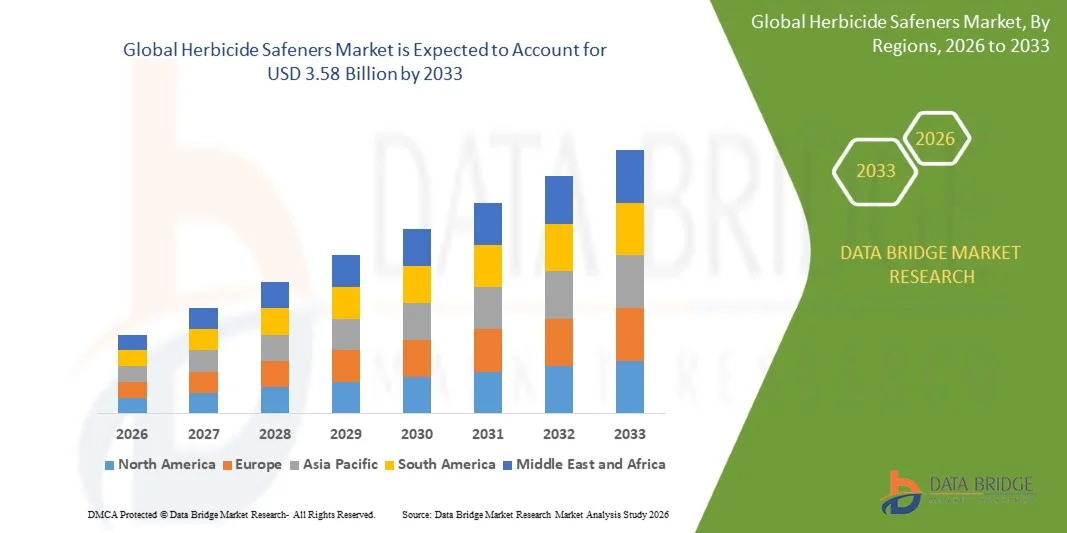
- As per Data Bridge Market Research analysis the herbicide safeners market was valued at USD 2.10 billion in 2025 and is projected to reach USD 3.58 billion by 2033, growing at a CAGR of 6.90% from 2026 to 2033.
- The market is experiencing steady growth driven by increasing adoption of selective herbicides, rising demand for effective weed management solutions, and growing use of safeners to protect crops from herbicide-induced injury while maintaining weed control efficiency.
- The increasing focus on improving crop productivity, expanding agricultural activities, and growing adoption of advanced crop protection technologies are encouraging farmers and agrochemical manufacturers to incorporate herbicide safeners into modern weed management programs.
Market Size & Forecast
- Market Value (2025): USD 2.10 Billion
- Expected Market Value (2033): USD 3.58 Billion
- Forecast CAGR (2026–2033): 6.90%
- Leading Region in 2025: North America
- Fastest Growing Region: Asia-Pacific
What are the Major Takeaways of the Herbicide Safeners Market?
- North America dominated the herbicide safeners market with the largest revenue share of 35.10% in 2025, supported by extensive adoption of advanced crop protection products, large-scale cultivation of corn, soybean, and wheat, and increasing demand for selective weed management solutions.
- Asia-Pacific herbicide safeners market is expected to witness the fastest growth rate from 2026 to 2033, supported by expanding agricultural production, rising food demand, increasing mechanization, and growing adoption of modern crop protection technologies across China, India, Japan, and Southeast Asia.
- The benoxacor segment held the largest market revenue share of 37.5% in 2025, driven by its widespread use with chloroacetanilide herbicides in corn and other major crops. Benoxacor is preferred due to its ability to enhance crop tolerance to herbicides while maintaining effective weed control performance.
- The isoxadifen segment is projected to register the fastest growth at a CAGR from 2026 to 2033, driven by increasing adoption in corn herbicide formulations and growing demand for improved crop safety. Rising utilization of safener-based selective herbicide programs is accelerating segment expansion.
- The pre-emergence segment held the largest market revenue share of 58.10% in 2025, driven by increasing adoption of preventive weed management practices and rising demand for residual herbicide protection. Growing emphasis on early-season weed control is accelerating segment expansion.
- The post-emergence is projected to register the fastest growth at a CAGR from 2026 to 2033, driven by increasing demand for effective weed control after crop emergence and the widespread use of selective herbicides during active weed growth. Post-emergence safeners support crop protection while enabling efficient control of established weeds.
Report Scope and Herbicide Safeners Market Segmentation
|
Attributes |
Herbicide Safeners Key Market Insights |
|
Segments Covered |
|
|
Countries Covered |
North America
Europe
Asia-Pacific
Middle East and Africa
South America
|
|
Key Market Players |
|
|
Market Opportunities |
|
|
Value Added Data Infosets |
In addition to the insights on market scenarios such as market value, growth rate, segmentation, geographical coverage, and major players, the market reports curated by the Data Bridge Market Research also include import export analysis, production capacity overview, production consumption analysis, price trend analysis, climate change scenario, supply chain analysis, value chain analysis, raw material/consumables overview, vendor selection criteria, PESTLE Analysis, Porter Analysis, and regulatory framework. |
What is the Key Trend in the Herbicide Safeners Market?
- The herbicide safeners market is increasingly witnessing the development of advanced herbicide formulations that combine crop protection with safener technologies, enabling effective weed control while reducing crop injury and improving application flexibility.
- For instance, in 2024, Syngenta highlighted its Storen corn herbicide, which combines four active ingredients with its MetaSafe crop safener technology to improve residual weed control while helping protect corn crops.
- Safener technologies are increasingly being incorporated into selective herbicide programs for major crops such as corn and cereals, supporting crop tolerance while allowing farmers to maintain effective weed management.
- For instance, the European Commission's regulatory list identifies several safeners used in authorized plant protection products, including benoxacor, cloquintocet, cyprosulfamide, isoxadifen-ethyl, and mefenpyr-diethyl, reflecting the established role of safeners in modern crop protection.
- As agrochemical manufacturers continue to improve formulation performance and crop safety, the development of herbicide products incorporating advanced safener technologies is expected to accelerate, reinforcing safeners as an important component of selective and efficient weed management.
What are the Key Drivers of the Herbicide Safeners Market?
- The increasing adoption of selective herbicides, rising crop protection requirements, and growing pressure to improve agricultural productivity are significantly increasing demand for herbicide safeners that protect crops from herbicide-induced injury.
- For instance, BASF's Status herbicide combines diflufenzopyr and dicamba with a proven safener for corn, demonstrating the integration of safener technology into herbicide formulations to improve crop safety while maintaining weed control performance.
- Farmers and agrochemical manufacturers are increasingly relying on safeners to expand the use of effective herbicide chemistries across major crops while improving crop tolerance and supporting more efficient weed management programs.
- For instance, HPM Chemicals and Fertilizers describes cloquintocet-mexyl as a safener used with clodinafop-propargyl to improve cereal crop tolerance and support selective control of annual grasses, including Lolium, Phalaris, and Setaria species.
- With increasing emphasis on crop yield protection, selective weed control, and efficient use of agricultural inputs, herbicide safeners will remain important for developing safer and more effective herbicide application programs.
Which Factors are Challenging the Growth of the Herbicide Safeners Market?
- Increasing regulatory scrutiny of safeners, lengthy approval procedures, and the need for extensive environmental and toxicological data are creating challenges for manufacturers seeking to commercialize and expand safener-based products.
- These regulatory requirements can increase product development costs and extend commercialization timelines, particularly for new safener molecules and formulations intended for use across multiple agricultural markets.
- For instance, the European Commission established a gradual review program for safeners and synergists already used in plant protection products, requiring substances to undergo regulatory assessment and meet defined data requirements for approval.
- The European Commission's 2025 regulatory update also excluded certain safeners, including benoxacor and fluxofenim, from the work programme because no requests for inclusion were received within the applicable deadline, highlighting the importance of regulatory compliance and documentation.
- The increasing regulatory requirements, environmental assessment costs, and lengthy approval processes continue to challenge market expansion, particularly for smaller agrochemical manufacturers. These barriers can slow the introduction of new safener technologies despite increasing demand for crop-safe and effective weed management solutions.
How is the Herbicide Safeners Market Segmented?
The market is segmented on the basis of type, application stage, herbicides selectivity, and crop.
- By Type
On the basis of type, the herbicide safeners market is segmented into benoxacor, furilazole, dichlormid, isoxadifen, and other safeners. The benoxacor segment held the largest market revenue share of 37.5% in 2025, driven by its widespread use with chloroacetanilide herbicides in corn and other major crops. Benoxacor is preferred due to its ability to enhance crop tolerance to herbicides while maintaining effective weed control performance.
The isoxadifen segment is projected to register the fastest growth at a CAGR from 2026 to 2033, driven by increasing adoption in corn herbicide formulations and growing demand for improved crop safety. Rising utilization of safener-based selective herbicide programs is accelerating segment expansion.
- By Application Stage
On the basis of application stage, the herbicide safeners market is segmented into post-emergence and pre-emergence. The pre-emergence segment held the largest market revenue share of 58.10% in 2025, driven by increasing adoption of preventive weed management practices and rising demand for residual herbicide protection. Growing emphasis on early-season weed control is accelerating segment expansion.
The post-emergence is projected to register the fastest growth at a CAGR from 2026 to 2033, driven by increasing demand for effective weed control after crop emergence and the widespread use of selective herbicides during active weed growth. Post-emergence safeners support crop protection while enabling efficient control of established weeds.
- By Herbicides Selectivity
On the basis of herbicides selectivity, the herbicide safeners market is segmented into selective herbicides and non-selective herbicides. The selective herbicides segment held the largest market revenue share in 2025, driven by the extensive application of safeners to improve crop tolerance against herbicides used for targeted weed control. Selective herbicides are preferred across major cereal and row crops due to their ability to control weeds while minimizing crop injury.
The non-selective herbicides segment is projected to register the fastest growth at a CAGR from 2026 to 2033, driven by increasing adoption of broad-spectrum weed management solutions in pre-planting, fallow land, and non-crop applications. Growing demand for efficient vegetation control is supporting segment expansion.
- By Crop
On the basis of crop, the herbicide safeners market is segmented into soybean, wheat, corn, sorghum, rice, barley, and other crops. The corn segment held the largest market revenue share in 2025, driven by extensive use of safener-containing herbicide formulations to protect corn crops from herbicide-induced injury. Increasing corn cultivation and growing adoption of advanced weed management practices are supporting segment dominance.
The soybean segment is projected to register the fastest growth at a CAGR from 2026 to 2033, driven by expanding soybean cultivation, increasing weed resistance concerns, and rising demand for effective crop-safe herbicide programs. Growing adoption of integrated weed management practices is accelerating segment expansion.
Which Region Holds the Largest Share of the Herbicide Safeners Market?
- North America dominated the herbicide safeners market with the largest revenue share of 35.10% in 2025, supported by extensive adoption of advanced crop protection products, large-scale cultivation of corn, soybean, and wheat, and increasing demand for selective weed management solutions.
- Farmers across the region increasingly use safener-containing herbicide formulations to improve crop tolerance and protect yields from herbicide injury. Well-established agricultural infrastructure, high mechanization, and strong research and development activities in agrochemicals further strengthen regional market growth.
U.S. Herbicide Safeners Market Insight
The U.S. herbicide safeners market captured the largest revenue share in 2025 within North America, fueled by extensive corn and soybean cultivation and widespread adoption of selective herbicide technologies. Farmers are increasingly prioritizing effective weed management solutions that minimize crop injury while maintaining herbicide performance. The country's advanced agricultural practices, high adoption of precision farming, and strong presence of major agrochemical manufacturers further contribute to market expansion.
Europe Herbicide Safeners Market Insight
Europe herbicide safeners market is expected to witness the fastest growth rate from 2026 to 2033, primarily driven by increasing demand for crop-safe weed management technologies and growing emphasis on sustainable agricultural practices. The adoption of selective herbicide formulations is supported by efforts to improve crop productivity while reducing unnecessary chemical exposure. Increasing investments in agricultural research and the development of improved crop protection formulations are further supporting regional market growth.
U.K. Herbicide Safeners Market Insight
The U.K. herbicide safeners market is expected to witness the fastest growth rate from 2026 to 2033, driven by increasing adoption of advanced crop protection products and growing emphasis on efficient weed management in cereal production. Farmers are increasingly seeking herbicide solutions that provide effective weed control while minimizing crop injury. The country's focus on sustainable agriculture, improved crop productivity, and responsible pesticide use is expected to continue stimulating market growth.
Germany Herbicide Safeners Market Insight
Germany herbicide safeners market is expected to witness the fastest growth rate from 2026 to 2033, fueled by increasing demand for efficient crop protection technologies and the country's strong focus on sustainable and precision agriculture. The widespread cultivation of wheat, barley, corn, and other crops is supporting demand for selective herbicide formulations containing safeners. Growing investments in agricultural innovation and environmentally responsible crop protection practices are further contributing to market expansion.
Asia-Pacific Herbicide Safeners Market Insight
The Asia-Pacific herbicide safeners market is expected to witness the fastest growth rate from 2026 to 2033, supported by expanding agricultural production, rising food demand, increasing mechanization, and growing adoption of modern crop protection technologies across China, India, Japan, and Southeast Asia. Farmers are increasingly adopting selective herbicides and safener technologies to improve weed control and protect crop yields. Growing investments in agricultural modernization and rising awareness of advanced weed management practices are accelerating regional market growth.
Japan Herbicide Safeners Market Insight
Japan herbicide safeners market is expected to witness the fastest growth rate from 2026 to 2033 due to the country's advanced agricultural technologies, limited arable land, and strong emphasis on improving crop productivity. Farmers are increasingly adopting precision crop protection solutions that provide effective weed management while minimizing crop damage. The integration of advanced agrochemical formulations with modern farming practices is supporting demand for herbicide safeners across rice, wheat, and other crops.
China Herbicide Safeners Market Insight
The China herbicide safeners market accounted for the largest market revenue share in Asia-Pacific in 2025, attributed to the country's large agricultural sector, increasing crop production, and growing adoption of modern crop protection technologies. Rising demand for corn, wheat, soybean, and rice is encouraging farmers to adopt more efficient weed management solutions that improve crop safety and productivity. Government initiatives supporting agricultural modernization, mechanization, and efficient use of crop protection inputs are further propelling market growth in China.
Which are the Top Companies in Herbicide Safeners Market?
The herbicide safeners industry is primarily led by well-established companies, including:
- Corteva Agriscience, Inc. (U.S.)
- Syngenta Group Co., Ltd. (Switzerland)
- Bayer AG (Germany)
- BASF SE (Germany)
- Nufarm Limited (Australia)
- ADAMA Agricultural Solutions Ltd. (Israel)
- UPL Limited (India)
- Drexel Chemical Company (U.S.)
- DuPont de Nemours, Inc. (U.S.)
- Sipcam-Oxon Group S.p.A. (Italy)
- HELM AG (Germany)
- Land O’Lakes, Inc. (U.S.)
- Tenkoz, Inc. (U.S.)
- Arysta LifeScience Corporation (U.S.)
- FMC Corporation (U.S.)
What are Latest Developments in Herbicide Safeners Market?
- In December 2024, Syngenta Crop Protection and Enko announced a milestone in their AI-driven collaboration to discover novel, broad-spectrum weed control molecules. The research uses Enko’s ENKOMPASS platform to identify leads for a new herbicide Mode of Action, with the aim of addressing resistant weeds such as Palmer amaranth, waterhemp, blackgrass, and Italian ryegrass. The collaboration had advanced the discoveries to the proof-of-concept stage. This development could shorten discovery timelines and strengthen innovation in herbicide resistance management.
- In November 2024, FMC Corporation completed the sale of its Global Specialty Solutions business to Environmental Science U.S. LLC, known as Envu, following the definitive agreement announced in July. The transaction was valued at USD 350 million and allowed FMC to sharpen its focus on crop protection products and technologies. FMC also continued as a contracted supplier of certain products and active ingredients during the transition. The divestment is expected to strengthen FMC’s strategic focus on agricultural innovation while supporting Envu’s expansion in non-crop markets.
- In September 2024, Syngenta Group launched Cropwise AI, a generative artificial intelligence solution designed to provide growers and agronomic advisers with data-driven crop management recommendations. The platform combines agronomic models, weather history, soil conditions, crop-growth observations, and yield data to improve decisions on input applications and pest and disease management. Syngenta reported that its seed recommendation models could help growers increase yields by up to 5%. The development strengthens the company’s digital agriculture capabilities and could support more precise and efficient crop protection practices.

- Interactive Data Analysis Dashboard
- Company Analysis Dashboard for high growth potential opportunities
- Research Analyst Access for customization & queries
- Competitor Analysis with Interactive dashboard
- Latest News, Updates & Trend analysis
- Harness the Power of Benchmark Analysis for Comprehensive Competitor Tracking
Data collection and base year analysis are done using data collection modules with large sample sizes. The stage includes obtaining market information or related data through various sources and strategies. It includes examining and planning all the data acquired from the past in advance. It likewise envelops the examination of information inconsistencies seen across different information sources. The market data is analysed and estimated using market statistical and coherent models. Also, market share analysis and key trend analysis are the major success factors in the market report. To know more, please request an analyst call or drop down your inquiry.
The key research methodology used by DBMR research team is data triangulation which involves data mining, analysis of the impact of data variables on the market and primary (industry expert) validation. Data models include Vendor Positioning Grid, Market Time Line Analysis, Market Overview and Guide, Company Positioning Grid, Patent Analysis, Pricing Analysis, Company Market Share Analysis, Standards of Measurement, Global versus Regional and Vendor Share Analysis. To know more about the research methodology, drop in an inquiry to speak to our industry experts.
Data Bridge Market Research is a leader in advanced formative research. We take pride in servicing our existing and new customers with data and analysis that match and suits their goal. The report can be customized to include price trend analysis of target brands understanding the market for additional countries (ask for the list of countries), clinical trial results data, literature review, refurbished market and product base analysis. Market analysis of target competitors can be analyzed from technology-based analysis to market portfolio strategies. We can add as many competitors that you require data about in the format and data style you are looking for. Our team of analysts can also provide you data in crude raw excel files pivot tables (Fact book) or can assist you in creating presentations from the data sets available in the report.