


Global Herpes Zoster Drug Market Size
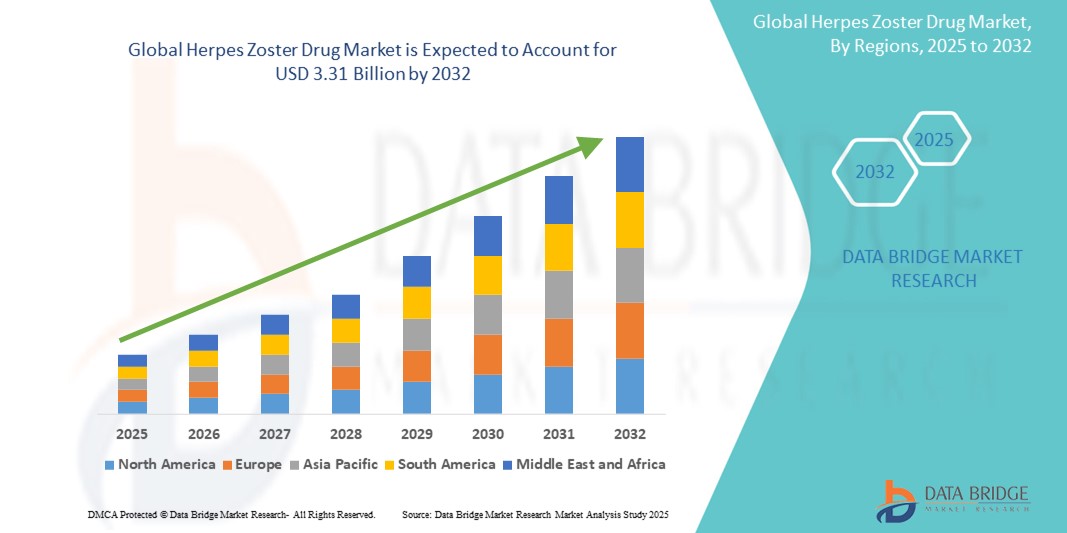
- The global herpes zoster drug market was valued at USD 1.23 billion in 2024 and is expected to reach USD 3.31 billion by 2032 at the CAGR of 13.20% during the forecast period
-
This growth is further propelled by factors such as the aging global population, improved vaccination coverage, and expanding access to antiviral medications in emerging healthcare markets.
Global Herpes Zoster Drug Market Analysis
- The increasing need for effective treatment options to manage acute viral outbreaks, postherpetic neuralgia (PHN), and associated neuropathic pain is boosting demand for antiviral agents, corticosteroids, and supportive pain therapies.
- The market benefits from ongoing R&D into next-generation vaccines and long-term postherpetic neuralgia management, public health awareness campaigns, and increased access to early diagnostic tools.
- North America is expected to dominate the herpes zoster drug market with a share of 41.31%, due to advanced healthcare infrastructure, the high adoption of cutting-edge localization technologies, and the strong presence of key market players
- For instance, the number of herpes zoster (shingles) cases reported in the U.S. has shown a steady increase over the past decade. From major hospitals to community clinics, the North America region not only administers treatments widely but also drives innovations in antiviral drug development for herpes zoster.
- Asia-Pacific is expected to be the fastest growing region in the herpes zoster drug market during the forecast period due to rapid improvements in healthcare facilities, increasing awareness about herpes zoster, and the rising number of patients seeking treatment.
- The antiviral drugs segment is expected to dominate the market with a market share of 38.65% due to its role in directly addressing the underlying viral infection. Symptomatic treatments and pain management therapies are also significant segments, providing relief from associated symptoms such as rash and neuropathic pain, but antiviral therapy continues to be the cornerstone of effective herpes zoster management.
Report Scope and Global Herpes Zoster Drug Market Segmentation
|
Attributes |
Global Herpes Zoster Drug Market Key Market Insights |
|
Segments Covered |
|
|
Countries Covered |
North America
Europe
Asia-Pacific
Middle East and Africa
South America
|
|
Key Market Players |
• F. Hoffmann-La Roche Ltd (Switzerland) • Teva Pharmaceutical Industries Ltd. (Israel) • Novartis AG (Switzerland) • Johnson & Johnson Services, Inc. (U.S.) • Sanofi S.A. (France) • Bayer AG (Germany) • Bristol-Myers Squibb Company (U.S.) • Mallinckrodt Pharmaceuticals (U.S.) |
|
Market Opportunities |
|
|
Value Added Data Infosets |
In addition to the insights on market scenarios such as market value, growth rate, segmentation, geographical coverage, and major players, the market reports curated by the Data Bridge Market Research also include depth expert analysis, patient epidemiology, pipeline analysis, pricing analysis, and regulatory framework |
Global Herpes Zoster Drug Market Trends
“Advancements in Antiviral Drug Formulations & Vaccine Development”
- One prominent trend in the herpes zoster drug market is the continued advancement in antiviral drug formulations and the development of more effective vaccines.
- These innovations enhance treatment efficacy by reducing the duration and severity of herpes zoster outbreaks and significantly lowering the risk of complications such as postherpetic neuralgia.
- For instance, modern subunit vaccines like Shingrix offer over 90% efficacy in preventing shingles and its complications, especially in older adults, which is revolutionizing preventive care in immunocompromised populations.
- The integration of novel delivery systems and long-acting antivirals is also supporting more patient-compliant regimens, improving treatment adherence and outcomes.
- These advancements are reshaping the herpes zoster treatment landscape, reducing recurrence rates, improving patient outcomes, and driving demand for innovative drug formulations and vaccination strategies
Market Dynamics
Driver
“Rising Incidence of Herpes Zoster in Aging Populations”
• The increasing prevalence of herpes zoster, especially among aging individuals and immunocompromised patients, is a key driver fueling the demand for herpes zoster therapeutics.
• As the global population ages, the number of individuals at risk for reactivation of the varicella-zoster virus continues to rise, particularly in those aged 50 and above.
• The painful nature of the disease and its potential complications, such as postherpetic neuralgia, necessitate timely treatment and prevention through antivirals and vaccination.
• The growing awareness about early diagnosis and availability of effective drugs and vaccines contributes to the rising demand for herpes zoster treatments.
For instance,
- in July 2022, the Centers for Disease Control and Prevention (CDC) reported a notable increase in shingles cases among people aged 60 and older in the U.S., highlighting the need for continued antiviral and vaccination coverage to reduce disease burden.
- In December 2021, according to the World Health Organization, countries like Japan and Germany are experiencing a rise in herpes zoster incidence due to aging demographics, pushing national health agencies to include shingles vaccines in routine immunization schedules
- As a result of the rising prevalence of herpes zoster, particularly among older adults, there is a significant increase in the demand for antiviral drugs and vaccines.
Opportunity
“Growing Adoption of Preventive Vaccination Programs ”
• The rising adoption of vaccination programs targeting herpes zoster presents a significant opportunity for market growth.
• Governments and healthcare providers are increasingly including herpes zoster vaccines in adult immunization schedules to curb incidence and reduce healthcare costs.
• These initiatives are particularly impactful in regions with high aging populations and strong public health infrastructure.
For instance:
- in January 2025, the European Centre for Disease Prevention and Control (ECDC) reported that several EU countries had initiated national programs offering Shingrix® for free or at subsidized rates to adults over 50 years, significantly increasing vaccination uptake.
- In November 2023, according to the U.S. Department of Health and Human Services, expansion of Medicare Part D coverage for shingles vaccines led to a substantial rise in adult vaccination rates, reducing hospitalization rates due to herpes zoster complications
- The continued push toward preventative care through immunization will likely reduce disease burden, improve patient quality of life, and open new avenues for pharmaceutical players.
Restraint/Challenge
“High Cost of Vaccines and Limited Access in Low-Income Regions”
• The high cost associated with herpes zoster vaccines, particularly newer formulations like Shingrix, poses a major barrier to widespread adoption in low- and middle-income countries.
• Limited healthcare budgets and lack of reimbursement policies restrict patient access to both preventive and therapeutic herpes zoster options in these regions.
• These affordability challenges lead to lower vaccination coverage and continued reliance on antiviral treatments post-infection, which may not be as effective in preventing complications.
For instance,
- in November 2024, a study published by the Global Health Policy Institute emphasized that the cost of Shingrix® in countries without government subsidies remains a major barrier, with patients often paying over USD 300 for the two-dose regimen.
- Consequently, such financial constraints can lead to disparities in access to herpes zoster prevention and treatment, ultimately limiting the market’s full growth potential, especially in developing economies
Herpes Zoster Drug Market Scope
The market is segmented on the basis of drug class, therapy class, end-users, and distribution channel
|
Segmentation |
Sub-Segmentation |
|
Drug Class |
|
|
Therapy type |
|
|
End-Users |
|
|
Distribution Channel |
|
In 2025, the antiviral drugs segment is projected to dominate the Herpes Zoster Drug Market with the largest share in the drug type segment.
The antiviral drugs segment is expected to hold the largest market share of approximately 38.65% in 2025 due to its established effectiveness in targeting the varicella-zoster virus, thereby reducing the severity and duration of herpes zoster outbreaks. Despite the availability of other drug types such as corticosteroids and analgesics, antiviral drugs remain the cornerstone of herpes zoster treatment because of their proven clinical benefits, widespread physician preference, and guideline recommendations. Their ability to limit viral replication and prevent complications like postherpetic neuralgia continues to drive their leading position in the market.
The pain management segment is expected to account for the largest share during the forecast period within the therapy type segment.
In 2025, pain management therapies are anticipated to dominate due to the high prevalence of herpes zoster-associated neuropathic pain and the increasing focus on improving patients’ quality of life. Pain management options, including analgesics and adjunct therapies, offer symptomatic relief and are crucial in addressing the debilitating pain experienced by patients both during and after active outbreaks. The rising demand for effective pain control, combined with ongoing advancements in targeted therapies and supportive regulatory approvals, is further accelerating the growth of this segment as an essential component of herpes zoster treatment protocols
Global Herpes Zoster Drug Market Regional Analysis
“North America is the Dominant Region in the Herpes Zoster Drug Market”
• North America dominates the herpes zoster drug market, driven by well-developed healthcare infrastructure, high awareness about shingles and postherpetic neuralgia, and the strong presence of leading pharmaceutical companies.
• The U.S. holds a significant share due to the widespread availability of vaccines and antiviral medications, a large aging population prone to herpes zoster outbreaks, and high healthcare spending.
• The availability of favorable reimbursement policies and consistent investments in research & development for antiviral therapies further strengthen the market.
• In addition, the rising number of herpes zoster cases, especially among older adults and immunocompromised individuals, along with strong public health initiatives promoting vaccination, is fueling market expansion across the region.
“Asia-Pacific is Projected to Register the Highest Growth Rate”
• The Asia-Pacific region is expected to witness the highest growth rate in the herpes zoster drug market, driven by improving healthcare infrastructure, growing public health awareness, and increasing geriatric population.
• Countries such as China, India, and Japan are emerging as key markets due to rising incidence of herpes zoster and greater focus on vaccine uptake and antiviral treatment accessibility.
• Japan, with its advanced healthcare system and high proportion of elderly citizens, remains a crucial market for herpes zoster drugs. The country is also active in promoting vaccination programs and antiviral treatment protocols.
• China and India, with their large populations and expanding access to healthcare services, are experiencing growing demand for herpes zoster treatments. Government immunization initiatives and the rising presence of global pharmaceutical players further contribute to market growth
Global Herpes Zoster Drug Market Share
The competitive landscape provides a comprehensive overview of the leading market players. This includes company profiles, financial performance, R&D activities, product pipelines, international presence, production capabilities, strategic developments, strengths, weaknesses, and contributions to antiviral and vaccine therapeutics.
The Major Market Leaders Operating in the Market Include:
• Pfizer Inc. (U.S.)
• F. Hoffmann-La Roche Ltd (Switzerland)
• Teva Pharmaceutical Industries Ltd. (Israel)
• Novartis AG (Switzerland)
• Johnson & Johnson Services, Inc. (U.S.)
• Sanofi S.A. (France)
• Bayer AG (Germany)
• Bristol-Myers Squibb Company (U.S.)
• Mallinckrodt Pharmaceuticals (U.S.)
Latest Developments in Global Herpes Zoster Drug Market
- In March 2023, Pfizer announced a Phase 3 study evaluating its next-generation shingles vaccine candidate with enhanced immunogenicity
- In July 2022, Roche partnered with a virology research institute to accelerate development of long-acting antivirals for herpes virus infections
- In 2024, South Korea’s health authority approved a new recombinant vaccine aimed at boosting protection against herpes zoster in adults over 60. The report also highlights emerging trends such as AI-supported outbreak prediction, advancements in vaccine adjuvant technology, and integrated care models for managing acute shingles and postherpetic neuralgia.

- Interactive Data Analysis Dashboard
- Company Analysis Dashboard for high growth potential opportunities
- Research Analyst Access for customization & queries
- Competitor Analysis with Interactive dashboard
- Latest News, Updates & Trend analysis
- Harness the Power of Benchmark Analysis for Comprehensive Competitor Tracking
Data collection and base year analysis are done using data collection modules with large sample sizes. The stage includes obtaining market information or related data through various sources and strategies. It includes examining and planning all the data acquired from the past in advance. It likewise envelops the examination of information inconsistencies seen across different information sources. The market data is analysed and estimated using market statistical and coherent models. Also, market share analysis and key trend analysis are the major success factors in the market report. To know more, please request an analyst call or drop down your inquiry.
The key research methodology used by DBMR research team is data triangulation which involves data mining, analysis of the impact of data variables on the market and primary (industry expert) validation. Data models include Vendor Positioning Grid, Market Time Line Analysis, Market Overview and Guide, Company Positioning Grid, Patent Analysis, Pricing Analysis, Company Market Share Analysis, Standards of Measurement, Global versus Regional and Vendor Share Analysis. To know more about the research methodology, drop in an inquiry to speak to our industry experts.
Data Bridge Market Research is a leader in advanced formative research. We take pride in servicing our existing and new customers with data and analysis that match and suits their goal. The report can be customized to include price trend analysis of target brands understanding the market for additional countries (ask for the list of countries), clinical trial results data, literature review, refurbished market and product base analysis. Market analysis of target competitors can be analyzed from technology-based analysis to market portfolio strategies. We can add as many competitors that you require data about in the format and data style you are looking for. Our team of analysts can also provide you data in crude raw excel files pivot tables (Fact book) or can assist you in creating presentations from the data sets available in the report.













