


What is the Hesperedin Market Size and Growth Rate?
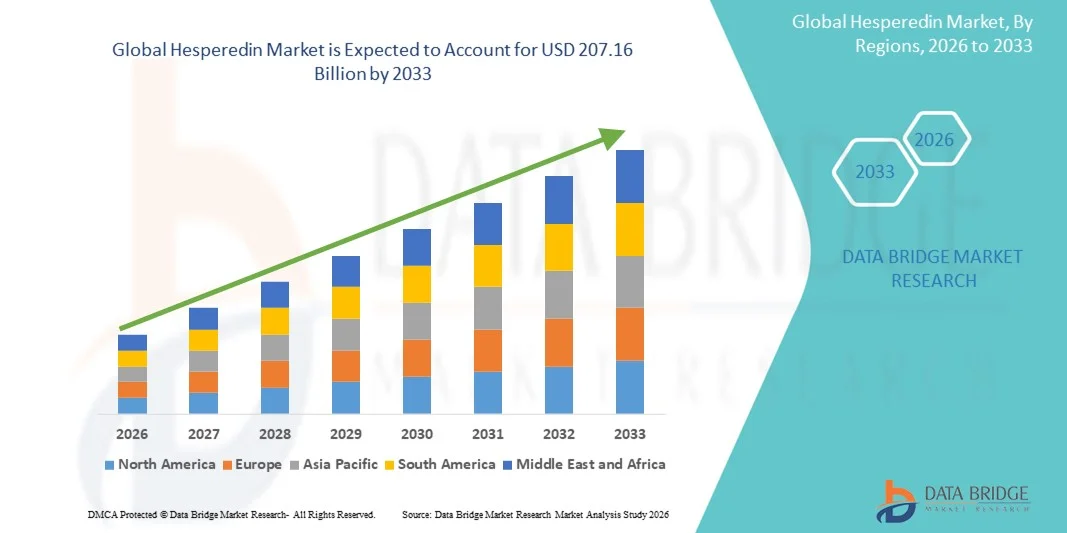
- As per Data Bridge Market Research Analysis the global hesperedin market size was valued at USD 137.05 billion in 2025 and is expected to reach USD 207.16 billion by 2033, at a CAGR of 5.30% during the forecast period
- The market growth is largely fueled by the increasing prevalence of cardiovascular disorders, diabetes, and inflammatory diseases, which are driving demand for natural and plant-derived therapeutics
- Furthermore, rising awareness of the health benefits of flavonoids, including antioxidant, anti-inflammatory, and cardioprotective properties, is accelerating the uptake of Hesperedin solutions, thereby significantly boosting the industry's growth
What are the Major Takeaways of Hesperedin Market?
- Hesperedin, a naturally occurring bioflavonoid, is increasingly gaining attention for its antioxidant, anti-inflammatory, and cardiovascular health benefits, making it a vital component in nutraceuticals, dietary supplements, and functional foods
- The escalating demand for Hesperedin is primarily fueled by rising health consciousness, growing awareness of natural therapeutics, and increasing preference for preventive healthcare solutions among consumers
- North America dominated the Hesperedin market with the largest revenue share of 43.2% in 2025, attributed to high consumer awareness, established nutraceutical infrastructure, and strong presence of leading manufacturers. The U.S. remains the key contributor, driven by rising adoption of dietary supplements, increased research on Hesperedin’s health benefits, and robust distribution channels including pharmacies and e-commerce platform
- Asia-Pacific is expected to be the fastest-growing region in the Hesperedin market during the forecast period, projected to expand at a CAGR from 2026 to 2033, fueled by increasing urbanization, rising disposable incomes, government initiatives promoting herbal supplements, and growing interest in preventive healthcare in countries such as China, India, and Japan
- The ≥95% purity segment held the largest market revenue share of 52.3% in 2025, due to its high potency, efficacy, and suitability for pharmaceutical, dietary supplement, and research applications
Report Scope and Hesperedin Market Segmentation
|
Attributes |
Hesperedin Key Market Insights |
|
Segments Covered |
|
|
Countries Covered |
North America
Europe
Asia-Pacific
Middle East and Africa
South America
|
|
Key Market Players |
|
|
Market Opportunities |
|
|
Value Added Data Infosets |
In addition to the insights on market scenarios such as market value, growth rate, segmentation, geographical coverage, and major players, the market reports curated by the Data Bridge Market Research also include in-depth expert analysis, patient epidemiology, pipeline analysis, pricing analysis, and regulatory framework. |
What is the Key Trend in the Hesperedin Market?
Emerging Therapeutic Applications and Research Expansion
- A significant and accelerating trend in the global Hesperedin market is the increasing focus on its multifunctional therapeutic potential, particularly its antioxidant, anti-inflammatory, and cardioprotective properties. Researchers are exploring Hesperedin for applications in neurodegenerative disorders, metabolic syndrome, and cancer adjuvant therapies, expanding beyond traditional dietary supplementation
- For instance, in 2024, multiple preclinical studies highlighted Hesperedin’s efficacy in reducing oxidative stress in models of diabetic neuropathy, demonstrating potential pathways for future clinical development. This trend reflects growing scientific interest in flavonoid-based therapies and natural bioactive compounds
- Clinical trials are increasingly evaluating Hesperedin’s bioavailability and pharmacokinetics, with novel formulations such as nanoemulsions and liposomal encapsulation being investigated to enhance systemic absorption and therapeutic effect
- The development of combination therapies using Hesperedin alongside standard treatments for cardiovascular and metabolic disorders is gaining momentum, supporting integrated approaches to disease management
- Research into Hesperedin’s molecular mechanisms, including modulation of inflammatory cytokines and endothelial function, is paving the way for targeted therapeutic applications in chronic inflammatory diseases
- In addition, increasing awareness of Hesperedin’s potential in oncology, particularly as an adjunct to reduce chemotherapy-induced toxicity, is drawing attention from pharmaceutical developers and nutraceutical companies
- The trend toward functional foods and nutraceutical integration continues to drive product innovations, with Hesperedin being incorporated into beverages, supplements, and fortified foods aimed at cardiovascular and metabolic health
- Ongoing exploration of Hesperedin’s neuroprotective effects in preclinical Alzheimer’s and Parkinson’s disease models is expected to stimulate future clinical trials and expand market interest
Hesperedin Market Dynamics
Driver
Increasing Demand Due to Expanding Clinical Research and Health Awareness
- The growing body of preclinical and clinical research demonstrating Hesperedin’s multifaceted health benefits is a primary driver for market growth. Studies supporting cardiovascular, metabolic, and neuroprotective effects have boosted both consumer and clinician interest
- For instance, in March 2023, a study published in Frontiers in Pharmacology highlighted Hesperedin’s cardioprotective effects in hypertensive animal models, which has encouraged nutraceutical companies to formulate targeted supplements
- Rising prevalence of lifestyle-related disorders such as hypertension, diabetes, and obesity is increasing demand for natural therapeutics and bioactive compounds, positioning Hesperedin as a preferred intervention
- Health-conscious consumers and the growing global trend for plant-based dietary supplements support broader market adoption
- The expansion of clinical trials exploring novel delivery systems, improved bioavailability, and combination therapies reinforces the market’s growth trajectory
- Increasing investment by pharmaceutical and nutraceutical companies in R&D for Hesperedin-based formulations fuels innovation and product differentiation
- Growing acceptance of Hesperedin as a complementary therapy in integrative medicine enhances its market presence across hospitals, specialty clinics, and retail channels
- Education campaigns highlighting antioxidant and anti-inflammatory benefits have improved consumer confidence, further driving adoption
Restraint/Challenge
Limitations in Bioavailability and Regulatory Hurdles
- Despite its therapeutic potential, Hesperedin faces challenges related to poor oral bioavailability, limiting systemic efficacy and therapeutic impact in clinical applications. Efforts to develop nano formulations and other delivery systems are ongoing but not yet universally implemented
- For instance, high doses of Hesperedin are often required to achieve measurable plasma concentrations, which can reduce patient compliance in long-term supplementation regimens
- Regulatory uncertainty around claims for flavonoid-based nutraceuticals creates hurdles for market expansion, especially in regions with strict health claim regulations
- Variability in raw material quality and extraction methods affects consistency of Hesperedin content in commercial products, posing challenges for standardization
- Some studies have indicated potential interactions with certain medications, necessitating physician oversight and consumer education to prevent adverse effects
- Addressing bioavailability limitations through innovative delivery systems, combined with harmonized regulatory frameworks, will be crucial for sustained market growth
- Enhanced clinical evidence demonstrating efficacy and safety in humans is required to overcome skepticism among healthcare professionals and strengthen market acceptance
- Partnerships between nutraceutical companies and research institutions can help mitigate these challenges by ensuring high-quality, standardized, and evidence-backed Hesperedin products.
How is the Hesperedin Market Segmented?
The market is segmented on the basis of source, type, and application.
- By Source
On the basis of source, the Hesperedin market is segmented into Orange, Lemon, and Others. The Orange segment dominated the largest market revenue share of 46.5% in 2025, driven by its high natural concentration of Hesperedin in orange peels, well-established extraction processes, and strong consumer preference. This segment benefits from extensive cultivation, consistent quality, and robust supply chains, making it widely adopted in dietary supplements, functional foods, and pharmaceutical applications. The bioavailability and standardization of orange-derived Hesperedin further reinforce its market dominance, while ongoing research and product innovations sustain demand. Regulatory acceptance and scalable production capabilities also contribute to its continued leadership.
The Lemon segment is anticipated to witness the fastest CAGR of 15.8% from 2026 to 2033, driven by rising consumer awareness of its antioxidant, anti-inflammatory, and cardioprotective properties. Increased R&D investment in lemon peel extraction, coupled with innovations in functional food and beverage applications, is fueling rapid adoption. Expansion in emerging markets and growing incorporation in nutraceuticals and fortified products further accelerates growth. Rising consumer preference for lemon-based formulations supports the segment’s dynamic growth trajectory.
- By Type
On the basis of type, the Hesperedin market is segmented into 80%-90%, 90%-94%, and ≥95% purity. The ≥95% purity segment held the largest market revenue share of 52.3% in 2025, due to its high potency, efficacy, and suitability for pharmaceutical, dietary supplement, and research applications. High-purity Hesperedin ensures precise dosing, consistent bioactivity, and enhanced therapeutic benefits, making it preferred for clinical and nutraceutical formulations. Stringent quality control, regulatory compliance, and adoption by premium product lines sustain its dominance. Manufacturers favor this segment to meet the increasing global demand for reliable and high-efficacy Hesperedin products.
The 90%-94% purity segment is expected to witness the fastest CAGR of 16.5% from 2026 to 2033, fueled by cost-effectiveness and expanding applications in food, beverage, and cosmetic products. This mid-purity grade offers a balance between efficacy and affordability, making it suitable for fortified foods, functional beverages, and skincare formulations. Rising consumer preference for natural bioactive ingredients in everyday products and increasing adoption by manufacturers support rapid growth. In addition, ongoing research on its health benefits and enhanced extraction techniques are expected to further propel demand in this segment.
- By Application
On the basis of application, the Hesperedin market is segmented into Food and Beverage, Cosmetics, Dietary Supplement, Pharmaceutical, and Others. The Dietary Supplement segment accounted for the largest market revenue share of 48.7% in 2025, driven by growing consumer awareness of cardiovascular, immune, and anti-inflammatory benefits. Manufacturers utilize Hesperedin’s clinically proven advantages to develop capsules, powders, and tablets, ensuring steady demand. Expanding retail distribution channels, e-commerce growth, and consumer trust in nutraceutical efficacy reinforce the segment’s leading position. Strategic product launches and increased marketing efforts further strengthen dominance.
The Food and Beverage segment is anticipated to witness the fastest CAGR of 14.9% from 2026 to 2033, fueled by rising consumer demand for natural bioactive compounds in daily diet. Increasing incorporation in functional beverages, fortified foods, and health drinks drives growth, supported by technological innovations that preserve bioactivity. Development of ready-to-drink formulations and functional snacks enriched with Hesperedin is further accelerating adoption. Expansion in health-conscious consumer segments enhances the segment’s growth potential.
Which Region Holds the Largest Share of the Hesperedin Market?
- North America dominated the hesperedin market with the largest revenue share of 43.2% in 2025
- Attributed to high consumer awareness, established nutraceutical infrastructure, and strong presence of leading manufacturers
- The market remains the key contributor, driven by rising adoption of dietary supplements, increased research on Hesperedin’s health benefits, and robust distribution channels including pharmacies and e-commerce platform
U.S. Hesperedin Market Insigh
The U.S. hesperedin market captured the largest revenue share of 82% in North America in 2025, fueled by the rising consumer focus on preventive healthcare, the availability of a wide range of Hesperedin-based products, and strong distribution networks spanning pharmacies, health stores, and online platforms. Ongoing clinical studies and product launches highlighting Hesperedin’s cardiovascular and metabolic health benefits further reinforce market growth.
Europe Hesperedin Market Insight
The Europe hesperedin market is projected to expand at a notable CAGR during the forecast period, primarily driven by increasing awareness of flavonoid-rich nutraceuticals, a strong presence of dietary supplement manufacturers, and growing demand for functional foods. Countries such as Germany, the U.K., and France are witnessing significant adoption of Hesperedin in supplements and fortified products.
U.K. Hesperedin Market Insight
The U.K. hesperedin market is anticipated to grow at a healthy CAGR, supported by rising consumer preference for plant-based dietary supplements, awareness campaigns on antioxidant benefits, and a well-established nutraceutical retail network including e-commerce channels.
Germany Hesperedin Market Insight
The Germany hesperedin market is expected to expand steadily during the forecast period, driven by growing consumer focus on heart health, government support for nutraceuticals, and increasing research on flavonoid-rich compounds. Germany’s robust nutraceutical manufacturing infrastructure and strong retail presence contribute to widespread adoption.
Asia-Pacific Hesperedin Market Insight
The Asia-Pacific hesperedin market is poised to grow at the fastest CAGR of 23% during the forecast period of 2026 to 2033, fueled by rising disposable incomes, increasing urbanization, government initiatives promoting herbal and preventive healthcare, and growing consumer awareness about natural nutraceuticals. Countries such as China, India, and Japan are witnessing high adoption rates for Hesperedin-based supplements and functional foods.
Japan Hesperedin Market Insight
The Japan hesperedin market is gaining momentum due to strong consumer awareness of flavonoid health benefits, high disposable income, and the country’s established functional food and supplement market. Growing interest in preventive healthcare and the aging population further drive demand for Hesperedin products.
China Hesperedin Market Insight
The China hesperedin market accounted for the largest market revenue share in Asia-Pacific in 2025, attributed to rapid urbanization, increasing disposable incomes, government support for herbal supplements, and strong domestic nutraceutical manufacturing. Rising health-consciousness and growing popularity of functional foods and dietary supplements are key factors propelling the market in China.
Hesperedin Market Share
The Hesperedin industry is primarily led by well-established companies, including:
• NutriScience Innovations (U.S.)
• Shaoxing Xinxing Food Co., Ltd. (China)
• Sunson Industry Group Co., Ltd. (China)
• Guangdong Yimeizhi Biotechnology Co., Ltd. (China)
• NutraScience Labs (U.S.)
• Naturex (France)
• Barry Callebaut (Switzerland)
• DSM Nutritional Products (Netherlands)
• Solasta Biotech (U.S.)
• Chromadex (U.S.)
• Zhejiang NHU Co., Ltd. (China)
• Fruitchem International (U.S.)
• Fermenta Biotech Ltd. (India)
• Bio-Botanica, Inc. (U.S.)
• Indena S.p.A. (Italy)
• Nutraceutical Corporation (U.S.)
• Arjuna Natural Extracts Ltd. (India)
• Herbaland Naturals Inc. (Canada)
• Hunan Nutramax Inc. (China)
What are Latest Developments in Global Hesperedin Market?
- In September 2024, the European Food Safety Authority (EFSA) approved glucosyl hesperidin for use in food supplements at up to 364 mg per day for adults, opening the ingredient to broader functional food and nutraceutical applications
- In August 2025, a systematic review published in Pharmacy Times highlighted hesperidin’s growing evidential base in lipid management, blood pressure reduction, glucose control, and liver/cerebral health, signalling its shift from a vitamin‑supplement niche toward broader clinical and preventive health roles

- Interactive Data Analysis Dashboard
- Company Analysis Dashboard for high growth potential opportunities
- Research Analyst Access for customization & queries
- Competitor Analysis with Interactive dashboard
- Latest News, Updates & Trend analysis
- Harness the Power of Benchmark Analysis for Comprehensive Competitor Tracking
Data collection and base year analysis are done using data collection modules with large sample sizes. The stage includes obtaining market information or related data through various sources and strategies. It includes examining and planning all the data acquired from the past in advance. It likewise envelops the examination of information inconsistencies seen across different information sources. The market data is analysed and estimated using market statistical and coherent models. Also, market share analysis and key trend analysis are the major success factors in the market report. To know more, please request an analyst call or drop down your inquiry.
The key research methodology used by DBMR research team is data triangulation which involves data mining, analysis of the impact of data variables on the market and primary (industry expert) validation. Data models include Vendor Positioning Grid, Market Time Line Analysis, Market Overview and Guide, Company Positioning Grid, Patent Analysis, Pricing Analysis, Company Market Share Analysis, Standards of Measurement, Global versus Regional and Vendor Share Analysis. To know more about the research methodology, drop in an inquiry to speak to our industry experts.
Data Bridge Market Research is a leader in advanced formative research. We take pride in servicing our existing and new customers with data and analysis that match and suits their goal. The report can be customized to include price trend analysis of target brands understanding the market for additional countries (ask for the list of countries), clinical trial results data, literature review, refurbished market and product base analysis. Market analysis of target competitors can be analyzed from technology-based analysis to market portfolio strategies. We can add as many competitors that you require data about in the format and data style you are looking for. Our team of analysts can also provide you data in crude raw excel files pivot tables (Fact book) or can assist you in creating presentations from the data sets available in the report.












