What is the Heterogeneous Networks Market Size and Growth Rate?
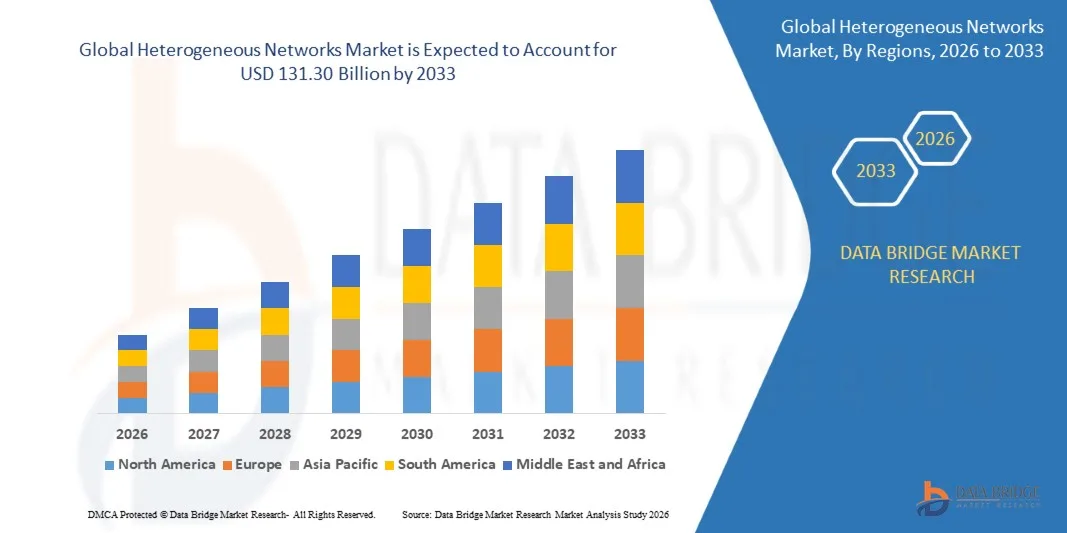
- As per Data Bridge Market Research analysis, the heterogeneous networks market was valued at USD 47.71 billion in 2025 and is projected to reach USD 131.30 billion by 2033, growing at a CAGR of 13.49% from 2026 to 2033.
- The market is experiencing consistent growth driven by rising demand for high-speed connectivity, rapid deployment of 5G networks, increasing mobile data traffic, and expanding applications across smart cities, enterprise connectivity, and industrial IoT.
- The growing number of connected devices globally, combined with rising demand for reliable network coverage and seamless data transmission, is compelling telecommunications operators and enterprises to adopt heterogeneous network solutions. Small cells, Wi-Fi, and macrocell technologies are being integrated to improve network capacity, reduce congestion, and extend coverage in densely populated areas, offering scalable and efficient connectivity for next-generation digital services.
Market Size & Forecast
- Global Market Value (2025): USD 47.71 Billion
- Expected Market Value (2033): USD 131.30 Billion
- Forecast CAGR (2026–2033): 13.49%
- Leading Region in 2025: North America
- Fastest Growing Region: Asia Pacific
What are the Major Takeaways of the Heterogeneous Networks Market?
- North America dominated the heterogeneous networks market with the largest revenue share of 36.2% in 2025, supported by advanced telecommunications infrastructure, early 5G adoption, and strong investments in network densification.
- Asia-Pacific is expected to be the fastest-growing region at a CAGR of 12.5% from 2026 to 2033, fueled by expanding 5G deployments, rising mobile data traffic, and increasing investments in next-generation telecommunications infrastructure
- The small cells segment led the market with a 37.86% share in 2025, driven by the growing need to enhance network capacity, improve indoor coverage, and manage increasing mobile data traffic.
- Carrier Wi-Fi are the fastest-growing product type, projected to register a CAGR of 13.97%, reflecting the surge in demand for cost-effective wireless connectivity and mobile data offloading.
- The integration segment dominated the services category with a 38% revenue share in 2025, led by the need to coordinate equipment, software, and network technologies from multiple vendors.
- Brownfield accounted for 60% of the market share in 2025, preferred by telecommunications operators upgrading existing network infrastructure to accommodate growing data traffic and advanced connectivity requirements.
- The enhanced intercell interference coordination (eICIC) segment is the fastest-growing technology category, with a CAGR of 13%, driven by increasing deployment of dense networks containing multiple cell sizes and overlapping coverage areas.
Report Scope and Heterogeneous Networks Market Segmentation
|
Attributes |
Heterogeneous Networks Key Market Insights |
|
Segments Covered |
|
|
Countries Covered |
North America
Europe
Asia-Pacific
Middle East and Africa
South America
|
|
Key Market Players |
|
|
Market Opportunities |
|
|
Value Added Data Infosets |
In addition to the market insights such as market value, growth rate, market segments, geographical coverage, market players, and market scenario, the market report curated by the Data Bridge Market Research team includes in-depth expert analysis, import/export analysis, pricing analysis, production consumption analysis, and pestle analysis. |
What is the Key Trend in the Heterogeneous Networks Market?
- Telecommunications operators are increasingly integrating macro cells, small cells, Wi-Fi, and 5G technologies to improve network coverage, increase capacity, and deliver seamless connectivity across indoor and outdoor environments.
- For instance, in January 2025, the GSMA highlighted continued 5G network transformation, with global mobile operator capital expenditure forecast at USD 180 billion in 2025, supporting investments in network integration, AI, Open RAN, and edge technologies.
- AI-powered network automation enables operators to optimize traffic distribution, manage network resources, and improve service quality across multiple radio access technologies.
- Telecom providers are also adopting Open RAN and virtualized network architectures to increase interoperability, reduce vendor dependence, and support flexible network deployment.
- For instance, in November 2024, the U.S. National Institute of Standards and Technology outlined how Open RAN supports interoperable, disaggregated network infrastructure designed to improve flexibility, innovation, and cost efficiency.
- As operators prioritize higher capacity, seamless connectivity, and more intelligent network management, heterogeneous network integration is becoming increasingly important for supporting 5G services and future connectivity requirements.
What are the Key Drivers of the Heterogeneous Networks Market?
- The rapid expansion of 5G networks and rising mobile data consumption are increasing demand for heterogeneous network solutions that combine macro cells, small cells, and Wi-Fi to improve coverage and network capacity.
- For instance, in September 2025, India's Department of Telecommunications reported that 5G services covered 85% of the country's population, with 508,000 5G base transceiver stations installed as of October 31, 2025, highlighting the continued expansion of wireless infrastructure.
- Telecommunications operators and enterprises are deploying heterogeneous networks to support connected devices, industrial IoT, smart cities, and high-bandwidth applications requiring reliable connectivity.
- For instance, in February 2024, the GSMA reported that 47 mobile operator groups representing 239 mobile networks had joined its Open Gateway initiative, demonstrating industry efforts to enable interoperable network capabilities and new digital services.
- The growing need for improved indoor coverage, lower latency, and efficient spectrum utilization is encouraging operators to combine complementary wireless technologies across dense urban and enterprise environments.
- As mobile traffic and connectivity requirements continue to increase, heterogeneous networks are becoming essential for expanding network capacity, enhancing user experiences, and supporting advanced digital services.
What Factors are Challenging the Growth of the Heterogeneous Networks Market?
- Heterogeneous network deployment requires substantial capital investment in small cells, macro cells, Wi-Fi access points, backhaul infrastructure, and network management systems.
- For instance, in October 2024, The Economic Times reported that cost, integration, and scalability challenges remained major near-term hurdles for Open RAN adoption in India, highlighting the financial and operational difficulties of deploying multivendor network infrastructure.
- These high implementation costs can limit adoption among smaller telecommunications operators and service providers, particularly in rural areas and price-sensitive emerging markets.
- Integrating equipment from multiple vendors and coordinating different radio access technologies can create interoperability, cybersecurity, and network optimization challenges for operators.
- For instance, in April 2025, the U.S. National Telecommunications and Information Administration published findings from its 5G Challenge testing, documenting configuration mismatches, software compatibility issues, and substantial integration effort across multivendor Open RAN systems.
- The combination of high infrastructure costs, integration complexity, and ongoing maintenance requirements continues to challenge widespread deployment, particularly among operators with limited budgets and technical resources.
How is the Heterogeneous Networks Market Segmented?
The heterogeneous networks market is segmented on the basis of product, services, deployment, technology, and vertical.
- By Product
On the basis of product, the heterogeneous networks market is segmented into small cells, Distributed Antenna Systems (DAS), Cloud Radio Access Networks (C-RAN), carrier Wi-Fi, and macro base stations. The small cells segment dominated the market with share of 37.86% in 2025, owing to the growing need to enhance network capacity, improve indoor coverage, and manage increasing mobile data traffic. Small cells are widely deployed in offices, shopping centers, stadiums, and densely populated urban areas where conventional macro networks may experience congestion. Their compact size enables operators to expand coverage without relying entirely on large cell towers. Increasing 5G deployments are further strengthening demand for small-cell infrastructure. These systems also support low-latency applications and improved connectivity for connected devices.
The carrier Wi-Fi segment is projected to register the fastest growth at CAGR of 13.97% from 2026 to 2033, driven by increasing demand for cost-effective wireless connectivity and mobile data offloading. Carrier Wi-Fi enables telecommunications operators to complement cellular networks and reduce pressure on licensed spectrum. These solutions are widely used in public venues, transportation hubs, commercial buildings, and residential environments. Integration with 5G networks and authentication technologies is improving connectivity between cellular and Wi-Fi services. Growing adoption of Wi-Fi 6 and Wi-Fi 7 is also enhancing network capacity and performance.
- By Services
On the basis of services, the heterogeneous networks market is segmented into design and consulting, RF planning, integration, testing, and training. The integration segment dominated the market with a market share of 38% in 2025, driven by the need to coordinate equipment, software, and network technologies from multiple vendors. Integration services help operators connect small cells, macro base stations, DAS, and Wi-Fi infrastructure within a unified network environment. These services support interoperability, network configuration, and seamless handovers between access technologies. Increasing deployment of 5G and virtualized network architectures is making integration more technically demanding. Telecom operators also rely on integration specialists to reduce deployment delays and operational disruptions. Growing network complexity continues to support demand for these services.
The services segment is projected to register a CAGR of 14.89% from 2026 to 2033, making it the fastest-growing broad component category in the heterogeneous networks market. Growth is supported by increasing demand for network design, deployment, integration, and optimization expertise. Operators are increasingly outsourcing complex network activities to specialist providers to manage costs and accelerate deployment. The expansion of small cells and multivendor architectures is creating additional requirements for testing and interoperability. Managed services can also help improve network performance and reduce operational complexity. Continued investment in 5G infrastructure and network modernization is expected to support demand for professional services.
- By Deployment
On the basis of deployment, the heterogeneous networks market is segmented into greenfield, brownfield, cells in hotspot, macro-pico, macro-femto, and macro-and-small-cell deployments. The brownfield deployment segment is estimated to dominate the market with share of 60% in 2025, supported by telecommunications operators upgrading existing network infrastructure to accommodate growing data traffic and advanced connectivity requirements. Brownfield deployments allow operators to integrate small cells, Wi-Fi access points, and other network technologies into established cellular networks. This approach helps preserve existing infrastructure investments while improving network capacity and coverage. Operators can modernize network architecture without replacing their entire infrastructure. The growing adoption of 5G technologies and the need for efficient network densification are further supporting this deployment model.
The greenfield deployment segment is estimated to register the fastest growth at CAGR of 14% from 2026 to 2033, driven by investments in new telecommunications infrastructure, smart cities, and private enterprise networks. Greenfield deployments enable operators to design network architecture according to current capacity, coverage, and performance requirements. These projects can incorporate advanced small cells, cloud-based radio access networks, and modern network management platforms from the beginning. Increasing investments in new urban developments and industrial facilities are supporting demand for newly designed heterogeneous networks. The absence of legacy infrastructure can simplify technology selection and network optimization.
- By Technology
On the basis of technology, the heterogeneous networks market is segmented into Enhanced Intercell Interference Coordination (eICIC), LTE WAN, and other technologies. The LTE WAN segment is estimated to hold a share of 45% in 2025, supported by the widespread deployment of LTE infrastructure and its continued role in providing reliable mobile broadband connectivity. LTE-based heterogeneous networks combine macro base stations with smaller cells to improve signal quality and network capacity. This architecture helps operators manage interference and maintain connectivity in areas with high user density. LTE WAN technologies also support connected devices, enterprise communications, and mobile applications requiring consistent network performance. Their compatibility with existing cellular infrastructure facilitates incremental network upgrades.
The Enhanced Intercell Interference Coordination (eICIC) segment is estimated to register the fastest growth at CAGR of 13% from 2026 to 2033, driven by increasing deployment of dense networks containing multiple cell sizes and overlapping coverage areas. eICIC coordinates transmissions between macro cells and smaller cells, reducing interference and improving resource utilization. This technology is particularly useful in heterogeneous LTE networks where differences in transmission power can affect smaller-cell performance. Improved interference management can enhance user throughput, coverage, and overall network efficiency. Increasing network densification and growing demand for reliable mobile broadband are supporting its adoption.
- By Vertical
On the basis of vertical, the heterogeneous networks market is segmented into consumer and residential, commercial and office buildings, utilities, public safety and security, transportation and logistics, academia and education, and travel and hospitality. The consumer and residential segment is estimated to hold an share of 35% in 2025, driven by increasing demand for reliable mobile broadband, connected-home services, and uninterrupted wireless connectivity. Households increasingly rely on high-speed internet for video streaming, remote working, online education, and connected devices. Heterogeneous networks combine cellular connectivity with Wi-Fi to improve coverage and manage rising data consumption. Small cells and advanced wireless access points can address connectivity challenges in apartment buildings and densely populated residential areas.
The commercial and office buildings segment is estimated to register the fastest growth at an CAGR of 15% from 2026 to 2033, driven by business digitalization, hybrid working, cloud applications, and connected enterprise environments. Offices require reliable indoor coverage to accommodate video conferencing, cloud computing, enterprise applications, and large numbers of connected devices. Distributed Antenna Systems, small cells, and enterprise Wi-Fi can improve connectivity across large buildings and multi-floor facilities. Growing adoption of private 5G networks and smart-building technologies is further supporting deployment. Businesses are increasingly prioritizing network reliability, security, and consistent user experiences.
Which Region Holds the Largest Share of the Heterogeneous Networks Market?
- North America dominated the heterogeneous networks market with the largest revenue share of 36.2% in 2025, supported by advanced telecommunications infrastructure, early 5G adoption, and strong investments in network densification.
- The region also benefits from high smartphone penetration, growing demand for high-speed mobile connectivity, and increasing adoption of small cells, carrier Wi-Fi, and advanced network management solutions. Continued investments in network densification, enterprise connectivity, and digital infrastructure are further strengthening North America's leadership position in the global market.
U.S. Heterogeneous Networks Market Insight
The U.S. heterogeneous networks market is witnessing strong growth due to rising investments in 5G infrastructure, network densification, and advanced wireless connectivity technologies. The country’s mature telecommunications ecosystem, along with increasing adoption of small cells, carrier Wi-Fi, and cloud-based radio access networks, is driving demand across enterprise, residential, and industrial applications. In addition, growing emphasis on network reliability, high-speed data transmission, and seamless connectivity is accelerating heterogeneous network deployment among telecommunications operators and businesses.
Asia-Pacific Heterogeneous Networks Market Insight
The Asia-Pacific heterogeneous networks market is expected to witness rapid growth, driven by expanding 5G deployment, increasing mobile data consumption, and rising investments in telecommunications infrastructure across countries such as China, India, and Japan. Growing urbanization, increasing smartphone penetration, and rising demand for reliable wireless connectivity are supporting regional market expansion. In addition, the growing adoption of smart-city initiatives, industrial IoT, and advanced mobile broadband services is accelerating heterogeneous network deployment across commercial, residential, and industrial sectors.
Japan Heterogeneous Networks Market Insight
The Japan heterogeneous networks market is witnessing consistent growth due to rising investments in advanced telecommunications infrastructure, 5G connectivity, and network optimization technologies. Telecommunications operators and enterprises are increasingly adopting small cells, Distributed Antenna Systems, and carrier Wi-Fi to improve coverage, network capacity, and connectivity in densely populated urban environments. Moreover, increasing integration of connected devices, smart infrastructure, and industrial IoT applications is further contributing to market growth in Japan.
China Heterogeneous Networks Market Insight
The China heterogeneous networks market is growing rapidly, driven by extensive 5G infrastructure deployment, expanding mobile data traffic, and strong investments in next-generation telecommunications technologies. Growing adoption of small cells, cloud radio access networks, and advanced wireless connectivity solutions across commercial, industrial, and residential sectors is significantly boosting market demand. In addition, rising investments in smart cities, connected manufacturing, and industrial IoT, alongside continuous network modernization, are positioning China as a major growth market for heterogeneous networks globally.
U.K. Heterogeneous Networks Market Insight
The U.K. heterogeneous networks market is experiencing steady growth, supported by rising adoption of 5G connectivity, network densification, and advanced wireless communication technologies. Increasing investments in small cells, indoor connectivity solutions, and network infrastructure modernization are contributing to market growth across commercial buildings, transportation hubs, and enterprise environments. Furthermore, the integration of cloud-based network management, Open RAN technologies, and intelligent network optimization solutions is improving network efficiency and connectivity, positioning the U.K. as an important market for heterogeneous network development.
Germany Heterogeneous Networks Market Insight
The Germany heterogeneous networks market is expanding steadily due to the country's strong industrial base, advanced telecommunications infrastructure, and increasing adoption of next-generation wireless connectivity solutions. Telecommunications operators, manufacturers, and enterprise service providers are increasingly utilizing small cells, private 5G networks, and Distributed Antenna Systems to support industrial automation, connected manufacturing, and reliable indoor connectivity. Continuous advancements in network virtualization, industrial IoT, and cloud-based network management, along with growing demand for secure and high-performance communications, are further driving market growth in Germany.
Which are the Top Companies in Heterogeneous Networks Market?
The heterogeneous networks industry is primarily led by well-established companies, including:
- Nokia Corporation (Finland)
- Telefonaktiebolaget LM Ericsson (Sweden)
- Huawei Technologies Co., Ltd. (China)
- SAMSUNG Electronics Co., Ltd. (South Korea)
- ZTE Corporation (China)
- Qualcomm Incorporated (U.S.)
- Mavenir Systems, Inc. (U.S.)
- Hewlett Packard Enterprise Company (U.S.)
- Airspan Networks Inc. (U.S.)
- Baicells Technologies (U.S.)
- CommScope, Inc. (U.S.)
- Comba Telecom Systems Holdings Limited (Hong Kong)
- NEC Corporation (Japan)
- Fujitsu Limited (Japan)
- Cisco Systems, Inc. (U.S.)
- JMA Wireless (U.S.)
- Proxim Wireless (U.S.)
- Vanu, Inc. (U.S.)
- Arium Networks (U.S.)
- Moso Networks (U.S.)
What are Latest Developments in Heterogeneous Networks Market?
- In March 2025, Nokia and its industry partners announced advances in AI-powered Radio Access Network (AI-RAN) development. The collaboration with KDDI, SoftBank, T-Mobile US, and NVIDIA focused on developing and optimizing AI-enabled network architectures to improve telecommunications infrastructure and support emerging digital services. Nokia also announced the opening of an AI-RAN Center in Dallas, Texas, to accelerate research and collaboration. This development highlights the growing role of artificial intelligence in heterogeneous network optimization and next-generation connectivity.
- In February 2025, Mavenir and EdgeQ introduced next-generation software-defined 4G and 5G small cells designed for neutral-host networks and urban densification. The solution combines 4G and 5G capabilities on a single chip, enabling operators to upgrade network capacity and transition between technologies without hardware redesign or reinstallation. The development supports flexible indoor and outdoor deployments while helping enterprises and telecommunications providers improve coverage and reduce deployment complexity.
- In June 2024, Hewlett Packard Enterprise launched HPE Aruba Networking Enterprise Private 5G, a solution designed to simplify the deployment and management of private cellular networks. The offering includes indoor and outdoor 4G/5G small-cell radios, cloud-native management, and automation capabilities for enterprise campuses and industrial environments. By combining private cellular connectivity with enterprise networking capabilities, the solution enables businesses to improve wireless coverage and support connected operations. The launch strengthens the integration of cellular and enterprise wireless technologies within heterogeneous network environments.
- In September 2022, Mavenir announced a new 5G small cell for high-capacity standalone indoor coverage. The E511 small cell was designed to support enterprise facilities, retail environments, warehouses, manufacturing sites, and public spaces. It supports distributed and centralized Open RAN architectures and incorporates zero-touch provisioning to simplify deployment. The product expanded Mavenir's multigenerational small-cell portfolio, helping communication service providers improve indoor coverage and network capacity while supporting flexible network configurations.
- In June 2021, Qualcomm Technologies unveiled its second-generation 5G RAN platform for small cells, the FSM200xx, designed around 3GPP Release 16 and Open RAN principles. The platform supports millimeter-wave and sub-6 GHz spectrum, targeting indoor and outdoor connectivity across offices, factories, airports, hospitals, and public venues. Its capabilities support network densification, private 5G deployments, and industrial automation. The development advanced the availability of flexible small-cell infrastructure for telecommunications operators and equipment manufacturers building heterogeneous 5G networks
- Interactive Data Analysis Dashboard
- Company Analysis Dashboard for high growth potential opportunities
- Research Analyst Access for customization & queries
- Competitor Analysis with Interactive dashboard
- Latest News, Updates & Trend analysis
- Harness the Power of Benchmark Analysis for Comprehensive Competitor Tracking
Data collection and base year analysis are done using data collection modules with large sample sizes. The stage includes obtaining market information or related data through various sources and strategies. It includes examining and planning all the data acquired from the past in advance. It likewise envelops the examination of information inconsistencies seen across different information sources. The market data is analysed and estimated using market statistical and coherent models. Also, market share analysis and key trend analysis are the major success factors in the market report. To know more, please request an analyst call or drop down your inquiry.
The key research methodology used by DBMR research team is data triangulation which involves data mining, analysis of the impact of data variables on the market and primary (industry expert) validation. Data models include Vendor Positioning Grid, Market Time Line Analysis, Market Overview and Guide, Company Positioning Grid, Patent Analysis, Pricing Analysis, Company Market Share Analysis, Standards of Measurement, Global versus Regional and Vendor Share Analysis. To know more about the research methodology, drop in an inquiry to speak to our industry experts.
Data Bridge Market Research is a leader in advanced formative research. We take pride in servicing our existing and new customers with data and analysis that match and suits their goal. The report can be customized to include price trend analysis of target brands understanding the market for additional countries (ask for the list of countries), clinical trial results data, literature review, refurbished market and product base analysis. Market analysis of target competitors can be analyzed from technology-based analysis to market portfolio strategies. We can add as many competitors that you require data about in the format and data style you are looking for. Our team of analysts can also provide you data in crude raw excel files pivot tables (Fact book) or can assist you in creating presentations from the data sets available in the report.