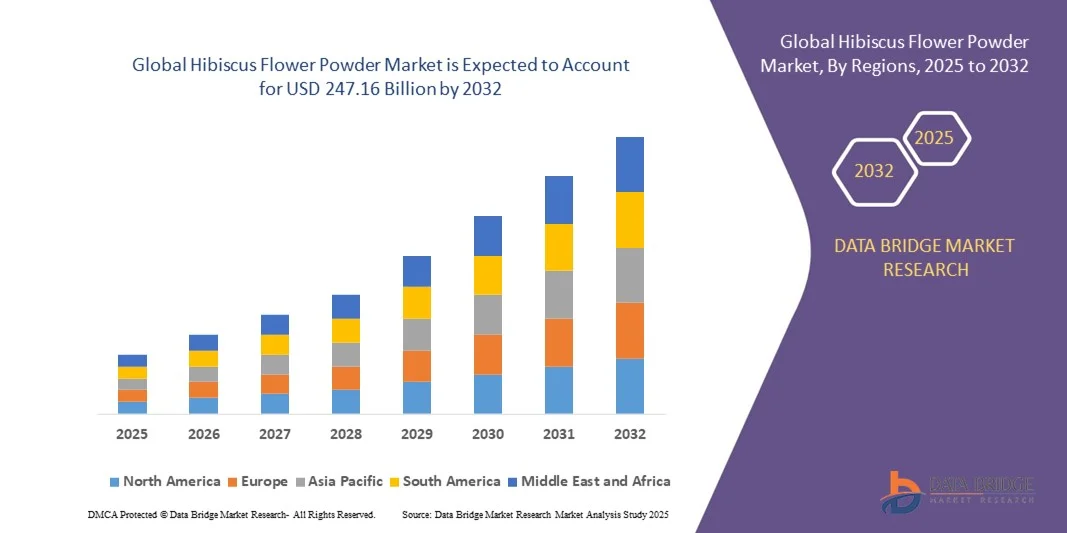
Hibiscus Flower Powder Market Size
- The global hibiscus flower powder market size was valued at USD 144.82 billion in 2024 and is expected to reach USD 247.16 billion by 2032, at a CAGR of 6.91% during the forecast period
- The market growth is largely fuelled by the rising demand for natural ingredients in food, beverages, cosmetics, and nutraceutical products, coupled with growing consumer preference for herbal and plant-based formulations
- Increasing awareness of the health benefits of hibiscus, such as antioxidant properties, blood pressure regulation, and skin care applications, is further driving market adoption
Hibiscus Flower Powder Market Analysis
- Growing utilization of hibiscus flower powder in beverages, dietary supplements, and personal care products is creating new avenues for market expansion
- Rising consumer inclination toward organic and clean-label products is promoting the adoption of hibiscus-based formulations, encouraging manufacturers to invest in product innovation and sustainable sourcing
- North America dominated the hibiscus flower powder market with the largest revenue share in 2024, driven by rising consumer preference for natural and functional ingredients in food, beverages, and personal care products
- Asia-Pacific region is expected to witness the highest growth rate in the global hibiscus flower powder market, driven by rapid urbanization, increasing disposable income, rising health awareness, and expansion of the herbal and natural product industries
- The packets segment held the largest market revenue share in 2024, driven by convenient portion sizes, easy storage, and suitability for retail distribution. Packets allow consumers to use precise quantities for beverages, food, and personal care formulations, enhancing usability and reducing wastage, making them a preferred choice across commercial and domestic applications.
Report Scope and Hibiscus Flower Powder Market Segmentation
|
Attributes |
Hibiscus Flower Powder Key Market Insights |
|
Segments Covered |
|
|
Countries Covered |
North America
Europe
Asia-Pacific
Middle East and Africa
South America
|
|
Key Market Players |
|
|
Market Opportunities |
|
|
Value Added Data Infosets |
In addition to the insights on market scenarios such as market value, growth rate, segmentation, geographical coverage, and major players, the market reports curated by the Data Bridge Market Research also include in-depth expert analysis, pricing analysis, brand share analysis, consumer survey, demography analysis, supply chain analysis, value chain analysis, raw material/consumables overview, vendor selection criteria, PESTLE Analysis, Porter Analysis, and regulatory framework. |
Hibiscus Flower Powder Market Trends
Increasing Adoption of Hibiscus Flower Powder in Food, Beverages, and Personal Care Products
- The growing incorporation of hibiscus flower powder in food, beverages, and personal care products is transforming the market by offering natural flavoring, coloring, and antioxidant benefits. Its versatility allows manufacturers to enhance product appeal and functional properties, driving widespread adoption across multiple sectors. In addition, its natural properties align with the rising consumer preference for clean-label and chemical-free products, boosting brand loyalty and repeat purchases
- Rising demand for natural and organic ingredients in cosmetics and nutraceuticals is accelerating the use of hibiscus flower powder. These products provide health benefits, improve skin and hair care, and meet consumer preferences for plant-based, chemical-free formulations. Furthermore, manufacturers are leveraging hibiscus powder for innovative formulations, such as anti-aging serums and herbal wellness teas, expanding its application scope and market penetration
- The affordability and year-round availability of hibiscus flower powder are making it attractive for small and large-scale manufacturers. Companies benefit from consistent quality, ease of formulation, and strong consumer recognition, leading to increased product launches and market penetration. This steady supply also enables manufacturers to experiment with new product lines, seasonal offerings, and limited-edition flavors, driving revenue growth and market diversification
- For instance, in 2023, several beverage and skincare brands in Europe and North America reported higher sales after introducing hibiscus-infused teas and skincare products, improving customer engagement and brand loyalty. In addition, promotional campaigns highlighting its natural antioxidant properties helped brands gain consumer trust and expand into new distribution channels, enhancing visibility and market share
- While hibiscus flower powder is driving innovation and natural product trends, its impact depends on supply chain stability, quality control, and formulation expertise. Manufacturers must focus on sustainable sourcing, product standardization, and effective marketing to fully capitalize on market opportunities. Integrating advanced processing techniques and eco-friendly packaging further strengthens brand positioning and aligns with consumer sustainability expectations
Hibiscus Flower Powder Market Dynamics
Driver
Increasing Consumer Preference for Natural and Functional Ingredients
- Rising consumer awareness of health benefits associated with natural antioxidants, vitamins, and minerals in hibiscus flower powder is driving demand. Its potential to support immunity, reduce oxidative stress, and promote overall wellness has increased adoption across food, beverage, and personal care industries. Moreover, health-conscious consumers are actively seeking functional beverages and supplements, further stimulating market expansion
- Manufacturers are prioritizing plant-based and chemical-free ingredients to meet regulatory standards and evolving consumer preferences. This trend is particularly strong in organic beverages, herbal teas, dietary supplements, and natural skincare formulations. In addition, the rising focus on preventive healthcare is pushing brands to develop hibiscus-based products with enhanced efficacy, supporting higher price points and brand differentiation
- Technological innovations in extraction and powder processing have enhanced quality, shelf life, and bioavailability. Companies are leveraging these advancements to provide consistent, high-quality hibiscus powder products, attracting health-conscious and eco-conscious consumers. Furthermore, modern processing techniques allow for greater customization in particle size, flavor intensity, and color, enabling product differentiation and premium offerings
- For instance, in 2022, leading nutraceutical companies in North America launched standardized hibiscus extracts with proven antioxidant properties, boosting product credibility and adoption rates. In addition, partnerships with research institutions to validate functional benefits further reinforced consumer confidence and supported market growth across multiple applications.
- While consumer awareness and health trends are strong drivers, continuous research, product standardization, and effective distribution are essential to maintain long-term market growth. Companies also need to focus on educating consumers through campaigns and labeling to highlight hibiscus powder’s benefits, ensuring sustained adoption and brand loyalty
Restraint/Challenge
Supply Chain Variability and Quality Standardization Issues
- Seasonal fluctuations, climatic conditions, and regional cultivation challenges impact hibiscus flower availability and raw material pricing. These factors create supply inconsistencies that can affect production schedules and product launch timelines. In addition, disruptions due to extreme weather or pest infestations can further constrain supply, requiring manufacturers to maintain buffer inventories and diversify sourcing
- Variability in quality, such as differences in anthocyanin content, flavor, and color, can affect product efficacy and consumer acceptance. Standardization is critical to ensure consistent functional properties across batches. Companies are increasingly investing in quality testing, certification programs, and controlled cultivation practices to maintain uniformity and meet regulatory and consumer expectations
- Limited processing and storage infrastructure in major hibiscus-producing regions can hinder scalability and increase production costs. Small-scale farmers may struggle to meet large-scale industrial demand consistently. Moreover, inadequate cold chain facilities or improper drying techniques can degrade powder quality, impacting shelf life and overall product appeal in competitive markets
- For instance, in 2023, several European beverage manufacturers faced delays due to inconsistent hibiscus powder quality, impacting new product launches and revenue forecasts. Companies had to implement additional quality checks and supplier audits, increasing operational costs while ensuring product reliability for end consumers
- While processing technologies continue to advance, addressing supply chain reliability, standardization, and cost-effectiveness remains crucial for sustained market expansion and global adoption. Collaborations with farmers, investment in processing units, and traceability solutions can mitigate challenges and ensure long-term supply security, supporting continued growth and market stability
Hibiscus Flower Powder Market Scope
The hibiscus flower powder market is segmented on the basis of packaging type, nature, application, end-product, and sales channel.
- By Packaging Type
On the basis of packaging type, the market is segmented into packets, bags, and cardboard boxes. The packets segment held the largest market revenue share in 2024, driven by convenient portion sizes, easy storage, and suitability for retail distribution. Packets allow consumers to use precise quantities for beverages, food, and personal care formulations, enhancing usability and reducing wastage, making them a preferred choice across commercial and domestic applications.
The bags segment is expected to witness the fastest growth rate from 2025 to 2032, fueled by their larger volume capacity, cost-effectiveness, and suitability for bulk purchases by manufacturers and retail chains. Bag packaging also supports eco-friendly materials and sustainable practices, appealing to environmentally conscious consumers and boosting adoption in both domestic and industrial markets.
- By Nature
On the basis of nature, the market is segmented into organic and conventional. The organic segment held the largest market share in 2024, attributed to rising consumer preference for chemical-free, natural products. Organic hibiscus powder is highly sought after in beverages, nutraceuticals, and cosmetics, supporting brand differentiation and premium pricing.
The conventional segment is expected to witness rapid growth from 2025 to 2032, driven by affordability and widespread availability. Conventional hibiscus powder caters to mass-market applications, including food and beverage production, and offers manufacturers a cost-effective option without compromising on functional properties.
- By Application
On the basis of application, the market is segmented into pharmaceutical, food and beverages, cosmetics, skin care, and others. The food and beverages segment dominated the market in 2024, owing to the widespread use of hibiscus powder in herbal teas, juices, and health drinks. Its natural flavoring, coloring, and antioxidant benefits make it a preferred ingredient for manufacturers seeking functional and appealing products.
The cosmetics and skin care segment is expected to witness the fastest growth rate from 2025 to 2032, driven by rising demand for natural, plant-based formulations. Hibiscus powder is increasingly incorporated in anti-aging creams, hair care products, and body care items, offering antioxidant, anti-inflammatory, and skin-conditioning benefits, expanding its application across premium and mass-market personal care products.
- By End-Product
On the basis of end-product, the market is segmented into powdered and tea bags. The powdered segment held the largest market revenue share in 2024, owing to its versatility in food, beverage, and cosmetic formulations. Powdered hibiscus allows manufacturers to standardize quality, dosage, and functional benefits, making it suitable for industrial and consumer products alike.
The tea bags segment is expected to witness the fastest growth rate from 2025 to 2032, fueled by rising health-conscious consumption and convenience-driven preferences. Ready-to-use tea bags offer portability and ease of preparation, attracting consumers in the retail, hospitality, and e-commerce segments, thereby expanding market reach and adoption.
- By Sales Channel
On the basis of sales channel, the market is segmented into direct sales, indirect sales, specialty stores, drug stores, online, and others. The online segment held the largest market share in 2024, driven by the growing e-commerce trend, wider accessibility, and the convenience of home delivery. Online platforms also enable manufacturers to target health-conscious and premium consumers effectively.
The specialty stores segment is expected to witness the fastest growth rate from 2025 to 2032, owing to the increasing popularity of organic and natural products. Specialty retailers provide curated product selections, quality assurance, and personalized consumer engagement, supporting higher adoption rates and brand recognition in both domestic and international markets.
Hibiscus Flower Powder Market Regional Analysis
- North America dominated the hibiscus flower powder market with the largest revenue share in 2024, driven by rising consumer preference for natural and functional ingredients in food, beverages, and personal care products
- Consumers in the region highly value the health benefits, natural coloring, and antioxidant properties offered by hibiscus flower powder
- This widespread adoption is further supported by high disposable incomes, increasing health awareness, and growing demand for organic and plant-based formulations, establishing hibiscus powder as a preferred ingredient across multiple industries
U.S. Hibiscus Flower Powder Market Insight
The U.S. hibiscus flower powder market captured the largest revenue share in North America in 2024, fueled by increasing demand for natural ingredients in functional foods, beverages, and cosmetic products. Manufacturers are focusing on incorporating hibiscus powder into teas, juices, dietary supplements, and skincare formulations to enhance product appeal and functional benefits. In addition, rising consumer inclination toward plant-based and chemical-free products, coupled with robust retail and e-commerce channels, is significantly driving market growth.
Europe Hibiscus Flower Powder Market Insight
The Europe hibiscus flower powder market is expected to witness the fastest growth rate from 2025 to 2032, primarily driven by increasing health-consciousness and the popularity of herbal and organic products. Consumers are attracted to hibiscus powder for its antioxidant properties, natural color, and flavoring benefits, promoting adoption in beverages, dietary supplements, and cosmetics. The growth is further supported by regulatory encouragement for natural and organic ingredients and the expanding herbal product market across the region.
U.K. Hibiscus Flower Powder Market Insight
The U.K. hibiscus flower powder market is expected to witness strong growth from 2025 to 2032, driven by increasing awareness of natural and functional ingredients in food, beverages, and personal care products. In addition, the growing trend of herbal and organic products among health-conscious consumers is encouraging manufacturers to integrate hibiscus powder into various applications. The U.K.’s robust e-commerce infrastructure and thriving natural product segment are expected to further stimulate market expansion.
Germany Hibiscus Flower Powder Market Insight
The Germany hibiscus flower powder market is expected to witness notable growth from 2025 to 2032, fueled by rising consumer demand for functional and organic products and increasing use of natural ingredients in beverages, supplements, and cosmetics. Germany’s well-established food and nutraceutical industry, combined with strong consumer preference for plant-based products, is supporting adoption. Moreover, manufacturers are leveraging local supply chains and sustainable sourcing to meet growing market demand.
Asia-Pacific Hibiscus Flower Powder Market Insight
The Asia-Pacific hibiscus flower powder market is expected to witness the fastest growth rate from 2025 to 2032, driven by increasing health awareness, rising disposable incomes, and expanding food, beverage, and cosmetic industries in countries such as China, India, and Japan. The region's growing preference for herbal and natural ingredients, supported by government initiatives promoting organic agriculture, is driving adoption. In addition, APAC’s role as a major hibiscus-producing region ensures product availability and competitive pricing, encouraging widespread use.
Japan Hibiscus Flower Powder Market Insight
The Japan hibiscus flower powder market is expected to witness significant growth from 2025 to 2032 due to the country’s high health consciousness, demand for natural ingredients, and preference for functional foods and beverages. Consumers are increasingly seeking products with antioxidant and wellness benefits, promoting adoption in teas, dietary supplements, and cosmetic formulations. Moreover, Japan’s advanced food and personal care industry, coupled with efficient distribution channels, supports steady market expansion.
China Hibiscus Flower Powder Market Insight
The China hibiscus flower powder market accounted for the largest revenue share in Asia-Pacific in 2024, attributed to the country’s vast production capacity, expanding middle class, and increasing demand for herbal and functional ingredients. Hibiscus powder is widely used in beverages, dietary supplements, and personal care products, benefiting from competitive pricing and strong domestic supply. Government support for organic and natural agriculture, along with rising consumer awareness of health and wellness, is driving market growth across multiple sectors.
Hibiscus Flower Powder Market Share
The Hibiscus Flower Powder industry is primarily led by well-established companies, including:
• Devodhyog Foundation (U.K.)
• Indus Valley (U.K.)
• Herb Essential (U.K.)
• Mesmara Botanics Private Limited (U.S.)
• Bio Actives Japan Corporation (U.S.)
• Martin Bauer Group (U.K.)
• RANSOM NATURALS LTD (U.K.)
• Earth Expo Company (U.S.)
• Banyan Botanicals (U.S.)
• Blend It Raw Apothecary (U.S.)
• Parchem Fine & Specialty Chemicals (U.S.)
• Nexira (U.K.)
• ANKLAM EXTRAKT GMBH (U.K.)

- Interactive Data Analysis Dashboard
- Company Analysis Dashboard for high growth potential opportunities
- Research Analyst Access for customization & queries
- Competitor Analysis with Interactive dashboard
- Latest News, Updates & Trend analysis
- Harness the Power of Benchmark Analysis for Comprehensive Competitor Tracking
Data collection and base year analysis are done using data collection modules with large sample sizes. The stage includes obtaining market information or related data through various sources and strategies. It includes examining and planning all the data acquired from the past in advance. It likewise envelops the examination of information inconsistencies seen across different information sources. The market data is analysed and estimated using market statistical and coherent models. Also, market share analysis and key trend analysis are the major success factors in the market report. To know more, please request an analyst call or drop down your inquiry.
The key research methodology used by DBMR research team is data triangulation which involves data mining, analysis of the impact of data variables on the market and primary (industry expert) validation. Data models include Vendor Positioning Grid, Market Time Line Analysis, Market Overview and Guide, Company Positioning Grid, Patent Analysis, Pricing Analysis, Company Market Share Analysis, Standards of Measurement, Global versus Regional and Vendor Share Analysis. To know more about the research methodology, drop in an inquiry to speak to our industry experts.
Data Bridge Market Research is a leader in advanced formative research. We take pride in servicing our existing and new customers with data and analysis that match and suits their goal. The report can be customized to include price trend analysis of target brands understanding the market for additional countries (ask for the list of countries), clinical trial results data, literature review, refurbished market and product base analysis. Market analysis of target competitors can be analyzed from technology-based analysis to market portfolio strategies. We can add as many competitors that you require data about in the format and data style you are looking for. Our team of analysts can also provide you data in crude raw excel files pivot tables (Fact book) or can assist you in creating presentations from the data sets available in the report.