What is the High End Field Programmable Gate Array (FPGA) Market Size and Growth Rate?
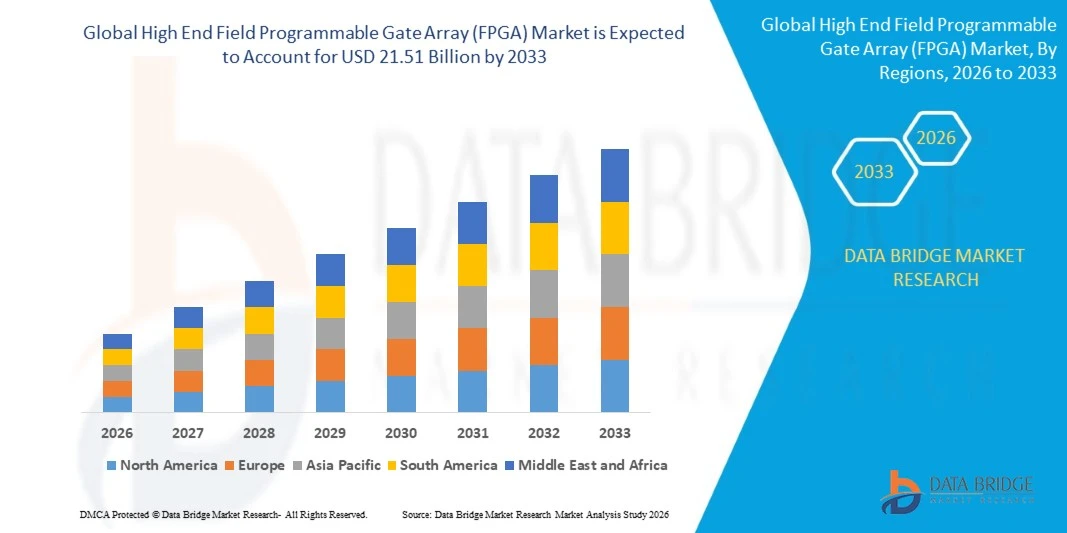
- As per Data Bridge Market Research analysis, the high end field programmable gate array (FPGA) market was valued at USD 4.65 billion in 2025 and is projected to reach USD 21.51 billion by 2033, growing at a CAGR of 21.10% from 2026 to 2033, across data-intensive applications.
- The market is experiencing rapid growth driven by rising demand for adaptive AI acceleration, expanding 5G and data center infrastructure, and increasing deployment across telecom, aerospace and defense, automotive, industrial, and test and measurement systems.
- The increasing shift toward heterogeneous computing, low-latency data processing, and hardware-level security, combined with growing integration of AI engines, high-speed transceivers, and advanced memory interfaces, is supporting market adoption. High end FPGAs are being applied across data center acceleration, 5G infrastructure, radar and electronic warfare, high-speed networking, and emulation, offering engineers reconfigurable parallel processing and long product lifecycles through advanced FPGA and AI chip platforms.
Market Size & Forecast
- Global Market Value (2025): USD 4.65 Billion
- Expected Market Value (2033): USD 21.51 Billion
- Forecast CAGR (2026–2033): 21.10%
What are the Major Takeaways of the High End Field Programmable Gate Array (FPGA) Market?
- North America dominated the high end field programmable gate array (FPGA) market with the largest revenue share of 41.20% in 2025, supported by strong data center investment, leading FPGA vendors, and extensive aerospace and defense and telecom demand.
- Asia-Pacific is expected to be the fastest-growing region at a CAGR of 23.40% from 2026 to 2033, fueled by rapid 5G rollout, expanding AI infrastructure, and growing domestic semiconductor ecosystems.
- The standalone FPGAs segment led the market with a 55.2% share in 2025, driven by extensive use in networking, communications, and test equipment.
- FPGA SoCs are the fastest-growing product type, projected to register a CAGR of 24.3%, reflecting the surge in demand for integrated processors and AI engines.
- The 16–28 nm segment dominated the node size category with a 44.3% revenue share in 2025, led by mature, proven high-end device families.
- Networking and switching accounted for 36.9% of the market share in 2025, preferred by increasing demand for high-speed, low-latency data transport.
- The IT and telecom segment is the fastest-growing end-user category, with a CAGR of 23.8%, driven by increasing 5G and cloud deployment.
Report Scope and High End Field Programmable Gate Array (FPGA) Market Segmentation
|
Attributes |
High End Field Programmable Gate Array (FPGA) Key Market Insights |
|
Segments Covered |
|
|
Countries Covered |
North America
Europe
Asia-Pacific
Middle East and Africa
South America
|
|
Key Market Players |
|
|
Market Opportunities |
|
|
Value Added Data Infosets |
In addition to the insights on market scenarios such as market value, growth rate, segmentation, geographical coverage, and major players, the market reports curated by the Data Bridge Market Research also include in-depth expert analysis, geographically represented company-wise production and capacity, network layouts of distributors and partners, detailed and updated price trend analysis and deficit analysis of supply chain and demand. |
What is the Key Trend in the High End Field Programmable Gate Array (FPGA) Market?
- Vendors are increasingly shifting toward heterogeneous adaptive platforms that combine programmable logic, embedded processors, AI engines, hard networking IP, and advanced memory interfaces in a single device to serve data center, communications, and embedded AI workloads.
- For instance, in November 2024, AMD’s Versal Premium Series Gen 2 was positioned as the industry’s first FPGA family with CXL 3.1, PCIe Gen6, and LPDDR5X support in hard IP, with silicon samples by early 2026 and production shipments in the second half of 2026.
- Memory architecture is evolving as vendors balance bandwidth, cost, and supply, with on-package LPDDR5X and other memory options being introduced for compact, data-intensive systems.
- Edge AI, robotics, and physical AI workloads are driving demand for FPGA platforms that deliver deterministic latency, sensor interfaces, and long-term availability.
- For instance, in March 2026, the Altera company showcased Agilex FPGAs enabling real-time physical AI for robotics and edge systems at Embedded World 2026, including an Agilex 5-based 25GbE sensor bridge demonstration that won a Best-in-Show Award for ultra-low-latency sensor streaming for edge AI, highlighting the move toward physical AI.
- As AI, 5G, and data-intensive computing continue to expand, high end FPGAs are expected to evolve from specialized accelerators into mainstream adaptive compute platforms that complement CPUs and GPUs across industries worldwide.
What are the Key Drivers of the High End Field Programmable Gate Array (FPGA) Market?
- Growing demand for data center acceleration, high-speed networking, and AI inference is increasing adoption of high end FPGAs that offer reconfigurable, low-latency parallel processing.
- For instance, in September 2025, according to Altera, Silver Lake completed its acquisition of a 51% stake in the company, with Intel retaining 49%, creating the world’s largest independent pure-play FPGA solutions provider focused on faster innovation and customer support, with a flexible supply strategy across leading process nodes and multiple foundry partners.
- Aerospace and defense, test and measurement, and communications customers require secure, long-life, high-performance programmable devices, supporting steady demand for advanced FPGA and adaptive SoC families.
- For instance, in April 2024, according to VentureBeat, AMD launched Versal AI Edge Series Gen 2 and Prime Series Gen 2 at Embedded World, with AI engines offering up to three times higher TOPs per watt and Subaru selecting them for EyeSight ADAS.
- With 5G rollout, software-defined networks, and AI at the edge expanding, high end FPGAs offer flexibility to adapt to evolving standards without new silicon development.
What Factors Are Challenging the Growth of the High End Field Programmable Gate Array (FPGA) Market?
- High end FPGAs are expensive and power-intensive, require specialized design skills and complex toolchains, and face competition from GPUs and custom ASICs in large-volume AI workloads.
- For instance, in June 2026, according to ServeTheHome, AI-driven demand for HBM constrained AMD’s HBM-powered adaptive SoCs, leading the company to pivot its Versal Premium Gen 2 memory-on-package parts to LPDDR5X, illustrating supply pressure on advanced memory.
- Long development cycles, verification complexity, and qualification requirements can delay deployments, particularly in aerospace, defense, and automotive programs where safety and security certification is essential.
- Advanced node manufacturing, packaging, and memory supply constraints can limit availability and raise device costs, affecting design decisions for cost-sensitive customers.
- For instance, in August 2026, according to ServeTheHome, standard Versal Premium Gen 2 devices were still ramping with mass production expected in the fourth quarter of 2026, while memory-on-package variants were scheduled for full mass production in the third quarter of 2027, highlighting extended timelines between sampling and volume availability for design teams.
- The combination of high device costs, design complexity, supply constraints, and competition from alternative accelerators can limit expansion among cost-sensitive customers, particularly where GPUs or ASICs already satisfy performance requirements.
How is the High End Field Programmable Gate Array (FPGA) Market Segmented?
The high end field programmable gate array (FPGA) market is segmented on the basis of product, node size, application, and end user.
- By Product
On the basis of product, the high end field programmable gate array (FPGA) market is segmented into standalone FPGAs and FPGA SoCs. The standalone FPGAs segment dominated the market with 55.2% share in 2025, supported by extensive use in networking, communications, test equipment, and emulation systems. Standalone devices provide large logic capacity, high-speed transceivers, and flexible interfaces for demanding designs. They are widely used across telecom, aerospace, and data center infrastructure. Improvements in transceiver speed, memory interfaces, and security features are further strengthening demand. Integration with mature design tools and IP also enables faster development across complex platforms.
The FPGA SoCs segment is projected to register the fastest growth at a CAGR of 24.3% from 2026 to 2033, driven by increasing demand for integrated processors and AI engines. FPGA SoCs combine programmable logic with Arm processors, AI engines, and hardened interfaces to accelerate end-to-end workloads. Their applications include embedded AI, 5G radios, radar, and industrial systems. Increasing demand for single-chip solutions is creating additional opportunities across automotive, aerospace, and healthcare designs. Improvements in AI performance per watt and safety features are enhancing adoption. Long lifecycle support is also expanding commercial use. Hardened interfaces, safety features, and lifecycles of 15 years or more make these devices attractive for aerospace, industrial, and automotive programs.
- By Node Size
On the basis of node size, the high end field programmable gate array (FPGA) market is segmented into below 16 nm, 16–28 nm, and above 28 nm. The 16–28 nm segment dominated the market with 44.3% share in 2025, supported by mature, proven device families used in networking, test, and defense systems. This range offers a balanced combination of performance, power, cost, and manufacturing maturity for high-volume programs. Its availability across multiple families and suppliers expands the potential customer base. System designers use these devices for long-life platforms that require stable supply and proven reliability. The segment also benefits from established design tools and ecosystem support.
The below 16 nm segment is projected to register the fastest growth at a CAGR of 25.6% from 2026 to 2033, supported by increasing adoption of advanced devices for AI acceleration and high-bandwidth data processing. Smaller nodes enable higher logic density, lower power, and faster transceivers and memory interfaces. Vendors are increasingly releasing 7 nm and newer families with hard AI and networking blocks. Data center, communications, and defense customers are specifying advanced nodes for compute-intensive designs. Improved packaging and memory integration further strengthen the segment’s attractiveness. Cost and supply availability remain important considerations for expansion.
- By Application
On the basis of application, the high end field programmable gate array (FPGA) market is segmented into AI acceleration & data processing, networking & switching, signal processing, and others. The networking and switching segment dominated the application category with 36.9% share in 2025, supported by increasing demand for high-speed, low-latency data transport. FPGAs enable programmable packet processing, protocol bridging, and smart network interface functions. Cloud and telecom upgrades are increasing use of reconfigurable hardware. Growth in 5G infrastructure and data center networks further strengthens demand. Operators and equipment makers are also seeking platforms that combine high bandwidth, security, and adaptability to new standards.
The AI acceleration and data processing segment is projected to register the fastest growth at a CAGR of 26.8% from 2026 to 2033, driven by increasing inference workloads, data-intensive analytics, and demand for energy-efficient accelerators. FPGAs offer low-latency, customizable pipelines for streaming, vision, and signal-heavy AI tasks. Cloud, telecom, and industrial users in North America, Europe, and Asia-Pacific are evaluating adaptive compute. New AI engines and memory options are creating additional opportunities. Reconfigurability makes FPGAs particularly attractive for evolving models and standards. Supportive ecosystems of tools and libraries can further improve adoption across regions.
- By End User
On the basis of end user, the high end field programmable gate array (FPGA) market is segmented into IT & telecom, data centers, aerospace & defense, automotive, industrial & test, and others. The IT and telecom segment dominated the end-user category with 38.4% share in 2025, supported by increasing requirements for flexible, high-bandwidth infrastructure. Network equipment makers and operators rely on FPGAs for baseband processing, packet handling, and radio functions. The segment includes wireless, optical, and wireline systems deployed worldwide. Increasing investment in 5G and cloud networks is creating further opportunities. Long equipment lifecycles also make supply continuity an important consideration in design decisions.
The data centers segment is projected to register the fastest growth at CAGR of 25.9% from 2026 to 2033, driven by increasing AI workloads, smart networking, storage acceleration, and security processing. Hyperscalers and server makers require flexible accelerators that complement CPUs and GPUs for specialized tasks. Vendors are introducing devices with CXL, PCIe Gen6, and advanced memory support. Closer collaboration between chip vendors and cloud providers is accelerating development of tailored solutions. Rising data volumes are further supporting adoption. Power efficiency, software support, and total cost remain important considerations for deployment.
Which Region Holds the Largest Share of the High End Field Programmable Gate Array (FPGA) Market?
- North America dominated the high end field programmable gate array (FPGA) market with the largest revenue share of 41.20% in 2025, supported by strong data center investment, leading FPGA vendors, and extensive aerospace and defense and telecom demand.
- The region also benefits from leading FPGA vendors, large hyperscale data centers, strong defense spending, and advanced semiconductor design ecosystems, along with growing adoption of adaptive AI platforms. Increasing investment in AI infrastructure and secure computing continues to strengthen North America’s position in the global market.
U.S. High End Field Programmable Gate Array (FPGA) Market Insight
The U.S. high end field programmable gate array (FPGA) market is witnessing consistent growth due to rising investments in AI infrastructure, defense modernization, and next-generation networks. Chip vendors, hyperscalers, and defense contractors are increasingly focusing on adaptive acceleration. Moreover, a strong semiconductor design base and continued launches of advanced FPGA and adaptive SoC families, supported by independent vendors and large cloud customers, are further contributing to market growth in the U.S.
Canada High End Field Programmable Gate Array (FPGA) Market Insight
Canada’s high-end Field Programmable Gate Array (FPGA) market is driven by growing demand for high-performance computing, aerospace and defense electronics, telecommunications, and advanced industrial automation. Adoption of high-speed, power-efficient, and reconfigurable semiconductor solutions supports applications in artificial intelligence, data processing, radar systems, and 5G infrastructure. Canada’s market benefits from research investments and increasing digital infrastructure modernization. However, high device costs, complex design requirements, and reliance on international semiconductor suppliers may constrain adoption.
Asia-Pacific High End Field Programmable Gate Array (FPGA) Market Insight
The Asia-Pacific high end field programmable gate array (FPGA) market is expected to witness rapid growth, driven by expanding 5G networks, rising AI data center investment, and increasing domestic semiconductor development across countries such as China, Japan, South Korea, and India. Growing demand for telecom equipment, industrial automation, and automotive electronics is supporting regional market expansion. In addition, the region’s strong electronics manufacturing base and government support for chip ecosystems are accelerating demand for advanced programmable devices.
China High End Field Programmable Gate Array (FPGA) Market Insight
The China high end field programmable gate array (FPGA) market is growing steadily, driven by large-scale 5G deployment, expanding data center capacity, and rising investment in domestic semiconductor capability. Growing use of FPGAs in telecom equipment, industrial systems, and test instruments is boosting market demand. In addition, the country’s strong electronics manufacturing base, policy support for chip self-reliance, and emerging local FPGA vendors are positioning China as an important market across Asia-Pacific, supported by growing engineering talent.
Japan High End Field Programmable Gate Array (FPGA) Market Insight
The Japan high end field programmable gate array (FPGA) market is experiencing steady growth, supported by strong electronics, automotive, and industrial equipment sectors. Automakers, equipment makers, and research institutions are increasingly seeking adaptive devices for ADAS, robotics, and communications. Furthermore, growing investment in advanced driver assistance, factory automation, and 5G infrastructure, along with high quality and safety standards, is supporting wider adoption of high end FPGAs in Japan.
Which are the Top Companies in High End Field Programmable Gate Array (FPGA) Market?
The high end field programmable gate array (FPGA) industry is primarily led by well-established companies, including:
- Advanced Micro Devices, Inc. (AMD) (U.S.)
- Altera Corporation (U.S.)
- Lattice Semiconductor Corporation (U.S.)
- Achronix Semiconductor Corporation (U.S.)
- Microchip Technology Inc. (U.S.)
- Intel Corporation (U.S.)
- Efinix, Inc. (U.S.)
- QuickLogic Corporation (U.S.)
- Gowin Semiconductor Corp. (China)
- Shanghai Fudan Microelectronics Group Co., Ltd. (China)
- Guangdong Anlogic Infotech Co., Ltd. (China)
- Shenzhen Pango Microsystems Co., Ltd. (China)
- Frontgrade Technologies (U.S.)
- Teledyne Technologies Incorporated (U.S.)
- Analog Devices, Inc. (U.S.)
- Menta SAS (France)
- Rapid Silicon, Inc. (U.S.)
- BAE Systems plc (U.K.)
- Renesas Electronics Corporation (Japan)
- Cologne Chip AG (Germany)
What are Latest Developments in High End Field Programmable Gate Array (FPGA) Market?
- In November 2024, AMD announced the Versal Premium Gen 2 Memory on Package adaptive SoC family, integrating up to 32 GB of LPDDR5X with up to 288 GB/s of bandwidth, reducing board area by up to 60%, with engineering samples expected by the end of 2026 and production shipments in the second half of 2027.
- In July 2025, AMD began shipping the first production units of its Versal Prime Series Gen 2 2VM3858 device, followed by full production of the 2VM3558 and sampling of the 2VM3358, delivering up to 100k DMIPs of scalar compute in packages as small as 23 mm by 23 mm for embedded applications in Pro AV, broadcast, and industrial IoT, with more scalar compute than competing FPGA SoCs according to AMD.
- In March 2026, Altera showcased Agilex FPGAs for real-time physical AI in robotics and edge systems at Embedded World 2026, where an Agilex 5-based 25GbE Holoscan Sensor Bridge demonstration won a Best-in-Show Award for enabling ultra-low-latency sensor streaming for edge AI applications, reflecting growing demand for deterministic latency and sensor interfaces in robotics.
- In September 2025, Silver Lake completed its acquisition of a 51% stake in Altera from Intel, which retained 49%, establishing Altera as the world’s largest independent pure-play FPGA solutions provider with operational independence, backing for faster innovation, and a flexible supply strategy across multiple foundry partners.
- In April 2024, AMD introduced Versal AI Edge Series Gen 2 and Versal Prime Series Gen 2 adaptive SoCs at Embedded World in Nuremberg, with new AI Engines expected to deliver up to three times higher TOPs per watt, and Subaru selected the devices for its next-generation EyeSight ADAS vision system.

- Interactive Data Analysis Dashboard
- Company Analysis Dashboard for high growth potential opportunities
- Research Analyst Access for customization & queries
- Competitor Analysis with Interactive dashboard
- Latest News, Updates & Trend analysis
- Harness the Power of Benchmark Analysis for Comprehensive Competitor Tracking
Global High End Field Programmable Gate Array Fpga Market, Supply Chain Analysis and Ecosystem Framework
To support market growth and help clients navigate the impact of geopolitical shifts, DBMR has integrated in-depth supply chain analysis into its Global High End Field Programmable Gate Array Fpga Market research reports. This addition empowers clients to respond effectively to global changes affecting their industries. The supply chain analysis section includes detailed insights such as Global High End Field Programmable Gate Array Fpga Market consumption and production by country, price trend analysis, the impact of tariffs and geopolitical developments, and import and export trends by country and HSN code. It also highlights major suppliers with data on production capacity and company profiles, as well as key importers and exporters. In addition to research, DBMR offers specialized supply chain consulting services backed by over a decade of experience, providing solutions like supplier discovery, supplier risk assessment, price trend analysis, impact evaluation of inflation and trade route changes, and comprehensive market trend analysis.
Data collection and base year analysis are done using data collection modules with large sample sizes. The stage includes obtaining market information or related data through various sources and strategies. It includes examining and planning all the data acquired from the past in advance. It likewise envelops the examination of information inconsistencies seen across different information sources. The market data is analysed and estimated using market statistical and coherent models. Also, market share analysis and key trend analysis are the major success factors in the market report. To know more, please request an analyst call or drop down your inquiry.
The key research methodology used by DBMR research team is data triangulation which involves data mining, analysis of the impact of data variables on the market and primary (industry expert) validation. Data models include Vendor Positioning Grid, Market Time Line Analysis, Market Overview and Guide, Company Positioning Grid, Patent Analysis, Pricing Analysis, Company Market Share Analysis, Standards of Measurement, Global versus Regional and Vendor Share Analysis. To know more about the research methodology, drop in an inquiry to speak to our industry experts.
Data Bridge Market Research is a leader in advanced formative research. We take pride in servicing our existing and new customers with data and analysis that match and suits their goal. The report can be customized to include price trend analysis of target brands understanding the market for additional countries (ask for the list of countries), clinical trial results data, literature review, refurbished market and product base analysis. Market analysis of target competitors can be analyzed from technology-based analysis to market portfolio strategies. We can add as many competitors that you require data about in the format and data style you are looking for. Our team of analysts can also provide you data in crude raw excel files pivot tables (Fact book) or can assist you in creating presentations from the data sets available in the report.