


High-Intensity Sweeteners Market Size
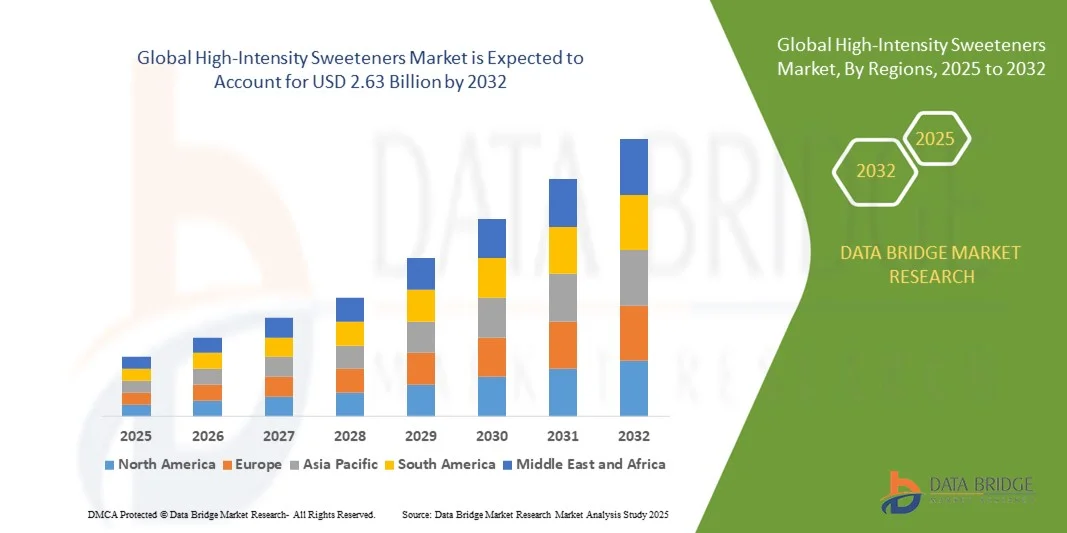
- The global high-intensity sweeteners market size was valued at USD 2.11 billion in 2024 and is expected to reach USD 2.63 billion by 2032, at a CAGR of 2.80% during the forecast period
- The market growth is largely fueled by the rising demand for low-calorie and sugar-free products across beverages, bakery, confectionery, and dietary applications, as consumers increasingly seek healthier alternatives to traditional sugar
- Furthermore, the growing prevalence of obesity and diabetes, combined with supportive government regulations and sugar-reduction initiatives, is encouraging food and beverage manufacturers to adopt high-intensity sweeteners, thereby driving overall market expansion
High-Intensity Sweeteners Market Analysis
- High-intensity sweeteners are sugar substitutes that deliver intense sweetness at minimal or zero calories, enabling manufacturers to formulate reduced-sugar products without compromising taste. They are used in a wide range of applications including soft drinks, dairy, bakery, pharmaceuticals, and dietary supplements
- The escalating demand for these sweeteners is primarily driven by increasing health awareness, a shift toward clean-label and natural ingredients, and ongoing product innovations that improve taste profiles and application flexibility
- North America dominated the high-intensity sweeteners market with a share of 44% in 2024, due to the strong presence of major food and beverage manufacturers and rising demand for low-calorie products
- Asia-Pacific is expected to be the fastest growing region in the high-intensity sweeteners market during the forecast period due to increasing urbanization, rising disposable incomes, and a shift toward healthier diets
- Artificial segment dominated the market with a market share of 63.5% in 2024, due to the widespread use of products such as aspartame, sucralose, and saccharin in a variety of processed foods and beverages. These sweeteners provide high sweetness levels at extremely low calorie counts, making them attractive to manufacturers targeting the growing demand for low-calorie and sugar-free products. Their cost-effectiveness, high stability in heat and acidic conditions, and long shelf life further strengthen their adoption in large-scale food and beverage production. In addition, their established regulatory approvals across key markets such as the U.S. and Europe continue to support their strong market presence
Report Scope and High-Intensity Sweeteners Market Segmentation
|
Attributes |
High-Intensity Sweeteners Key Market Insights |
|
Segments Covered |
|
|
Countries Covered |
North America
Europe
Asia-Pacific
Middle East and Africa
South America
|
|
Key Market Players |
|
|
Market Opportunities |
|
|
Value Added Data Infosets |
In addition to the insights on market scenarios such as market value, growth rate, segmentation, geographical coverage, and major players, the market reports curated by the Data Bridge Market Research also include in-depth expert analysis, pricing analysis, brand share analysis, consumer survey, demography analysis, supply chain analysis, value chain analysis, raw material/consumables overview, vendor selection criteria, PESTLE Analysis, Porter Analysis, and regulatory framework. |
High-Intensity Sweeteners Market Trends
Rising Demand for Low-Calorie and Sugar-Free Products
- The high-intensity sweeteners market is witnessing robust growth as consumers adopt low-calorie and sugar-free diets to prevent obesity, diabetes, and other health-related issues. Food and beverage manufacturers are increasingly formulating products with sugar substitutes to meet growing demand for healthier alternatives without compromising taste
- For instance, Coca-Cola has expanded its product line with zero-sugar variants sweetened with aspartame and stevia, while PepsiCo has adopted sucralose- and stevia-based sweeteners in its low-calorie beverages. These product launches reflect how major brands are capitalizing on consumer preference for sugar-free and reduced-calorie options
- High-intensity sweeteners provide sweetness at very low concentrations compared to sugar, making them cost-effective while supporting calorie reduction goals. Their use is expanding in beverages, confectionery, and dairy products where manufacturers face regulatory sugar-reduction targets and growing consumer scrutiny over sugar content
- In addition, natural sweeteners such as stevia and monk fruit extracts are gaining traction as clean-label solutions. These options combine high sweetness intensity with plant-based origins, aligning with both health trends and consumer demand for natural ingredients in food products
- The move toward sugar-free and functional products in categories such as protein bars, sports drinks, and flavored water is further strengthening the role of low-calorie sweeteners. Companies are leveraging high-intensity sweeteners to market innovative products to health-driven and weight-conscious consumers
- The rising demand for low-calorie and sugar-free products demonstrates a structural shift in dietary choices. As manufacturers innovate across product categories, high-intensity sweeteners are becoming an integral ingredient shaping the future of food and beverage industries worldwide
High-Intensity Sweeteners Market Dynamics
Driver
Growing Health Awareness
- Growing health awareness among consumers worldwide is a central driver of the high-intensity sweeteners market. The links between excessive sugar intake and chronic conditions such as diabetes, cardiovascular disease, and obesity are prompting consumers to seek healthier food and beverage choices
- For instance, Nestlé has incorporated stevia into several of its dairy and beverage products as part of its broader strategy to reduce sugar content, while Danone has reformulated its flavored yogurts with sucralose and stevia to appeal to health-conscious customers. These company initiatives highlight how global players are tapping into rising health awareness trends
- High-intensity sweeteners allow consumers to enjoy sweet-tasting products without increasing caloric intake, helping address dietary imbalances and supporting weight management goals. Their use enables food producers to create products that align with preventive health measures and consumer wellness attitudes
- In addition, rising government initiatives and public health campaigns on sugar reduction are amplifying consumer demand for sugar substitutes. This regulatory encouragement aligns well with growing consumer interest in healthier lifestyles, creating strong momentum for continued market expansion
- The widespread consumer focus on health and wellness ensures that high-intensity sweeteners remain a preferred alternative to sugar. This driver underscores continuous growth opportunities as manufacturers innovate to meet the evolving needs of mindful consumers across global markets
Restraint/Challenge
Regulatory Restrictions and Consumer Skepticism
- Regulatory restrictions and consumer skepticism pose significant challenges for the high-intensity sweeteners market. Many artificial sweeteners face strict regulatory reviews and approval processes due to concerns over their safety and long-term health effects
- For instance, aspartame has been closely scrutinized by organizations such as the European Food Safety Authority (EFSA) and U.S. Food and Drug Administration (FDA), leading to debates and consumer hesitancy in its adoption. Such regulatory and perception issues impact consumer confidence and market acceptance
- Stringent regulations on permissible levels of various sweeteners in food and beverages constrain manufacturer flexibility. This compliance burden slows product innovation and requires companies to invest heavily in testing, certifications, and reformulation to meet different regional requirements
- In addition, natural sweeteners such as stevia, although gaining popularity, also face skepticism regarding aftertaste or differing sensory profiles compared to sugar. Consumer hesitation affects rapid adoption, particularly in mature or traditional food markets where taste expectations remain unchanged
- Overcoming these challenges will require rigorous safety validation, transparent labeling, and consumer education to build trust in sugar alternatives. Establishing long-term confidence among both regulators and consumers will be vital for unlocking the full potential of high-intensity sweeteners and ensuring their broader market acceptance
High-Intensity Sweeteners Market Scope
The market is segmented on the basis of type and application.
- By Type
On the basis of type, the high-intensity sweeteners market is segmented into artificial and natural. The artificial segment dominated the largest market revenue share of 63.5% in 2024, driven by the widespread use of products such as aspartame, sucralose, and saccharin in a variety of processed foods and beverages. These sweeteners provide high sweetness levels at extremely low calorie counts, making them attractive to manufacturers targeting the growing demand for low-calorie and sugar-free products. Their cost-effectiveness, high stability in heat and acidic conditions, and long shelf life further strengthen their adoption in large-scale food and beverage production. In addition, their established regulatory approvals across key markets such as the U.S. and Europe continue to support their strong market presence.
The natural segment is anticipated to witness the fastest growth rate from 2025 to 2032, fueled by rising consumer preference for clean-label and plant-based ingredients. Natural sweeteners such as stevia, monk fruit, and thaumatin are increasingly sought after as consumers become more health conscious and wary of synthetic additives. Their perceived health benefits, minimal impact on blood sugar levels, and alignment with organic and non-GMO trends drive strong demand from both food manufacturers and health-focused brands. The growing investment in improved extraction techniques and product innovation to enhance taste profiles is further propelling the rapid expansion of natural high-intensity sweeteners.
- By Application
On the basis of application, the high-intensity sweeteners market is segmented into beverages, bakery and confectionery, dietary products, pharmaceuticals, table top sweeteners, and others. The beverages segment accounted for the largest market revenue share in 2024, driven by its extensive use in carbonated drinks, flavored water, energy drinks, and fruit juices. Beverage manufacturers rely on high-intensity sweeteners to maintain desired sweetness while keeping calorie content low, meeting the surging demand for diet and zero-sugar beverages. The ability of sweeteners to remain stable across different pH levels and temperatures also enhances their suitability in various beverage formulations. Increasing consumer shift toward healthier hydration options and stringent sugar taxation in several countries further boost their usage in beverages globally.
The dietary products segment is projected to register the fastest growth rate from 2025 to 2032, supported by the growing popularity of low-calorie, keto-friendly, and diabetic-friendly foods. High-intensity sweeteners play a critical role in enhancing taste while maintaining nutritional profiles in protein bars, meal replacement shakes, and weight management products. The rising prevalence of obesity and diabetes, coupled with an expanding consumer base focused on fitness and wellness, is driving manufacturers to incorporate these sweeteners into dietary offerings. Product innovations, including new blends with better taste-masking properties, are expected to accelerate adoption in this segment over the forecast period.
High-Intensity Sweeteners Market Regional Analysis
- North America dominated the high-intensity sweeteners market with the largest revenue share of 44% in 2024, driven by the strong presence of major food and beverage manufacturers and rising demand for low-calorie products
- The region benefits from high consumer awareness regarding sugar reduction and widespread acceptance of sugar substitutes in beverages, bakery, and dietary products
- Supportive regulatory approvals and growing diabetic and obese populations further enhance market penetration. Technological advancements in formulation and blending also encourage the use of both artificial and natural sweeteners across diverse applications
U.S. High-Intensity Sweeteners Market Insight
The U.S. market captured the largest revenue share in 2024 within North America, fueled by rising consumer preference for sugar-free beverages, sports drinks, and health-focused food products. Strong demand for low-calorie sweeteners in diet sodas and functional foods, coupled with government initiatives to reduce added sugar consumption, drives market growth. The presence of leading manufacturers and ongoing innovations in natural sweeteners such as stevia and monk fruit also support the country’s dominance.
Europe High-Intensity Sweeteners Market Insight
The Europe high-intensity sweeteners market is projected to grow at a steady CAGR during the forecast period, supported by stringent regulations on sugar intake and growing health awareness among consumers. Rising incidence of diabetes and obesity, along with sugar taxes in countries such as France and Germany, are encouraging food and beverage companies to adopt high-intensity sweeteners. The demand for natural sweeteners is particularly strong as European consumers increasingly prefer clean-label and plant-based alternatives.
U.K. High-Intensity Sweeteners Market Insight
The U.K. market is anticipated to grow at a notable CAGR, driven by government policies targeting sugar reduction and a strong shift toward healthier lifestyles. The growing popularity of low-calorie soft drinks, sugar-free bakery products, and dietary supplements supports the adoption of both artificial and natural sweeteners. Innovation in product formulations to meet taste and texture expectations further accelerates market expansion.
Germany High-Intensity Sweeteners Market Insight
The Germany market is expected to expand at a considerable CAGR, fueled by rising consumer awareness about calorie control and demand for functional foods. The country’s robust food and beverage manufacturing base, combined with a preference for natural ingredients, is encouraging the use of stevia and monk fruit. Regulatory emphasis on sugar reduction in packaged foods also supports market growth.
Asia-Pacific High-Intensity Sweeteners Market Insight
The Asia-Pacific high-intensity sweeteners market is poised to grow at the fastest CAGR from 2025 to 2032, driven by increasing urbanization, rising disposable incomes, and a shift toward healthier diets. Rapid expansion of the food and beverage industry, particularly in China, Japan, and India, is boosting the adoption of artificial and natural sweeteners in soft drinks, desserts, and dietary products. Government campaigns promoting sugar reduction and the availability of cost-effective sweetener options further accelerate market growth.
Japan High-Intensity Sweeteners Market Insight
Japan is witnessing rising demand for high-intensity sweeteners due to its aging population and preference for functional, low-calorie foods. The country’s well-established food processing industry and focus on health-conscious products drive the integration of both natural and artificial sweeteners in beverages and dietary supplements.
China High-Intensity Sweeteners Market Insight
China accounted for the largest revenue share in Asia-Pacific in 2024, supported by its vast consumer base, rapid urbanization, and strong manufacturing capabilities. Growing demand for sugar-free soft drinks, sports drinks, and confectionery products is fueling market expansion. Domestic production of stevia and other natural sweeteners also strengthens China’s position as a key supplier and consumer in the region.
High-Intensity Sweeteners Market Share
The high-intensity sweeteners industry is primarily led by well-established companies, including:
- Cargill, Incorporated (U.S.)
- ADM (U.S.)
- Ajinomoto Co., Inc. (Japan)
- Givaudan (Switzerland)
- Firmenich SA (Switzerland)
- International Flavors & Fragrances Inc. (U.S.)
- Symrise (Germany)
- Takasago International Corporation (Japan)
- MANE (France)
- T.Hasegawa USA Inc. (Japan)
- Tate & Lyle (U.K.)
- Kerry (Ireland)
- Celanese Corporation (U.S.)
- HYET Sweet (Netherlands)
- Batory Foods (U.S.)
- Jinhe Industrial (China)
- Beijing Weiduo Chemical Co., Ltd. (China)
- GLG LIFE TECH CORP. (Canada)
- Monk Fruit Corp. (New Zealand)
- JK Sucralose Inc. (China)
- Ingredion Incorporated (U.S.)
Latest Developments in Global High-Intensity Sweeteners Market
- In May 2024, Zhucheng Haotian Pharm Co., Ltd (China) introduced SoPure Andromeda, a stevia product designed for beverage applications to reduce sugar content, strengthening China’s position in the natural sweeteners market and catering to the surging demand for healthier, low-calorie drinks. This launch enhances the company’s competitive edge in the growing stevia-based beverage segment by offering a clean-label solution with high consumer appeal
- In July 2023, Tate & Lyle PLC (U.K.) unveiled TASTEVA SOL Stevia Sweetener, a premium-tasting stevia with over 200 times the solubility of Reb M and D products, marking a significant advancement in formulation efficiency. This innovation supports the U.K. market’s shift toward high-performance natural sweeteners, enabling manufacturers to create better-tasting, reduced-sugar products and expanding Tate & Lyle’s influence in global clean-label solutions
- In July 2023, Zhucheng Haotian Pharm Co., Ltd (China) launched the SoPure Galaxy-Series, a stevia product range formulated to enhance dairy applications, meeting growing consumer demand for healthier and more natural dairy products. This launch reinforces China’s leadership in plant-based sweeteners while broadening product usage across dairy categories, which are witnessing rising preference for low-sugar options
- In June 2023, Ingredion Incorporated (U.S.) introduced PureCircle Clean Taste Solutions, a versatile sweetener line targeting beverages, dairy, tea, coffee, sports nutrition, bakery, confectionery, savory, sauces, and dressings. This development strengthens the U.S. market by offering food and beverage manufacturers flexible, clean-tasting sugar-reduction solutions to meet escalating consumer demand for healthier and reduced-calorie products
- In November 2020, Ajinomoto Co., Inc. launched AJISWEET RA, a stevia-based sweetener with reduced bitterness for use in beverages and confectioneries, enhancing the sensory profile of low-sugar products. This early move helped establish a stronger foothold for Ajinomoto in the natural sweetener category and set the stage for subsequent market advancements in taste-improved stevia formulations

- Interactive Data Analysis Dashboard
- Company Analysis Dashboard for high growth potential opportunities
- Research Analyst Access for customization & queries
- Competitor Analysis with Interactive dashboard
- Latest News, Updates & Trend analysis
- Harness the Power of Benchmark Analysis for Comprehensive Competitor Tracking
Global High Intensity Sweeteners Market, Supply Chain Analysis and Ecosystem Framework
To support market growth and help clients navigate the impact of geopolitical shifts, DBMR has integrated in-depth supply chain analysis into its Global High Intensity Sweeteners Market research reports. This addition empowers clients to respond effectively to global changes affecting their industries. The supply chain analysis section includes detailed insights such as Global High Intensity Sweeteners Market consumption and production by country, price trend analysis, the impact of tariffs and geopolitical developments, and import and export trends by country and HSN code. It also highlights major suppliers with data on production capacity and company profiles, as well as key importers and exporters. In addition to research, DBMR offers specialized supply chain consulting services backed by over a decade of experience, providing solutions like supplier discovery, supplier risk assessment, price trend analysis, impact evaluation of inflation and trade route changes, and comprehensive market trend analysis.
Data collection and base year analysis are done using data collection modules with large sample sizes. The stage includes obtaining market information or related data through various sources and strategies. It includes examining and planning all the data acquired from the past in advance. It likewise envelops the examination of information inconsistencies seen across different information sources. The market data is analysed and estimated using market statistical and coherent models. Also, market share analysis and key trend analysis are the major success factors in the market report. To know more, please request an analyst call or drop down your inquiry.
The key research methodology used by DBMR research team is data triangulation which involves data mining, analysis of the impact of data variables on the market and primary (industry expert) validation. Data models include Vendor Positioning Grid, Market Time Line Analysis, Market Overview and Guide, Company Positioning Grid, Patent Analysis, Pricing Analysis, Company Market Share Analysis, Standards of Measurement, Global versus Regional and Vendor Share Analysis. To know more about the research methodology, drop in an inquiry to speak to our industry experts.
Data Bridge Market Research is a leader in advanced formative research. We take pride in servicing our existing and new customers with data and analysis that match and suits their goal. The report can be customized to include price trend analysis of target brands understanding the market for additional countries (ask for the list of countries), clinical trial results data, literature review, refurbished market and product base analysis. Market analysis of target competitors can be analyzed from technology-based analysis to market portfolio strategies. We can add as many competitors that you require data about in the format and data style you are looking for. Our team of analysts can also provide you data in crude raw excel files pivot tables (Fact book) or can assist you in creating presentations from the data sets available in the report.













