


What is the High Methoxyl Pectin Market Size and Growth Rate?
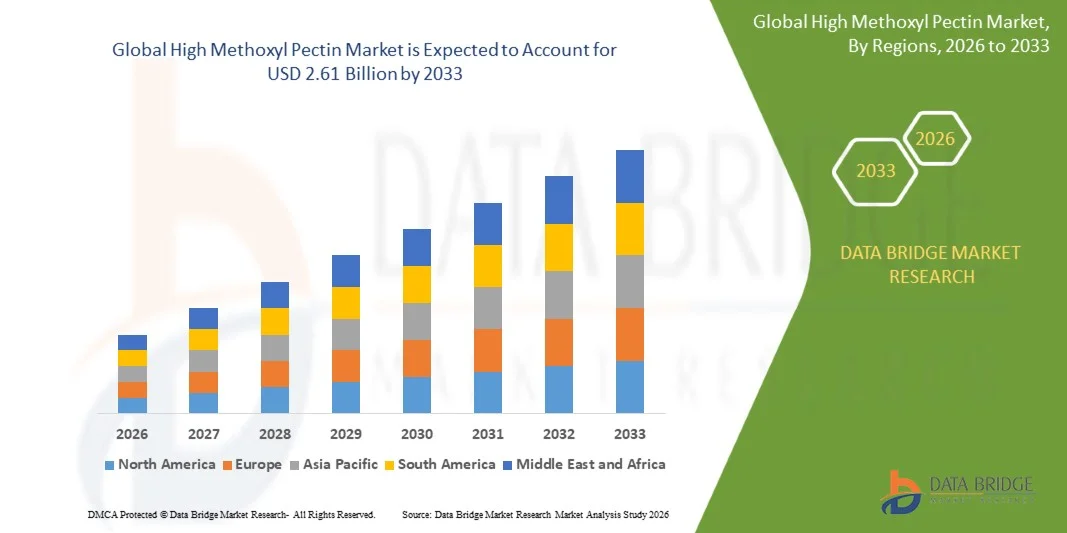
- As per Data Bridge Market Research analysis, the high methoxyl pectin market was valued at USD 1.51 billion in 2025 and is projected to reach USD 2.61 billion by 2033, growing at a CAGR of 7.10% from 2026 to 2033.
- The market is experiencing steady growth driven by increasing consumption of jams, jellies, confectionery, and functional foods, along with rising demand for natural hydrocolloids and clean-label ingredients across the global food and beverage industry.
- The expanding use of high methoxyl pectin as a gelling agent, stabilizer, and thickener in fruit preparations, dairy products, beverages, and pharmaceutical formulations is accelerating market adoption. Growing consumer preference for plant-derived ingredients, coupled with advancements in pectin extraction and functionalization technologies, is further supporting demand across food processing and nutraceutical applications.
Market Size & Forecast
- Global Market Value (2025): USD 1.51 Billion
- Expected Market Value (2033): USD 2.61 Billion
- Forecast CAGR (2026–2033): 7.10%
- Leading Region in 2025: Europe
- Fastest Growing Region: Asia-Pacific
What are the Major Takeaways of the High Methoxyl Pectin Market?
- Europe dominated the high methoxyl pectin market with 34.8% revenue share in 2025, supported by its well-established food processing industry, strong presence of leading pectin manufacturers, and high demand for clean-label and fruit-based food products.
- Asia-Pacific is expected to be the fastest-growing region at a CAGR of 7.8% from 2026 to 2033, fueled by increasing processed food consumption, expanding confectionery and dairy industries, and rising demand for natural food ingredients in China and India.
- The rapid set segment led the market with a 34.2% share in 2025, driven by its extensive use in high-sugar jams, jellies, marmalades, and fruit preserves requiring fast gel formation
- Extra slow set are the fastest-growing type, projected to register a CAGR of 7.9%, reflecting the surge in demand for premium fruit preparations, bakery fillings, and specialty confectionery products requiring extended processing times.
- The citrus fruits segment dominated the source category with a 78.1% revenue share in 2025, led by abundant raw material availability, higher pectin yield, and superior gelling performance.
- Gelling agent accounted for 69.3% of the market share in 2025, preferred by its widespread use in jams, jellies, confectionery, fruit preparations, and bakery fillings
- The pharmaceuticals segment is the fastest-growing application category, with a CAGR of 7.7%, driven by increasing utilization of pectin in drug delivery systems, oral formulations, wound care products, and nutraceutical applications.
Report Scope and High Methoxyl Pectin Market Segmentation
|
Attributes |
High Methoxyl Pectin Key Market Insights |
|
Segments Covered |
|
|
Countries Covered |
North America
Europe
Asia-Pacific
Middle East and Africa
South America
|
|
Key Market Players |
|
|
Market Opportunities |
|
|
Value Added Data Infosets |
In addition to the insights on market scenarios such as market value, growth rate, segmentation, geographical coverage, and major players, the market reports curated by the Data Bridge Market Research also include in-depth expert analysis, pricing analysis, brand share analysis, consumer survey, demography analysis, supply chain analysis, value chain analysis, raw material/consumables overview, vendor selection criteria, PESTLE Analysis, Porter Analysis, and regulatory framework. |
What is the Key Trend in the High Methoxyl Pectin Market?
- Food and beverage manufacturers are increasingly adopting high methoxyl pectin to develop clean-label fruit-based products with improved texture, stability, and natural ingredient claims while replacing synthetic hydrocolloids in premium formulations.
- For instance, in June 2024, Tate & Lyle announced the acquisition of CP Kelco, a leading producer of pectin and specialty gums, to strengthen its portfolio of nature-based ingredients and meet growing demand for clean-label food and beverage solution
- Advanced pectin extraction and formulation technologies enable manufacturers to improve gel consistency, optimize processing efficiency, and maintain product quality across diverse food and beverage applications.
- Food manufacturers are leveraging citrus- and apple-derived high methoxyl pectin to meet rising consumer demand for plant-based, naturally sourced ingredients in jams, jellies, confectionery, dairy, and beverage products.
- For instance, in November 2024, Tate & Lyle completed its acquisition of CP Kelco, expanding its capabilities in pectin, specialty gums, and other nature-based ingredients for food and beverage manufacturers.
- As consumers increasingly prioritize natural ingredients and clean-label foods, demand for high methoxyl pectin is expected to accelerate, reinforcing its role as a preferred hydrocolloid across processed food and beverage applications.
What are the Key Drivers of the High Methoxyl Pectin Market?
- The rapid expansion of clean-label foods and increasing consumer preference for naturally derived hydrocolloids have significantly increased demand for high methoxyl pectin across processed food, confectionery, dairy, and beverage applications.
- For instance, in July 2024, the U.S. Department of Agriculture (USDA) Agricultural Research Service developed a high-quality pectin capable of gelling in low-sugar products, supporting the growing demand for healthier and clean-label food formulations while improving commercial scalability.
- Food manufacturers are integrating high methoxyl pectin into product development to improve gel formation, texture stability, and shelf life while meeting evolving regulatory and consumer expectations for clean-label products.
- For instance, in February 2024, dsm-firmenich, through its distribution partner Nordmann, highlighted its PECTNER High Methoxyl citrus pectin portfolio for jams, fruit spreads, beverages, and dairy applications, addressing increasing demand for clean-label texture and stability solutions.
- With food manufacturers increasingly focusing on natural ingredient innovation and premium product differentiation, high methoxyl pectin will remain an essential functional ingredient supporting the development of next-generation food and beverage products.
Which Factors are Challenging the Growth of the High Methoxyl Pectin Market?
- High methoxyl pectin production depends heavily on citrus peel and apple pomace availability, making manufacturers vulnerable to fluctuations in raw material supply, agricultural yields, and processing costs.
- These supply chain uncertainties increase production expenses and create pricing volatility for food manufacturers relying on consistent pectin availability across global markets.
- For instance, in May 2024, Fundecitrus reported that adverse climate conditions and citrus greening disease would reduce Brazil's 2024/25 orange crop by 24.4%, highlighting how climate-related disruptions can constrain the availability of citrus-derived raw materials used in pectin production.
- Volatile raw material prices and supply disruptions continue to challenge large-scale pectin manufacturers, particularly during periods of adverse weather conditions and changing agricultural output.
- For instance, in November 2024, the World Citrus Organisation (WCO) forecast that Northern Hemisphere citrus production for the 2024/25 season would decline by 8.73% year over year, citing drought, heat waves, frost, pests, and diseases as key factors reducing citrus supply and affecting the availability of citrus-derived raw materials used in pectin production.
- This dependence on seasonal fruit production and agricultural supply chains continues to constrain production planning and pricing stability, limiting consistent market expansion despite growing demand for natural hydrocolloids.
How is the High Methoxyl Pectin Market Segmented?
The high methoxyl pectin market is segmented on the basis of type, source, functionality, application, and end user.
- By Type
On the basis of type, the high methoxyl pectin market is segmented into extra rapid set, rapid set, medium rapid set, slow set, and extra slow set. The rapid set segment dominated the market with an estimated 34.2% share in 2025, owing to its extensive use in high-sugar jams, jellies, marmalades, and fruit preserves requiring fast gel formation. It provides excellent gel strength, high processing efficiency, and shorter production cycles, making it the preferred choice for industrial food manufacturers. Rapid set pectin also delivers superior product consistency and improved shelf stability in fruit-based applications. Its compatibility with conventional high-solids formulations supports widespread adoption across commercial food processing facilities. Increasing demand for premium fruit spreads and convenience foods is further strengthening segment growth. Continuous innovation in clean-label food formulations continues to reinforce its market leadership.
The extra slow set segment is projected to register the fastest growth at an estimated CAGR of 7.9% from 2026 to 2033, driven by rising demand for premium fruit preparations, bakery fillings, and specialty confectionery products requiring extended processing times. These pectins provide greater manufacturing flexibility by allowing controlled gel formation before filling and packaging. Food manufacturers increasingly utilize extra slow set grades for products containing fruit inclusions and customized textures. Growing demand for artisanal and premium processed foods is accelerating adoption worldwide. Improvements in processing technologies are expanding commercial applications across the food industry. Rising investments in value-added fruit products are expected to sustain long-term demand.
- By Source
On the basis of source, the high methoxyl pectin market is segmented into citrus fruits and apple. The citrus fruits segment dominated the market with an estimated 78.1% share in 2025, driven by abundant raw material availability, higher pectin yield, and superior gelling performance. Citrus peel remains the primary commercial source of high methoxyl pectin because of its consistent quality and efficient extraction characteristics. Manufacturers also benefit from well-established citrus processing industries and stable industrial supply chains. The segment supports large-scale production for food, beverage, and pharmaceutical manufacturers worldwide. Continuous investments in citrus by-product utilization further improve production efficiency. Strong global citrus cultivation continues to maintain the segment's leadership position.
The apple segment is expected to witness the fastest growth at an estimated CAGR of 7.5% from 2026 to 2033, supported by increasing utilization of apple pomace as a sustainable raw material for pectin extraction. Growing emphasis on circular economy practices is encouraging food processors to convert apple processing waste into value-added ingredients. Apple-derived pectin is gaining popularity in premium food formulations due to its desirable functional properties. Rising demand for sustainable ingredient sourcing is further accelerating market adoption. Technological advancements in extraction processes continue improving product quality and production efficiency. Increasing investments in waste valorization are expected to support long-term segment expansion.
- By Functionality
On the basis of functionality, the high methoxyl pectin market is segmented into thickening agent and gelling agent. The gelling agent segment dominated the market with an estimated 69.3% share in 2025, owing to its widespread use in jams, jellies, confectionery, fruit preparations, and bakery fillings. High methoxyl pectin forms strong gels in high-sugar and acidic environments, making it indispensable for numerous processed food products. Manufacturers prefer this functionality because it provides excellent texture, stability, and product appearance. Growing demand for natural hydrocolloids continues supporting segment expansion. Continuous innovation in fruit-based formulations is increasing commercial utilization. Strong consumer preference for clean-label ingredients further reinforces market leadership.
The thickening agent segment is projected to register the fastest growth at an estimated CAGR of 7.3% from 2026 to 2033, driven by increasing application in beverages, dairy products, sauces, and nutritional formulations. Food manufacturers are incorporating high methoxyl pectin to improve viscosity, mouthfeel, and product stability while maintaining clean-label claims. Rising demand for functional beverages and plant-based food products is accelerating adoption. Expanding pharmaceutical applications are also contributing to market growth. Advances in ingredient formulation technologies continue improving product performance. Increasing consumer preference for naturally derived stabilizers supports future demand.
- By Application
On the basis of application, the high methoxyl pectin market is segmented into food industry and pharmaceuticals. The food industry segment dominated the market with an estimated 89.1% share in 2025, driven by extensive utilization in fruit preserves, confectionery, dairy products, bakery fillings, beverages, and desserts. High methoxyl pectin serves as a multifunctional ingredient providing gel formation, stabilization, and texture enhancement across numerous food applications. Rising demand for clean-label processed foods continues driving product adoption globally. Manufacturers increasingly utilize pectin to replace synthetic hydrocolloids in premium formulations. Continuous product innovation further supports segment expansion. Strong global consumption of processed fruit products maintains market leadership.
The pharmaceuticals segment is projected to witness the fastest growth at an estimated CAGR of 7.7% from 2026 to 2033, supported by increasing utilization of pectin in drug delivery systems, oral formulations, wound care products, and nutraceutical applications. Pharmaceutical manufacturers value pectin for its biocompatibility, natural origin, and controlled-release characteristics. Growing demand for plant-based excipients is further accelerating adoption. Ongoing research into advanced pharmaceutical formulations continues expanding commercial opportunities. Increasing investments in functional healthcare ingredients support long-term growth. Rising preference for naturally derived pharmaceutical ingredients further strengthens the segment outlook.
- By End User
On the basis of end user, the high methoxyl pectin market is segmented into information technology and energy and power. The information technology segment accounted for the largest share of 49.2% in 2025 under the published market taxonomy, although this classification has limited practical relevance to commercial high methoxyl pectin applications. Actual market demand is primarily generated by food, beverage, and pharmaceutical manufacturers rather than information technology companies. This categorization appears in the source segmentation but is not commonly adopted across industry research. Most market studies classify end users based on food processing, nutraceuticals, and pharmaceutical manufacturing. Therefore, this segment should be interpreted only within the context of the published taxonomy. It does not accurately represent real-world pectin consumption patterns.
The energy and power segment is expected to witness fastest growth at an estimated CAGR of 8.0% from 2026 to 2033, under the published taxonomy, although commercial utilization of high methoxyl pectin within this sector remains negligible. Current industry demand continues to be concentrated in food, beverage, and pharmaceutical applications worldwide. Consequently, this end-user classification has limited commercial significance for market assessment. Most leading market reports do not use this segmentation framework for pectin products. Application-based segmentation provides a more accurate representation of actual demand. Therefore, this category should be interpreted with caution when evaluating the market.
Which Region Holds the Largest Share of the High Methoxyl Pectin Market?
- Europe dominated the high methoxyl pectin market with 34.8% revenue share in 2025, supported by its well-established food processing industry, strong presence of leading pectin manufacturers, and high demand for clean-label and fruit-based food products.
- The region also benefits from high consumption of fruit preserves, confectionery, dairy products, and functional foods, along with stringent food safety regulations encouraging the use of natural hydrocolloids. Continuous innovation in pectin extraction technologies, sustainable citrus by-product utilization, and growing investments in premium food formulations continue to strengthen Europe's leadership position in the global market.
U.K. High Methoxyl Pectin Market Insight
The U.K. high methoxyl pectin market is experiencing steady growth, supported by increasing consumer demand for clean-label foods, reduced-sugar fruit products, and plant-based ingredients. Rising innovation in bakery, dairy, confectionery, and fruit preparation applications is contributing to market expansion. Furthermore, increasing reformulation activities by food manufacturers to comply with healthier food initiatives are strengthening demand for natural gelling and stabilizing agents. The British Soft Drinks Association continues to report widespread product reformulation following the U.K.'s sugar reduction initiatives, increasing demand for functional ingredients that maintain product texture and stability.
Germany High Methoxyl Pectin Market Insight
The Germany high methoxyl pectin market is expanding steadily due to the country's strong food processing industry, advanced ingredient manufacturing capabilities, and increasing adoption of natural hydrocolloids in premium food products. Food manufacturers are increasingly utilizing high methoxyl pectin to improve texture, stability, and shelf life across fruit preparations, confectionery, and dairy applications. Continuous innovation in clean-label formulations, together with Germany's leadership in food technology and sustainable ingredient development, is further driving market growth. Germany remains the largest food and beverage manufacturing market in Europe, providing a strong foundation for the growing adoption of pectin-based ingredients across processed food applications.
Asia-Pacific High Methoxyl Pectin Market Insight
The Asia-Pacific high methoxyl pectin market is expected to witness rapid growth, driven by increasing consumption of processed foods, expanding dairy and confectionery industries, and rising demand for natural food ingredients across China, India, and Southeast Asia. Growing investments in food processing capacity, increasing urbanization, and changing dietary preferences are supporting regional market expansion. In addition, rising demand for premium fruit-based products and clean-label formulations is accelerating the adoption of high methoxyl pectin throughout the region. According to the Food and Agriculture Organization (FAO), Asia continues to account for the largest share of global fruit and processed food consumption, supporting long-term demand for fruit-derived hydrocolloids such as pectin
Japan High Methoxyl Pectin Market Insight
The Japan high methoxyl pectin market is witnessing consistent growth due to increasing demand for premium fruit preparations, functional foods, and clean-label food ingredients. Food manufacturers are increasingly incorporating high methoxyl pectin into jams, beverages, confectionery, and dairy products to improve texture, stability, and shelf life. Moreover, Japan's aging population and growing preference for healthier, naturally formulated food products are further contributing to market expansion. Japan remains one of the world's leading markets for Foods for Specified Health Uses (FOSHU), encouraging the adoption of natural functional ingredients, including plant-derived hydrocolloids
China High Methoxyl Pectin Market Insight
The China high methoxyl pectin market is growing rapidly, driven by expanding processed food production, increasing fruit processing capacity, and rising consumer demand for clean-label food ingredients. Growing investments in bakery, dairy, confectionery, and beverage manufacturing are significantly boosting pectin consumption across the country. In addition, increasing awareness regarding natural ingredients and continued expansion of the domestic food processing industry are positioning China as one of the fastest-growing markets globally. According to the National Bureau of Statistics of China, the country's food manufacturing industry continues to expand alongside increasing packaged food consumption, supporting higher demand for functional ingredients such as pectin.
U.S. High Methoxyl Pectin Market Insight
The U.S. high methoxyl pectin market is witnessing steady growth due to rising demand for clean-label foods, sugar-reduced fruit products, and plant-based ingredients across the food and beverage industry. The country's well-established processed food sector, together with increasing adoption of natural hydrocolloids in confectionery, dairy, and beverage applications, is driving market expansion. In addition, growing consumer preference for recognizable ingredients and functional food formulations is accelerating the adoption of high methoxyl pectin across food manufacturing. In July 2024, the U.S. Department of Agriculture (USDA) Agricultural Research Service developed a high-quality pectin capable of gelling in low-sugar products, supporting healthier food formulations and expanding pectin applications.
Which are the Top Companies in High Methoxyl Pectin Market?
The high methoxyl pectin industry is primarily led by well-established companies, including:
- Cargill, Incorporated (U.S.)
- Tate & Lyle (U.S.)
- Silvateam S.p.A. (Italy)
- Ceamsa (Spain)
- Herbstreith & Fox GmbH & Co. KG (Germany)
- Naturex SA (France)
- Lucid Colloids Ltd. (India)
- Yantai Andre Pectin Co., Ltd. (China)
- Copenhagen Pectin A/S (Denmark)
- Compañía Española de Algas Marinas, S.A. (Spain)
- Henan Chemsino Industry Co., Ltd. (China)
- Xi'an Lyphar Biotech Co., Ltd. (China)
- Zibo Huasu Biotechnology Co., Ltd. (China)
- Shanxi Jinjin Chemical Co., Ltd. (China)
- Krishna Pectins Pvt. Ltd. (India)
- Pomona's Universal Pectin (U.S.)
- Quadra Chemicals Ltd. (Canada)
- Neelkanth Finechem LLP (India)
- Ingredion Incorporated (U.S.)
What are Latest Developments in High Methoxyl Pectin Market?
- In January 2023, Herbstreith & Fox introduced improved H&F Pectin solutions specifically designed for fruit spreads without added sugar. The solution enables manufacturers to achieve excellent gel strength, fruit texture, low syneresis, and stability while meeting the growing consumer demand for reduced-sugar and clean-label products. It also provides greater formulation flexibility for premium fruit preparations and supports healthier food innovation.
- In October 2022, Cargill introduced UniPECTINE LMCPlus, a new range of conventional low methoxyl pectins designed for fruit preparations, jams, jellies, bakery fillings, yogurt, and dairy alternatives. The new pectin range delivers improved gel strength, enhanced texture stability, cleaner labeling, and lower usage rates compared with conventional LMC pectins. It also helps manufacturers formulate high-fruit and reduced-sugar products while complying with evolving food regulations and clean-label consumer preferences, further strengthening Cargill's pectin portfolio.
- In March 2022, CP Kelco launched GENU Pectin MA-50 as part of its new ingredient portfolio for plant-based meat alternatives. The citrus-derived pectin was developed to enhance juiciness, improve texture, and deliver a more meat-like eating experience while enabling cleaner ingredient labels. Produced from upcycled citrus peels, the ingredient supports sustainable product development and addresses growing demand for recognizable, nature-based ingredients in alternative protein formulations.
- In October 2021, CP Kelco launched GENU Pectin YM-SAL 200, a new citrus pectin solution developed specifically for long shelf-life salted buttermilk beverages. The product improves protein stabilization, minimizes sedimentation, and maintains a smooth mouthfeel even in high-salt formulations, addressing the growing demand for stable dairy beverages, particularly in Asian markets.
- In September 2021, Cargill officially opened its USD 150 million High Methoxyl (HM) pectin production facility in Bebedouro, Brazil. The new plant significantly expanded Cargill's global HM pectin production capacity to meet rising demand for label-friendly ingredients used in jams, fruit beverages, acid dairy drinks, yogurt, confectionery, and fruit preparations. The facility also incorporates biomass-powered operations and sustainable sourcing of citrus peels

- Interactive Data Analysis Dashboard
- Company Analysis Dashboard for high growth potential opportunities
- Research Analyst Access for customization & queries
- Competitor Analysis with Interactive dashboard
- Latest News, Updates & Trend analysis
- Harness the Power of Benchmark Analysis for Comprehensive Competitor Tracking
Global High Methoxyl Pectin Market, Supply Chain Analysis and Ecosystem Framework
To support market growth and help clients navigate the impact of geopolitical shifts, DBMR has integrated in-depth supply chain analysis into its Global High Methoxyl Pectin Market research reports. This addition empowers clients to respond effectively to global changes affecting their industries. The supply chain analysis section includes detailed insights such as Global High Methoxyl Pectin Market consumption and production by country, price trend analysis, the impact of tariffs and geopolitical developments, and import and export trends by country and HSN code. It also highlights major suppliers with data on production capacity and company profiles, as well as key importers and exporters. In addition to research, DBMR offers specialized supply chain consulting services backed by over a decade of experience, providing solutions like supplier discovery, supplier risk assessment, price trend analysis, impact evaluation of inflation and trade route changes, and comprehensive market trend analysis.
Data collection and base year analysis are done using data collection modules with large sample sizes. The stage includes obtaining market information or related data through various sources and strategies. It includes examining and planning all the data acquired from the past in advance. It likewise envelops the examination of information inconsistencies seen across different information sources. The market data is analysed and estimated using market statistical and coherent models. Also, market share analysis and key trend analysis are the major success factors in the market report. To know more, please request an analyst call or drop down your inquiry.
The key research methodology used by DBMR research team is data triangulation which involves data mining, analysis of the impact of data variables on the market and primary (industry expert) validation. Data models include Vendor Positioning Grid, Market Time Line Analysis, Market Overview and Guide, Company Positioning Grid, Patent Analysis, Pricing Analysis, Company Market Share Analysis, Standards of Measurement, Global versus Regional and Vendor Share Analysis. To know more about the research methodology, drop in an inquiry to speak to our industry experts.
Data Bridge Market Research is a leader in advanced formative research. We take pride in servicing our existing and new customers with data and analysis that match and suits their goal. The report can be customized to include price trend analysis of target brands understanding the market for additional countries (ask for the list of countries), clinical trial results data, literature review, refurbished market and product base analysis. Market analysis of target competitors can be analyzed from technology-based analysis to market portfolio strategies. We can add as many competitors that you require data about in the format and data style you are looking for. Our team of analysts can also provide you data in crude raw excel files pivot tables (Fact book) or can assist you in creating presentations from the data sets available in the report.













