


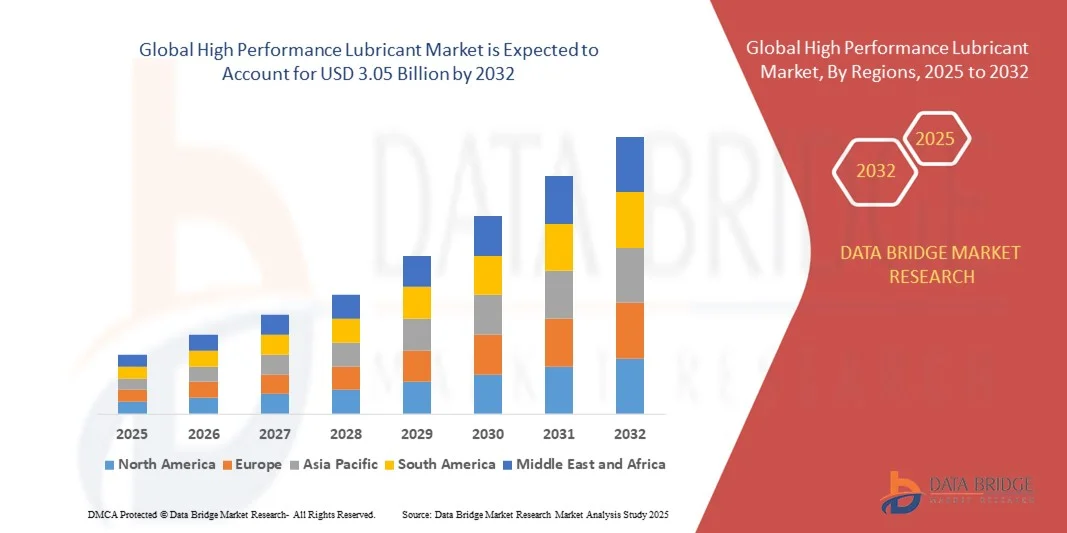
High Performance Lubricant Market Size
- The global high performance lubricant market size was valued at USD 2.55 billion in 2024 and is expected to reach USD 3.05 billion by 2032, at a CAGR of 2.20% during the forecast period
- The market growth is largely fuelled by the increasing demand for advanced lubricants that offer superior thermal stability, oxidation resistance, and extended equipment life across automotive and industrial sectors
- Growing emphasis on energy efficiency and the adoption of high-end machinery in industries such as aerospace, manufacturing, and marine are further driving product demand
High Performance Lubricant Market Analysis
- The global high performance lubricant market is witnessing steady growth as industries prioritize efficiency, sustainability, and equipment reliability. These lubricants are specifically formulated to operate under extreme temperature and pressure conditions, enhancing system performance and reducing maintenance downtime
- Rising industrial automation and the need for precise mechanical operations have boosted the adoption of synthetic lubricants, which outperform conventional oils in terms of stability and longevity. The automotive sector, in particular, is emerging as a key contributor, with manufacturers increasingly using high performance lubricants in electric and hybrid vehicles to improve powertrain efficiency
- North America dominated the high performance lubricant market with the largest revenue share of 38.45% in 2024, driven by strong industrial infrastructure, advanced automotive manufacturing, and the rising demand for energy-efficient machinery lubricants
- Asia-Pacific region is expected to witness the highest growth rate in the global high performance lubricant market, driven by increasing manufacturing activities, infrastructure development, and rising demand for high-quality lubricants across emerging economies
- The synthetic segment held the largest market revenue share in 2024 due to its superior oxidation stability, thermal resistance, and extended drain intervals compared to conventional lubricants. Synthetic lubricants are widely used across automotive and industrial applications where high performance and long service life are essential under extreme operating conditions
Report Scope and High Performance Lubricant Market Segmentation
|
Attributes |
High Performance Lubricant Key Market Insights |
|
Segments Covered |
|
|
Countries Covered |
North America
Europe
Asia-Pacific
Middle East and Africa
South America
|
|
Key Market Players |
• Royal Dutch Shell (U.K.) |
|
Market Opportunities |
|
|
Value Added Data Infosets |
In addition to the insights on market scenarios such as market value, growth rate, segmentation, geographical coverage, and major players, the market reports curated by the Data Bridge Market Research also include import export analysis, production capacity overview, production consumption analysis, price trend analysis, climate change scenario, supply chain analysis, value chain analysis, raw material/consumables overview, vendor selection criteria, PESTLE Analysis, Porter Analysis, and regulatory framework. |
High Performance Lubricant Market Trends
Rising Integration Of High Performance Lubricants In Electric And Hybrid Vehicles
- The growing adoption of electric and hybrid vehicles (EVs and HEVs) is significantly reshaping the high performance lubricant market. These vehicles require specialized lubricants that can withstand high thermal stress and ensure efficient energy transfer in electric drivetrains. As a result, manufacturers are increasingly focusing on formulating advanced fluids tailored to meet the unique cooling and friction reduction requirements of EV systems, supporting longer vehicle lifespans and enhanced performance under high-voltage conditions
- The demand for e-transmission fluids, dielectric coolants, and thermal management lubricants is accelerating, driven by the rapid expansion of EV production. Automotive OEMs are partnering with lubricant manufacturers to develop formulations that enhance efficiency and extend component lifespan. This collaboration is fostering innovation and differentiation in the market, with lubricant firms integrating smart sensors and monitoring technologies to optimize fluid performance and system reliability
- The increasing emphasis on sustainability and carbon emission reduction is further driving the shift toward eco-friendly synthetic lubricants. These products offer longer drain intervals, improved oxidation stability, and enhanced fuel economy, making them an ideal fit for next-generation vehicles and modern industrial applications. Moreover, regulatory pressure and consumer preference for sustainable mobility are motivating companies to invest in biodegradable and low-toxicity formulations
- For instance, in 2024, several automotive lubricant producers in Europe and Japan launched high-performance synthetic formulations optimized for electric and hybrid vehicles, improving energy efficiency and system durability while supporting global decarbonization goals. These innovations focused on minimizing electrical conductivity, enhancing thermal stability, and providing long-term corrosion protection for battery and motor components
- While the trend offers significant opportunities, producers must ensure compatibility with emerging EV technologies, maintain cost competitiveness, and focus on performance validation to capture long-term market potential. Continuous R&D and cross-industry collaboration will be critical for developing next-generation lubricants capable of meeting diverse regional and technical requirements
High Performance Lubricant Market Dynamics
Driver
Expanding Demand From Automotive And Industrial Sectors
- The growing requirement for high performance lubricants in automotive and industrial applications is a major market driver. These lubricants provide superior protection under extreme temperatures and pressures, reducing wear and improving efficiency across critical machinery and vehicle components. Their advanced formulations ensure reliable operation in high-stress environments, minimizing downtime and extending maintenance intervals for industrial systems
- The rise in high-performance engines, turbines, and precision manufacturing equipment has amplified the need for synthetic and semi-synthetic lubricants with advanced thermal and oxidative stability. This growing demand is further reinforced by industrial modernization and automation trends across global markets. Manufacturers are increasingly turning to lubricants that deliver energy savings, reduced frictional heat, and improved load-bearing capacity under continuous operation
- Stringent fuel efficiency standards and the push toward emission reduction are compelling manufacturers to use premium-grade lubricants that enhance performance and reduce frictional losses. This has expanded adoption across both OEMs and aftermarket segments. The automotive industry, in particular, is transitioning toward low-viscosity, high-performance formulations to meet evolving carbon neutrality targets and engine efficiency regulations
- For instance, in 2023, major lubricant producers in the U.S. and Germany expanded production capacities to meet rising demand from the automotive and aerospace sectors, aligning with global efficiency and sustainability initiatives. These expansions focused on producing synthetic base oils and advanced additive packages, enabling consistent supply to high-growth industrial regions
- While demand continues to rise, maintaining consistent quality, managing raw material volatility, and aligning formulations with regional environmental norms remain key priorities for long-term market growth. Manufacturers must also adapt to localized industrial trends and invest in digital tools for predictive maintenance and performance analytics
Restraint/Challenge
Fluctuating Raw Material Prices And Stringent Environmental Regulations
- Volatile prices of base oils and additive chemicals, largely influenced by fluctuations in crude oil supply, present a significant challenge for lubricant producers. These variations directly impact production costs and profit margins, especially for small and mid-sized manufacturers operating in competitive markets. Such instability also disrupts long-term supply agreements and complicates production planning and pricing strategies
- Stringent environmental regulations related to lubricant composition, disposal, and emissions control are adding compliance pressures. Manufacturers must invest in cleaner production technologies and sustainable formulations to meet evolving environmental standards. This often requires expensive process overhauls and certification costs, which can limit the ability of smaller firms to compete effectively in regulated markets
- Limited availability of advanced synthetic base stocks, coupled with high R&D expenses for developing bio-based lubricants, further constrains market expansion. Companies are increasingly exploring circular economy models to mitigate dependency on petroleum-based feedstocks. However, scalability, raw material sourcing, and performance parity remain ongoing challenges for bio-based lubricant adoption
- For instance, in 2023, several European lubricant manufacturers temporarily reduced output due to increased regulatory costs and supply chain disruptions caused by fluctuating crude prices and additive shortages. These disruptions impacted product availability and led to higher market prices, pressuring downstream automotive and industrial users
- While regulatory and cost challenges persist, ongoing advancements in bio-based technologies, recycling initiatives, and performance-enhancing additive innovation are expected to strengthen the market’s sustainability and resilience over the long term. Strategic partnerships and government-backed sustainability programs will further help offset production challenges and encourage green product adoption
High Performance Lubricant Market Scope
The market is segmented on the basis of source, type, and end users.
- By Source
On the basis of source, the high performance lubricant market is segmented into synthetic and bio-based. The synthetic segment held the largest market revenue share in 2024 due to its superior oxidation stability, thermal resistance, and extended drain intervals compared to conventional lubricants. Synthetic lubricants are widely used across automotive and industrial applications where high performance and long service life are essential under extreme operating conditions.
The bio-based segment is expected to witness the fastest growth rate from 2025 to 2032, driven by the increasing focus on sustainability and stringent environmental regulations. Bio-based lubricants, derived from renewable feedstocks, are gaining traction as eco-friendly alternatives with low toxicity and biodegradability, making them increasingly preferred in industries committed to reducing their carbon footprint.
- By Type
On the basis of type, the high performance lubricant market is segmented into engine oil, hydraulic and transmission fluids, metalworking fluids, general industrial oil, process oil, and others. The engine oil segment accounted for the largest revenue share in 2024, supported by its critical role in enhancing engine efficiency, reducing friction, and improving durability across high-performance automotive and industrial engines. Its demand is reinforced by the ongoing trend toward advanced synthetic formulations in modern vehicles.
The hydraulic and transmission fluids segment is projected to witness the fastest growth from 2025 to 2032, owing to the rising need for efficient power transfer and system protection in industrial and off-highway machinery. These fluids offer superior thermal stability, wear resistance, and compatibility with advanced mechanical systems, making them essential for maintaining operational reliability in demanding environments.
- By End Users
On the basis of end users, the high performance lubricant market is segmented into automotive and transportation, heavy machinery and equipment, food and beverage, power generation, chemical manufacturing, and others. The automotive and transportation segment dominated the market in 2024, driven by the growing use of high-performance lubricants in passenger and commercial vehicles to improve fuel economy, reduce emissions, and enhance engine protection under extreme conditions.
The power generation segment is anticipated to record the fastest growth from 2025 to 2032, propelled by the increasing adoption of advanced lubricants in turbines, compressors, and other high-load systems. These lubricants help improve efficiency, reduce downtime, and extend equipment life, making them critical to the smooth operation of renewable and conventional energy generation facilities.
High Performance Lubricant Market Regional Analysis
- North America dominated the high performance lubricant market with the largest revenue share of 38.45% in 2024, driven by strong industrial infrastructure, advanced automotive manufacturing, and the rising demand for energy-efficient machinery lubricants
- The region benefits from a robust presence of key industry players, high R&D investments, and a steady shift toward synthetic and bio-based lubricants in line with sustainability goals
- The continuous growth of automotive production and the expanding aerospace and heavy equipment sectors are further supporting market expansion, making North America a key hub for innovation and premium-grade lubricant consumption
U.S. High Performance Lubricant Market Insight
The U.S. high performance lubricant market captured the largest revenue share in 2024 within North America, fuelled by rapid industrial automation and the growing demand for advanced lubricants in the automotive, aerospace, and manufacturing sectors. The country’s emphasis on energy efficiency, extended equipment lifespan, and reduced carbon emissions has driven the adoption of synthetic lubricants. Continuous technological advancements and partnerships between OEMs and lubricant manufacturers are further propelling market growth. In addition, the strong presence of automotive giants and industrial machinery producers reinforces the country’s leadership in high performance lubricant consumption.
Europe High Performance Lubricant Market Insight
The Europe high performance lubricant market is expected to witness significant growth from 2025 to 2032, driven by stringent environmental standards and the rising adoption of eco-friendly, bio-based lubricants. European industries are prioritizing low-emission and high-efficiency lubricants to comply with sustainability directives. The region’s thriving automotive and industrial manufacturing sectors, particularly in Germany, France, and the U.K., are boosting demand. Furthermore, innovations in lubricant formulations for electric and hybrid vehicles are strengthening Europe’s position as a leading market for next-generation lubricant technologies.
U.K. High Performance Lubricant Market Insight
The U.K. high performance lubricant market is expected to witness a robust growth rate from 2025 to 2032, driven by increasing demand from the transportation, manufacturing, and renewable energy sectors. The country’s growing focus on sustainability and energy efficiency has led to the rapid adoption of bio-based and synthetic lubricants. In addition, the expansion of the automotive aftermarket and the presence of advanced industrial infrastructure are encouraging widespread usage of performance-grade lubricants. Strategic collaborations between lubricant suppliers and automotive OEMs are further supporting long-term market growth.
Germany High Performance Lubricant Market Insight
The Germany high performance lubricant market is expected to witness steady growth from 2025 to 2032, supported by the nation’s strong industrial base and advanced automotive sector. Germany’s emphasis on innovation, efficiency, and sustainability has accelerated the development of high-quality synthetic and bio-based lubricants. The country’s focus on electric vehicle production and energy-efficient machinery enhances the use of advanced lubricants in both manufacturing and transportation applications. Growing R&D investments and technological collaborations continue to reinforce Germany’s leadership in the European lubricant market.
Asia-Pacific High Performance Lubricant Market Insight
The Asia-Pacific high performance lubricant market is expected to witness the fastest growth rate from 2025 to 2032, driven by expanding automotive manufacturing, rapid industrialization, and increasing investments in renewable energy. Countries such as China, Japan, and India are witnessing heightened demand for synthetic lubricants due to advancements in automotive technology and heavy equipment operations. Government initiatives promoting cleaner and more efficient industrial practices are further fueling market growth. The region’s growing production capacity and the emergence of local lubricant manufacturers are making high performance lubricants more accessible and affordable.
Japan High Performance Lubricant Market Insight
The Japan high performance lubricant market is expected to witness significant growth from 2025 to 2032, driven by the increasing production of hybrid and electric vehicles and the nation’s focus on technological innovation. Japanese manufacturers are adopting advanced synthetic and energy-efficient lubricants to enhance machinery reliability and performance. The presence of leading automotive and electronics producers fosters strong demand for high-grade lubricants. Moreover, Japan’s sustainability-driven industrial policies and innovation in lubricant chemistry continue to support the market’s upward trajectory.
China High Performance Lubricant Market Insight
The China high performance lubricant market accounted for the largest revenue share in Asia-Pacific in 2024, attributed to the country’s expanding industrial infrastructure, automotive production, and rapid technological advancement. China’s continuous push toward industrial modernization and energy efficiency has boosted demand for synthetic lubricants. The strong presence of domestic manufacturers, along with increasing government support for green and sustainable lubricants, is propelling market growth. Furthermore, the growing export of automotive and industrial machinery lubricants is solidifying China’s position as a key contributor to the global high performance lubricant market.
High Performance Lubricant Market Share
The High Performance Lubricant industry is primarily led by well-established companies, including:
• Royal Dutch Shell (U.K.)
• Exxon Mobil Corporation (U.S.)
• bp p.l.c. (U.K.)
• China Petrochemical Corporation (China)
• Chevron Corporation (U.S.)
• Indian Oil Corporation Limited (India)
• LUKOIL (Russia)
• FUCHS (Germany)
• The Chemours Company (U.S.)
• Total (France)
• Valvoline Inc. (U.S.)
• High Performance Lubricants (U.S.)
• Petroliam Nasional Berhad (PETRONAS) (Malaysia)
• Gazprom Neft PJSC (Russia)
• PT Pertamina (Persero) (Indonesia)
• AMSOIL INC (U.S.)
• Telko Ltd (Finland)
• PetroChina Company Limited (China)
• GULF OIL Corporation Limited (India)
• Idemitsu Kosan Co. (Japan)

- Interactive Data Analysis Dashboard
- Company Analysis Dashboard for high growth potential opportunities
- Research Analyst Access for customization & queries
- Competitor Analysis with Interactive dashboard
- Latest News, Updates & Trend analysis
- Harness the Power of Benchmark Analysis for Comprehensive Competitor Tracking
Global High Performance Lubricant Market, Supply Chain Analysis and Ecosystem Framework
To support market growth and help clients navigate the impact of geopolitical shifts, DBMR has integrated in-depth supply chain analysis into its Global High Performance Lubricant Market research reports. This addition empowers clients to respond effectively to global changes affecting their industries. The supply chain analysis section includes detailed insights such as Global High Performance Lubricant Market consumption and production by country, price trend analysis, the impact of tariffs and geopolitical developments, and import and export trends by country and HSN code. It also highlights major suppliers with data on production capacity and company profiles, as well as key importers and exporters. In addition to research, DBMR offers specialized supply chain consulting services backed by over a decade of experience, providing solutions like supplier discovery, supplier risk assessment, price trend analysis, impact evaluation of inflation and trade route changes, and comprehensive market trend analysis.
Data collection and base year analysis are done using data collection modules with large sample sizes. The stage includes obtaining market information or related data through various sources and strategies. It includes examining and planning all the data acquired from the past in advance. It likewise envelops the examination of information inconsistencies seen across different information sources. The market data is analysed and estimated using market statistical and coherent models. Also, market share analysis and key trend analysis are the major success factors in the market report. To know more, please request an analyst call or drop down your inquiry.
The key research methodology used by DBMR research team is data triangulation which involves data mining, analysis of the impact of data variables on the market and primary (industry expert) validation. Data models include Vendor Positioning Grid, Market Time Line Analysis, Market Overview and Guide, Company Positioning Grid, Patent Analysis, Pricing Analysis, Company Market Share Analysis, Standards of Measurement, Global versus Regional and Vendor Share Analysis. To know more about the research methodology, drop in an inquiry to speak to our industry experts.
Data Bridge Market Research is a leader in advanced formative research. We take pride in servicing our existing and new customers with data and analysis that match and suits their goal. The report can be customized to include price trend analysis of target brands understanding the market for additional countries (ask for the list of countries), clinical trial results data, literature review, refurbished market and product base analysis. Market analysis of target competitors can be analyzed from technology-based analysis to market portfolio strategies. We can add as many competitors that you require data about in the format and data style you are looking for. Our team of analysts can also provide you data in crude raw excel files pivot tables (Fact book) or can assist you in creating presentations from the data sets available in the report.













