


What is the Global High Temperature Co-Fired Ceramics (HTCC) Market Size and Growth Rate?
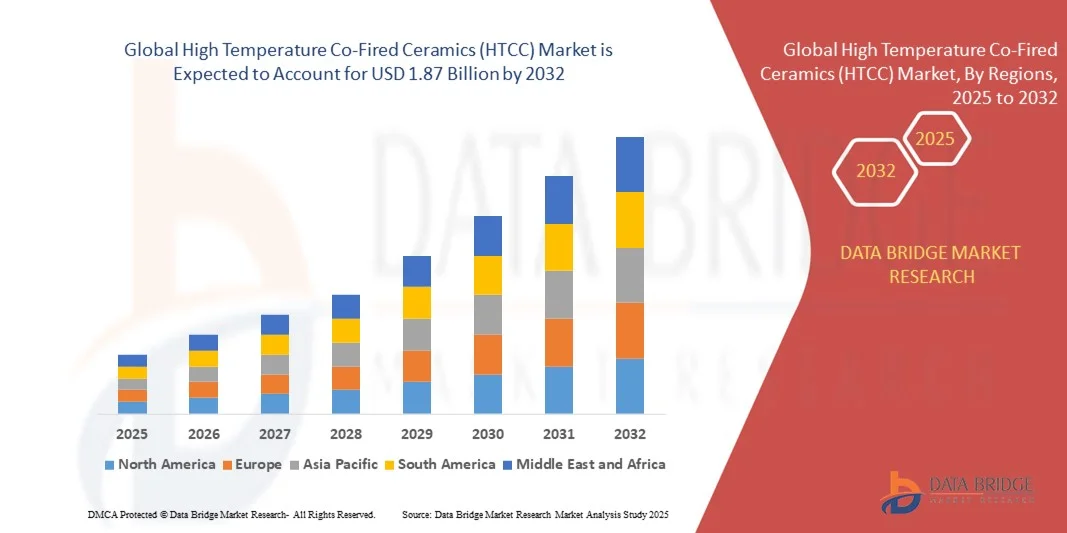
- As per Data Bridge Market Research Analysis the global high temperature co-fired ceramics (HTCC) market size was valued at USD 1.46 billion in 2024 and is expected to reach USD 1.87 billion by 2032, at a CAGR of 3.10% during the forecast period
- Rise in demand by healthcare and medical devices industry coupled with growing awareness in regards to the miniaturized and high-performing electronic devices is the root cause fuelling up the market growth rate
- Rising industrialization and growth and expansion of various end user verticals especially in the developing economies will also directly and positively impact the growth rate of the market
Market Size & Forecast
- Global Market Value (2024): USD 1.46 billion
- Expected Market Value (2032): USD 1.87 billion
- Forecast CAGR (2024–2032): 3.10%
What are the Major Takeaways of High Temperature Co-Fired Ceramics (HTCC) Market?
- Growth in the demand for automotive applications, increased focus on optimizing the production and surge in the technological advancements in industrial manufacturing processes will further carve the way for the growth of the market
- However, insufficiency in raw material supply owing to the lockdown and restrictions will pose a major challenge to the growth of the market. Fluctuations in the prices of raw materials and will dampen the market growth rate
- The Asia-Pacific region dominated the high temperature co-fired ceramics (HTCC) market with the largest revenue share of 41.2% in 2024, driven by expanding electronics manufacturing, growing adoption of electric vehicles (EVs), and advancements in communication technologies
- The North America HTCC market is projected to grow at the fastest CAGR of 12.5% from 2025 to 2032, propelled by rapid advancements in aerospace, defense, and semiconductor industries
- The Alumina HTCC Board segment dominated the market with a revenue share of 45.3% in 2024, driven by its high thermal conductivity, electrical insulation properties, and widespread adoption across consumer electronics, automotive, and industrial sectors
Report Scope and High Temperature Co-Fired Ceramics (HTCC) Market Segmentation
|
Attributes |
High Temperature Co-Fired Ceramics (HTCC) Key Market Insights |
|
Segments Covered |
|
|
Countries Covered |
North America
Europe
Asia-Pacific
Middle East and Africa
South America
|
|
Key Market Players |
|
|
Market Opportunities |
|
|
Value Added Data Infosets |
|
What is the Key Trend in the High Temperature Co-Fired Ceramics (HTCC) Market?
Advancements in Miniaturization and High-Density Integration
- A major trend in the global high temperature co-fired ceramics (HTCC) market is the push towards miniaturized, high-density multilayer designs, enabling more compact and efficient electronic modules. These developments are particularly crucial for industries such as automotive, aerospace, and consumer electronics, where space and performance optimization are critical
- For instance, manufacturers are integrating multiple functional layers, including passive components and conductive pathways, into single HTCC substrates, enhancing performance while reducing size and weight
- The adoption of advanced materials and printing techniques, such as fine-line metallization and laser drilling, is driving improvements in electrical performance, thermal management, and reliability
- This trend is fostering demand for HTCC solutions that support complex, high-frequency, and high-power electronic applications, making them indispensable for modern electronic systems
- Companies such as Kyocera and Murata are innovating HTCC products with improved dielectric properties, higher thermal conductivity, and denser packaging to meet the growing needs of high-performance electronics
- As industries push for smaller, faster, and more reliable electronics, the trend towards miniaturized, high-density HTCC components is expected to continue accelerating, shaping product design and manufacturing strategies
What are the Key Drivers of High Temperature Co-Fired Ceramics (HTCC) Market?
- The growing demand for compact, high-performance electronic modules in automotive, aerospace, and consumer electronics sectors is driving the HTCC market. HTCC substrates offer excellent thermal stability, mechanical strength, and reliability under harsh operating conditions, which makes them a preferred choice
- Increasing adoption of electric vehicles (EVs) and hybrid vehicles is creating demand for high-density electronic modules, in which HTCC components play a critical role for power electronics and sensors
- The proliferation of 5G networks and high-frequency communication devices is increasing the need for low-loss, high-frequency HTCC substrates, enabling faster signal transmission and enhanced system efficiency
- Advances in manufacturing technologies, such as multi-layer lamination and laser drilling, are improving HTCC performance while reducing production costs, encouraging broader adoption
- HTCC’s ability to integrate passive components and multiple circuits in a single module reduces board space, enhances durability, and simplifies assembly, supporting both industrial and consumer electronics growth
- Overall, the combination of technological advantages, miniaturization requirements, and rising demand from electronics-intensive sectors is propelling the HTCC market globally
Which Factor is Challenging the Growth of the High Temperature Co-Fired Ceramics (HTCC) Market?
- The high initial cost of HTCC manufacturing and specialized equipment is a major challenge for market expansion, particularly for small and mid-sized electronics manufacturers. HTCC production requires precision processes, expensive raw materials, and strict quality control
- Complex manufacturing steps such as multi-layer lamination, high-temperature sintering, and fine-line metallization increase both capital and operational expenses, limiting adoption in cost-sensitive markets
- The availability of alternative substrates such as LTCC (Low Temperature Co-Fired Ceramics) and standard PCBs in less demanding applications can also constrain HTCC demand
- In addition, strict quality and reliability standards in high-performance applications pose technical barriers, requiring continuous R&D investment for defect-free production
- While advancements in automation and material innovations are gradually reducing costs, the perception of HTCC as a premium solution may still hinder adoption in emerging regions
- Overcoming these challenges through process optimization, cost reduction, and enhanced performance offerings will be crucial for sustained growth in the HTCC market
How is the High Temperature Co-Fired Ceramics (HTCC) Market Segmented?
The high temperature co-fired ceramics (HTCC) market is segmented on the basis of product type, material type and application.
- By Product Type
On the basis of product type, the High Temperature Co-Fired Ceramics (HTCC) market is segmented into Alumina HTCC Board, Aluminium Nitride HTCC Board, and Mullite Ceramics Substrate. The Alumina HTCC Board segment dominated the market with a revenue share of 45.3% in 2024, driven by its high thermal conductivity, electrical insulation properties, and widespread adoption across consumer electronics, automotive, and industrial sectors. Alumina HTCC boards are preferred for multilayer circuits and high-reliability applications due to their stability under harsh operating conditions.
The Aluminium Nitride HTCC Board segment is expected to witness the fastest CAGR of 22.1% from 2025 to 2032, attributed to its superior thermal management capabilities, making it suitable for high-power electronic modules, LED devices, and 5G communication systems. Growing demand for miniaturized, high-density packaging and efficient heat dissipation is further accelerating adoption, positioning Aluminium Nitride HTCC as a high-growth product type in the global market.
- By Material Type
On the basis of material type, the High Temperature Co-Fired Ceramics (HTCC) market is segmented into Glass-Ceramic Material and Ceramic Material. The Ceramic Material segment accounted for the largest revenue share of 52% in 2024, due to its excellent mechanical strength, thermal stability, and electrical insulation properties. Ceramic HTCC substrates are widely used in aerospace, defense, and industrial electronics where reliability and high-temperature endurance are critical.
The Glass-Ceramic Material segment is projected to witness the fastest CAGR of 20.5% from 2025 to 2032, fueled by innovations in glass-ceramic composites that enhance dielectric performance, reduce weight, and support multilayer integration for high-frequency applications. Increasing adoption in telecom, automotive, and consumer electronics sectors, combined with demand for energy-efficient and high-performance modules, is driving the growth of glass-ceramic HTCC substrates. The ongoing material innovations make this segment a key area of investment for manufacturers.
- By Application
On the basis of application, the High Temperature Co-Fired Ceramics (HTCC) market is segmented into Defense, Aerospace, Industrial, Healthcare, Optical, Consumer Electronics, Automotive, Telecommunications, and Others. The Telecommunications segment dominated the market with a revenue share of 38% in 2024, owing to the surge in high-frequency, high-power modules for 5G infrastructure, base stations, and mobile communication devices. HTCC substrates offer low-loss, high-reliability solutions that are ideal for telecom applications requiring precise signal transmission and compact designs.
The Automotive segment is anticipated to witness the fastest CAGR of 23.4% from 2025 to 2032, driven by increasing adoption of electric vehicles, power electronics, and advanced driver-assistance systems (ADAS). Demand for thermal management, miniaturized circuits, and high-density packaging is accelerating the use of HTCC substrates in automotive electronics, making this sector a key driver of market expansion in the forecast period.
Which Region Holds the Largest Share of the High Temperature Co-Fired Ceramics (HTCC) Maret?
- The Asia-Pacific region dominated the high temperature co-fired ceramics (HTCC) market with the largest revenue share of 41.2% in 2024, driven by expanding electronics manufacturing, growing adoption of electric vehicles (EVs), and advancements in communication technologies
- The region benefits from a robust semiconductor industry in countries such as China, Japan, and South Korea, coupled with government support for industrial automation and smart infrastructure development
- Moreover, the rising production of 5G-enabled devices and renewable energy systems further strengthens demand for HTCC components, which offer superior thermal stability and miniaturization benefits
- The Asia-Pacific region is expected to maintain its dominance throughout the forecast period, supported by continuous innovation and the presence of major ceramic material producers
China High Temperature Co-Fired Ceramics (HTCC) Market Insight
The China HTCC market held the largest market share within Asia-Pacific in 2024, driven by strong demand from the electronics, automotive, and telecommunication industries. The nation’s strategic investments in 5G infrastructure, EVs, and IoT have significantly fueled HTCC adoption. Local manufacturers are increasingly focusing on developing cost-effective ceramic substrates and sensors for advanced applications. Furthermore, government initiatives promoting domestic semiconductor production have accelerated market growth. The increasing use of HTCC in electric power modules and communication devices positions China as a key contributor to the global HTCC supply chain.
Japan High Temperature Co-Fired Ceramics (HTCC) Market Insight
The Japan HTCC market continues to grow steadily due to the country’s established electronics ecosystem and focus on technological precision. Japanese manufacturers are leveraging HTCC technology for miniaturized and high-performance electronic components used in medical, automotive, and aerospace sectors. The strong presence of leading companies such as Kyocera Corporation and Murata Manufacturing Co., Ltd. enhances Japan’s market competitiveness. In addition, Japan’s shift toward electric mobility and next-generation communication technologies sustains HTCC demand. The nation’s emphasis on innovation, reliability, and export-driven manufacturing ensures steady market expansion in the coming years.
India High Temperature Co-Fired Ceramics (HTCC) Market Insight
The India HTCC market is witnessing robust growth due to the government’s “Make in India” initiative and rising investments in semiconductor fabrication and electronics manufacturing. The growing demand for consumer electronics, renewable energy systems, and smart devices is encouraging local production of HTCC components. Furthermore, collaborations with Japanese and Taiwanese firms are fostering technology transfer and skill development in ceramic manufacturing. The increasing adoption of industrial automation and defense electronics also contributes to market expansion. India’s improving infrastructure and economic growth make it a promising emerging market for HTCC technology.
Which Region is the Fastest Growing Region in the High Temperature Co-Fired Ceramics (HTCC) Market?
The North America HTCC market is projected to grow at the fastest CAGR of 12.5% from 2025 to 2032, propelled by rapid advancements in aerospace, defense, and semiconductor industries. The U.S. leads regional growth, backed by rising investments in EV batteries, satellite communication, and high-frequency electronics. Growing adoption of miniaturized and heat-resistant ceramic components across industrial and automotive applications is further boosting demand. Increasing R&D efforts by manufacturers and government support for domestic semiconductor production reinforce market expansion. North America’s innovation-driven ecosystem ensures significant future growth for HTCC applications across multiple sectors.
U.S. High Temperature Co-Fired Ceramics (HTCC) Market Insight
The U.S. HTCC market accounted for the majority of North America’s revenue share in 2024, supported by strong demand from the defense, telecommunications, and renewable energy industries. The country’s push for localized semiconductor production and electrification of transportation is fueling HTCC utilization. Major players are investing in high-performance ceramic substrates and advanced packaging technologies to improve device efficiency and reliability. In addition, partnerships between material suppliers and OEMs are fostering innovation. The integration of HTCC components in 5G, radar, and aerospace systems underscores the U.S.’s critical role in driving the global HTCC market forward.
Which are the Top Companies in High Temperature Co-Fired Ceramics (HTCC) Market?
The high temperature co-fired ceramics (HTCC) industry is primarily led by well-established companies, including:
- KYOCERA Corporation (Japan)
- NGK SPARK PLUG CO., LTD. (Japan)
- SCHOTT AG (Germany)
- MARUWA Co., Ltd. (Japan)
- Yokowo Co., Ltd. (Japan)
- NTK Technologies (U.S.)
- NIKKO CORP. (Japan)
- Murata Manufacturing Co., Ltd. (Japan)
- KOA Speer Electronics, Inc. (U.S.)
- Hitachi Metals, Ltd. (Japan)
- DuPont (U.S.)
- API Microelectronics Limited (U.K.)
- Neo Tech Inc. (U.S.)
- ACX Corp. (U.S.)
- Mirion Technologies (Selmic) Oy (Finland)
- TAIYO YUDEN CO., LTD. (Japan)
- TDK Corporation (Japan)
- CeramTec GmbH (Germany)
- Adamant Namiki Precision Jewel Co., Ltd. (Japan)
- American Technical Ceramics Corp (U.S.)
- VIA Electronic GmbH (Germany)

- Interactive Data Analysis Dashboard
- Company Analysis Dashboard for high growth potential opportunities
- Research Analyst Access for customization & queries
- Competitor Analysis with Interactive dashboard
- Latest News, Updates & Trend analysis
- Harness the Power of Benchmark Analysis for Comprehensive Competitor Tracking
Global High Temperature Co Fired Ceramics Htcc Market, Supply Chain Analysis and Ecosystem Framework
To support market growth and help clients navigate the impact of geopolitical shifts, DBMR has integrated in-depth supply chain analysis into its Global High Temperature Co Fired Ceramics Htcc Market research reports. This addition empowers clients to respond effectively to global changes affecting their industries. The supply chain analysis section includes detailed insights such as Global High Temperature Co Fired Ceramics Htcc Market consumption and production by country, price trend analysis, the impact of tariffs and geopolitical developments, and import and export trends by country and HSN code. It also highlights major suppliers with data on production capacity and company profiles, as well as key importers and exporters. In addition to research, DBMR offers specialized supply chain consulting services backed by over a decade of experience, providing solutions like supplier discovery, supplier risk assessment, price trend analysis, impact evaluation of inflation and trade route changes, and comprehensive market trend analysis.
Data collection and base year analysis are done using data collection modules with large sample sizes. The stage includes obtaining market information or related data through various sources and strategies. It includes examining and planning all the data acquired from the past in advance. It likewise envelops the examination of information inconsistencies seen across different information sources. The market data is analysed and estimated using market statistical and coherent models. Also, market share analysis and key trend analysis are the major success factors in the market report. To know more, please request an analyst call or drop down your inquiry.
The key research methodology used by DBMR research team is data triangulation which involves data mining, analysis of the impact of data variables on the market and primary (industry expert) validation. Data models include Vendor Positioning Grid, Market Time Line Analysis, Market Overview and Guide, Company Positioning Grid, Patent Analysis, Pricing Analysis, Company Market Share Analysis, Standards of Measurement, Global versus Regional and Vendor Share Analysis. To know more about the research methodology, drop in an inquiry to speak to our industry experts.
Data Bridge Market Research is a leader in advanced formative research. We take pride in servicing our existing and new customers with data and analysis that match and suits their goal. The report can be customized to include price trend analysis of target brands understanding the market for additional countries (ask for the list of countries), clinical trial results data, literature review, refurbished market and product base analysis. Market analysis of target competitors can be analyzed from technology-based analysis to market portfolio strategies. We can add as many competitors that you require data about in the format and data style you are looking for. Our team of analysts can also provide you data in crude raw excel files pivot tables (Fact book) or can assist you in creating presentations from the data sets available in the report.













