


High-Temperature Sterilization Equipment Market Overview
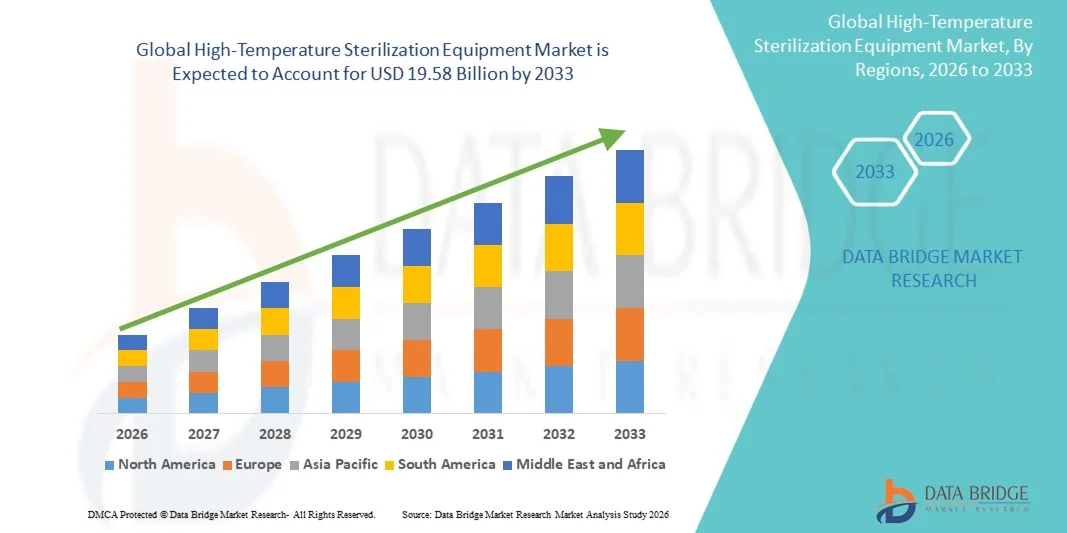
The High-Temperature Sterilization Equipment Market was valued at USD 10.50 billion in 2025 and is projected to reach USD 19.58 billion by 2033, growing at a CAGR of 8.70% from 2026 to 2033. The high-temperature sterilization equipment market is experiencing consistent growth driven by rising demand for effective infection control solutions, increasing hospital-acquired infection (HAI) prevention initiatives, and expanding use of sterilization systems across hospitals, diagnostic laboratories, and pharmaceutical manufacturing facilities. Growing surgical volumes worldwide, combined with stricter healthcare regulations and sterilization standards imposed by regulatory authorities, are compelling healthcare providers to adopt advanced autoclaves and thermal sterilization systems to ensure patient safety and compliance.
The increasing incidence of chronic diseases and rising number of surgical procedures globally are further accelerating demand for reliable sterilization technologies. Hospitals and ambulatory surgical centers are increasingly relying on steam sterilizers, dry heat sterilizers, and high-pressure autoclaves to ensure effective reprocessing of surgical instruments. In addition, advancements in automation, digital monitoring, and energy-efficient sterilization systems are improving operational efficiency, cycle accuracy, and safety standards. The expansion of healthcare infrastructure in emerging economies and growing investments in hospital modernization are further supporting market growth across both developed and developing regions.
Key Market Trends & Insights
- North America dominated the High-Temperature Sterilization Equipment Market with the largest revenue share of 38.46% in 2025, supported by advanced healthcare infrastructure, high surgical volumes, strong infection control regulations, and widespread adoption of automated sterilization systems across hospitals and pharmaceutical facilities. The region also benefits from strict compliance standards issued by regulatory bodies such as the FDA and CDC, driving continuous upgrades of sterilization equipment across healthcare settings.
- The Steam Sterilization segment dominated the market with a revenue share of 61.34% in 2025, owing to its high efficiency, rapid microbial destruction capability, and widespread adoption across hospitals, surgical centers, and pharmaceutical manufacturing facilities.
- Asia-Pacific is expected to be the fastest-growing region at a CAGR of 7.9% from 2026 to 2033, fueled by expanding healthcare infrastructure, rising hospital construction, increasing surgical procedures, and growing investments in pharmaceutical manufacturing across China, India, and Japan. Improving infection control awareness and government initiatives to modernize healthcare systems are further accelerating regional market growth.
- The Pharmaceutical segment is expected to witness the fastest growth at a CAGR of 8.1% from 2026 to 2033, driven by stringent regulatory requirements for sterile manufacturing environments, increasing biologics production, and rising demand for contamination-free drug development and production processes.
- The Hospitals and Clinics segment dominated the market with a 57.64% revenue share in 2025, supported by high patient inflow, rising surgical procedures, and mandatory sterilization protocols for infection prevention and patient safety across healthcare facilities worldwide.
Market Size & Forecast
- Global Market Value (2025): USD 10.50 Billion
- Expected Market Value (2033): USD 19.58 Billion
- Forecast CAGR (2026–2033): 8.70%
- Leading Region in 2025: North America
- Fastest Growing Region: Asia-Pacific
Report Scope and High-Temperature Sterilization Equipment Market Segmentation
|
Attributes |
High-Temperature Sterilization Equipment Key Market Insights |
|
Segments Covered |
|
|
Countries Covered |
North America · U.S. · Canada · Mexico Europe · Germany · France · U.K. · Netherlands · Switzerland · Belgium · Russia · Italy · Spain · Turkey · Rest of Europe Asia-Pacific · China · Japan · India · South Korea · Singapore · Malaysia · Australia · Thailand · Indonesia · Philippines · Rest of Asia-Pacific Middle East and Africa · Saudi Arabia · U.A.E. · South Africa · Egypt · Israel · Rest of Middle East and Africa South America · Brazil · Argentina · Rest of South America |
|
Key Market Players |
• STERIS plc (U.S.) |
|
Market Opportunities |
· Expansion of Pharmaceutical and Biologics Manufacturing Facilities · Rising Adoption of Automated and IoT-Enabled Sterilization Systems · Healthcare Infrastructure Expansion in Emerging Economies |
|
Value Added Data Infosets |
In addition to the insights on market scenarios such as market value, growth rate, segmentation, geographical coverage, and major players, the market reports curated by the Data Bridge Market Research also include in-depth expert analysis, geographically represented company-wise production and capacity, network layouts of distributors and partners, detailed and updated price trend analysis and deficit analysis of supply chain and demand. |
High-Temperature Sterilization Equipment Market Trends
Trend: Rising Adoption of Automated, Energy-Efficient, and Smart Sterilization Systems
The high-temperature sterilization equipment market is witnessing a strong shift toward fully automated and digitally integrated sterilization systems across hospitals, pharmaceutical manufacturing facilities, and diagnostic laboratories. Healthcare providers are increasingly adopting advanced steam autoclaves and dry heat sterilizers equipped with IoT-based monitoring, cycle validation, and electronic recordkeeping to improve compliance with infection control standards. According to the World Health Organization (WHO), healthcare-associated infections (HAIs) affect hundreds of millions of patients globally each year, reinforcing the need for reliable sterilization infrastructure.
In addition, pharmaceutical manufacturers are increasingly deploying validated sterilization systems in compliance with Good Manufacturing Practices (GMP) to ensure contamination-free production of sterile injectables and biologics. The demand for energy-efficient sterilizers with reduced cycle times is also increasing as hospitals focus on operational cost optimization and sustainability initiatives.
High-Temperature Sterilization Equipment Market Dynamics
Key Market Driver: Rising Surgical Procedures and Increasing Focus on Infection Prevention
The growing number of surgical procedures worldwide is a major driver for the high-temperature sterilization equipment market. According to global clinical estimates, tens of millions of surgical interventions are performed annually, requiring strict sterilization of surgical instruments and reusable medical devices. The increasing burden of chronic diseases such as cardiovascular disorders, cancer, and orthopedic conditions is significantly contributing to higher hospital admissions and surgical volumes.
Hospitals and ambulatory surgical centers are expanding sterilization capacity to meet rising patient inflow and ensure patient safety. In addition, regulatory bodies such as the U.S. FDA, European Medicines Agency (EMA), and CDC have strengthened infection prevention and sterilization guidelines, further driving adoption of validated high-temperature sterilization systems. Expansion of healthcare infrastructure in emerging economies such as India, China, and Brazil is also supporting market growth.
Key Restraint/Challenge: High Equipment Cost and Operational Complexity
A major challenge in the high-temperature sterilization equipment market is the high initial investment and maintenance cost associated with advanced sterilization systems. Modern autoclaves and integrated sterilization units require significant capital expenditure for installation, validation, and compliance certification.
In addition, ongoing costs related to maintenance, calibration, consumables, and energy consumption increase the total cost of ownership, particularly for small and mid-sized healthcare facilities. Operational complexity, including strict cycle validation requirements and regulatory compliance documentation, also increases workload for hospital staff. In resource-limited regions, lack of technical expertise and infrastructure gaps further restrict adoption of advanced sterilization technologies.
Key Market Opportunity: Expansion of Pharmaceutical Manufacturing and Smart Sterilization Integration
The rapid expansion of global pharmaceutical and biotechnology manufacturing presents a significant opportunity for the high-temperature sterilization equipment market. Increasing production of vaccines, biologics, and sterile injectable drugs requires highly reliable sterilization systems that meet stringent regulatory standards. For instance, global vaccine manufacturing capacity expanded significantly after 2020, increasing demand for validated sterilization infrastructure in production lines. In addition, the integration of smart sterilization systems with cloud-based monitoring platforms is enabling real-time cycle tracking, predictive maintenance, and compliance automation. Emerging opportunities also include integration with hospital digital ecosystems, where sterilization data is linked with surgical workflow systems to improve operational efficiency. Growing healthcare investments in Asia-Pacific and Middle East countries are expected to further accelerate adoption of advanced sterilization technologies across hospitals and pharmaceutical facilities.
High-Temperature Sterilization Equipment Market Scope
The High-Temperature Sterilization Equipment market is segmented on the basis of type and application.
- By Types
On the basis of type, the High-Temperature Sterilization Equipment Market is segmented into steam sterilization, dry sterilization, and others. The Steam Sterilization segment dominated the market with a revenue share of 61.34% in 2025, owing to its high efficiency, rapid microbial destruction capability, and widespread adoption across hospitals, surgical centers, and pharmaceutical manufacturing facilities. Steam sterilizers (autoclaves) remain the gold standard due to their ability to effectively eliminate bacteria, viruses, and spores while ensuring cost-efficient and validated sterilization cycles. Increasing surgical procedures, rising hospital-acquired infection (HAI) prevention protocols, and strong regulatory compliance requirements are further strengthening segment dominance.
The Dry Sterilization segment is expected to witness the fastest growth at a CAGR of 6.9% from 2026 to 2033, driven by its effectiveness in sterilizing heat-stable and moisture-sensitive instruments such as glassware, metal tools, and powders used in pharmaceutical production. Growing demand from laboratories and specialty healthcare facilities, along with improved energy efficiency and reduced corrosion risk compared to steam systems, is accelerating adoption. In addition, rising pharmaceutical R&D activities and increasing use of dry heat sterilization in niche medical applications are further supporting segment expansion globally.
- By Application
On the basis of application, the market is segmented into hospitals & clinics, pharmaceutical, and others. The Hospitals & Clinics segment dominated the market with a revenue share of 58.72% in 2025, supported by high patient inflow, rising surgical procedures, and strict infection prevention protocols. Hospitals are the largest end users of high-temperature sterilization systems due to continuous demand for sterilized surgical instruments, diagnostic tools, and reusable medical devices. Increasing prevalence of hospital-acquired infections (HAIs), expansion of healthcare infrastructure, and strong regulatory enforcement from health authorities are further driving adoption across both developed and emerging economies.
The Pharmaceutical segment is expected to witness the fastest growth at a CAGR of 7.3% from 2026 to 2033, fueled by expanding drug manufacturing activities, increasing production of biologics and injectables, and strict GMP (Good Manufacturing Practice) compliance requirements. Pharmaceutical companies are increasingly investing in advanced sterilization systems to ensure contamination-free production environments and maintain product safety standards. Rising global demand for vaccines, injectable therapies, and sterile packaging solutions is further accelerating the adoption of high-temperature sterilization equipment in pharmaceutical manufacturing facilities worldwide.
High-Temperature Sterilization Equipment Market Regional Analysis
North America dominated the High-Temperature Sterilization Equipment Market and accounted for the largest revenue share of 38.46% in 2025, supported by advanced healthcare infrastructure, high surgical volumes, strong infection control regulations, and widespread adoption of automated sterilization systems across hospitals and pharmaceutical facilities. The region benefits from well-established hospital networks, high compliance with sterilization standards, and continuous upgrades in infection prevention technologies. Strict regulatory oversight by agencies such as the FDA and CDC further drives the adoption of advanced autoclaves, dry heat sterilizers, and automated high-temperature sterilization systems across healthcare institutions. Increasing prevalence of hospital-acquired infections (HAIs) and rising demand for surgical procedures continue to strengthen market dominance in the region.
U.S. High-Temperature Sterilization Equipment Market Insight
The U.S. High-Temperature Sterilization Equipment market is witnessing strong growth due to rising surgical volumes, increasing prevalence of chronic diseases requiring operative care, and strict infection control mandates across healthcare facilities. Hospitals and ambulatory surgical centers are rapidly upgrading to automated, high-efficiency sterilization systems to ensure patient safety and regulatory compliance. The strong presence of leading medical device manufacturers and continuous innovation in sterilization technologies are further accelerating adoption. In addition, growing pharmaceutical production and vaccine manufacturing activities are increasing demand for validated sterilization processes in controlled environments.
Europe High-Temperature Sterilization Equipment Market Insight
The Europe High-Temperature Sterilization Equipment market remains a major contributor to global revenue, driven by strong healthcare regulations, advanced hospital infrastructure, and high adoption of infection prevention protocols. Countries across the region emphasize strict sterilization compliance under EU medical device and infection control guidelines, ensuring consistent equipment upgrades. Rising surgical procedures, growing geriatric population, and increasing demand for sterile pharmaceutical production environments are further supporting market growth. Continuous investment in modernizing healthcare facilities and improving patient safety standards continues to strengthen Europe’s position in the global market.
U.K. High-Temperature Sterilization Equipment Market Insight
The U.K. High-Temperature Sterilization Equipment market is experiencing steady growth supported by increasing surgical volumes, NHS-driven infection control initiatives, and modernization of hospital sterilization units. Hospitals are adopting advanced autoclave systems and automated sterilization workflows to improve efficiency and reduce contamination risks. Rising demand for minimally invasive surgeries and expansion of outpatient surgical centers are further driving equipment adoption. Integration of digital monitoring systems and compliance tracking solutions is also improving operational efficiency across healthcare facilities.
Germany High-Temperature Sterilization Equipment Market Insight
The Germany High-Temperature Sterilization Equipment market is expanding steadily due to strong healthcare infrastructure, high standards of medical hygiene, and advanced pharmaceutical manufacturing capabilities. German hospitals and laboratories widely adopt high-temperature sterilization systems to comply with strict infection control regulations. The country’s strong medical device manufacturing base and focus on precision healthcare further support market growth. Increasing surgical procedures and growing investments in hospital modernization are accelerating the adoption of advanced sterilization technologies.
Asia-Pacific High-Temperature Sterilization Equipment Market Insight
The Asia-Pacific High-Temperature Sterilization Equipment market is expected to witness the fastest growth, registering a CAGR of 7.9% from 2026 to 2033, driven by rapid expansion of healthcare infrastructure, rising hospital construction, and increasing surgical procedures across emerging economies such as China, India, and Japan. Growing awareness of infection control practices and government-led healthcare modernization programs are significantly boosting demand for sterilization equipment. In addition, rising investments in pharmaceutical manufacturing, vaccine production, and medical device industries are further accelerating regional market expansion. Expanding access to advanced surgical care and improving healthcare expenditure are also contributing to strong growth momentum.
Japan High-Temperature Sterilization Equipment Market Insight
The Japan High-Temperature Sterilization Equipment market is witnessing steady growth due to a rapidly aging population, increasing surgical interventions, and advanced hospital infrastructure. Japanese healthcare facilities emphasize high standards of sterilization and infection control, driving adoption of technologically advanced autoclaves and dry heat sterilizers. Strong presence of medical device innovation and continuous investment in healthcare automation further support market expansion. In addition, growing pharmaceutical production and research activities are contributing to increased demand for sterilization equipment.
China High-Temperature Sterilization Equipment Market Insight
The China High-Temperature Sterilization Equipment market is growing rapidly due to large-scale hospital expansion, increasing surgical volumes, and strong government investment in healthcare modernization. Rising awareness of hospital-acquired infections and strict regulatory enforcement of sterilization standards are driving widespread adoption of advanced sterilization systems. China’s expanding pharmaceutical manufacturing sector, including biologics and vaccine production, is further boosting demand for high-temperature sterilization equipment. Continuous improvements in healthcare infrastructure and rapid technological adoption are positioning China as one of the fastest-growing markets globally.
High-Temperature Sterilization Equipment Market Share
The High-Temperature Sterilization Equipment industry is primarily led by well-established companies, including:
- STERIS plc (U.S.)
- Getinge AB (Sweden)
- Stryker Corporation (U.S.)
- Belimed AG (Switzerland)
- Tuttnauer (Netherlands)
- Astell Scientific Ltd. (U.K.)
- Steelco S.p.A. (Italy)
- MMM Group (Germany)
- Matachana Group (Spain)
- Shinva Medical Instrument Co., Ltd. (China)
- Sakura Seiki Co., Ltd. (Japan)
- Yamato Scientific Co., Ltd. (Japan)
- Panasonic Healthcare Co., Ltd. (Japan)
- Shinva Ande Healthcare Apparatus Co., Ltd. (China)
- Sterilucent, Inc. (U.S.)
- Andersen Sterilizers (U.S.)
- Hirayama Manufacturing Corporation (Japan)
- Fedegari Autoclavi S.p.A. (Italy)
- Systec GmbH (Germany)
- Zirbus technology GmbH (Germany)
- LTE Scientific Ltd. (U.K.)
- Primus Sterilizer Company (U.S.)
- Consolidated Sterilizer Systems (U.S.)
- RENOSEM Co., Ltd. (South Korea)
- MEDISAFE International (U.K.)
- W&H Group (Austria)
- MELAG Medizintechnik GmbH & Co. KG (Germany)
- Getinge Infection Control (Sweden)
- BMM Weston (U.K.)
- SteelcoBelimed (Switzerland/Italy)
- Laoken Medical Technology Co., Ltd. (China)
- IC Medical GmbH (Germany)
- Ziemer Sterilization Systems (Germany)
- Cisa Production S.r.l. (Italy)
Latest Developments in High-Temperature Sterilization Equipment Market
- In March 2021, STERIS, a global leader in infection prevention technologies, expanded its V-PRO low-temperature sterilization portfolio with enhanced RFID-enabled tracking integration for hospital sterile processing departments. The upgraded system improved cycle traceability, reduced instrument turnaround time, and strengthened compliance with hospital infection control protocols. This development reflected the growing shift toward digitalized sterilization workflows in advanced healthcare systems globally
- In July 2022, Getinge launched its new high-capacity steam sterilizer systems designed for surgical centers and large hospital CSSD units. The system featured faster cycle times, improved energy efficiency, and enhanced load capacity to support increasing surgical volumes. The launch strengthened Getinge’s position in automated hospital sterilization infrastructure amid rising demand for high-throughput infection control solutions
- In February 2023, Tuttnauer introduced its next-generation T-Edge autoclave series, designed for compact clinical environments and outpatient surgical centers. The system offered faster sterilization cycles, simplified digital controls, and plug-and-play installation features, making it suitable for small and mid-sized healthcare facilities. This launch supported the growing trend of decentralized sterilization solutions in ambulatory care settings
- In September 2023, Getinge unveiled the GSS610H high-speed steam sterilizer designed for high-volume surgical centers. The system was engineered to process multiple instrument trays in reduced cycle times, significantly improving operational efficiency in sterile processing departments. It was rapidly adopted across hospitals and surgery centers due to its ability to support increasing surgical throughput demands
- In May 2024, STERIS introduced advancements in its sterile processing ecosystem with upgraded tracking and workflow optimization capabilities integrated into its sterilization platforms. The enhancements focused on improving instrument traceability, reducing human error, and supporting compliance with stringent healthcare sterilization standards. This development aligned with increasing global emphasis on infection prevention and hospital-acquired infection (HAI) reduction strategies
- In January 2025, Belimed expanded its automated hospital sterilization systems portfolio with next-generation washer-disinfector and sterilizer integration solutions. The systems were designed to improve efficiency in central sterile services departments (CSSD) through automation and digital monitoring. The launch reinforced the industry-wide transition toward fully integrated sterile processing workflows in modern hospitals

- Interactive Data Analysis Dashboard
- Company Analysis Dashboard for high growth potential opportunities
- Research Analyst Access for customization & queries
- Competitor Analysis with Interactive dashboard
- Latest News, Updates & Trend analysis
- Harness the Power of Benchmark Analysis for Comprehensive Competitor Tracking
Data collection and base year analysis are done using data collection modules with large sample sizes. The stage includes obtaining market information or related data through various sources and strategies. It includes examining and planning all the data acquired from the past in advance. It likewise envelops the examination of information inconsistencies seen across different information sources. The market data is analysed and estimated using market statistical and coherent models. Also, market share analysis and key trend analysis are the major success factors in the market report. To know more, please request an analyst call or drop down your inquiry.
The key research methodology used by DBMR research team is data triangulation which involves data mining, analysis of the impact of data variables on the market and primary (industry expert) validation. Data models include Vendor Positioning Grid, Market Time Line Analysis, Market Overview and Guide, Company Positioning Grid, Patent Analysis, Pricing Analysis, Company Market Share Analysis, Standards of Measurement, Global versus Regional and Vendor Share Analysis. To know more about the research methodology, drop in an inquiry to speak to our industry experts.
Data Bridge Market Research is a leader in advanced formative research. We take pride in servicing our existing and new customers with data and analysis that match and suits their goal. The report can be customized to include price trend analysis of target brands understanding the market for additional countries (ask for the list of countries), clinical trial results data, literature review, refurbished market and product base analysis. Market analysis of target competitors can be analyzed from technology-based analysis to market portfolio strategies. We can add as many competitors that you require data about in the format and data style you are looking for. Our team of analysts can also provide you data in crude raw excel files pivot tables (Fact book) or can assist you in creating presentations from the data sets available in the report.













